Material Comparison
Grasscloth vs Textured Paint: Which Wall Finish Wins?
Real woven fiber vs painted texture — compared on depth, cost, durability, maintenance and resale value. We include limewash and Venetian plaster in the comparison so you can choose the right textured finish for your space.
Key Takeaways
- Texture: Grasscloth delivers real 3D woven depth; paint techniques only approximate the look.
- Cost: Grasscloth $11–34/sq ft installed vs textured paint $2–8/sq ft.
- Durability: Grasscloth 15–20 years vs paint 3–5 years before refresh.
- Maintenance: Paint wins — wipeable, touchable-up. Grasscloth needs dry brush only.
- Moisture: Paint wins for wet areas. Grasscloth is dry-room only.
- Acoustics: Grasscloth reduces echo (NRC 0.15–0.30); paint has zero acoustic benefit.
- Best combo: Grasscloth on the feature wall, complementary limewash or paint on adjacent walls.
How Do Grasscloth and Textured Paint Compare at a Glance?
| Dimension | Grasscloth | Textured Paint | Limewash | Venetian Plaster |
|---|---|---|---|---|
| Texture Type | Real woven fiber (3D) | Applied surface pattern | Soft mineral mottling | Layered stone-like depth |
| Material Cost | $5–20/sq ft | $0.10–1/sq ft | $1–3/sq ft | $2–5/sq ft |
| Installed Cost | $11–34/sq ft | $2–4/sq ft | $3–6/sq ft | $6–15/sq ft |
| Lifespan | 15–20 years | 3–5 years | 5–10 years | 15–25 years |
| Maintenance | Dry brush only | Wipeable, touch-up | Periodic refresh | Minimal |
| Moisture OK? | No | Yes | Partial | Yes |
| Acoustic Value | NRC 0.15–0.30 | None | None | Minimal |
| DIY Friendly? | No (specialist) | Yes | Moderate | No (specialist) |
| Eco-Friendly | Yes (biodegradable) | Varies (VOCs) | Yes (mineral) | Yes (mineral) |
| Best For | Feature walls, lobbies | Whole rooms, wet areas | Wabi-sabi, organic feel | Luxury, high-traffic |
How Does Texture Quality Compare?
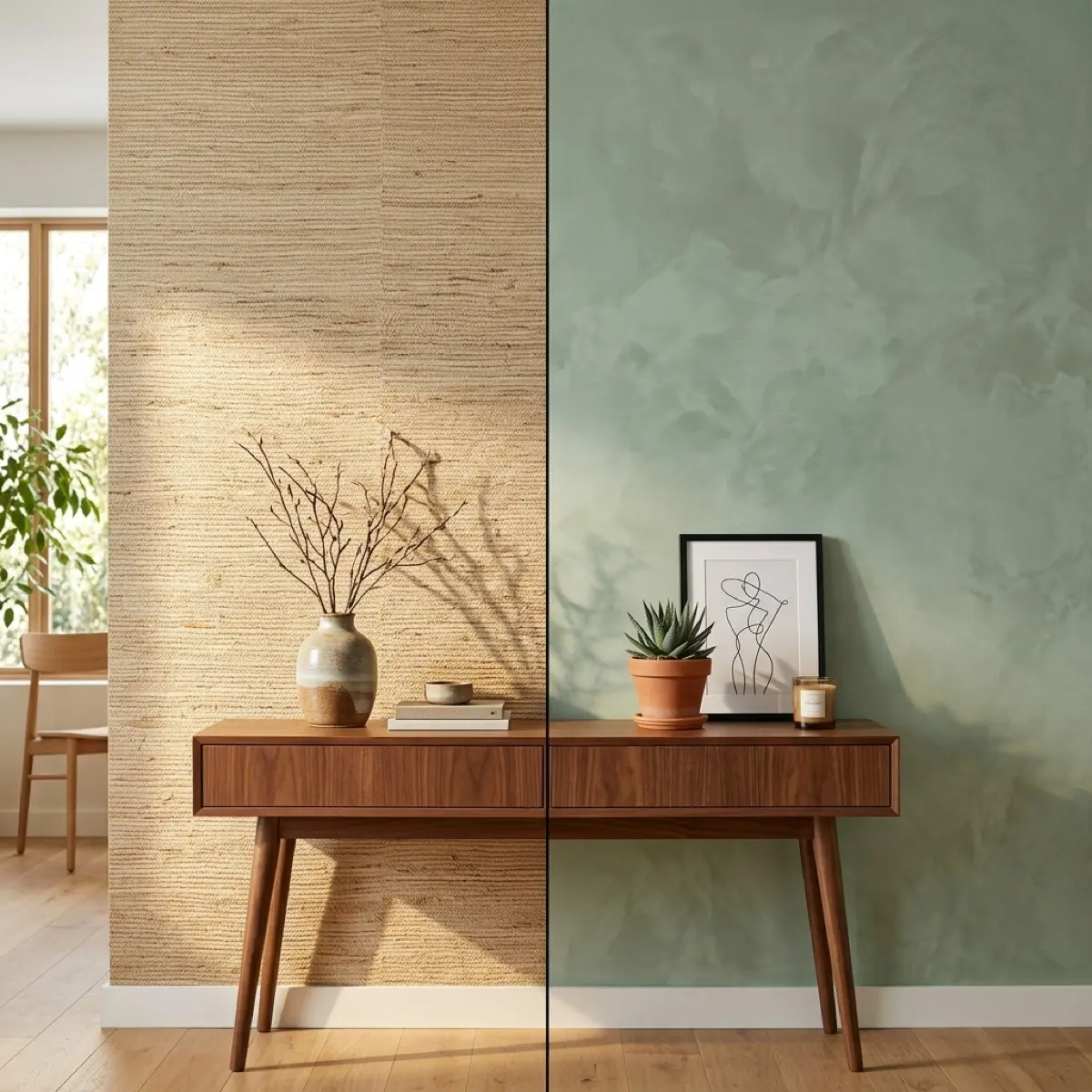
This is the most significant difference. Grasscloth delivers genuine three-dimensional texture — you see and feel individual plant fibers running horizontally across the surface. The natural variation in weave density, fiber thickness, and color creates a depth that shifts with changing light throughout the day. No paint technique can replicate this.
Textured paint creates surface-level pattern variation — stippling, ragging, sponging, or roller textures that add visual interest but lack the tactile depth of woven fiber. The texture is uniform and repetitive because it's applied mechanically rather than grown organically.
Limewash creates a beautiful soft, cloud-like mineral finish with color variation — excellent for wabi-sabi aesthetics — but it's a flat finish with no physical relief. Venetian plaster comes closest to grasscloth's depth through layered application that creates genuine dimensional variation, but the result is smooth and polished rather than textured and organic.
How Much More Does Grasscloth Cost Than Textured Paint?
Grasscloth costs 3–8× more than textured paint when you factor in both material and professional installation. Here's the math for a typical 150 sq ft accent wall:
| Finish (150 sq ft wall) | Material | Labor | Total |
|---|---|---|---|
| Textured paint | $15–150 | $300–450 | $315–600 |
| Limewash | $150–450 | $300–600 | $450–1,050 |
| Venetian plaster | $300–750 | $600–1,500 | $900–2,250 |
| Grasscloth | $750–3,000 | $900–2,100 | $1,650–5,100 |
However, the cost-per-year story is different. Textured paint needs refreshing every 3–5 years ($315–600 × 3–4 cycles over 15 years = $945–2,400). Grasscloth lasts the full 15–20 years with zero reapplication — making the total cost of ownership more competitive than the upfront numbers suggest.
Which Is More Durable and Easier to Maintain?
Textured paint wins decisively on day-to-day maintenance. You can wipe it, touch it up, repaint sections, and clean it with standard household products. Grasscloth requires delicate handling — dry brushing or vacuuming only, no wet cleaning, and any stain or water mark is permanent.
But grasscloth wins on longevity. Once installed properly in a suitable environment (dry, low-traffic), it maintains its appearance for 15–20 years without any intervention. Paint's "easy maintenance" is partly because it needs frequent maintenance — touch-ups every 1–2 years and full repainting every 3–5 years.
Moisture and Humidity Tolerance
- Textured paint: Suitable for kitchens, bathrooms, and humid climates
- Limewash: Breathable and moisture-regulating, but not for direct water contact
- Venetian plaster: Excellent moisture resistance when sealed
- Grasscloth: Not suitable for humid environments — absorbs moisture, risks mold growth behind the covering
Can Textured Paint Replicate the Grasscloth Look?
No. Modern faux-finish techniques can approximate grasscloth's horizontal striation pattern, but they cannot replicate three things:
- Physical depth: Real grasscloth has 1–3mm of woven fiber relief that catches light and creates shadows
- Natural variation: Each panel of grasscloth has unique fiber patterns — paint is mechanically consistent
- Tactile quality: Running your hand across grasscloth is a fundamentally different sensory experience than touching painted drywall
If you want the grasscloth look without the price or maintenance, consider faux grasscloth vinyl wallpaper — it captures more visual depth than paint while being washable and budget-friendly.
Does Grasscloth or Textured Paint Add More Resale Value?
In mid-to-high-end homes, grasscloth signals luxury and craftsmanship to buyers. Real estate agents report that natural wallcovering in dining rooms and primary bedrooms creates a perception of quality that textured paint cannot match. Grasscloth is a recognized design element in luxury listings.
Textured paint — especially limewash, which is trending heavily in 2026 — also adds perceived value, but it's more easily replicated by the next owner. Neither adds value in budget properties where buyers typically prefer neutral flat paint they can personalize.
Which Should You Choose for Your Space?
| Scenario | Best Choice | Why |
|---|---|---|
| Feature wall (bedroom, dining) | Grasscloth | Maximum texture impact, acoustic benefit, luxury signal |
| Whole room coverage | Textured paint or limewash | Cost-effective, uniform finish, easier to maintain |
| Kitchen or bathroom | Textured paint or Venetian plaster | Moisture tolerance essential |
| Hotel lobby or restaurant | Grasscloth + complementary paint | Biophilic design, acoustic dampening, luxury positioning |
| Budget-conscious project | Limewash or textured paint | 1/3 to 1/8 the cost of grasscloth |
| Maximum durability | Venetian plaster | 15–25 year life, moisture-proof, scrubbable |
| Eco-friendly priority | Grasscloth or limewash | Natural, biodegradable, zero/low VOC |
The Best of Both Worlds
Many designers use grasscloth on the feature wall for dramatic texture, paired with complementary limewash or paint on surrounding walls. This delivers the luxury impact of natural wallcovering at a fraction of the cost of full-room grasscloth — typically saving 60–75% compared to covering all four walls.
Frequently Asked Questions
Is grasscloth better than textured paint?
For texture depth and luxury feel, yes. Grasscloth provides genuine three-dimensional woven texture that textured paint cannot replicate. It also offers acoustic dampening and biophilic design benefits. However, textured paint wins on cost ($1–4/sq ft vs $11–34/sq ft installed), maintenance ease, and moisture tolerance. Choose grasscloth for statement walls in dry, low-traffic spaces; choose textured paint for whole-room coverage or wet areas.
How much more does grasscloth cost than textured paint?
Grasscloth costs 3–8× more than textured paint. Installed grasscloth runs $11–34 per sq ft (material + specialty labor), while textured paint techniques cost $2–8 per sq ft depending on complexity. For a 150 sq ft accent wall, expect $1,650–5,100 for grasscloth vs $300–1,200 for textured paint.
Can textured paint look like grasscloth?
Modern faux-finish techniques can approximate grasscloth's horizontal striation pattern, but they cannot replicate the three-dimensional depth, natural fiber variation, or tactile quality of real woven grasscloth. For the grasscloth look at lower cost, consider faux grasscloth vinyl wallpaper.
Which is better for resale value: grasscloth or textured paint?
Grasscloth generally adds more perceived value in mid-to-high-end homes. Real estate agents report that natural wallcovering in dining rooms and primary bedrooms signals luxury and craftsmanship to buyers. Textured paint (especially limewash) also adds value but is more easily replicated.
What about limewash vs grasscloth?
Limewash creates a soft, mottled, cloud-like mineral finish ideal for wabi-sabi and Mediterranean aesthetics. Grasscloth delivers structured, horizontal woven texture with visible fiber depth. Limewash costs $3–6/sq ft installed but requires periodic refreshing. Grasscloth costs $11–34/sq ft but lasts 15–20 years without maintenance.
Related Guides
Grasscloth Guide
Complete material reference.
Real vs Faux Grasscloth
How to tell the difference.
Wallcovering + Paint
Combining materials effectively.
Feature Wall Design
Accent wall strategies.
Grasscloth Pros & Cons
Honest advantages and drawbacks.
Textured Walls Guide
All texture options compared.
Feel the Difference
No photo captures what makes grasscloth special — the texture is best experienced by hand. Start with the free Digital Sample Kit, then choose the right physical sample layer to compare against your paint finish.
Request Samples