Sustainability Guide
Eco-Friendly Wallcovering: 9 Sustainable Materials Ranked
Not all "green" wallcoverings are equal. We rank 9 materials by VOC emissions, certifications, lifespan and end-of-life recyclability — with the LEED and WELL credit data architects actually need.
Key Takeaways
- Top 3: Grasscloth, cork and linen score highest across all sustainability metrics.
- Avoid: Standard PVC vinyl — contains phthalates, emits VOCs, is non-biodegradable.
- Certifications that matter: NSF/ANSI 342, GREENGUARD Gold, FSC, Oeko-Tex, EPD/HPD.
- LEED credits: Eco wallcoverings contribute to MR (disclosure) + EQ (low-emitting) categories.
- WELL credits: Natural materials support Air and Mind (biophilic design) features.
- Greenwashing test: Demand third-party certification, not self-declared "eco" labels.
- Lifecycle wins: Natural wallcoverings last 15–25 years vs paint's 3–5, reducing cumulative environmental impact.
What Makes a Wallcovering Eco-Friendly?
A wallcovering is genuinely eco-friendly when it meets five criteria across its full lifecycle — not just one marketing claim. Many products labeled "green" or "sustainable" fail on three or more of these dimensions.
| Criterion | What to Check | Red Flag |
|---|---|---|
| Raw Materials | Renewable, responsibly sourced fibers (FSC, European Flax®) | Petroleum-based substrates (PVC, polyester) |
| Manufacturing | Low-energy process, water-based inks, waste reduction | Solvent-based printing, high VOC adhesives |
| Indoor Air Quality | GREENGUARD Gold or CDPH v1.2 tested, zero formaldehyde | No emission testing data available |
| Durability | 15+ year lifespan reduces replacement cycles | Disposable "fast fashion" wallpaper (2–5 year life) |
| End of Life | Biodegradable, recyclable, or compostable | PVC — non-recyclable, releases dioxins if incinerated |
How Do 9 Wallcovering Materials Rank on Sustainability?
We evaluated nine common wallcovering materials across VOC emissions, renewable sourcing, biodegradability, lifespan and certification availability. Here is the ranking from most to least sustainable:
| # | Material | VOC | Renewable | Biodegradable | Lifespan | Score |
|---|---|---|---|---|---|---|
| 1 | Grasscloth | Near zero | Yes (annual crops) | Yes | 10–20 yr | ★★★★★ |
| 2 | Cork | Near zero | Yes (bark harvest) | Yes | 15–25 yr | ★★★★★ |
| 3 | Linen | Very low | Yes (flax crop) | Yes | 10–20 yr | ★★★★☆ |
| 4 | Wood Veneer | Low | Yes (FSC) | Partially | 15–25 yr | ★★★★☆ |
| 5 | Recycled Paper | Low | Yes (post-consumer) | Yes | 8–15 yr | ★★★☆☆ |
| 6 | Non-Woven (cellulose) | Low | Partially | Partially | 10–15 yr | ★★★☆☆ |
| 7 | Bio-Vinyl (d.ecodura™) | Low | Partially | No | 15–20 yr | ★★☆☆☆ |
| 8 | Standard Vinyl (Type II) | Moderate | No (PVC) | No | 15–20 yr | ★☆☆☆☆ |
| 9 | Foil / Metallic | Moderate | No | No | 10–15 yr | ★☆☆☆☆ |
Why Grasscloth Ranks #1
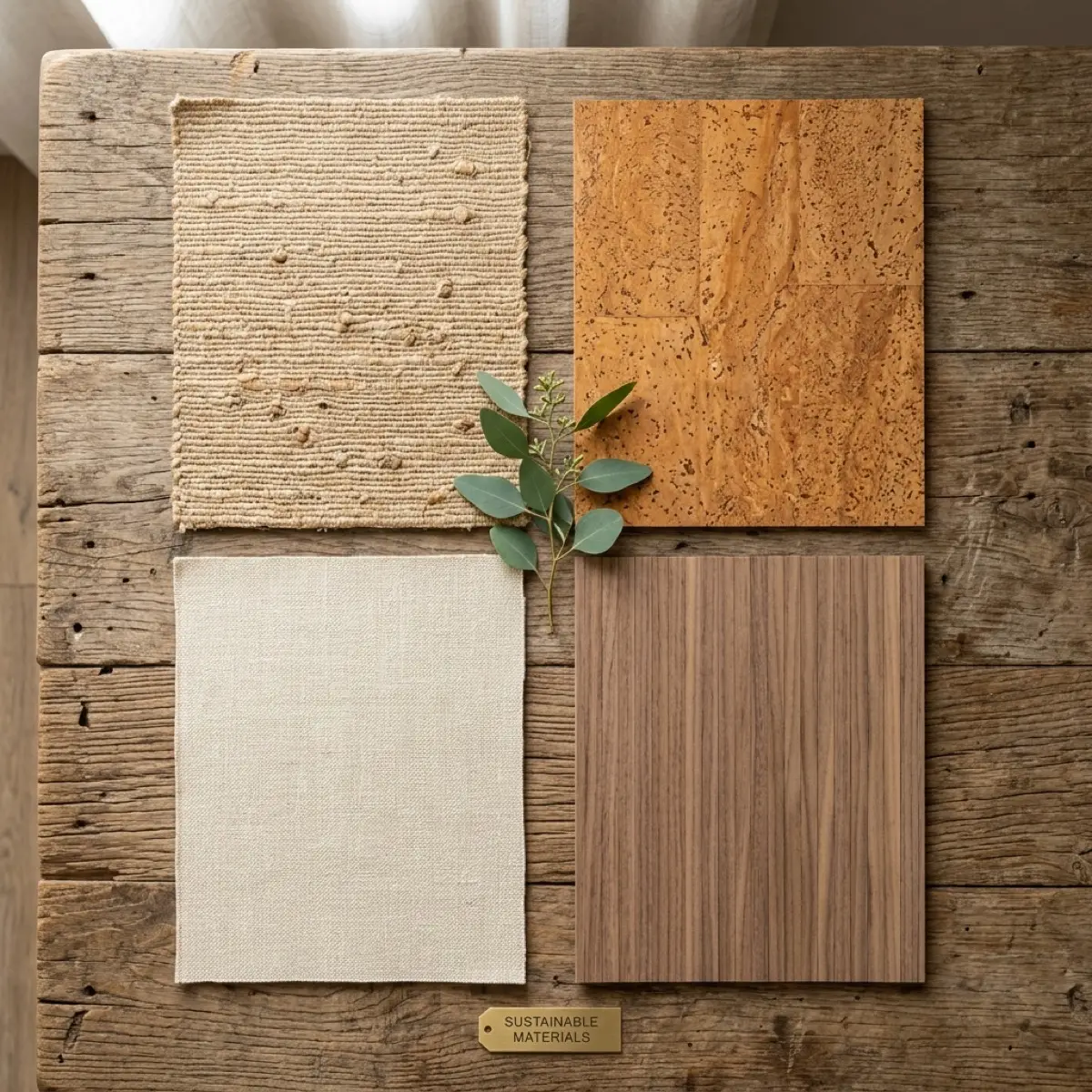
Grasscloth uses rapidly renewable annual crops — jute, seagrass, hemp and ramie — that grow without irrigation or pesticides. The weaving process requires minimal energy compared to vinyl extrusion. The finished product emits near-zero VOCs, is fully biodegradable, and the paper backing can be FSC-certified. Our grasscloth is produced with water-based dyes and zero-formaldehyde adhesives.
Why Cork Ranks #2
Cork is uniquely sustainable because the bark is harvested without cutting down the tree — cork oaks regenerate their bark every 9 years and live 150–200 years. A single tree absorbs 3–5× more CO₂ after harvesting. Cork wallcovering adds acoustic and thermal insulation, is naturally antimicrobial, and fully biodegradable.
Which Certifications Should You Look For?
Five certifications separate genuinely sustainable products from greenwashed marketing. Here is what each one verifies and how it connects to building certification credits:
| Certification | What It Verifies | LEED Credit | WELL Feature |
|---|---|---|---|
| NSF/ANSI 342 | Full lifecycle sustainability (Silver/Gold/Platinum) | MR: Product Disclosure | Materials concept |
| GREENGUARD Gold | Low chemical emissions (VOC, formaldehyde) | EQ: Low-Emitting Materials | Air: VOC limits |
| FSC | Responsible forestry (paper, wood, cork) | MR: Sourcing of Raw Materials | — |
| Oeko-Tex 100 | No harmful substances in textile products | Supporting documentation | Materials concept |
| EPD + HPD | Lifecycle impact data + ingredient disclosure | MR: Product Disclosure (1–2 pts) | Materials Optimization |
Pro tip for specifiers: NSF/ANSI 342 is the wallcovering industry's own multi-attribute standard — it evaluates raw materials, energy, water, waste and indoor air quality in a single certification. Request this first when evaluating supplier claims.
How Do Eco-Friendly Wallcoverings Contribute to LEED?
Sustainable wallcoverings can contribute to 3–5 LEED v4.1 credit points across two categories. Here is the specific credit mapping:
- MR Credit: Building Product Disclosure and Optimization — EPDs earn 1 point (20+ products with EPDs across the project), HPDs earn 1 point (material ingredient reporting)
- MR Credit: Sourcing of Raw Materials — FSC-certified wallcoverings contribute to the 20% threshold for bio-based materials
- EQ Credit: Low-Emitting Materials — GREENGUARD Gold or CDPH v1.2-tested wallcoverings count toward the 75% compliance threshold for walls and ceilings
For complete LEED wallcovering specification guidance, see our dedicated technical guide. For WELL Building Standard compliance, natural materials also support the Mind concept (biophilic design) and Air concept (VOC reduction).
Is Wallpaper More Eco-Friendly Than Paint?
Natural wallcoverings outperform paint on lifecycle sustainability, even though paint has a lower upfront environmental footprint. The key factor is replacement frequency:
| Factor | Natural Wallcovering | Low-VOC Paint |
|---|---|---|
| Lifespan | 15–25 years | 3–5 years |
| Replacement cycles (15 yr) | 1 installation | 3–5 repaintings |
| Cumulative VOC exposure | Near zero (once installed) | Moderate (each repaint cycle) |
| Waste generation | Low (biodegradable at EOL) | Paint cans, rollers, drop cloths × 3–5 |
| Carbon footprint per year | Lower (amortized over 15+ years) | Higher (cumulative transport + application) |
Exception: Standard PVC vinyl wallpaper is less eco-friendly than paint. PVC contains phthalate plasticizers, is non-recyclable, and releases dioxins during incineration. If sustainability matters, choose natural fiber wallcoverings — not vinyl.
How Do You Spot Greenwashing in Wallcovering?
The wallcovering industry has a greenwashing problem. Here are five red flags that indicate a product's eco claims may not be substantiated:
- "Eco-friendly" without certification: Self-declared labels mean nothing. Demand NSF/ANSI 342, GREENGUARD Gold or Oeko-Tex — third-party verified
- "Natural" vinyl: Some manufacturers call PVC wallpaper "natural" because it contains mineral fillers. PVC is petroleum-based regardless of fillers
- "VOC-free" without test data: Request CDPH Standard Method v1.2 or GREENGUARD test reports. "VOC-free" is not a regulated term
- No EPD or HPD available: Transparent manufacturers publish Environmental and Health Product Declarations. If a supplier cannot provide them, their sustainability claims are unverifiable
- "Recyclable" PVC: While technically possible, PVC wallcovering recycling infrastructure is virtually nonexistent. Less than 1% of PVC wallcovering is actually recycled
What Are the Best Eco-Friendly Options by Room Type?
Sustainability requirements vary by space. Here is a room-by-room material selection guide:
| Space | Best Eco Material | Why | Avoid |
|---|---|---|---|
| Living room / bedroom | Grasscloth, linen | Maximum texture, breathability, zero VOC | PVC vinyl |
| Home office | Cork | Acoustic insulation, pin-friendly, natural | Foil/metallic |
| Hotel lobby | Grasscloth, wood veneer | Biophilic design, WELL credits, durability | Standard vinyl |
| Healthcare | Linen, bio-vinyl | Antimicrobial, scrubbable, GREENGUARD | Untreated grasscloth |
| Kitchen / bathroom | Bio-vinyl, recycled non-woven | Moisture resistance + low VOC | Natural fibers (humidity risk) |
Which Wall Coverings Are PVC-Free?
All woven natural-fiber wall coverings — grasscloth, sisal, jute, seagrass, hemp and linen — are inherently PVC-free: the face is plant fiber, the backing is paper or non-woven. Cork and mica sheets are also PVC-free. The materials to check carefully are "vinyl grasscloth" look-alikes and heavy-duty commercial wallcoverings, where a PVC face layer is standard. If a supplier cannot state the face and backing composition in writing, treat the PVC-free claim as unverified.
Which Certifications Matter for Eco-Friendly Wall Coverings?
Three certification families do the real work: FSC covers responsibly sourced paper backing; GREENGUARD / low-VOC emissions certificates cover indoor air quality; ASTM E84 / EN 13501 cover fire performance, which commercial projects require alongside eco claims. Certification is typically arranged by the buyer's brand for their market — a sourcing partner supports the process with mill documentation and material specs. Ask for test reports tied to the actual production lot, not brochure-level claims.
Frequently Asked Questions
What is the most eco-friendly wallcovering?
Grasscloth made from jute, seagrass or hemp is the most eco-friendly wallcovering overall. It uses rapidly renewable plant fibers, requires minimal processing, produces near-zero VOC emissions, is fully biodegradable, and can contribute to LEED MR and IEQ credits. Cork is a close second due to its harvesting method that keeps trees alive.
Is wallpaper more eco-friendly than paint?
Natural wallcoverings like grasscloth, cork and linen are more eco-friendly than most paints over their lifecycle. While low-VOC paint has a lower upfront environmental impact, it needs reapplication every 3–5 years. Natural wallcoverings last 15–25 years, reducing cumulative material consumption and waste. However, PVC vinyl wallpaper is less eco-friendly than paint.
What certifications should I look for in eco-friendly wallcovering?
Look for five key certifications: NSF/ANSI 342 (wallcovering sustainability standard with Silver/Gold/Platinum tiers), GREENGUARD Gold (low VOC emissions), FSC (responsible forestry for paper/wood/cork), Oeko-Tex Standard 100 (no harmful substances), and EPD/HPD documentation (lifecycle transparency for LEED credits).
Can eco-friendly wallcovering help with LEED certification?
Yes. Eco-friendly wallcoverings can contribute to multiple LEED v4.1 credits: MR Credit (Building Product Disclosure) through EPDs and HPDs, EQ Credit (Low-Emitting Materials) through GREENGUARD or CDPH testing, and MR Credit (Sourcing of Raw Materials) through FSC certification. NSF/ANSI 342-certified products are specifically designed for LEED documentation.
How do I know if a wallcovering is truly sustainable or just greenwashed?
Verify three things: (1) Third-party certifications — NSF/ANSI 342, GREENGUARD Gold, FSC or Oeko-Tex rather than self-declared claims, (2) Transparency documents — request the product's EPD and HPD for lifecycle data, (3) Material composition — check for PVC, phthalates and formaldehyde in the substrate and printing inks.
Is grasscloth wallpaper non-toxic?
Natural grasscloth is plant fiber on a paper backing with water-based dyes — near-zero VOC and no PVC. The variables to verify are the adhesive you hang it with and any stain-guard treatment, so specify low-VOC paste and ask for the treatment's emissions data.
Related Guides
Grasscloth Guide
Complete natural wallcovering reference.
Cork Wallcovering
Sustainable cork material guide.
VOC Emissions
Indoor air quality standards.
LEED Wallcovering
Green building credit guide.
WELL Standard
Wellness building compliance.
Sustainable Manufacturing
How we make green wallcoverings.
Source Verified Sustainable Wallcovering
Our natural wallcoverings use water-based dyes and zero-formaldehyde adhesives, and ship with full material documentation to support your Oeko-Tex or NSF/ANSI 342 certification. Request samples to review.
Request Samples + Certifications