Design Guide
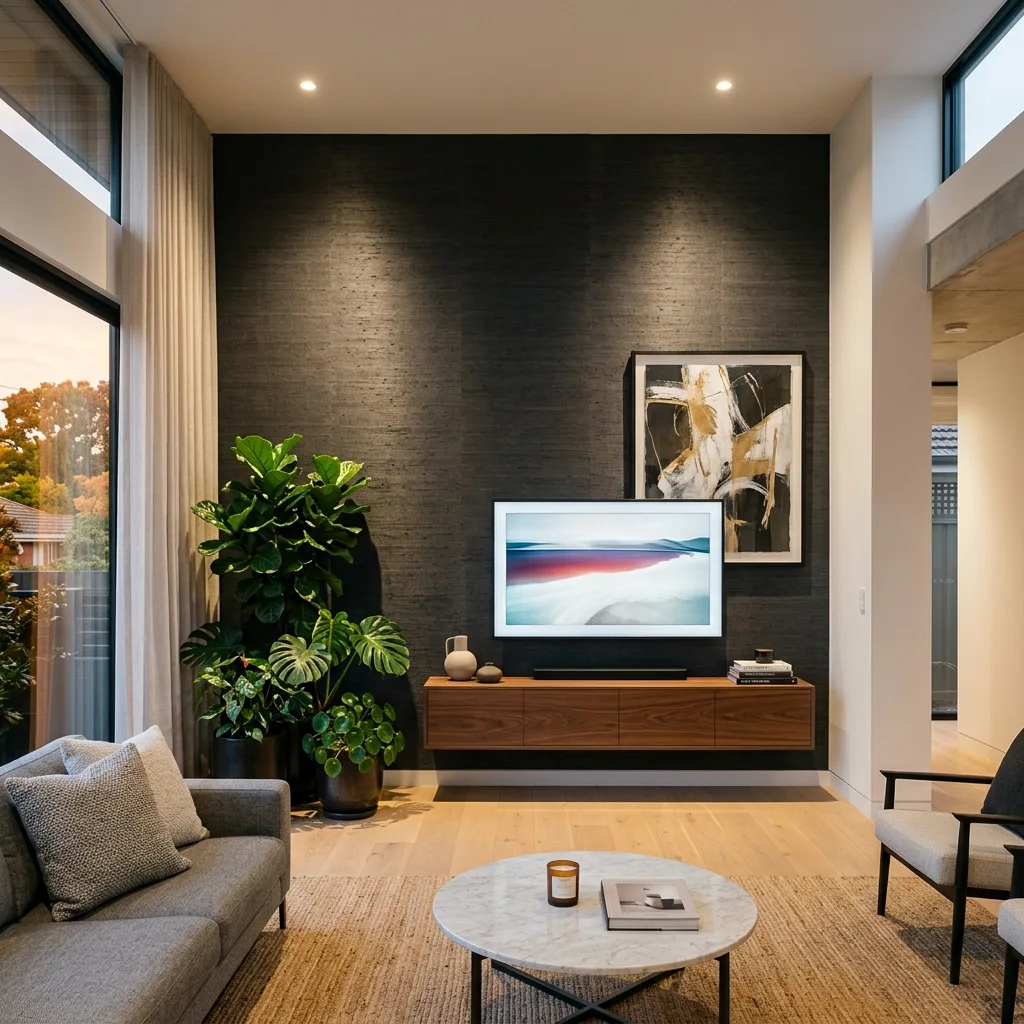
Natural Wallcovering Feature Walls: Design, Placement & Material Guide
How to create a statement wall with grasscloth, sisal or cork — which wall to choose, material selection by room, color strategy and common mistakes to avoid.
Key Takeaways
- Choose the "first-seen" wall — the wall you face when entering.
- One wall only — the contrast with painted walls creates the impact.
- Bold textures work best — grasscloth and sisal create more drama than paper weave.
- Dark colors amplify impact — charcoal, forest green, chocolate on texture.
- Paint the adjacent walls to complement, not compete.
- 3-5 rolls typically needed — affordable entry to natural wallcovering.
- Avoid window walls — raking light exaggerates seams.
Which Wall Should Be the Feature Wall?
| Room | Best Feature Wall | Why |
|---|---|---|
| Living room | Behind the sofa | First wall seen from entry; backdrop for seating |
| Bedroom | Behind the headboard | Creates cocooning effect; natural frame for the bed |
| Dining room | Behind the table or buffet | Textured backdrop for gatherings |
| Home office | Behind the desk (video call backdrop) | Professional, textured background for calls |
| Entryway | The wall facing the front door | Sets the tone for the entire home |
What Materials Create the Most Impact?
| Material | Impact Level | Best Colors for Feature |
|---|---|---|
| Grasscloth | High — bold weave | Charcoal, forest green, chocolate, navy |
| Sisal | High — refined texture | Deep terracotta, burgundy, dark sage |
| Cork | Medium-High — organic | Natural, dark walnut, metallic accent |
| Mica | High — shimmer | Bronze, copper, dark gold |
| Paper weave | Medium — subtle | Warm neutral, soft sage (better for full-room) |
How Do You Coordinate Adjacent Walls?
- Pick the wallcovering first — it has more visual complexity than paint
- Match paint to the wallcovering's undertone: sample the wallcovering, then find a paint 2-3 shades lighter
- Keep adjacent walls simple: flat or matte paint only — no competing textures
- Wrap corners when possible: continuing wallcovering 6-12 inches around the corner creates a more intentional look
- Consider the ceiling: Paint the ceiling the same color as the side walls for cohesion — or go bold and wallcover the ceiling
What Are the Common Feature Wall Mistakes?
- Choosing the window wall: Raking light from windows hits the wall at an angle, exaggerating seams and texture unevenly
- Too-light colors: A feature wall in cream grasscloth barely reads as a feature — go bold or go full-room
- Competing with furniture: A busy bookshelf or large TV on the feature wall obscures the texture
- Ignoring lighting: Add wall sconces or picture lights to highlight the texture — see how light reveals the weave
- Wrong wall in open plans: In open-concept spaces, the feature wall should be visible from the primary living area
How Much Material Do You Need?
A single feature wall typically requires 3-5 rolls — making it the most accessible way to introduce natural wallcovering. Quick estimate:
- 10 ft × 8 ft wall = ~3 rolls (standard 36" × 24' rolls)
- 14 ft × 9 ft wall = ~4-5 rolls
- Add 10% overage for pattern matching and waste
See our specification guide for exact calculation methods and our MOQ guide for minimum orders.
Frequently Asked Questions
Should I do a feature wall or full room?
Depends on the goal. Feature walls create focal drama — one wall stands out. Full-room treatment creates atmosphere — the entire space feels wrapped in texture. For Japandi or wabi-sabi aesthetics (see guide), full-room is better. For modern or transitional spaces, a feature wall provides impact without overwhelming.
Can I use peel-and-stick grasscloth for a feature wall?
Yes, but with caveats. Peel-and-stick is good for renters or temporary installations. Real grasscloth with traditional paste gives a better result — the material lies flatter, seams are tighter, and it lasts 10-15 years vs. 2-3 for adhesive-backed products.
What about feature walls in bathrooms?
Only powder rooms. Natural wallcovering should not be used in full bathrooms with showers — the humidity and moisture will damage the fiber. Powder rooms (half-baths without a shower) are fine and often stunning with natural wallcovering.
Related Guides
Color Trends
2026 palette forecast.
Dark vs Light
Tone selection.
Ceiling Wallcovering
The fifth wall.
Wainscoting
Wall panel pairing.
With Paint
Color coordination.
Installation
Professional tips.
Start with One Wall
A feature wall needs just 3-5 rolls. Request samples in bold colors to see how texture and depth transform your space.
Request Feature Wall Samples