Buyer Guide
Natural Wallcovering Pricing Explained
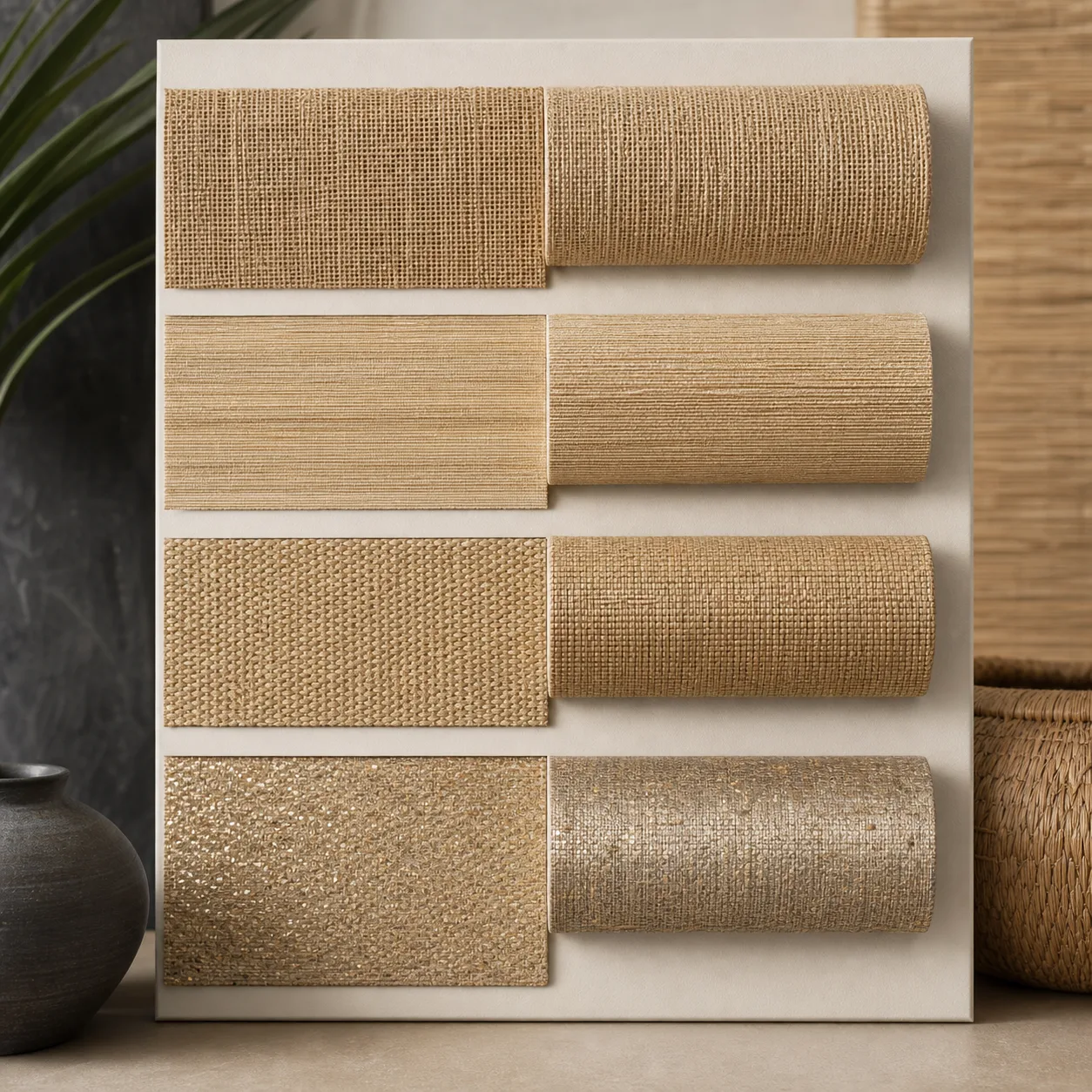
Why does grasscloth cost more than standard wallpaper? What drives the price difference between materials? Here's a transparent breakdown of what you're paying for — from raw fiber to installed wall.
Key Takeaways
- Material type is the biggest price driver — grasscloth is most affordable; mica and gold foil are premium.
- Hand-woven production = higher labor cost than machine-printed wallpaper.
- Factory-direct eliminates distributor and retailer markups.
- Volume pricing — larger orders get better per-roll pricing.
- Installation costs $3–8/sq ft — professional installation is strongly recommended.
- Budget 10–15% extra for overage (waste, repairs, dye-lot matching).
- Total project cost = material + shipping + installation + overage.
How Does Material Type Affect Price?
| Material | Retail Price Range (per roll) | Why |
|---|---|---|
| Paper Weave | $50–120 | Simplest weave, most abundant raw material |
| Grasscloth (jute/seagrass) | $80–200 | Hand-woven natural fiber, moderate complexity |
| Sisal | $100–250 | Denser fiber, more labor-intensive weave |
| Cork | $120–300 | Harvested bark material, limited supply |
| Wood Veneer | $200–400 | Real wood sheets bonded to backing, precision cutting |
| Gold Foil | $250–500 | Metal leaf application, high waste rate in production |
| Mica | $300–600+ | Hand-applied mineral chips, most labor-intensive |
Note: These are typical retail price ranges. Wholesale and factory-direct pricing is significantly lower. Contact us for project-specific quotes.
What Drives the Cost of Natural Wallcovering?
1. Raw material sourcing
Natural fibers are agricultural products with variable supply. Jute and seagrass are relatively abundant and affordable. Cork is harvested from bark (9-year growth cycles). Mica is mined as thin mineral sheets. Each material has different supply constraints that affect base cost.
2. Production method
Natural wallcovering is hand-woven or hand-applied — not machine-printed like vinyl wallpaper. This means:
- Higher labor cost per roll
- Slower production speed (limiting daily output)
- More production waste (natural fiber breakage, color inconsistencies)
- Each roll requires individual quality inspection
3. Finishing and treatments
Additional treatments increase cost: dyeing (custom colorways cost more than natural tones), fire retardant treatment (required for commercial projects), stain-guard coating, and UV-resistant finishing. Each treatment adds a production step.
4. Order volume
Like most manufactured goods, larger orders get better per-unit pricing. The fixed costs (dye batch setup, production scheduling, quality control) are spread across more rolls, reducing per-roll cost.
5. Distribution channel
The path from manufacturer to your wall includes markups at each step:
- Manufacturer → Distributor: 30–50% markup
- Distributor → Retailer: 40–60% markup
- Retailer → Consumer: 50–100% markup
Buying factory-direct eliminates the middle layers. This is how designers and distributors access significantly better pricing — and why we offer direct-to-trade sales.
How Much Does Installation Cost?
| Factor | Cost Range |
|---|---|
| Professional installation labor | $3–8 per sq ft |
| Wall preparation (if needed) | $1–3 per sq ft |
| Adhesive | $15–30 per gallon (covers ~50 sq ft) |
| Removal of old wallcovering | $1–4 per sq ft |
Installation costs vary by region, wall complexity (corners, windows, outlets) and installer experience. Natural wallcovering requires a specialist installer — general painters typically lack the specific skills. See our DIY vs professional guide for when professional installation is required.
How Do You Calculate Total Project Cost?
- Measure your walls — calculate total square footage (or square meters)
- Calculate roll count — divide total area by the coverage per roll (check the spec sheet; standard is ~5.5 m² per roll)
- Add overage — add 10–15% for cutting waste and future repairs
- Material cost = roll count × price per roll
- Shipping cost = based on weight, volume and destination (EXW Chengdu for direct orders; FOB or CIF on request)
- Installation cost = total sq ft × installer rate
- Total = material + shipping + installation
Why Is Grasscloth More Expensive Than Vinyl?
| Factor | Natural Grasscloth | Vinyl Wallpaper |
|---|---|---|
| Production | Hand-woven, slow | Machine-printed, fast |
| Raw material | Agricultural, variable supply | PVC, stable supply |
| Waste rate | 5–15% production waste | <2% waste |
| Installation | Specialist required | General installer OK |
| Longevity | 15–25+ years | 8–15 years |
| Aesthetic value | Unique, organic, luxurious | Uniform, repeatable |
| Resale value | Increases perceived home value | Neutral impact |
Natural grasscloth costs more upfront but lasts longer, adds more perceived value to a space, and creates a finish that vinyl cannot replicate. For high-end residential, hospitality and executive commercial spaces, the premium is justified by the unique aesthetic and longevity.
Frequently Asked Questions
Can I get wholesale pricing as a designer?
Yes. We offer partner-mill pricing for designers, architects, distributors and contractors. No traditional distribution markup. Contact us with your project details for a custom quote — pricing is based on material type, quantity and customization requirements.
Why do prices vary so much between suppliers?
Three reasons: material quality (premium fibers vs. budget alternatives), distribution channel (direct vs. through multiple traditional distribution channels), and brand premium (designer brands charge for the name). The same quality material can cost 2–3× more at retail than direct from the manufacturer.
Is it worth paying more for premium materials?
It depends on the application. For accent walls, executive offices and hospitality suites, premium materials (mica, gold foil, cork) create a visual impact that justifies the investment. For larger areas like full-room coverage, mid-range materials (grasscloth, sisal) offer excellent quality at a more practical price point.
Related Guides
Why Is Grasscloth So Expensive?
The handwork behind the price.
First Bulk Order
Complete ordering process.
MOQ Guide
Minimum order quantities.
Evaluate Samples
7-point quality checklist.
Specify Grasscloth
Write professional specs.
DIY vs Professional
When to hire a pro.
Commercial vs Residential
Specification differences.
Custom Grasscloth Wallpaper
Woven-to-sample custom colorways: how the development process works from your reference to production.
Get a Custom Quote
Tell us your material, quantity and project timeline — we'll provide partner-mill pricing with no traditional distribution markup.
Request a Quote