Buyer Guide
How to Evaluate Natural Wallcovering Samples
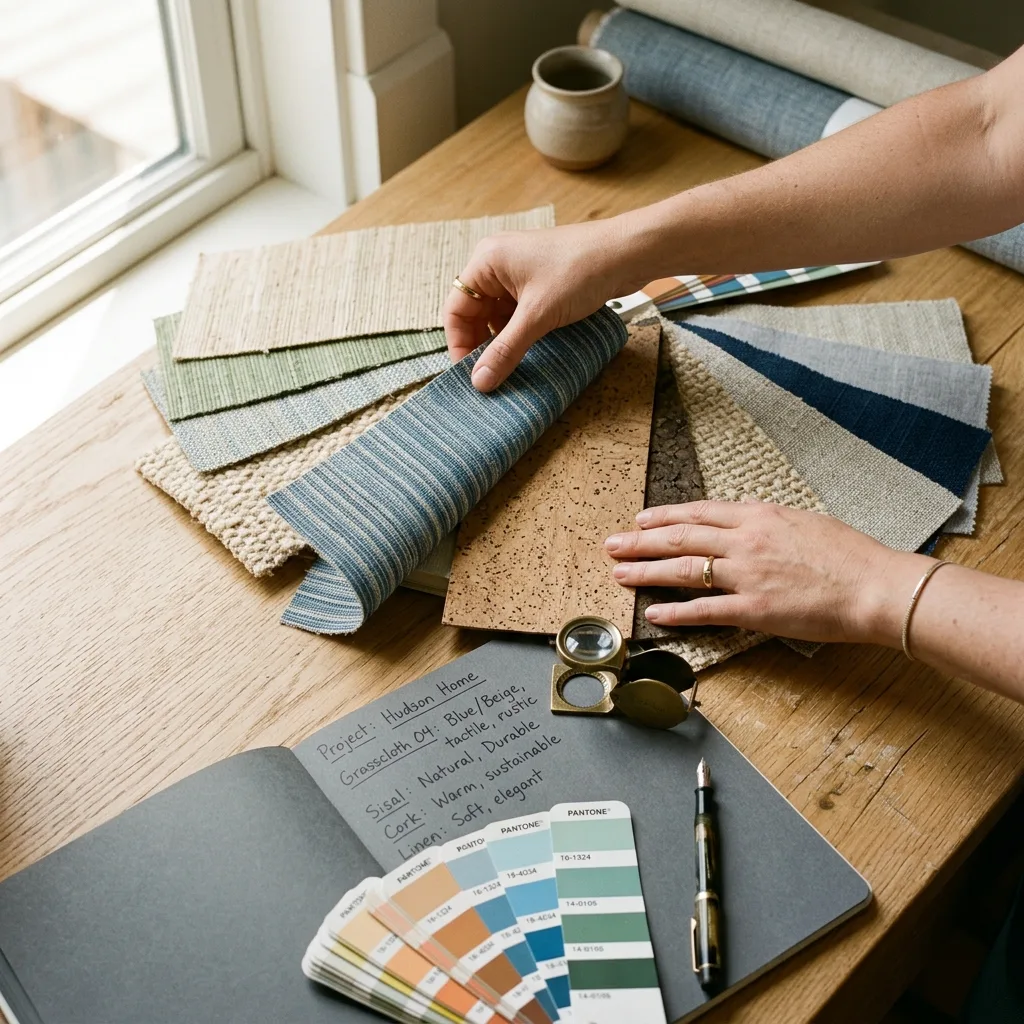
A swatch can look perfect online and wrong in your space. Here's a systematic 7-point quality checklist for evaluating grasscloth, sisal, cork and other natural wallcovering samples — before you commit to a bulk order.
Key Takeaways
- View samples in your actual room — color shifts dramatically under different lighting.
- Natural variation is normal — color and texture differences are features, not defects.
- Check both sides: Front fiber quality AND backing construction matter.
- Test in daylight AND evening light — grasscloth texture creates a luster that changes throughout the day.
- Thinner grasscloth may show wall color through — plan to paint the wall a matching base coat.
- Digital samples are starting points — always order physical swatches before committing.
- Production samples ≠ swatches — request a production-grade sample for final color approval.
What Are the 7 Quality Checkpoints?
| # | Checkpoint | What to Look For |
|---|---|---|
| 1 | Color accuracy | Match under daylight, evening light and room lighting |
| 2 | Texture and hand | Fiber density, weave depth, tactile quality |
| 3 | Weave consistency | Stable pattern, secure fiber attachment, no loose threads |
| 4 | Backing quality | Paper or non-woven backing integrity, adhesion to fibers |
| 5 | Weight and opacity | Material thickness, light transmission, wall show-through |
| 6 | Dye lot uniformity | Compare multiple samples from the same batch for consistency |
| 7 | Space suitability | Traffic level, moisture exposure, sunlight, maintenance needs |
How Should You Evaluate Color?
Color is the most commonly misjudged quality because it changes dramatically with lighting:
- Hold the sample against the wall where it will be installed — not on a desk or table
- Check in daylight: View the sample with curtains open during peak daylight hours
- Check in evening light: View again under your evening artificial lighting (warm LED reads differently than cool LED)
- Compare to adjacent surfaces: Hold the sample next to your trim, flooring and furniture to check harmony
- View from distance: Step back 2–3 meters — grasscloth texture blends at distance, and the overall color impression changes
Pro tip: Tape the sample to the wall and leave it for 24–48 hours. You'll see it under every lighting condition — morning sun, overcast afternoon, evening lamps — before committing.
What Does "Natural Variation" Actually Mean?
First-time buyers often worry about inconsistencies they see in samples. Here's what's normal and what's a legitimate quality concern:
| Characteristic | Normal (Feature) | Quality Issue (Defect) |
|---|---|---|
| Color | Subtle tonal variation across the swatch | Blotchy patches or obvious color boundaries |
| Texture | Slight irregularity in fiber thickness | Bare spots, holes or fiber bunching |
| Weave | Minor variations in weave tightness | Loose fibers pulling free from backing |
| Seams | Visible seams between panels (always visible) | Seams with large gaps or overlaps |
| Backing | Smooth paper or non-woven base | Delamination, bubbling or adhesive showing |
Key principle: If the variation looks organic and distributed (like wood grain), it's a feature. If it looks mechanical and concentrated (like a printing error), it's a defect.
How Do You Check Backing and Weight?
Turn the sample over. The backing tells you a lot about quality and installation behavior:
- Paper backing: Traditional, widely used. Check that fibers are firmly bonded to the paper — gently tug a fiber to test adhesion.
- Non-woven backing: More dimensionally stable, easier to strip if removed later. Preferred for commercial installations.
- Weight: Hold the sample — heavier material (thicker fiber layer, denser weave) generally means better opacity and durability. Lighter, thinner grasscloth may allow the wall color to show through between fibers.
- Opacity test: Hold the sample up to a light source. If significant light passes through, you'll need to paint the wall a matching base coat before installation to prevent dark wall color from showing through.
What's the Difference Between Swatches and Production Samples?
| Sample Type | Size | Purpose | Accuracy |
|---|---|---|---|
| Digital catalog (PDF) | Screen only | Initial screening — shortlist materials and colors | Low — screen-dependent |
| Swatch / color card | ~10 × 10 cm | Physical color and texture evaluation | Moderate — representative |
| Production sample | 1 m × 0.91 m | Final approval — exact production quality | High — production-grade |
Workflow: Start with the digital catalog (free, instant) to shortlist 3–5 options. Order physical swatches to evaluate in your space. Once you've narrowed to your final choice, request a production sample for definitive color approval before placing your bulk order.
How Do You Evaluate Samples for Different Spaces?
- High-traffic areas (corridors, lobbies): Check abrasion resistance — rub the sample surface firmly with your thumb. Natural grasscloth will show scuffing; if this concerns you, consider contract-grade alternatives.
- Humid spaces (near bathrooms, coastal homes): Check moisture sensitivity — place a small water drop on the sample edge. If it absorbs instantly and creates a ring, the material is not suitable for humid environments.
- Sun-facing walls: Ask about lightfastness ratings. Dark colors on south/west walls will fade fastest.
- Dining areas: Consider stain resistance — natural grasscloth is "dry clean only." For areas near food, install above a chair rail or choose stain-guard treated material.
- Children's rooms / pet areas: Natural grasscloth is not suitable. Fibers tear easily and stains are permanent. Use contract-grade vinyl grasscloth-look instead.
Frequently Asked Questions
How many samples should I order?
Order 3–5 swatches to compare options side by side. Once you've narrowed to your top choice, request a full production sample for final approval. It's worth the small upfront cost — changing your mind after 50+ rolls arrive is far more expensive.
Can I trust the color on my screen?
No. Screen color depends on your display calibration, brightness settings and ambient lighting. Digital catalogs are excellent for shortlisting and comparing patterns, but physical samples are essential for final color decisions. This is why we offer physical swatch packs with the cost credited toward your first order.
What if the production sample doesn't match the swatch?
Slight variation between swatch and production sample is normal — they may come from different dye lots. The production sample represents what your bulk order will look like. If the difference is unacceptable, discuss it with your supplier before approving production. Once you sign off on the production sample, it becomes the reference standard for your order.
Related Guides
First Bulk Order
Complete ordering process.
MOQ Guide
Minimum order quantities.
Specify Grasscloth
Write professional specs.
Real vs Faux
How to tell the difference.
Fading Prevention
UV protection strategies.
Grasscloth Guide
Complete grasscloth reference.
Ready to See Samples?
Start with our free digital catalog, then order physical swatches to evaluate in your actual space.
Request Samples