Technical Guide
Custom Colorway Development for Natural Wallcovering
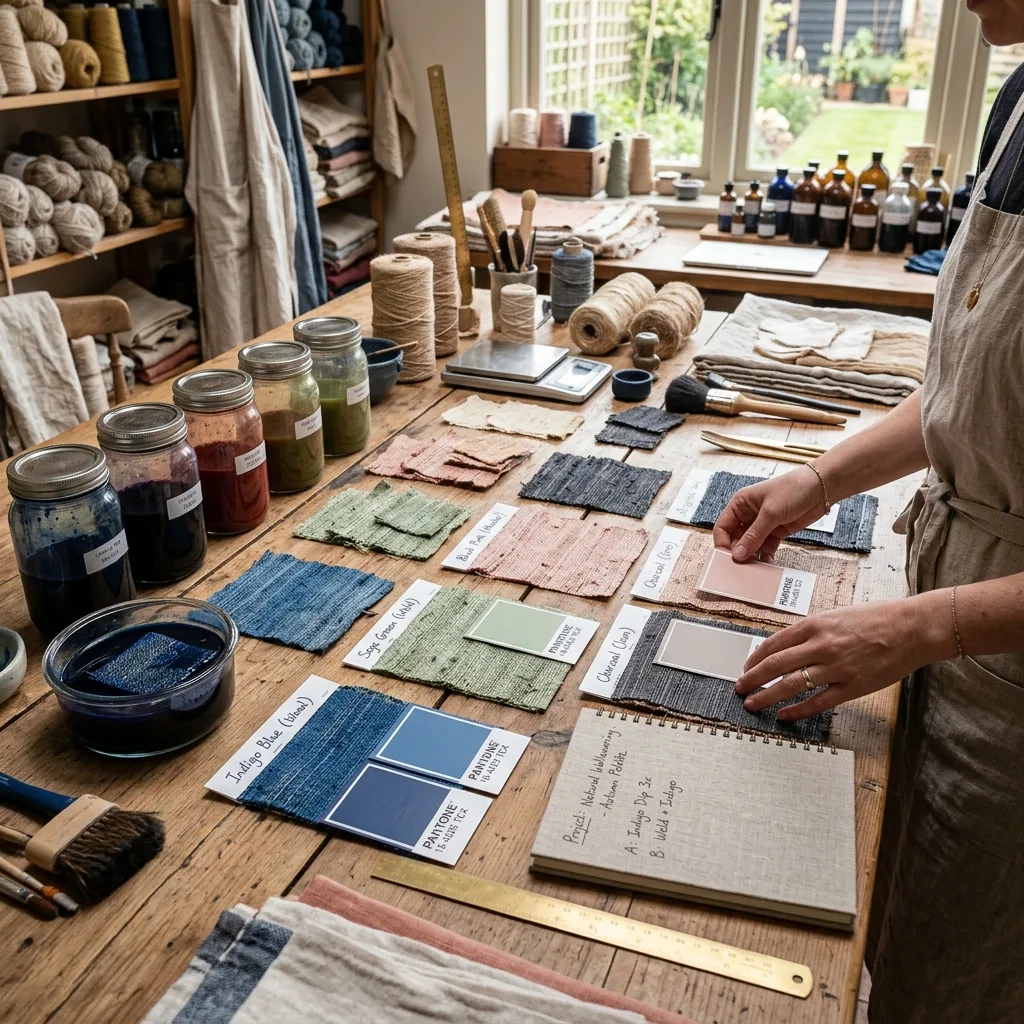
How to get the exact color you need — from Pantone reference to lab dip approval to production. The complete process for custom color matching on grasscloth, sisal, cork and other natural fiber wallcoverings.
Key Takeaways
- Any color is possible — match Pantone, paint chips, fabric or physical samples.
- Lab dip timeline: 2–4 weeks — 2–3 options shipped for approval.
- MOQ: 100 rolls per custom color, including new colours on existing materials.
- Color development fee: $50–100 — credited to first production order.
- Natural fiber = inherent variation — expect ΔE 1.5–3.0 vs. synthetic precision.
- D65 light verification — samples evaluated under standardized lighting.
- Formulas stored permanently — reorders match the original batch.
How Does the Custom Color Process Work?
| Step | Timeline | What Happens |
|---|---|---|
| 1. Submit reference | Day 1 | Send your color target — Pantone code, paint chip, fabric swatch or photo |
| 2. Lab dip production | 1–2 weeks | Our dye lab produces 2–3 variations on the target material |
| 3. Lab dip shipping | 3–5 days | Physical samples shipped via DHL for your evaluation |
| 4. Client approval | Your timeline | Select the approved dip; request adjustments if needed |
| 5. Strike-off (optional) | 1–2 weeks | Full-width production sample for final sign-off on large orders |
| 6. Bulk production | 4–6 weeks | Full order produced to approved standard |
Total timeline: From color submission to delivered goods: 8–14 weeks. Factor this into your project planning timeline.
What Color References Can You Work From?
| Reference Type | Accuracy | Notes |
|---|---|---|
| Pantone (coated/uncoated) | Best — industry standard | Specify C or U; results vary by substrate absorption |
| Paint chip (Benjamin Moore, Sherwin-Williams) | Excellent — physical reference | Mail the actual chip; photos shift color |
| Fabric/textile swatch | Very good | Useful when matching wallcovering to upholstery |
| Existing wallcovering sample | Best — same substrate category | Ideal for matching competitor products |
| RAL / NCS code | Good | Convert to Pantone equivalent for our reference |
| Photo / digital file | Low — use with caution | Screen calibration issues; always send a physical reference |
Best practice: Always provide a physical reference alongside any digital specification. Screens, printers and monitors all display color differently — only a physical sample eliminates ambiguity.
Why Does Natural Fiber Color Matching Differ from Synthetic?
Natural wallcovering materials absorb dye differently than synthetic substrates. This creates both challenges and beautiful characteristics:
- Fiber absorption varies: Individual grass or sisal fibers absorb dye at slightly different rates — this creates the natural texture and depth that makes these materials appealing
- Color tolerance (ΔE): Expect ΔE 1.5–3.0 on natural fibers vs. ΔE 0.5–1.0 on vinyl. This is within industry standard for natural materials
- Light metamerism: Natural fibers can shift appearance under different light sources (daylight vs. incandescent). We evaluate under D65 standardized lighting
- Batch consistency: Same dye formula on same fiber = consistent results. We store formulas permanently for reorder accuracy
- Material affects color: The same Pantone on grasscloth looks different than on sisal or cork because the base fiber color and texture differ
What Are the Costs?
| Service | Cost | Notes |
|---|---|---|
| Lab dip (2–3 options) | $50–100 per color | Credited to first production order |
| Second round lab dip | $30–50 per color | If first round needs adjustment |
| Full-width strike-off | $100–200 | Optional; recommended for orders 200+ rolls |
| Production per-roll price | Same as catalog colors | No premium for custom color |
| Formula storage | Free — permanent | Reorders reference stored formula |
Key point: Custom color production rolls are priced the same as catalog colors — the only additional cost is the lab dip development fee, which is credited back on your first order.
How Do You Approve and Manage Colors?
- Evaluate under multiple lights: Check lab dips under daylight, incandescent and fluorescent — color shifts are normal for natural materials
- Compare to reference side by side: Place your original reference directly adjacent to the lab dip on a neutral white surface
- Approve in writing: Sign off on the specific dip number (we label each option) — this becomes the production standard
- Retain the approved dip: Keep it as your reference for incoming quality checks and future reorders
- Communicate to installers: Share the approved dip with your installation team so they know what to expect at delivery
What About Dye Lot Variation?
Even with stored formulas and controlled processes, slight dye lot variation is inherent to natural materials. Here's how to manage it:
- Order 10% overage: Ensures enough material from the same dye lot for the entire installation
- Single-batch guarantee: For rooms up to ~300 sq ft, the order runs from a single dye batch to eliminate variation
- Cross-batch matching: For larger projects, we run continuity checks between batches during QC inspection
- Installer technique: Professional installers alternate rolls from different cartons to blend any subtle variation — see our installation guide
Frequently Asked Questions
Can I get just one custom color?
Yes. There's no minimum number of colors — you can develop a single custom colorway. The minimum order is 100 rolls of that color. Many clients start with one signature color, then expand to a full palette over time.
How close will the match be?
On natural fibers, expect a ΔE of 1.5–3.0 from your Pantone reference. This is imperceptible to most people in isolation and well within industry standards for natural wallcovering. If you need tighter tolerances (ΔE < 1.0), we recommend synthetic-backed materials or PVC — but then you lose the natural texture and character.
Can I match a competitor's product?
Yes. Send us a physical sample of the product you want to match — we'll have lab dips run on your chosen substrate. This is one of the most common custom color requests. We match the color, but the weave pattern and texture will reflect our materials, giving you a differentiated product.
Related Guides
Custom Grasscloth Wallpaper
Woven to your sample: how custom replication works.
Private Label
OEM/ODM services.
Build Product Line
Collection strategy.
Quality Control
5-stage QC process.
Evaluate Samples
7-point quality checklist.
Lead Time
Production timeline.
First Bulk Order
Complete ordering process.
Match Your Color
Send us a Pantone reference, paint chip or physical sample — we'll have lab dips made and shipped to you within 2 weeks.
Start Color Development