Business Guide
How to Build a Natural Wallcovering Product Line
From a single SKU to a full collection — here's how distributors, designers and retailers build a wallcovering product line. Material selection, collection architecture, pricing strategy and go-to-market planning.
Key Takeaways
- Start small: 3–5 materials × 4–6 colors = 15–30 SKUs.
- Lead with bestsellers: Grasscloth, sisal and paper weave have the broadest demand.
- Collection architecture matters: Good/better/best tiers create natural upsell paths.
- Budget $10K–30K for a starter collection at 100 rolls/SKU.
- Color strategy: Neutrals first, then accent colors — neutrals are 80% of volume.
- Sample program is essential — budget for swatch books and memo samples.
- Test before scaling: Validate demand before investing in specialty materials.
What Materials Should You Start With?
| Material | Demand Level | Price Point | Starter Priority |
|---|---|---|---|
| Grasscloth | ★★★★★ | Mid | Must have — #1 seller |
| Sisal | ★★★★☆ | Mid | Must have — strong texture appeal |
| Paper Weave | ★★★★☆ | Entry | Must have — accessible price point |
| Jute | ★★★☆☆ | Entry–Mid | Phase 2 — complements grasscloth |
| Cork | ★★★☆☆ | Mid–Premium | Phase 2 — unique texture category |
| Wood Veneer | ★★★☆☆ | Premium | Phase 3 — high impact, niche demand |
| Mica | ★★☆☆☆ | Premium | Phase 3 — specialty statement pieces |
| Gold/Silver Foil | ★★☆☆☆ | Premium+ | Phase 3 — luxury accent only |
Rule of thumb: Your first collection should be 80% proven sellers, 20% differentiators. Grasscloth + sisal + paper weave cover the proven sellers. Add one specialty material (cork or jute) for differentiation.
How Should You Structure Your Collection?
The most effective product line architecture uses a good/better/best tiering system:
| Tier | Materials | Role | Typical Markup |
|---|---|---|---|
| Good (Entry) | Paper weave, jute | Volume driver, accessible entry point | 2.0–2.5× |
| Better (Core) | Grasscloth, sisal | Bestsellers, highest volume | 2.5–3.0× |
| Best (Premium) | Cork, wood veneer, mica, foil | Margin driver, prestige positioning | 3.0–4.0× |
This structure gives your sales team natural upsell conversations: "If you like the paper weave texture, the grasscloth version gives you even more depth at a modest step-up."
How Do You Choose Colors?
- Start with neutrals: White, ivory, beige, tan, grey and taupe account for ~80% of wallcovering sales volume
- Add warm earth tones: Sage, olive, terracotta, clay — trending in both residential and hospitality
- Include 1–2 statement colors: Navy, charcoal or deep green for accent walls — low volume but high design impact
- Skip bold primaries: Bright reds, yellows and oranges have very limited commercial demand in natural wallcovering
- Color-match to paint standards: Reference Pantone, Benjamin Moore or Sherwin-Williams colors that designers already specify
Recommended starter palette per material: 2 whites/ivories + 2 warm neutrals (beige/tan) + 1 grey/taupe + 1 earth tone = 6 colorways per material.
What Does the Investment Look Like?
| Component | Starter Collection | Full Collection |
|---|---|---|
| SKU count | 15–30 SKUs | 60–100+ SKUs |
| Inventory | $10,000–30,000 (100 rolls/SKU) | $20,000–50,000+ |
| Sample program | $500–1,500 (swatch cards + memos) | $2,000–5,000 (printed swatch books) |
| Packaging & branding | Included in private label pricing | Included |
| Photography | $500–2,000 (lifestyle + product shots) | $2,000–5,000 |
| Website/catalog | $1,000–3,000 | $3,000–10,000 |
| Total launch budget | $12,000–37,000 | $27,000–70,000+ |
How Do You Create a Sample Program?
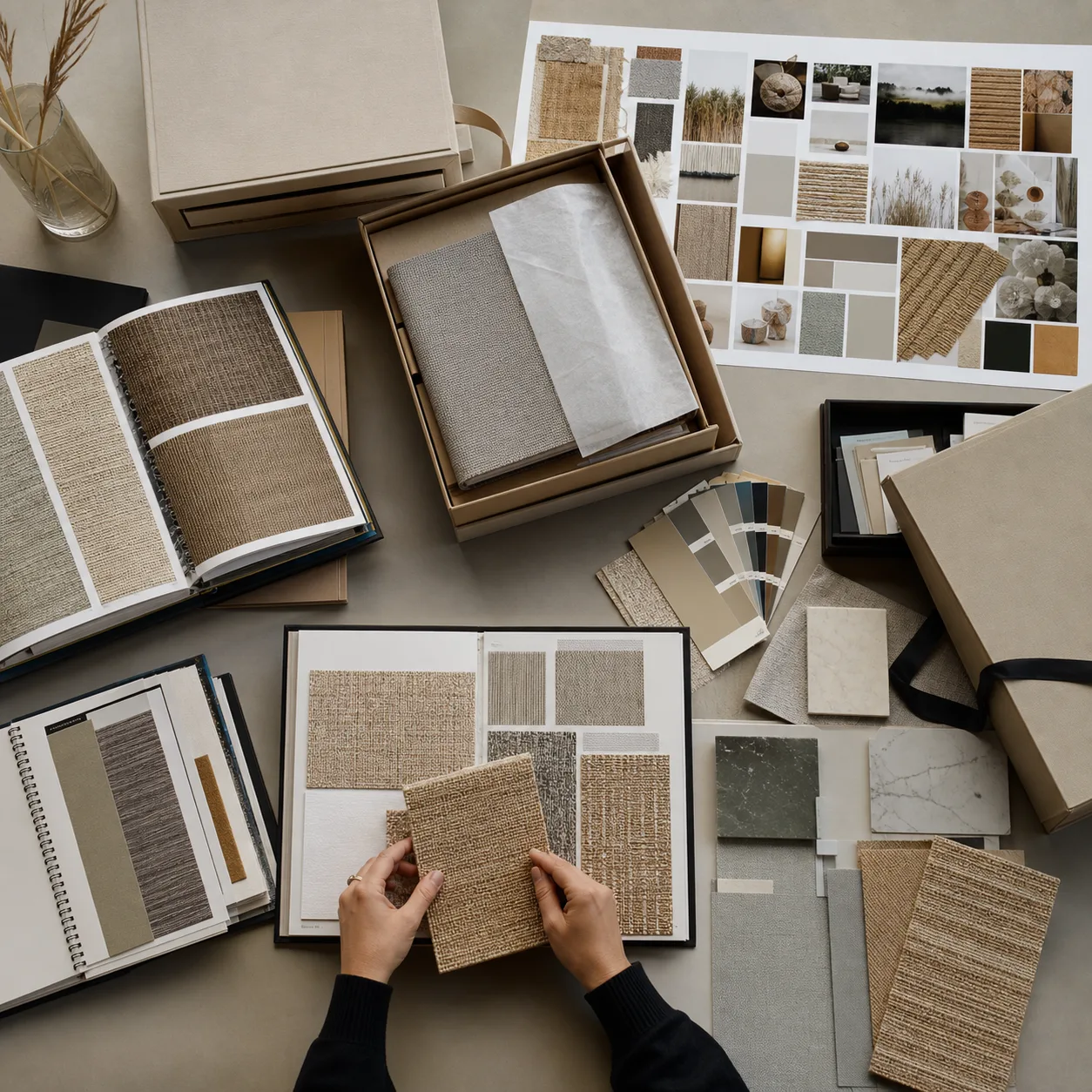
Samples drive 90%+ of wallcovering sales — designers and specifiers need to touch the material before ordering. Essential sample formats:
- Swatch cards (4"×6"): Low-cost, easy to mail — include with every inquiry response
- Memo samples (8"×10" or larger): Standard trade format — designers request these to present to clients
- Swatch book: Bound collection of all SKUs — leave-behind for showrooms and design firms
- Full-width strike-offs: Roll-width samples for large project approvals — produced on request
We supply all sample formats as part of the private label program. Swatch cards and memo samples can be branded with your logo and contact information.
What Is Your Go-to-Market Strategy?
- Define your channel: Trade-only (showrooms, designers, A&D firms)? Retail? E-commerce? Each channel has different pricing, packaging and marketing requirements
- Build your sample kit: Create a professional swatch book and memo sample set before approaching buyers
- Target initial accounts: Start with 10–20 design firms or showrooms in your market — personal relationships close first orders
- Attend trade shows: HD Expo, NeoCon, ICFF, and regional design center events are where B2B wallcovering relationships begin
- Launch digital presence: Product photography, material specifications and sample request forms on your website
- Offer competitive terms: Net 30 for established accounts, sample program at no charge or deposit-refundable
Frequently Asked Questions
How long does it take to launch a product line?
3–6 months from decision to first delivery. Timeline: 2–4 weeks for material selection and color approval, 4–6 weeks for production, 2–5 weeks for shipping, plus 2–4 weeks for sample program development and photography. You can sell from samples while initial inventory is in transit.
Should I hold inventory or sell to order?
Hybrid approach works best. Hold stock of your top 5–10 bestselling SKUs (neutrals in grasscloth and sisal) for fast fulfillment. Sell specialty materials and custom colors to order with standard lead times. This minimizes inventory risk while offering broad selection.
Can I test with a smaller collection first?
Absolutely — we recommend it. Start with a single material (grasscloth) in 4–6 colors at 100 rolls each. Total investment: ~$4,000–8,000. This gives you enough inventory to fulfill initial orders while validating market demand. Expand based on what sells.
Related Guides
Private Label
OEM/ODM services.
Top Manufacturers
Brands vs OEM factories.
Pricing Explained
What drives cost.
MOQ Guide
Minimum order quantities.
First Bulk Order
Complete ordering process.
Evaluate Samples
7-point quality checklist.
Launch Your Collection
Tell us your target market and budget — we'll propose a starter collection with material recommendations, pricing and a sample program plan.
Plan Your Product Line