Installation Guide
How to Reverse Hang Grasscloth
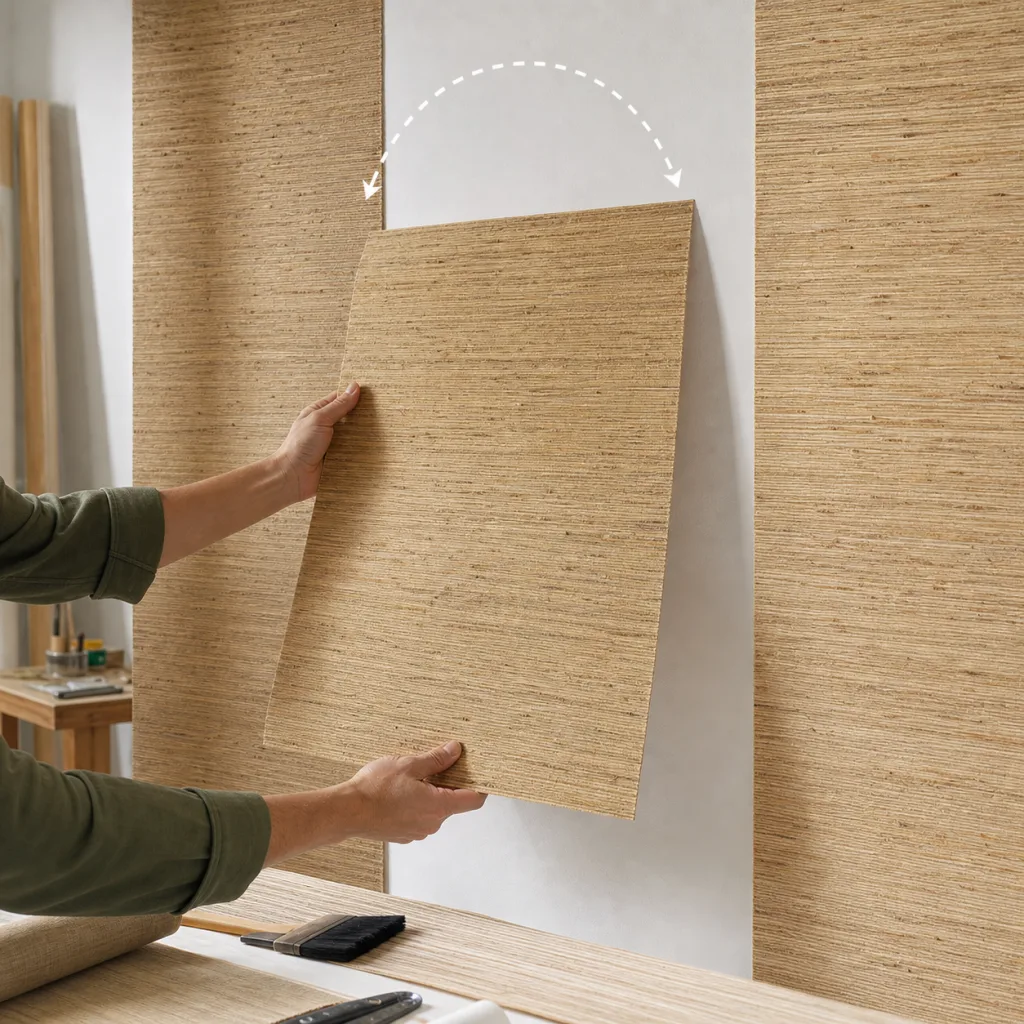
Reverse hanging is a professional installation technique that blends color shading across natural wallcovering strips. Here's when to use it, how it works, and step-by-step instructions.
Key Takeaways
- Reverse hanging = rotating every other strip 180° (top-to-bottom, then bottom-to-top).
- Why it works: Natural wallcovering often has a left-to-right shading gradient — reversing pairs same-shade edges together.
- Best for: Plain grasscloth, sisal, jute and paper-weave without directional pattern.
- Not for: Patterned wallcovering that has a clear up/down direction.
- Always dry-hang first (no paste) to preview the result before committing.
- Combine with roll alternation (1-2-3-1-2-3) for best results.
- Mark the top of every strip on the back with a pencil arrow to track orientation.
What Is Reverse Hanging?
Reverse hanging (also called "drop and reverse" or "railroading" in some markets) is an installation technique where every other strip of wallcovering is rotated 180° before hanging. Strip 1 hangs with the top of the roll at the ceiling; strip 2 hangs with the top of the roll at the baseboard; strip 3 returns to normal orientation.
This technique is specific to non-directional, natural fiber wallcoverings. It's rarely used with printed or patterned wallpaper because those have a clear "right way up."
Why Does Reverse Hanging Work?
Natural wallcoverings are hand-woven, and the weaving process creates a subtle left-to-right shading gradient across each roll. One edge tends to be slightly darker or denser than the other — this is called the selvage effect.
When strips are hung in the same orientation, the dark edge of strip 1 meets the light edge of strip 2, creating a visible shading contrast at every seam. This is often described as a "light-dark-light-dark" banding pattern.
By reversing every other strip, you pair similar-shade edges together:
- Strip 1 dark edge → meets → Strip 2 dark edge (rotated)
- Strip 2 light edge → meets → Strip 3 light edge (normal)
The result is a much more gradual, blended transition between panels rather than a sharp shading contrast.
When Should You Reverse Hang?
| Material | Reverse Hang? | Why |
|---|---|---|
| Plain grasscloth | Yes — recommended | Strong selvage shading in most rolls |
| Sisal | Yes — recommended | Coarse fibers amplify shading variation |
| Jute | Yes — recommended | Similar shading gradient to grasscloth |
| Paper-weave | Yes — recommended | Non-directional texture benefits from blending |
| Cork | Optional | Less shading variation; try dry-hang first |
| Mica | Check manufacturer | Some mica has directional shimmer |
| Gold foil | No | Metallic direction is usually fixed |
| Patterned wallcovering | No | Pattern has a clear up/down orientation |
Always check manufacturer instructions. Some products are labeled "reverse hang recommended" or carry a ↕ symbol on the roll. If in doubt, do a dry-hang test.
How Do You Reverse Hang Step by Step?
- Cut all strips to length — add 5 cm (2″) top and bottom for trimming
- Mark orientation — on the back of each strip, draw a pencil arrow pointing to the "top" (the end that came from the top of the roll)
- Number the strips — write 1, 2, 3, etc. on the back in hanging order
- Assign orientation:
- Odd strips (1, 3, 5...): arrow points UP (top of roll at ceiling)
- Even strips (2, 4, 6...): arrow points DOWN (top of roll at baseboard)
- Dry-hang the first 4–5 strips (no paste) against the wall to preview the result — check that the shading blends smoothly
- Adjust if needed — if the dry-hang shows an unexpected pattern or the material has a subtle directional texture, reconsider and try all-same-direction
- Hang with adhesive following the assigned orientation — paste the wall, not the material
Should You Combine Reverse Hanging with Roll Alternation?
Yes — this is the gold standard for natural wallcovering installation. The two techniques work together:
- Reverse hanging addresses shading variation within each roll (left-to-right gradient)
- Roll alternation (cycling strips from 3+ rolls: A1, B1, C1, A2, B2, C2...) addresses color variation between rolls
Combined, they produce the most uniform, blended appearance possible with natural fiber wallcovering. Most professional installers use both techniques simultaneously.
What Are the Common Mistakes with Reverse Hanging?
- Forgetting to mark strips — once cut, all strips look the same from the back. If you lose track of which end is "top," you can't reverse hang accurately. Always mark with pencil arrows before cutting.
- Reversing patterned material — if the wallcovering has a directional print, stripe or floral motif, reversing will make the pattern appear upside down on alternating strips
- Not dry-hanging first — some materials look worse reversed if they have asymmetric weave texture. Always preview before committing with adhesive.
- Mixing up numbering — once strips are cut and numbered, hang them strictly in sequence. Swapping order defeats the purpose of the blending pattern.
Reverse Hanging vs. Standard Hanging: Visual Comparison
| Aspect | Standard Hanging | Reverse Hanging |
|---|---|---|
| Seam shading | Dark edge meets light edge (sharp contrast) | Same-shade edges meet (gradual blend) |
| Color banding | Visible light-dark-light pattern | Blended, more uniform appearance |
| Complexity | Simpler — all strips same direction | Requires marking, numbering, dry-hanging |
| Material waste | Minimal | Same — no extra material needed |
| Best result | Patterned or directional wallcovering | Plain grasscloth, sisal, jute |
Frequently Asked Questions
Does reverse hanging eliminate visible seams?
No. Reverse hanging reduces shading contrast at seams but does not eliminate them. Seams are a natural characteristic of handwoven wallcovering. For further seam reduction, combine with tinted primer and edge coloring techniques.
Does reverse hanging use more material?
No. Reverse hanging uses the same amount of material as standard hanging. You simply rotate every other strip — no extra cutting or waste is involved.
How do I know if my wallcovering should be reverse hung?
Check the manufacturer's label — many grasscloth products carry a ↕ symbol or "reverse hang recommended" instruction. If unlabeled, do a dry-hang test with 3–4 strips to compare standard vs. reversed orientation.
Related Guides
Handle Seams
Minimize seam visibility.
Installation Guide
Full 7-step installation process.
Installation Mistakes
7 errors that ruin installations.
Wall Preparation
How to prep walls properly.
Corners & Outlets
Tricky spots handled right.
Grasscloth Guide
Complete grasscloth reference.
Need Installation Support?
We provide material-specific installation instructions with every order, including reverse-hang recommendations for each product.
Contact Us