Installation Guide
7 Natural Wallcovering Installation Mistakes to Avoid
These seven errors ruin more grasscloth and sisal installations than anything else. Most are irreversible once they happen. Learn them before you hang your first strip.
Key Takeaways
- Never use a seam roller — it crushes natural fibers and leaves permanent flat marks.
- Paste the wall, not the material — moisture on the face causes irreversible staining.
- Acclimatize rolls 48 hours — skipping this causes expansion gaps after installation.
- Use clay-based or starch adhesive — vinyl paste won't bond to natural fiber backing.
- Cannot reposition — natural fibers absorb paste on contact; plan layout first.
- Book from multiple rolls — using one roll at a time creates color banding.
- Change blades constantly — dull blades fray fibers at cuts.
Why Do Natural Wallcovering Installations Fail?
Natural wallcoverings — grasscloth, sisal, jute, cork — behave nothing like vinyl or non-woven wallpapers. Installers trained on synthetic materials often apply the same techniques and discover too late that natural fibers are far less forgiving. Every mistake below is one we've seen repeatedly in our years in natural wallcovering — and most are irreversible once they happen.
Mistake #1: Using a Seam Roller
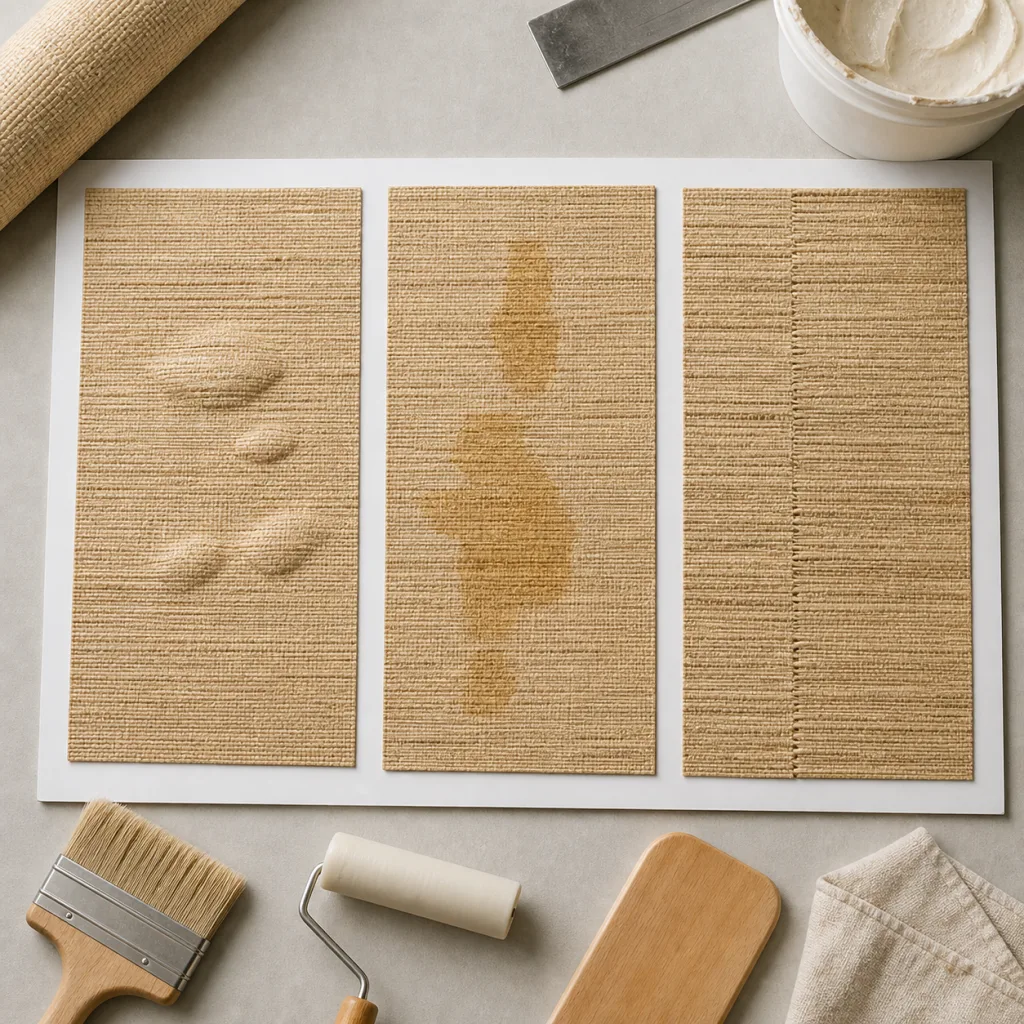
This is the #1 most common error and causes the most visible damage. A standard seam roller crushes the natural fibers at panel edges, creating permanent flat, shiny lines that contrast sharply with the surrounding texture. The damage cannot be repaired — the affected panels must be replaced.
The fix: Use a soft-bristle wallcovering brush to smooth panels from center outward. Never apply concentrated pressure to seam edges. If edges lift slightly, press gently with a barely-damp sponge.
Mistake #2: Pasting the Material Instead of the Wall
Natural fibers are porous and absorbent. Applying adhesive to the back of the material causes paste to wick through to the face, leaving permanent dark stains that cannot be cleaned. This is the opposite of the "paste-the-paper" method used with many vinyl wallpapers.
The fix: Always use the paste-the-wall method. Apply adhesive to the wall with a medium-nap roller, covering slightly more than one strip width. Position the dry material directly onto the pasted wall.
Mistake #3: Skipping Acclimatization
Natural fibers expand and contract with changes in temperature and humidity. Installing material straight from the box — especially if shipped in different climate conditions — means the fibers haven't reached equilibrium with the room. Result: seam gaps appear 24–72 hours later as the material adjusts.
The fix: Unbox all rolls and store them upright in the installation room for 48 hours minimum. This is non-negotiable. Some installers allow 72 hours for extreme climate differences (e.g., shipping from subtropical Chengdu to arid Arizona).
Mistake #4: Using the Wrong Adhesive
Standard vinyl wallpaper paste will not bond properly to natural fiber backing. The result is panels that peel away from walls within days or weeks. Some vinyl adhesives also contain chemicals that can discolor natural fibers.
The fix: Use a clay-based or heavy-duty starch adhesive specifically designed for natural wallcoverings (e.g., Roman PRO-880 Ultra Clear). Always test adhesive on a scrap piece first to ensure it doesn't bleed through or stain.
Mistake #5: Trying to Reposition After Contact
Unlike vinyl wallpaper which can be slid into position on wet paste, natural wallcoverings bond immediately on contact. The porous fibers absorb moisture from the adhesive and lock in place. Attempting to slide or lift a panel will tear the fibers, stretch the backing, or leave adhesive residue on the wall.
The fix: Plan your layout completely before hanging the first strip. Dry-hang the first 3–4 strips (no paste) to preview the panel sequence. Mark your plumb line carefully. When you commit, position accurately on the first attempt.
Mistake #6: Not Booking Panels from Multiple Rolls
Natural fibers have inherent color variation between rolls — this is a feature of handwoven material, not a defect. Using one roll at a time (hanging strips 1–6 from Roll A, then switching to Roll B) creates a visible color band where the rolls change.
The fix: Alternate strips from different rolls (Roll A strip 1, Roll B strip 1, Roll C strip 1, Roll A strip 2...). This blends the natural color variation across the entire wall for a cohesive, organic look.
Mistake #7: Using a Dull Blade for Trimming
Natural fibers — especially sisal and jute — will fray and tear when cut with a dull blade. The result is ragged, uneven edges at the ceiling and baseboard lines that look unprofessional and are impossible to fix without replacing the strip.
The fix: Use a snap-off utility knife and change the blade after every 2–3 cuts. Always cut against a broad knife or straight edge. A fresh blade slices cleanly through natural fibers without pulling or tearing.
Quick Reference: Mistakes at a Glance
| # | Mistake | Consequence | Fix |
|---|---|---|---|
| 1 | Seam roller | Permanent flat lines | Soft-bristle brush only |
| 2 | Paste on material | Permanent staining | Paste the wall |
| 3 | Skip acclimatization | Seam gaps in 24–72 hrs | 48 hours in room |
| 4 | Wrong adhesive | Panels peel off | Clay-based / starch paste |
| 5 | Reposition after contact | Torn fibers, residue | Plan layout first |
| 6 | Single-roll hanging | Color banding | Alternate rolls |
| 7 | Dull blade | Frayed edges | Fresh blade every 2–3 cuts |
Frequently Asked Questions
Can installation mistakes on grasscloth be repaired?
Most mistakes — seam roller marks, paste stains, fiber tears — are permanent and require panel replacement. This is why professional installation is strongly recommended. Prevention is far cheaper than replacement.
Should I hire a professional installer for natural wallcovering?
Yes. Natural wallcoverings are significantly harder to install than vinyl. They cannot be repositioned, require specific adhesives, and are permanently damaged by common vinyl-wallpaper techniques. Always hire an installer with specific natural wallcovering experience.
How do I find an installer experienced with grasscloth?
Ask for references specifically mentioning natural wallcovering projects. Request photos of previous grasscloth or sisal installations. We include a material-specific spec sheet with every order so your installer knows exactly what to expect.
Related Guides
Installation Guide
Full 7-step installation process.
Grasscloth Guide
Complete grasscloth reference.
Sisal Guide
Complete sisal wallcovering reference.
Grasscloth vs Faux
Real vs imitation compared.
How to Specify
Writing wallcovering specifications.
MOQ Guide
Minimum order quantities explained.
Need Installation Support?
We provide detailed, material-specific installation instructions and a spec sheet with every order — everything your installer needs to hang it correctly.
Contact Us