Maintenance Guide
Can You Paint Over Grasscloth Wallpaper?
Yes, you can paint over grasscloth — but should you? It's permanent, it changes the texture, and it makes future removal nearly impossible. Here's when painting makes sense, how to do it right, and when removal is the better option.
Key Takeaways
- Yes, you can paint over grasscloth — but it's permanent and nearly irreversible.
- Oil-based primer is mandatory — latex primer reactivates the wallpaper adhesive and causes bubbling.
- Expect 2–3 coats — grasscloth is highly absorbent and requires more paint than smooth walls.
- Texture remains visible — paint changes the color, not the weave texture.
- Seams stay visible — paint does not hide grasscloth seams.
- Removal becomes impossible — painted grasscloth cannot be stripped; you'll need to replace the drywall.
- Consider removal instead if you want a smooth painted finish or plan to sell the home.
Should You Paint Over Grasscloth or Remove It?
| Factor | Paint Over | Remove First |
|---|---|---|
| Cost | $50–150 (primer + paint) | $200–800 (labor + wall repair) |
| Time | 1 day | 2–3 days (removal + repair + paint) |
| Finished look | Textured, seams visible | Smooth, clean finish |
| Reversibility | Irreversible | Full flexibility for future |
| Resale impact | Neutral to negative | Positive |
| Wall damage risk | None | Moderate (drywall surface may tear) |
Paint over when: you like the texture but want a different color, you want to avoid wall repair, or the grasscloth is extremely well-bonded and difficult to remove.
Remove first when: you want a smooth finish, you plan to sell the home, or you want flexibility to change wall treatments in the future.
Why Is Oil-Based Primer Mandatory?
This is the most critical step and the one most DIYers skip — with disastrous results.
Grasscloth wallpaper is attached with water-based adhesive. When you apply latex (water-based) primer or paint directly, the water in the product reactivates the adhesive behind the wallpaper. This causes:
- Bubbling — trapped moisture creates bubbles under the grasscloth surface
- Peeling — the wallpaper separates from the wall as the adhesive softens
- Sagging — heavy, water-saturated grasscloth pulls away from the wall under gravity
Oil-based primer (shellac-based primers like Zinsser B-I-N are ideal) seals the surface without introducing water. It creates a barrier that:
- Prevents adhesive reactivation
- Blocks stain bleed-through from natural fibers
- Creates a uniform surface for topcoat adhesion
After the oil-based primer has dried and cured, you can safely apply latex topcoats.
How Do You Paint Over Grasscloth Step by Step?
- Inspect and re-glue: Check all seams and edges. Re-glue any lifting sections with seam adhesive and let them dry completely (24 hours). Paint will not fix loose wallpaper — it will make it worse.
- Clean the surface: Vacuum the grasscloth with a soft brush attachment to remove dust embedded in the weave. Do not use water or cleaning solutions.
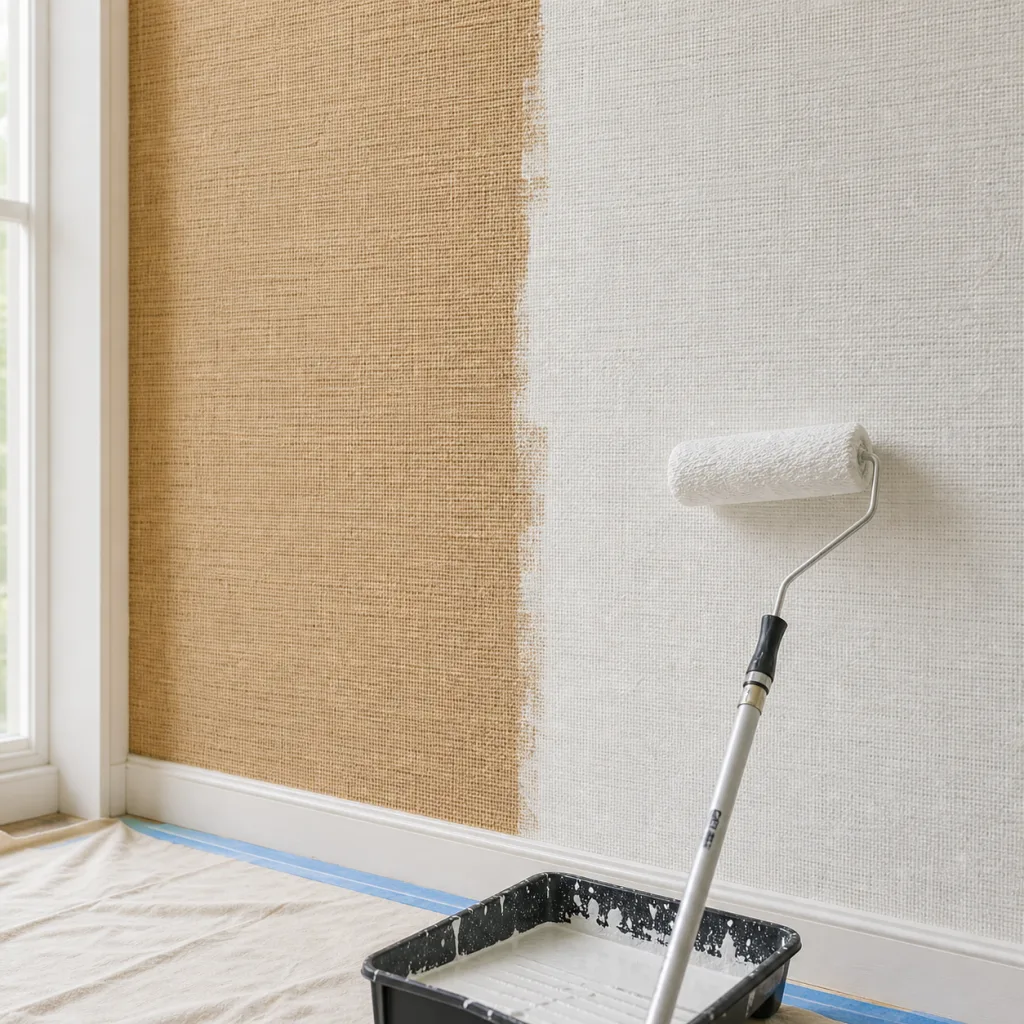
- Protect the room: Cover floors with drop cloths. Tape off baseboards, crown molding and trim with painter's tape.
- Apply oil-based primer: Use a roller with a ⅜" to ½" nap (medium thickness) to push primer into the fiber grooves. Roll in multiple directions — vertical first, then horizontal — to ensure full coverage. Apply one generous coat.
- Let primer cure: Allow the primer to dry and cure according to the manufacturer's instructions (typically 1–2 hours for shellac-based). The room will need ventilation — shellac primers have strong fumes.
- Apply first topcoat: Use a high-quality latex paint with a ⅜"–½" nap roller. Again, roll in multiple directions. The first coat will look thin and patchy — this is normal for absorbent grasscloth.
- Apply second (and possibly third) coat: Allow each coat to dry fully (2–4 hours) before recoating. Most grasscloth requires 2–3 topcoats for uniform color.
What Paint Finish Works Best on Grasscloth?
| Finish | Result on Grasscloth | Recommendation |
|---|---|---|
| Flat / Matte | Minimizes texture visibility, most natural look | Best for most situations |
| Eggshell | Slight sheen, subtle texture highlight | Good balance of look + durability |
| Satin | Moderate sheen, emphasizes weave texture | Use only if you want visible texture |
| Semi-gloss / Gloss | Heavy sheen, every fiber and seam visible | Not recommended |
Recommendation: Use flat or matte if you want to minimize the grasscloth look. Use eggshell for a good balance of subtlety and washability. Avoid high-sheen finishes — they highlight every fiber, seam and imperfection.
What Will the Result Look Like?
Painted grasscloth creates a unique textured wall finish that looks different from both unpainted grasscloth and smooth painted walls:
- Texture remains: The weave pattern shows through the paint, creating a subtle dimensional effect
- Seams remain: Grasscloth seams are still visible after painting — paint does not fill or hide them
- Color becomes uniform: The natural color variation between panels disappears under paint
- Fiber feel changes: The surface becomes smoother and less fibrous to the touch, but the weave ridges remain
Some designers intentionally paint grasscloth to create a "textured wall" effect that's more interesting than flat painted drywall but more uniform than natural grasscloth. This works particularly well with neutral colors (white, cream, soft gray) where the texture adds depth without competing with the color.
Frequently Asked Questions
Can I use latex primer instead of oil-based?
No. Latex primer is water-based and will reactivate the wallpaper adhesive, causing the grasscloth to bubble, peel and separate from the wall. Always use an oil-based or shellac-based primer (Zinsser B-I-N is the most recommended product). After the oil-based primer cures, you can safely use latex topcoats.
Can I remove painted grasscloth later?
In practice, no. Paint seals the fibers and penetrates the backing, making it impervious to water, steamers and wallpaper stripper solutions. Removing painted grasscloth almost always means tearing the drywall face paper, requiring extensive skim coating or drywall replacement. Consider this a permanent decision.
How much paint do I need?
Grasscloth absorbs significantly more paint than smooth drywall. Budget 30–50% more paint than normal for the same area. A standard room that would need 1 gallon on smooth walls may need 1.5–2 gallons on grasscloth (including primer and 2–3 topcoats).
Related Guides
Remove Grasscloth
How to strip natural wallcovering.
Repair Grasscloth
Fix tears, seams and stains.
Wall Preparation
Prep walls for new installation.
Installation Guide
Full 7-step installation process.
Best Adhesive
Choosing the right paste.
DIY vs Professional
When to hire a pro.
Considering New Wallcovering?
If you're thinking about painting over old grasscloth, consider replacing it with fresh material instead. We can supply matching or upgraded natural wallcovering.
Contact Us