Material Comparison
Grasscloth vs Cork: A Sourcing Specialist's Comparison
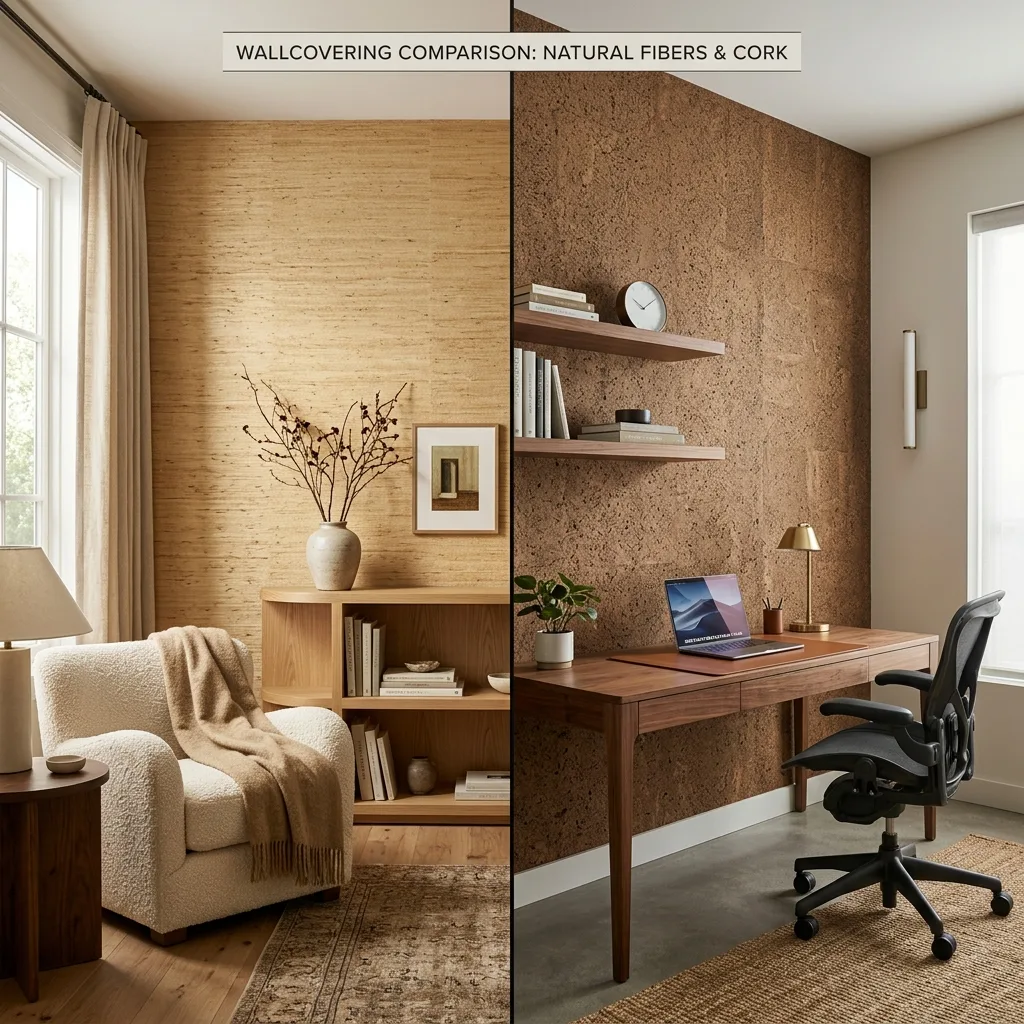
Two premium natural wallcoverings with very different strengths — compared head-to-head on texture, acoustic performance, durability, sustainability and cost. Data from our partner factories.
Key Takeaways
- Grasscloth = woven texture (jute/seagrass fibers); cork = bark veneer (Quercus suber).
- Cork wins on acoustics: NRC 0.15–0.30 vs grasscloth’s 0.05–0.10 (2–3× better).
- Grasscloth wins on color range: dye-receptive fibers vs cork’s limited natural palette.
- Price gap: grasscloth $8–18/m² vs cork $12–25/m² (FOB).
- Cork is hypoallergenic: does not absorb dust; ideal for allergy-sensitive occupants.
- Both are sustainable: biodegradable, low VOC, LEED-eligible.
- Best combo: grasscloth in living areas for visual warmth, cork in offices/media rooms for noise control.
At a Glance: Grasscloth vs Cork
| Feature | Grasscloth | Cork |
|---|---|---|
| Raw Material | Woven plant fibers (jute, seagrass, hemp) | Cork oak bark (Quercus suber) |
| Texture | Open weave, organic, tactile | Smooth-to-granular, earthy |
| Acoustic NRC | 0.05–0.10 | 0.15–0.30 |
| Thermal Insulation | Minimal | Good (closed-cell structure) |
| Moisture Resistance | Low (avoid wet areas) | Moderate (natural suberin) |
| Durability | Moderate | Moderate |
| Standard Width | 0.91 m (36″) | 0.91 m (36″) |
| Color Range | Extensive (dye-receptive fibers) | Limited (natural tans, browns, charcoals) |
| Price Range (FOB) | $8–18 /m² | $12–25 /m² |
| Custom color MOQ | 100 rolls | 100 rolls |
| Fire Rating | Class B1 (GB 8624) | Class B1 (GB 8624) |
| Best For | Living rooms, bedrooms, hotel lobbies | Offices, media rooms, wellness spaces |
How Do Grasscloth and Cork Differ in Texture?
Grasscloth delivers a distinctly woven aesthetic — you see and feel the individual fibers running horizontally across a paper or non-woven backing. The open weave creates visible texture variation and characteristic seams between panels, lending every wall a unique, artisanal quality. Designers value this organic irregularity as a mark of authenticity.
Cork offers a fundamentally different texture. Thin veneers of cork bark are laminated to a backing, creating a surface that is smooth-to-slightly-granular rather than woven. The visual effect is more earthy and architectural — resembling natural stone or bark rather than fabric. Cork's marbled, honeycomb-like grain pattern is subtle and highly distinctive.
When to Choose Grasscloth for Texture
- Residential living rooms and bedrooms seeking organic warmth
- Hotel guest rooms where a handcrafted, wabi-sabi feel is desired
- Feature walls that benefit from pronounced woven texture
- Projects requiring a wide range of dyed colorways
When to Choose Cork for Texture
- Home offices and studies where a grounded, earthy aesthetic works
- Wellness spaces (yoga studios, spas) emphasizing natural calm
- Commercial lobbies where a unique, architectural wall finish stands out
- Spaces where you want natural texture without visible seams
Which Performs Better on Acoustics and Insulation?
This is where cork significantly outperforms grasscloth. Cork's closed-cell structure naturally traps sound waves, achieving a Noise Reduction Coefficient (NRC) of 0.15–0.30 — approximately 2–3× better than grasscloth's 0.05–0.10. According to acoustic engineering data, a 3 mm cork wallcovering can reduce ambient noise by 10–15 dB in the 500–2000 Hz speech frequency range.
Cork also provides measurable thermal insulation. Its closed-cell structure gives it a thermal conductivity of approximately 0.040 W/m·K, similar to standard insulation materials. Grasscloth, being an open-weave material, offers negligible thermal benefit.
Best Acoustic Applications for Cork
- Home theaters & media rooms — reduces echo and reverberation
- Open-plan offices — absorbs ambient noise from conversations
- Conference rooms — improves speech clarity and reduces distraction
- Hotel corridors — dampens footfall and luggage noise
How Durable Is Each Material?
Both materials are moderate-durability natural products, but they fail in different ways. Grasscloth is vulnerable to water stains and surface abrasion — spills can leave permanent marks, and furniture contact can fray fibers. Cork is more moisture-tolerant (thanks to its natural suberin content) but can crack or chip on impact, especially thinner veneers.
Both materials should be cleaned by dry brushing or vacuuming only. Neither tolerates wet cleaning or chemical solvents. For high-traffic commercial areas, consider acrylic-coated cork or Type II vinyl grasscloth alternatives.
Cork’s Hypoallergenic Advantage
Cork does not absorb dust, pet dander or pollen — making it a hypoallergenic wall surface preferred in healthcare and allergy-sensitive residential settings. Grasscloth’s open-weave fibers can trap airborne particles over time, requiring more frequent vacuuming.
Which Is More Sustainable: Grasscloth or Cork?
Both are genuinely sustainable choices, but cork has a unique advantage:
| Sustainability Factor | Grasscloth | Cork |
|---|---|---|
| Raw Material Renewal | Annual crops (jute, seagrass) | Bark regenerates every 9–12 years without harming tree |
| Carbon Sequestration | Moderate (plant fibers) | High (cork forests absorb 14.7M tonnes CO₂/year) |
| Biodegradable | Yes | Yes |
| VOC Emissions | Very low | Very low |
| Common Certifications | Oeko-Tex, FSC (backing paper) | FSC, PEFC, EU Ecolabel |
Source: APCOR (Portuguese Cork Association) Annual Report 2024 — cork oak forests in the Mediterranean absorb an estimated 14.7 million tonnes of CO₂ annually.
How Much Does Grasscloth vs Cork Cost?
Grasscloth is generally 15–25% less expensive than cork at comparable quality levels. Cork requires more specialized processing (bark harvesting → boiling → slicing → lamination), which adds to production cost.
| Material | Standard Colors | Custom Finishes | Premium Grades |
|---|---|---|---|
| Grasscloth | $8–12 /m² | $12–15 /m² | $15–18 /m² |
| Cork | $12–16 /m² | $16–20 /m² | $20–25 /m² |
Note: Prices are indicative EXW Chengdu ranges as of May 2026. Actual pricing depends on quantity, thickness and specific finish. Contact us for a project-specific quote. See our pricing guide for landed-cost calculations.
Which Is Right for Your Project?
Choose Grasscloth If:
- Your design prioritizes organic woven texture and visual warmth
- You need a wide color palette (grasscloth accepts dyes more readily)
- Budget is a key consideration
- The space is residential or low-traffic hospitality
Choose Cork If:
- Acoustic performance is a project requirement
- The space benefits from thermal insulation (exterior walls, older buildings)
- You want an earthy, architectural wall finish rather than a woven one
- The environment has moderate humidity (powder rooms, well-ventilated kitchens)
Consider Both If:
Many designers use grasscloth in public-facing areas (lobbies, dining rooms) for visual impact, and cork in functional spaces (offices, media rooms, corridors) for acoustic benefit. Both share the same 0.91 m width and installation method, so they can be combined in a single project order — simplifying sourcing and logistics.
Frequently Asked Questions
Is grasscloth or cork better for soundproofing?
Cork is significantly better for sound absorption, with a Noise Reduction Coefficient (NRC) of 0.15–0.30 compared to grasscloth's 0.05–0.10. Cork's closed-cell structure traps sound waves, making it a preferred choice for home theaters, offices and meeting rooms where acoustic comfort matters.
Can grasscloth or cork be used in bathrooms?
Neither is recommended for full bathrooms. Cork has better moisture resistance than grasscloth due to its natural suberin content, but prolonged humidity will degrade both materials. For powder rooms with good ventilation, cork is the safer choice. For high-humidity environments, consider vinyl-backed alternatives.
Which is more eco-friendly, grasscloth or cork?
Both are sustainable natural materials, but cork has a slight edge: cork oak bark regenerates every 9–12 years without harming the tree, earning it strong sustainability credentials. Grasscloth fibers (jute, seagrass) are annual crops, also renewable but with higher agricultural input.
Related Guides
Grasscloth Guide
Complete reference on grasscloth wallcovering.
Cork Guide
Complete reference on cork wallcovering.
Grasscloth vs Vinyl
Natural vs synthetic wallcovering comparison.
Grasscloth vs Sisal
The two most popular natural wallcoverings compared.
Grasscloth Pros & Cons
Honest advantages and drawbacks.
MOQ Guide
Minimum order quantities explained.
Need Help Deciding?
Tell us about your project — space type, acoustic needs and design intent — and we'll recommend the right material with physical samples.
Request Samples