Maintenance Guide
How to Prevent Grasscloth Fading from Sunlight
Natural wallcovering uses vegetable-based dyes that are inherently sensitive to UV light. Direct sunlight causes irreversible color change within months. Here's how to protect your investment with window treatments, room planning and material selection.
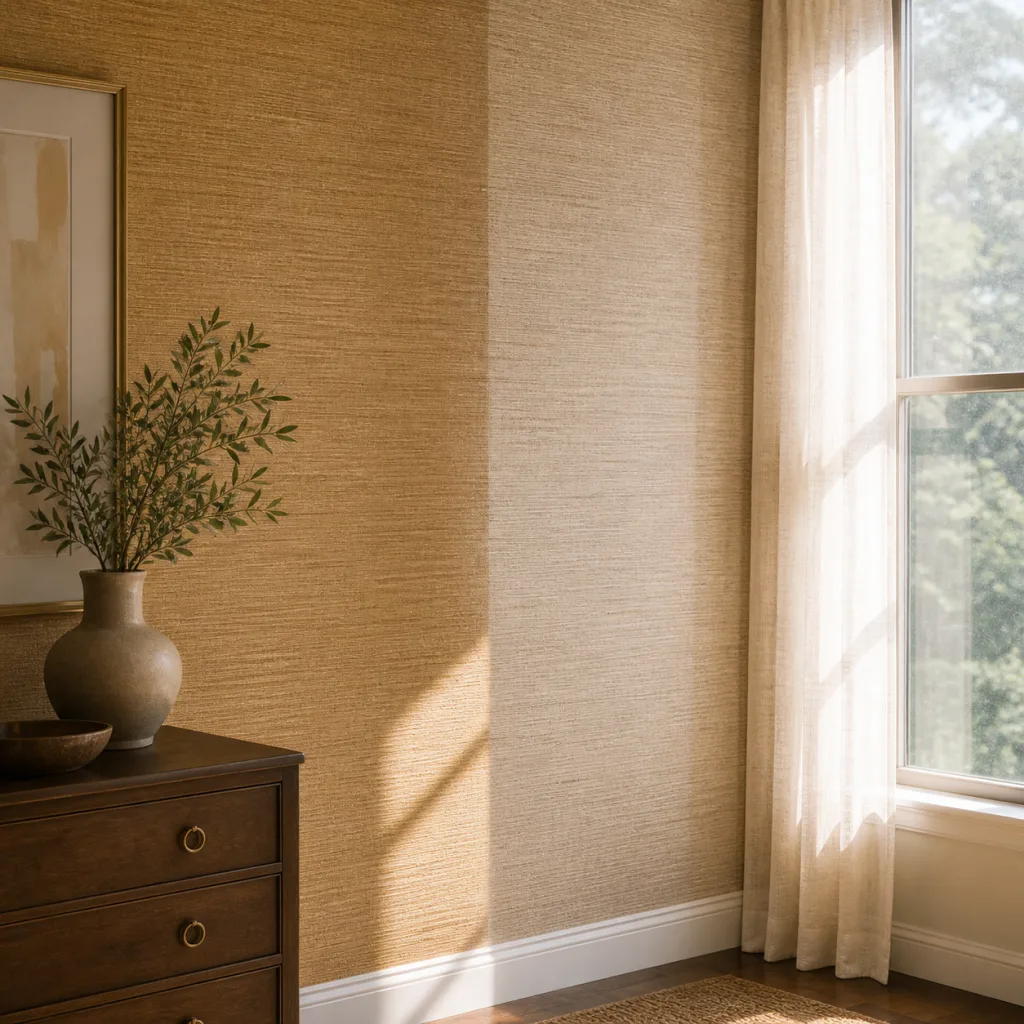
Key Takeaways
- Fading is permanent — UV damage to natural dyes cannot be reversed.
- UV window film is the most effective, invisible protection (blocks 99% of UV).
- Solar shades filter light while maintaining views — ideal for sun-facing rooms.
- South and west walls receive the most direct sunlight — highest fading risk.
- Rotate wall art regularly to prevent "tan line" shadow marks.
- Ask for lightfastness ratings when specifying material — higher ratings mean slower fading.
- Dark colors fade fastest — lighter, natural-tone grasscloth is more forgiving.
Why Does Grasscloth Fade?
Natural wallcovering fades because its color comes from vegetable-based dyes and natural pigments — not synthetic colorants. UV radiation breaks down the molecular bonds in these organic pigments, causing them to lighten, yellow or shift color over time.
The process is cumulative and irreversible. Even diffused daylight contributes to gradual fading, though direct sunlight causes the most rapid damage. The rate depends on:
- UV intensity — direct sun fades faster than indirect light
- Exposure duration — hours per day of sun exposure matter
- Dye type — some natural dyes are more lightfast than others
- Fiber type — darker-dyed fibers show fading more visibly than natural/undyed fibers
- Window orientation — south and west windows deliver the most intense UV
Which Window Treatments Protect Best?
| Window Treatment | UV Blocking | Light Impact | View | Cost |
|---|---|---|---|---|
| UV-filtering window film | Up to 99% | Minimal — nearly invisible | Full view preserved | $8–15 /sq ft installed |
| Solar shades (1–5% openness) | 90–95% | Moderate — reduces glare | View maintained | $150–400 /window |
| Lined drapery | 95–100% when closed | High — darkens room | None when closed | $200–600 /window |
| Sheer curtains | 30–50% | Low — softens light | View maintained | $50–150 /window |
| Cellular/honeycomb shades | 80–95% | Moderate | None when closed | $150–350 /window |
Best combination: UV window film (always-on passive protection) + solar shades or lined drapery (adjustable for peak sun hours). This gives you 99%+ UV reduction when shades are drawn, and still 99% when they're open.
Which Walls Are Most at Risk?
| Window Orientation | Fading Risk | Peak Exposure | Recommendation |
|---|---|---|---|
| South-facing | Very High | All day (most total UV) | UV film + solar shades mandatory |
| West-facing | Very High | Afternoon (most intense UV) | UV film + blackout option for PM |
| East-facing | Moderate | Morning (less intense) | UV film recommended |
| North-facing | Low | Indirect light only | Minimal protection needed |
Planning tip: If you're choosing which walls to cover with grasscloth, prioritize walls that don't face windows — or rooms with north-facing windows. This is the simplest, most effective fading prevention strategy.
Which Materials Are Most Fade-Resistant?
| Material | Fade Resistance | Why |
|---|---|---|
| Undyed / natural color | Highest | No dye to break down; natural fiber color changes minimally |
| Light / neutral tones | High | Less visible color shift; fading blends with natural variation |
| Sisal (coarse fiber) | Moderate-High | Thick fibers absorb less UV per unit; fading is more gradual |
| Cork | Moderate-High | Natural brown tones fade slowly; thick material provides UV buffering |
| Dark-dyed grasscloth | Low | Deep dyes show the most dramatic fading and uneven color shift |
| Mica / metallic | Low-Moderate | Mineral chips don't fade, but backing paper and adhesive can yellow |
When specifying grasscloth for sun-exposed rooms, ask your supplier for lightfastness test data. Materials with ISO 105-B02 ratings of 5+ (on a 1–8 scale) will hold color significantly longer than unrated products.
How Do You Prevent "Tan Lines" from Wall Art?
"Tan lines" are shadow marks caused by artwork, mirrors or shelves blocking sunlight from part of the wall. The exposed area fades while the covered area retains its original color, creating a visible outline when the art is moved.
- Rotate art positions every 6–12 months to even out exposure
- Use UV-filtering glass in picture frames — this protects both the art and the wall behind it
- Avoid hanging large items on sun-facing grasscloth walls unless UV protection is in place
- Consider floating shelves instead of flush-mounted art — the gap allows more even light distribution
Can Faded Grasscloth Be Restored?
No. UV damage to natural dyes is a permanent chemical change. There is no treatment, coating or cleaning method that can restore the original color. Your options for faded grasscloth are:
- Panel replacement — replace faded strips with matching material from the same dye lot (if you kept spare rolls)
- Full replacement — strip and reinstall with new wallcovering
- Paint over — painting over grasscloth creates a uniform color but is permanent and changes the texture feel
- Accept the patina — some designers and homeowners appreciate the natural aging of grasscloth as a desirable "lived-in" character
Frequently Asked Questions
How fast does grasscloth fade in direct sunlight?
In direct, unfiltered south- or west-facing sunlight, visible fading can occur within 3–6 months. Dark-dyed grasscloth may show noticeable color shift in as little as 6–8 weeks. With UV window film installed, the same exposure may take 3–5+ years to produce comparable fading.
Does indirect light cause fading too?
Yes, but much more slowly. Indirect or ambient daylight still contains UV radiation, just at lower intensity. In a north-facing room with only indirect light, grasscloth may take 5–10+ years to show visible fading. Regular rotation of wall art and moderate window treatment is still recommended.
Is there a UV-resistant grasscloth?
Some manufacturers offer grasscloth with enhanced lightfastness treatments — UV-inhibiting coatings applied during production. These extend color life but don't eliminate fading entirely. Ask for lightfastness ratings (ISO 105-B02) when specifying. Products rated 5+ hold color significantly longer than standard unrated material.
Related Guides
Stain Removal
Clean grasscloth safely.
Repair Grasscloth
Fix tears, seams and stains.
Paint Over Grasscloth
When painting is the answer.
Installation Guide
Proper installation from day one.
Grasscloth Guide
Complete grasscloth reference.
Commercial vs Residential
Specification differences.
Need UV-Resistant Material?
We offer grasscloth with enhanced lightfastness treatments for sun-exposed installations. Ask us about UV-rated options for your project.
Contact Us