Material Comparison
Cork Wallcovering vs Acoustic Panels: Which Controls Sound Better?
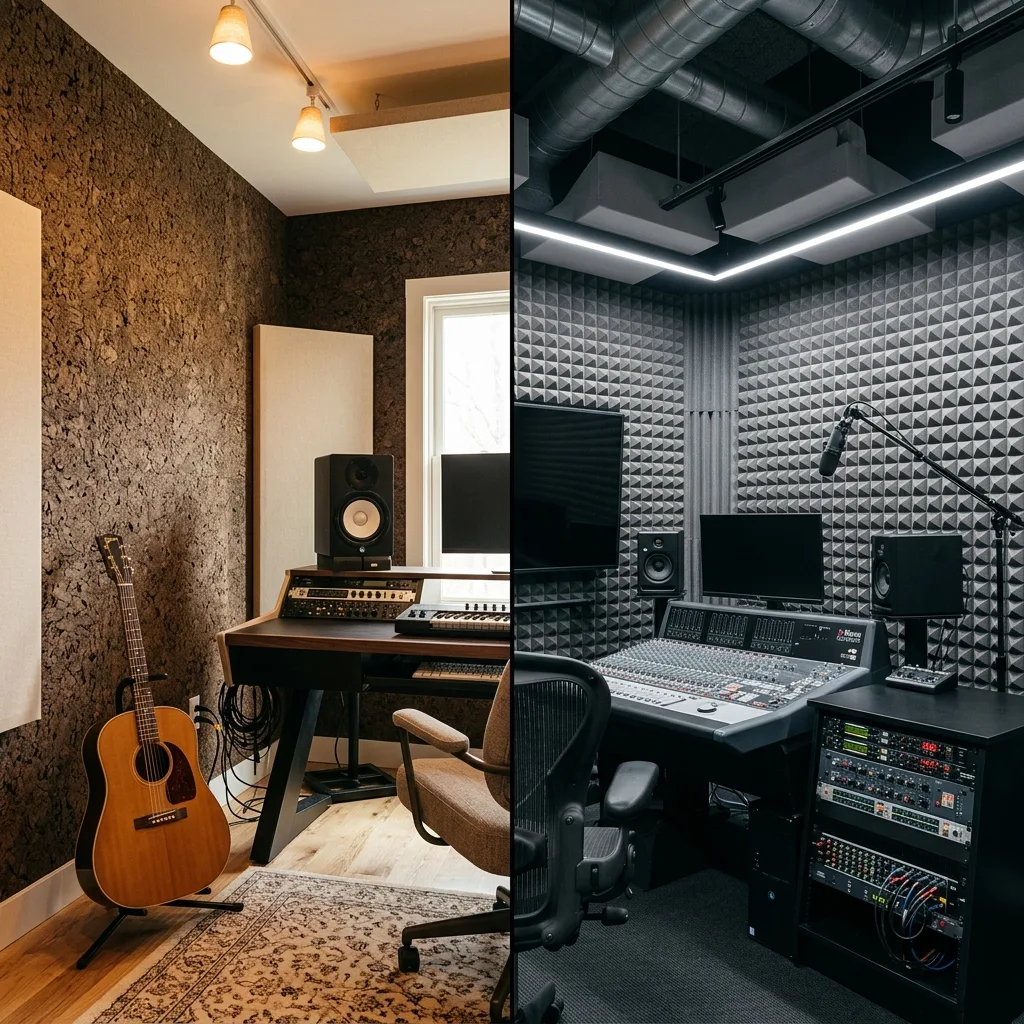
Cork wallcovering provides modest acoustic improvement with a beautiful natural finish. Dedicated acoustic panels absorb 3–5× more sound but look industrial. Here's how to choose — or combine both — for your project.
Key Takeaways
- NRC gap is large: cork 0.10–0.30 vs acoustic panels 0.70–1.00.
- Cork = design-first with mild acoustic benefit.
- Panels = performance-first — engineered for maximum sound absorption.
- Neither soundproofs a room — both reduce echo within a space, not block sound between rooms.
- Cork adds thermal insulation (~0.040 W/m·K); most panels do not.
- Cork is sustainable: renewable bark, biodegradable, near-zero VOC.
- Hybrid approach is often best: cork on walls + panels on ceilings.
At a Glance: Cork vs Acoustic Panels
| Feature | Cork Wallcovering | Acoustic Panels |
|---|---|---|
| Primary Purpose | Decorative wall finish | Engineered sound absorption |
| Material | Natural cork oak bark | PET felt, fiberglass, foam, or fabric-wrapped mineral wool |
| NRC Rating | 0.10–0.30 | 0.70–1.00 |
| Thermal Insulation | Good (~0.040 W/m·K) | Varies (fiberglass yes, foam minimal) |
| Aesthetics | Natural, warm, earthy grain | Functional; fabric-wrapped can look polished |
| Thickness | 2–6 mm | 25–50 mm (thicker = better absorption) |
| Installation | Adhesive to wall (like wallcovering) | Mechanical mount, Z-clips, adhesive |
| Coverage | Full wall, seamless | Partial coverage (strategic placement) |
| Moisture Resistance | Moderate (natural suberin) | Varies (some absorb moisture) |
| Sustainability | Renewable bark, biodegradable | Varies (PET recycled, fiberglass less so) |
| Fire Rating | Class B1 (GB 8624) | Class A (most commercial panels) |
| Price | $12–25 /m² (FOB) | $30–80 /m² (installed) |
| Best For | Design-led spaces needing mild echo control | Studios, theaters, open offices needing serious noise control |
How Does Cork Absorb Sound?
Cork's acoustic ability comes from its closed-cell structure — each cubic centimeter contains roughly 40 million tiny air-filled cells that trap and dampen sound waves. A 3–6 mm cork wallcovering achieves an NRC of 0.10–0.30, meaning it absorbs 10–30% of sound energy at mid-frequencies. This is noticeably better than bare drywall (NRC ~0.05) but far below dedicated acoustic products.
Cork is most effective at reducing flutter echo — the sharp, ping-pong-like reflections between parallel hard walls. In a residential living room or small office, cork wallcovering can make a perceptible improvement in speech clarity and ambient comfort without any visible acoustic hardware.
Cork also provides thermal insulation (~0.040 W/m·K), a benefit that dedicated acoustic panels rarely offer.
How Do Acoustic Panels Compare?
Dedicated acoustic panels are engineered for maximum absorption. Materials like mineral wool, fiberglass, or dense PET felt are designed to convert sound energy into heat, achieving NRC ratings of 0.70–1.00 — roughly 3–5× higher than cork.
The key difference is thickness and density. Most acoustic panels are 25–50 mm thick (vs cork's 2–6 mm), providing far more material for sound waves to penetrate and dissipate. Panels are particularly effective at controlling reverberation time (RT60) in large open spaces.
Modern acoustic panels come in fabric-wrapped, printed, or slatted designs that can look sophisticated — but they rarely match cork's organic, natural warmth as a continuous wall finish.
What's the Difference Between Absorption and Soundproofing?
This is a critical distinction that many buyers confuse:
- Sound absorption (what both cork and panels do) reduces echo and reverberation within a room, improving speech clarity and ambient comfort.
- Soundproofing / sound isolation blocks sound from traveling between rooms — this requires mass, decoupling and airtight construction (e.g., double stud walls, mass-loaded vinyl).
Neither cork wallcovering nor standard acoustic panels will meaningfully reduce sound transmission through a wall. For projects requiring both acoustic treatment and sound isolation, the wall structure itself must be upgraded — cork or panels are surface treatments only.
How Do Costs Compare?
| Category | Cork Wallcovering (FOB) | Acoustic Panels (installed) |
|---|---|---|
| Standard | $12–16 /m² | $30–50 /m² |
| Mid-Range | $16–20 /m² | $50–65 /m² |
| Premium | $20–25 /m² | $65–80 /m² |
Cork is significantly less expensive per square meter, but keep in mind that acoustic panels are often installed at 30–50% wall coverage (strategic placement), not full walls — so total project cost may be comparable.
Cork prices are EXW Chengdu as of May 2026. Contact us for a project-specific quote.
Which Is Right for Your Project?
Choose Cork Wallcovering If:
- Aesthetics are the priority — you want a beautiful, natural wall finish
- The space needs mild echo reduction, not professional-grade acoustic control
- You value thermal insulation as a secondary benefit
- The design calls for full-wall, seamless coverage
- Sustainability is a project requirement (LEED, WELL Building)
Choose Acoustic Panels If:
- The space has serious acoustic issues (long reverb, speech intelligibility problems)
- You're designing a recording studio, home theater, or conference room
- The project requires measurable NRC targets (e.g., ASTM C423 tested)
- Strategic, partial-wall placement is acceptable
Consider Combining Both:
The smartest approach for design-conscious projects is a hybrid strategy: use cork wallcovering as the primary visible wall finish for warmth and style, then add dedicated acoustic panels on ceilings, behind furniture, or in concealed locations. This delivers high acoustic performance without compromising the room's natural aesthetic.
Frequently Asked Questions
Does cork wallcovering really absorb sound?
Yes, but modestly. Cork's closed-cell structure absorbs 10–30% of sound energy (NRC 0.10–0.30), which noticeably reduces echo compared to bare drywall. It's effective for mild ambient improvement but not a substitute for dedicated acoustic treatment.
How much better are acoustic panels than cork for noise?
Dedicated acoustic panels absorb 3–5× more sound than cork wallcovering. A typical 50 mm fiberglass panel achieves NRC 0.85+ while 4 mm cork achieves NRC ~0.20. The difference is primarily due to thickness and material density.
Can cork wallcovering soundproof a room?
No. Cork reduces echo within a room (sound absorption) but does not meaningfully block sound from passing through walls (soundproofing). True soundproofing requires mass, decoupling and airtight construction — not surface treatments.
Related Guides
Cork Guide
Complete reference on cork wallcovering.
Grasscloth vs Cork
Natural woven fiber vs cork bark compared.
Sisal vs Cork
Durability vs acoustics head-to-head.
Natural vs Synthetic
Plant-based vs vinyl wallcovering.
Grasscloth vs Vinyl
The classic natural vs synthetic debate.
Installation Guide
How to install natural wallcoverings.
Hear the Difference
Request cork wallcovering samples and experience the natural texture and acoustic benefit firsthand.
Request Samples