Material Comparison
Sisal vs Cork: Durability Meets Acoustics
Two natural wallcoverings with opposite strengths — sisal excels on durability and abrasion resistance while cork leads on acoustics and thermal insulation. Here's an honest comparison from a sourcing partner that supplies both.
Key Takeaways
- Sisal = agave fiber (stiff, woven, abrasion-resistant); cork = oak bark (cellular, soft, sound-absorbing).
- Durability: sisal wins — high tensile strength, ideal for high-traffic areas.
- Acoustics: cork wins — NRC 0.15–0.30 vs sisal's 0.05–0.10.
- Moisture: cork has moderate resistance (natural suberin); sisal is moisture-sensitive.
- Texture: sisal is woven and refined; cork is smooth-to-granular and earthy.
- Price: sisal $10–18/m² vs cork $12–25/m² (FOB).
- Both are sustainable: biodegradable, near-zero VOC, renewable sources.
At a Glance: Sisal vs Cork
| Feature | Sisal | Cork |
|---|---|---|
| Raw Material | Agave sisalana fiber | Cork oak bark (Quercus suber) |
| Texture | Tight woven, refined, tactile | Smooth-to-granular, earthy, marbled |
| Durability | High (abrasion-resistant) | Moderate (can dent/chip) |
| Acoustic NRC | 0.05–0.10 | 0.15–0.30 |
| Thermal Insulation | Minimal | Good (0.040 W/m·K) |
| Moisture Resistance | Low | Moderate (natural suberin) |
| UV Resistance | Moderate | Low (fades in direct sun) |
| Color Range | Extensive (dye-receptive) | Limited (natural tans, browns, charcoals) |
| Standard Width | 0.91 m (36″) | 0.91 m (36″) |
| Price (FOB) | $10–18 /m² | $12–25 /m² |
| Custom color MOQ | 100 rolls | 100 rolls |
| Fire Rating | Class B1 (GB 8624) | Class B1 (GB 8624) |
| Best For | Lobbies, dining, high-traffic commercial | Offices, media rooms, wellness spaces |
How Do Sisal and Cork Differ in Texture?
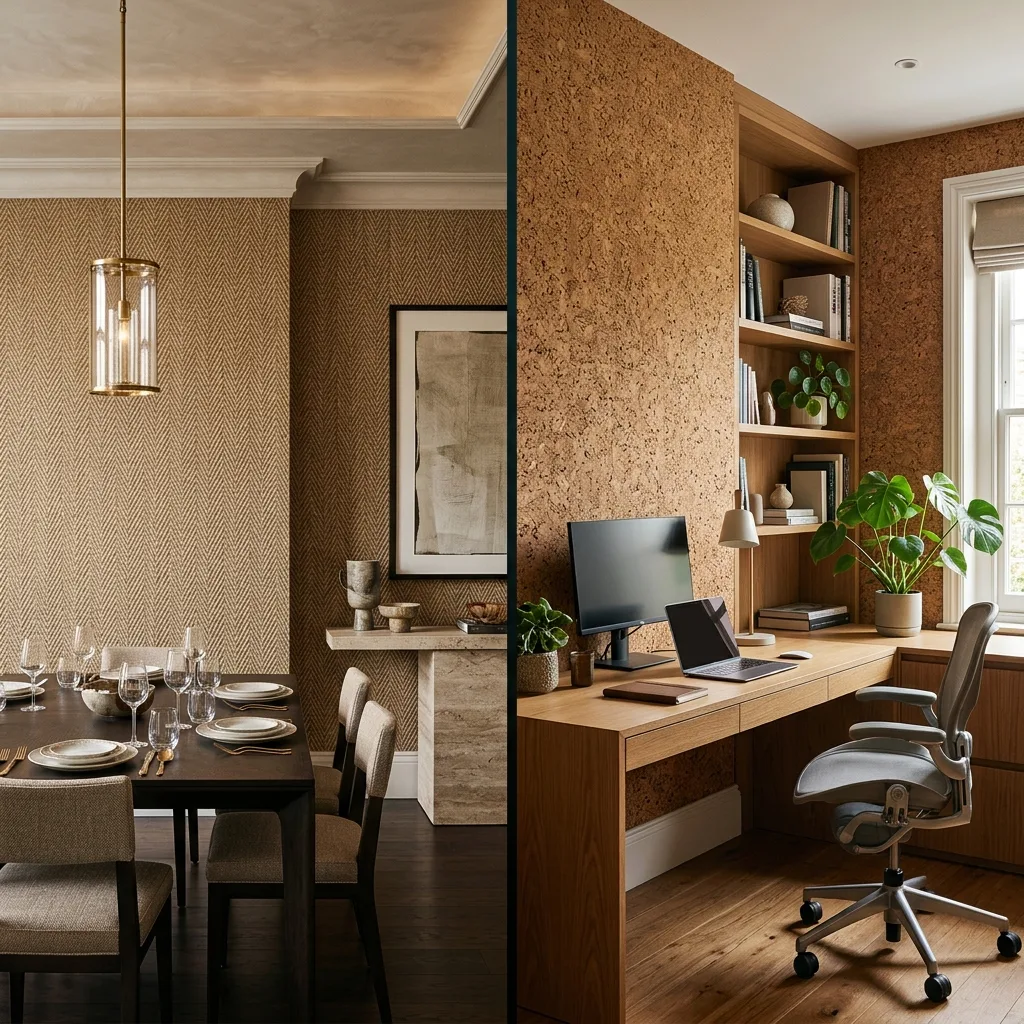
Sisal is a woven material — agave fibers run horizontally across a paper or non-woven backing, creating a tight, structured weave with subtle texture variation. The result reads as refined and sophisticated, with a "hotel-chic" aesthetic that works equally well in formal dining rooms and corporate offices.
Cork is not woven but laminated — thin veneers of cork oak bark are bonded to a backing, creating a smooth-to-slightly-granular surface. The visual effect is earthy and architectural, with a distinctive marbled, honeycomb-like grain pattern. Cork's texture is more about visual depth than tactile fiber.
Which Is More Durable?
Sisal wins on abrasion resistance. Agave fiber has high tensile strength and withstands daily contact from furniture, luggage and foot traffic. This makes sisal the preferred choice for high-traffic commercial spaces — hotel corridors, restaurant feature walls, busy office lobbies.
Cork is softer and more vulnerable to impact damage. Heavy furniture or luggage can dent or chip the bark veneer. However, cork has a unique advantage: it resists moisture better than sisal thanks to its natural suberin content. Cork can tolerate moderate humidity and occasional splashes, while sisal will stain permanently from water contact.
Both materials should be cleaned by dry brushing or vacuuming only. Neither tolerates wet scrubbing or chemical solvents.
Which Is Better for Soundproofing?
Cork excels at acoustic absorption. Its porous, closed-cell structure acts as a sound sponge, achieving an NRC of 0.15–0.30 — roughly 2–3× better than sisal's 0.05–0.10. A 3 mm cork wallcovering can reduce ambient noise by 10–15 dB in the speech frequency range (500–2000 Hz).
Cork also provides measurable thermal insulation (conductivity ~0.040 W/m·K), which sisal does not offer. For projects where acoustic comfort or energy efficiency matters — home theaters, conference rooms, exterior walls — cork is the clear winner.
Sisal does have some acoustic benefit — its woven fiber surface reduces echo better than flat paint or vinyl — but it cannot match cork's dedicated sound-dampening performance.
How Do Costs Compare?
| Category | Sisal (FOB) | Cork (FOB) |
|---|---|---|
| Standard | $10–13 /m² | $12–16 /m² |
| Mid-Range | $13–16 /m² | $16–20 /m² |
| Premium | $16–18 /m² | $20–25 /m² |
Sisal is 15–30% less expensive than cork. Cork requires specialized processing — bark harvesting, boiling, slicing and lamination — which adds to production cost.
Prices are EXW Chengdu as of May 2026. Contact us for a project-specific quote.
Which Is Right for Your Project?
Choose Sisal If:
- The space is high-traffic commercial (hotel lobbies, corridors, restaurants)
- You need a refined woven texture with wide color range
- Durability and abrasion resistance are project priorities
- Budget is a consideration
Choose Cork If:
- Acoustic performance is a project requirement
- The space benefits from thermal insulation
- You want an earthy, architectural wall finish
- The environment has moderate humidity (powder rooms, kitchens)
Consider Both:
Many projects use sisal in high-traffic public areas (lobbies, dining rooms) for durability, and cork in functional spaces (offices, media rooms, corridors) for acoustic benefit. Both share the same 0.91 m width, so they can be combined in a single order.
Frequently Asked Questions
Is sisal or cork wallcovering more durable?
Sisal is more durable for abrasion and daily wear thanks to agave fiber's high tensile strength. Cork is softer and can dent or chip on impact, but it resists moisture better due to its natural suberin content.
Is cork wallcovering better for soundproofing than sisal?
Yes. Cork's porous cellular structure absorbs sound significantly better than sisal, with an NRC of 0.15–0.30 compared to sisal's 0.05–0.10. Cork also provides thermal insulation that sisal does not.
Can sisal or cork wallcovering be used in bathrooms?
Sisal should never be used in wet areas. Cork has moderate moisture resistance due to its natural suberin, making it suitable for well-ventilated powder rooms but not full bathrooms.
Related Guides
Sisal Guide
Complete reference on sisal wallcovering.
Cork Guide
Complete reference on cork wallcovering.
Grasscloth vs Cork
Texture vs acoustics comparison.
Sisal vs Jute
Agave vs corchorus fiber compared.
Grasscloth vs Sisal
The two most popular natural wallcoverings.
Natural vs Synthetic
Plant fibers vs vinyl wallcovering.
Compare Them In Person
Request sisal and cork samples side by side — the texture difference is best appreciated by touch.
Request Samples