Material Comparison
Natural vs Synthetic: The Complete Comparison
Natural fibers or engineered synthetics? We supply natural wallcoverings and know both sides. Here's an honest comparison on texture, indoor air quality, durability, sustainability and cost.
Key Takeaways
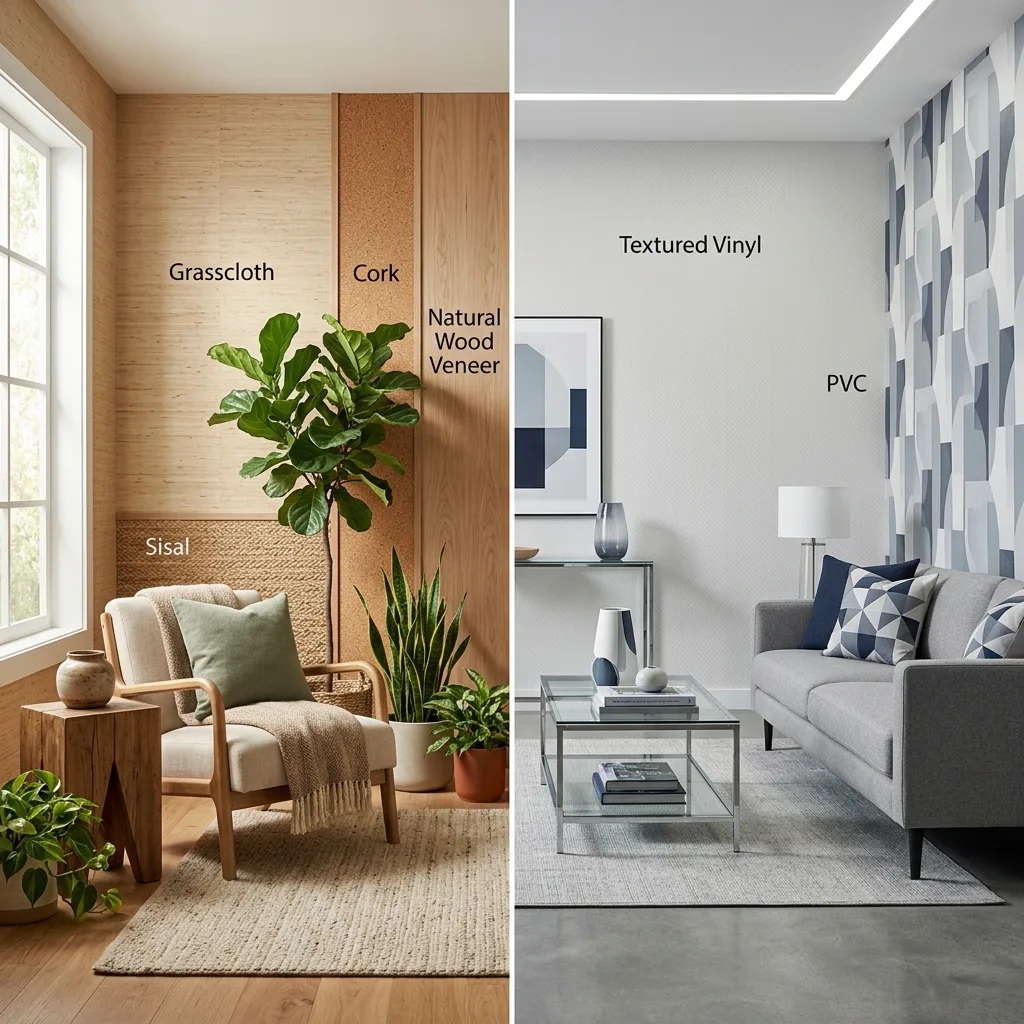
- Natural = plant/mineral fibers (jute, sisal, cork, flax, wood veneer); synthetic = PVC, vinyl, non-woven polymer.
- VOC emissions: natural wallcoverings emit near-zero VOCs; vinyl can off-gas phthalates for 6–12 months.
- Breathability: natural fibers allow moisture vapor transmission; vinyl traps moisture behind the wall.
- Durability: synthetic wins — Type II vinyl handles abrasion, scrubbing and moisture.
- Texture: every natural panel is unique; synthetic is uniform and repeatable.
- Price: synthetic $3–10/m² vs natural $8–35/m² (FOB).
- Sustainability: natural is biodegradable and renewable; vinyl is petroleum-based and non-recyclable.
At a Glance: Natural vs Synthetic
| Feature | Natural | Synthetic |
|---|---|---|
| Materials | Grasscloth, sisal, cork, linen, wood veneer, mica | PVC vinyl, non-woven, polyester |
| Texture | Unique, handcrafted, tactile | Uniform, printed, embossed |
| VOC Emissions | Very low to zero | Moderate (phthalates in PVC) |
| Breathability | High (moisture vapor passes through) | Low (can trap moisture) |
| Durability | Moderate (residential) | High (Type II commercial) |
| Moisture Resistance | Low–Moderate | High (washable, scrubbable) |
| Fire Rating | Class B1 (GB 8624) | Class A / ASTM E-84 |
| Acoustic Benefit | Moderate (cork NRC 0.15–0.30) | Minimal |
| Color Range | Good (natural tones + dyed) | Unlimited (digital print) |
| Price (FOB) | $8–35 /m² | $3–10 /m² |
| Sustainability | Biodegradable, renewable | Petroleum-based, non-recyclable |
| Best For | Luxury residential, boutique hospitality | High-traffic commercial, healthcare, wet areas |
How Do Natural and Synthetic Wallcoverings Differ in Texture?
Natural wallcoverings deliver texture you can see and feel. Grasscloth has a coarse, horizontal weave; sisal shows tight rope-like fibers; cork displays a marbled bark grain; wood veneer reveals real timber patterns. Every panel is slightly different — designers value this organic irregularity as a mark of authenticity and craft.
Synthetic wallcoverings achieve texture through embossing and printing. Modern vinyl can mimic grasscloth, linen and even stone with impressive accuracy. However, the repeat pattern is uniform — identical across every roll. Close inspection reveals the difference: synthetic lacks the dimensional depth and tactile warmth of real fiber.
Are Natural Wallcoverings Healthier for Indoor Air?
Yes. Natural wallcoverings emit very low to zero VOCs because they contain no PVC, plasticizers or chemical coatings. Many carry Oeko-Tex Standard 100 certification, confirming they are free from harmful substances.
Vinyl wallcoverings — particularly PVC-based products — can off-gas phthalates and other volatile compounds for 6–12 months after installation. This is a growing concern for healthcare, education and residential projects where indoor air quality (IAQ) is a priority.
Natural wallcoverings are also breathable: their porous fiber structure allows moisture vapor to pass through the wall assembly, reducing the risk of trapped condensation and mold growth. Vinyl creates a vapor barrier that can trap moisture behind the covering — a known risk factor for mold in humid climates.
Which Is More Durable?
Synthetic wins on durability. Type II commercial vinyl wallcovering (20–32 oz/linear yard) withstands abrasion, scrubbing, chemical cleaning and moderate impact — meeting ASTM F793 standards for high-traffic commercial environments.
Natural wallcoverings are moderate-durability products. Grasscloth is vulnerable to water stains and fiber fraying from contact. Cork resists moisture but can chip on impact. Wood veneer is scratch-resistant but hygroscopic. All natural wallcoverings should be cleaned by dry brushing or vacuuming only — none tolerate wet scrubbing.
For high-traffic areas that need a natural look, consider faux-grasscloth vinyl — a Type II synthetic that mimics the woven texture while providing commercial-grade durability. See our real vs faux grasscloth guide.
Which Is More Sustainable?
| Factor | Natural | Synthetic |
|---|---|---|
| Raw Material | Renewable plants/minerals | Petroleum-derived polymers |
| Biodegradable | Yes (fully) | No (500+ years in landfill) |
| Recyclable | Limited (compostable) | Rarely (PVC recycling is complex) |
| Manufacturing Footprint | Low energy, minimal chemicals | High energy, chemical-intensive |
| VOC in Production | Very low | Moderate–High |
| Certifications | Oeko-Tex, FSC, European Flax® | Greenguard (select products) |
Natural wallcoverings align with LEED, WELL and Living Building Challenge criteria for material health and responsible sourcing. For projects targeting green building certification, natural materials provide clear documentation advantages.
How Do Costs Compare?
| Category | Natural (FOB) | Synthetic (FOB) |
|---|---|---|
| Entry Level | $8–12 /m² | $3–5 /m² |
| Mid-Range | $12–20 /m² | $5–8 /m² |
| Premium | $20–35 /m² | $8–10 /m² |
| Installation | $8–15 /m² (specialist) | $4–8 /m² (standard) |
Prices are indicative FOB Shanghai ranges as of May 2026. Contact us for a project-specific quote.
Which Is Right for Your Project?
Choose Natural If:
- Your design demands authentic, one-of-a-kind texture
- Indoor air quality is a priority (healthcare, schools, luxury residential)
- The project targets LEED or WELL certification
- You want a genuine sustainability story for your brand
- The space is low-to-moderate traffic
Choose Synthetic If:
- The space is high-traffic commercial (corridors, lobbies, retail)
- Moisture resistance is required (bathrooms, kitchens, pools)
- Budget is the primary constraint
- You need unlimited color/pattern options via digital printing
- Easy, scrubbable maintenance is essential
Consider Combining Both:
Many designers use natural wallcovering on feature walls and public-facing areas for visual impact, and synthetic in back-of-house, wet areas and high-traffic corridors for practical performance. This hybrid approach maximizes design impact while managing budget and maintenance requirements.
Frequently Asked Questions
Are natural wallcoverings better than vinyl?
It depends on your priorities. Natural wallcoverings offer superior breathability, lower VOC emissions, unique textures and better sustainability. Synthetic wallcoverings offer higher durability, moisture resistance, easier maintenance and lower cost. For luxury residential and hospitality, natural wins; for high-traffic commercial or wet areas, synthetic is more practical.
Do natural wallcoverings emit VOCs?
Natural wallcoverings emit very low to zero VOCs because they are made from plant fibers and mineral materials without PVC plasticizers. Many carry Oeko-Tex Standard 100 certification. Vinyl wallcoverings can off-gas phthalates and other VOCs, particularly in the first 6–12 months after installation.
Can natural wallcoverings be used in bathrooms?
Most natural wallcoverings are not recommended for full bathrooms due to moisture sensitivity. For high-humidity areas, use Type II vinyl wallcovering or faux-grasscloth vinyl that mimics natural texture while resisting moisture. Cork wallcovering has moderate moisture tolerance and may work in well-ventilated powder rooms.
Related Guides
Grasscloth Guide
Complete reference on grasscloth wallcovering.
Grasscloth vs Vinyl
Natural vs synthetic head-to-head.
Real vs Faux Grasscloth
How to tell the difference.
Grasscloth Pros & Cons
Honest advantages and drawbacks.
Grasscloth vs Cork
Texture vs acoustics comparison.
Installation Guide
How to install natural wallcoverings.
Experience the Difference
Request natural wallcovering samples — the texture, weight and warmth of real fiber is best appreciated in person.
Request Samples