Dark Brown Grasscloth Wallpaper
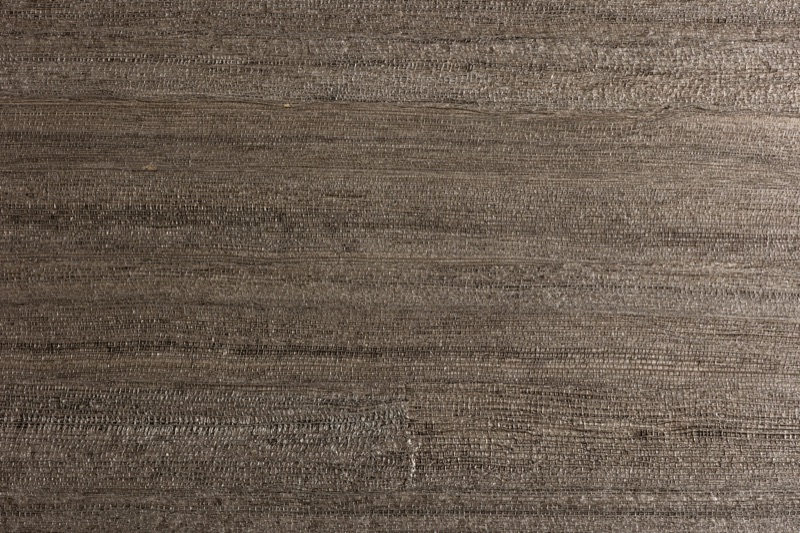
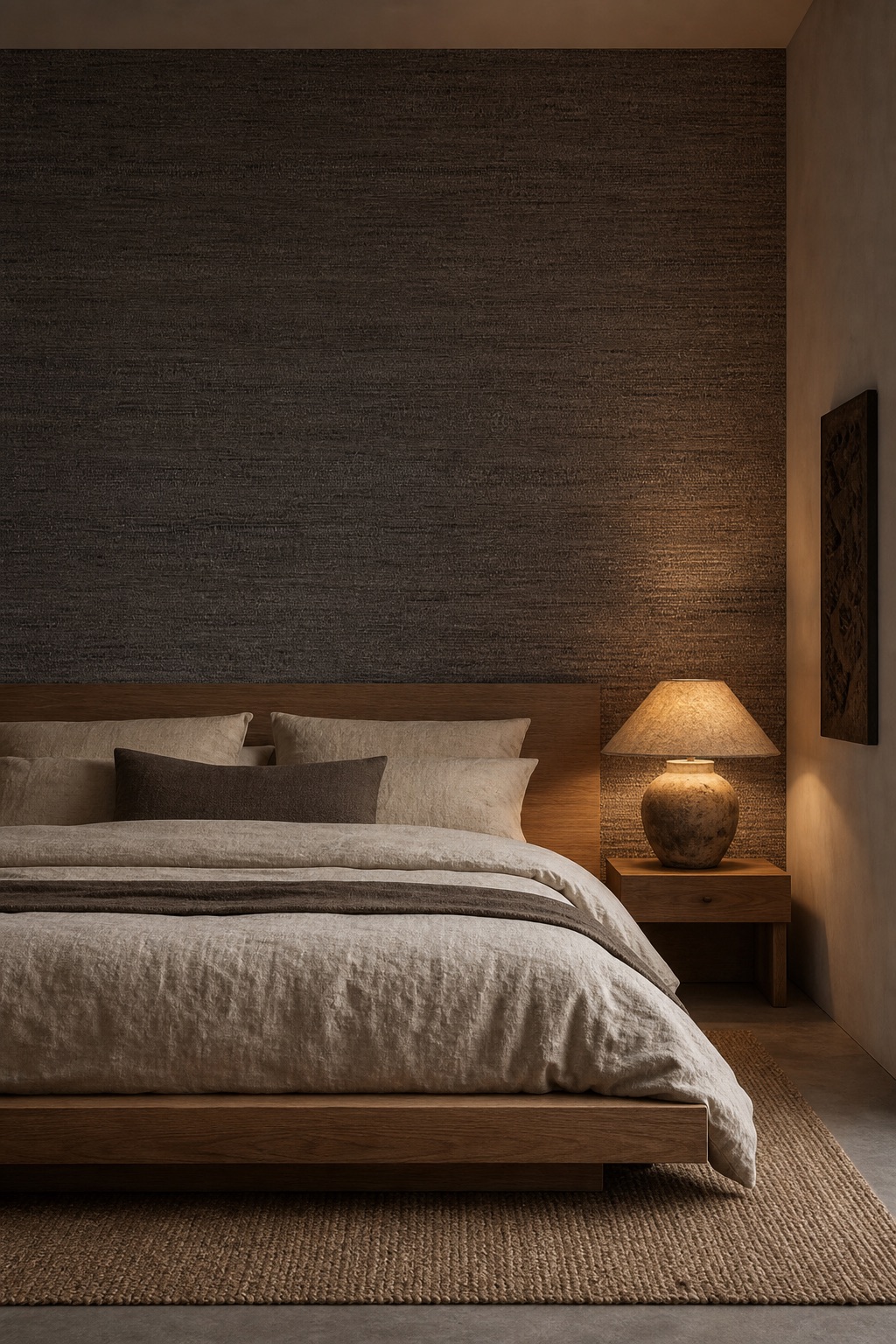
Tobacco Weft is a dark brown grasscloth wallpaper produced with partner mills using flat-pressed natural reed, woven in a tight horizontal plain weave that resolves across a full wall into a quiet, material-rich field of fine parallel lines. The colour sits between espresso and raw earth: warm-undertoned, complex, and consistently deep regardless of wall size. Supplied to interior designers and trade buyers from 50 rolls (≈250 m²), it is suited to specification contexts where a deeply atmospheric but materially honest surface is required, from boutique hotel suites and private studies to residential dining rooms with considered lighting plans.
Warm Dusk at Every Hour: How Charcoal-Brown Reed Reads Across Lighting Conditions
- Under natural daylight the colour presents as a deep, complex neutral; the tight weft rows cast microscopic horizontal shadows that give the surface genuine texture depth rather than flat colour.
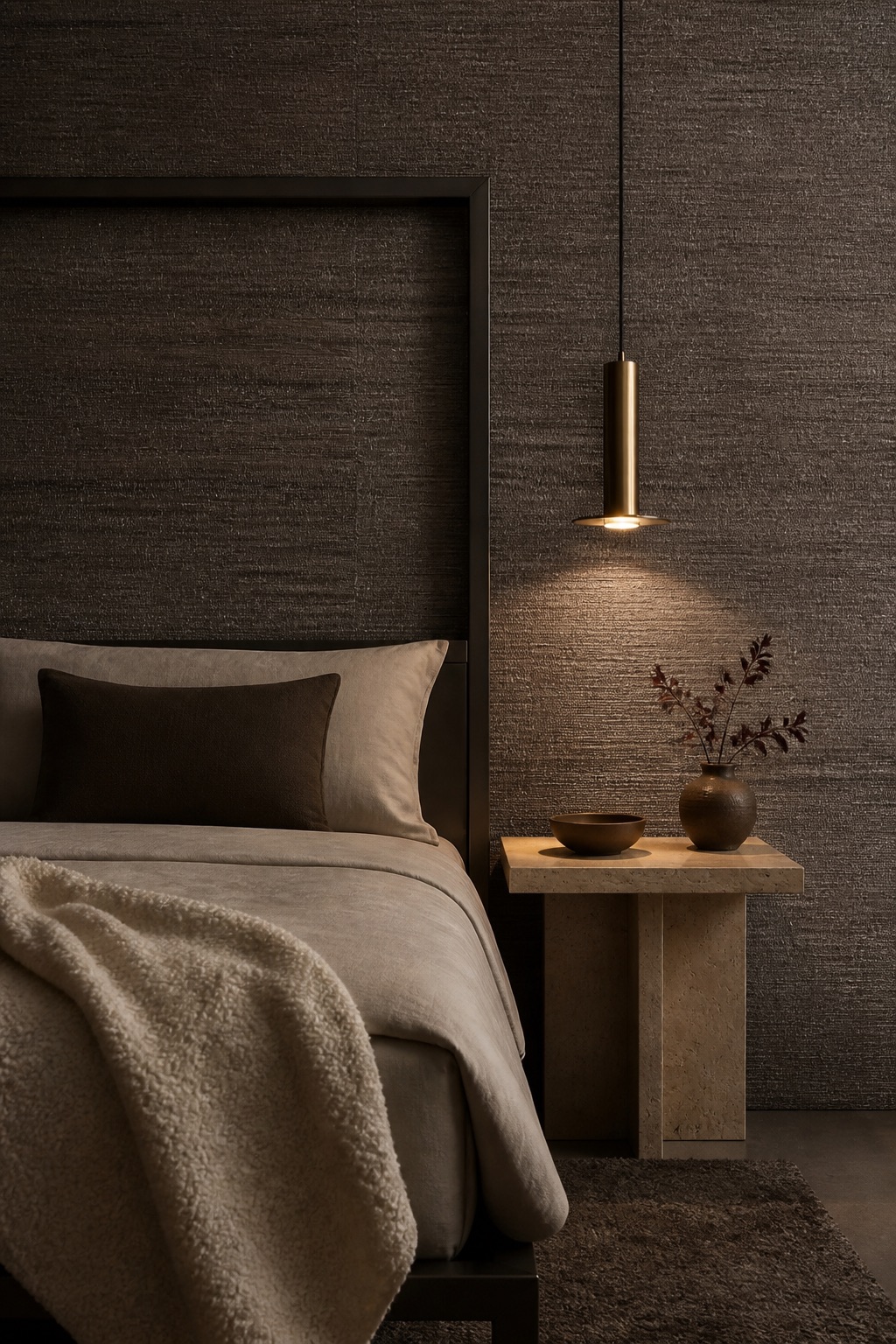
- As natural light fades and warm artificial sources take over, the taupe undertone emerges and the wall softens perceptibly, making the room feel more enclosed and considered.
- Faint light-catching filaments in the weave respond to point sources such as pendants and downlights with a trace of reflected life, distinguishing the surface from painted plaster without reading as metallic.
- North-facing and low-light rooms are well served by this tone: the warmth counteracts cool grey ambient light and prevents the surface reading as flat or cold.
- Raking light from a wall sconce or low pendant reveals the horizontal fibre structure in fine relief, adding spatial depth that shifts perceptibly as the light angle changes through the day.
This is a colour that earns its depth in dim conditions. Under bright midday light, Tobacco Weft reads as a rich, complex dark neutral, with the horizontal weft rows visible as texture at arm's length and as a smooth tonal field at the distances most walls are viewed from. As natural light withdraws and warm artificial sources take over, the charcoal recedes and the taupe undertone moves forward, shifting the character of the room from sober to atmospheric. The faint light-catching filaments woven through the reed respond to pendant and downlight sources as very subtle glints, giving the surface a living quality that painted walls cannot replicate. Specify this dark brown grasscloth wallpaper on the wall that receives raking light from your primary fixture and it will perform at its most architectural.
The Horizontal Register: What Tight Weft Rows Do to a Room's Proportions
- Tight horizontal weft rows create a consistent linear register across the entire wall face, reinforcing the horizontal datum and making a room read as wider and lower.
- Medium texture scale means the rows are visible up close as genuine surface relief but dissolve into a coherent tonal field at reading distance.
- Occasional slub lines (natural irregularity in the reed fibre) vary the weft rhythm without disrupting the overall horizontal direction, preserving a sense of organic honesty.
- The flat-pressed fibre construction keeps the surface profile low, suitable for high-traffic corridors where a pronounced raised texture could catch and snag.
- Reverse-hang installation (alternating roll orientation drop by drop) is recommended to minimise tonal banding at seams, which reads more visibly on densely coloured grasscloth than on pale naturals.
The defining characteristic of this grasscloth is structural rather than decorative: a plain weave of tight horizontal reed rows that resolves at wall scale into a coherent, low-key field rather than a graphic pattern. Where geometric or herringbone weaves assert themselves as design statements, Tobacco Weft recedes into the architecture, making its mark through depth and warmth rather than visual complexity. The horizontal register subtly lowers ceilings and widens rooms, a useful effect in narrow hotel corridors or tall-ceilinged private dining rooms where a vertical or neutral surface texture would leave the proportions unchallenged. Installers should plan seam placement carefully on densely coloured grasscloth, since tonal variation between rolls is inherent to natural-fibre dyeing; working from a single dye lot and reversing alternate drops produces the most consistent result.
Hotel Suites, Private Studies, and Dining Rooms: Where Dark Brown Grasscloth Wallpaper Performs Best
- Hotel suite bedheads and feature walls: the warm dark tone creates the cocoon quality that hospitality specification teams consistently seek for premium-tier rooms.
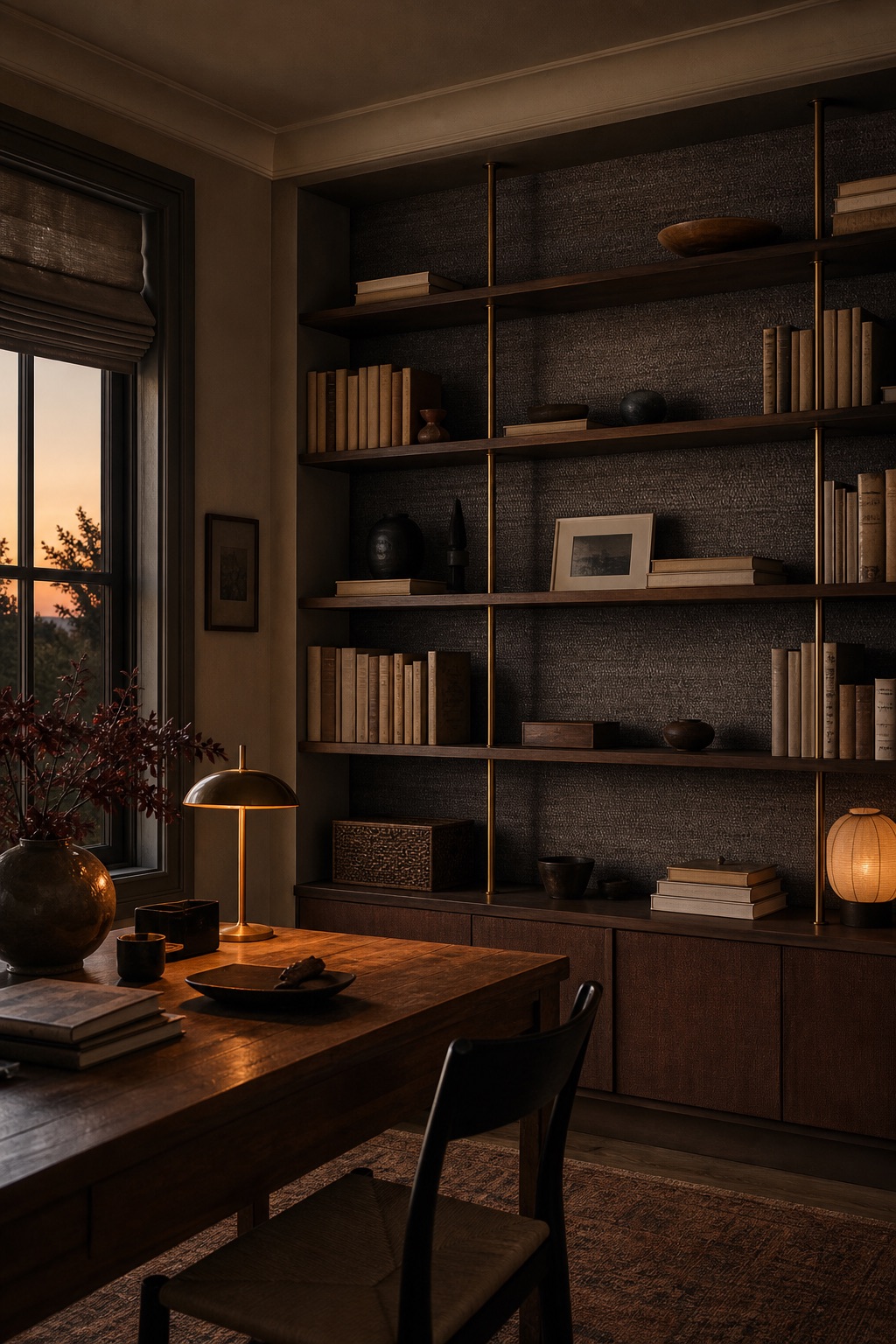
- Private studies and home libraries: the colour reads as serious and grounded without being oppressive, supporting focused, retreat-like environments.
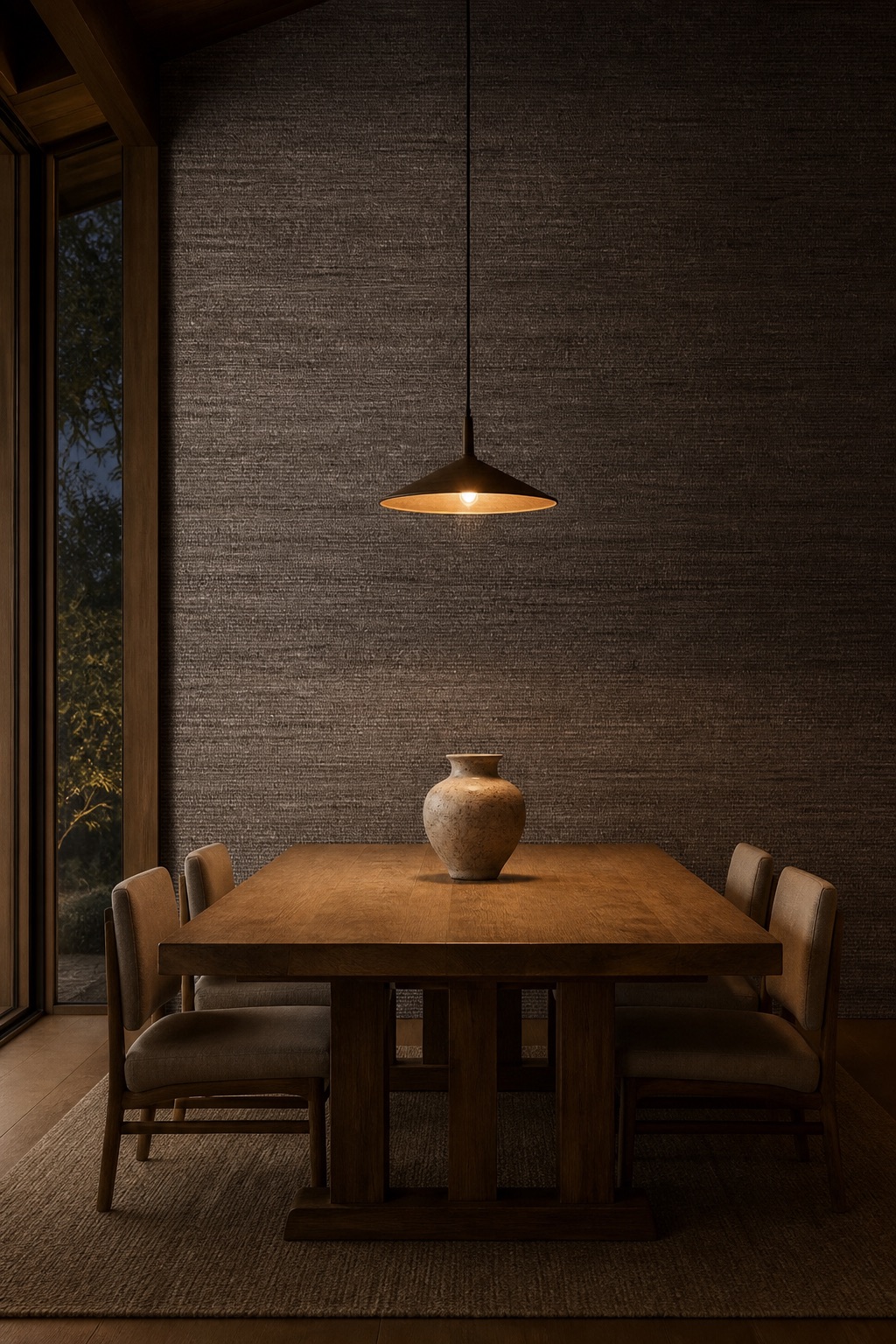
- Atmospheric dining rooms: dark brown grasscloth on the primary view wall or behind a dining banquette deepens the evening character of the room.
- Japandi and wabi-sabi interiors: the organic irregular fibre, the warm charcoal, and the flat-pressed natural reed are genuine material credentials for both design languages.
- Avoid high-humidity environments such as bathrooms and kitchen splashback zones; natural reed responds to sustained moisture with fibre swelling and possible backing delamination.
Tobacco Weft performs best in rooms designed around evening use or in spaces where a sense of retreat is the primary brief. Hotel suite bedrooms, private studies, and dining rooms with considered lighting plans are the contexts that consistently produce strong results, spaces where the colour's warmth activates fully and the horizontal surface texture reads as material richness rather than surface noise. For japandi and wabi-sabi projects, the coarse flat-pressed reed and the organic irregularity of the slub lines are authentic material properties, not stylistic approximations. Commercial hospitality installations can proceed with standard roll dimensions of 0.915 m × 5.5 m per roll, supplied from 50 rolls (≈250 m²) minimum.
Reed Fibre, Humidity, and What to Expect Over the Life of the Wallcovering
- Natural reed grasscloth is hygroscopic: it will expand slightly in high humidity and contract in dry conditions; this is normal material behaviour and not a defect.
- Stable performance is typically achieved in the 40–65% RH range; sustained exposure above this threshold risks backing delamination and fibre distortion over time.
- Spot cleaning with a dry or barely damp cloth is appropriate for surface dust; solvent cleaners and abrasive products will damage the fibre and should not be used.
- Colour fading under direct UV exposure is a known characteristic of naturally dyed grasscloth; UV-filtering glazing significantly extends colour life in sun-facing rooms.
- Grasscloth wallcovering cannot be repaired patch-for-patch once installed; ordering a modest overage (typically 10–15%) from the same dye lot provides matching stock for future repairs.
Reed grasscloth is a natural, minimally processed material and its performance over time reflects that character. The fibres absorb and release atmospheric moisture, which means micro-movement in the surface is expected across seasons and is not a sign of installation failure. For hotel and commercial applications, maintaining consistent HVAC humidity control during and after installation produces the best long-term result. Staining is the most common source of premature ageing: oil or ink on natural fibre leaves a mark that cannot be fully removed, so specifying this surface on a wall protected from direct contact is good practice. Further detail on maintenance protocols is in our guide on [caring for grasscloth](/guides/clean-grasscloth).
The Working Process: Samples, Studio Proofing, and Batch Consistency
- Physical sample books are available to trade specifiers; the cost is credited against qualifying orders up to 10% of order value.
- Custom colourway proofing is quoted before work begins, typically one to two weeks, with the proofing cost confirmed in writing before production starts.
- Once a proof is approved, production at partner mills runs approximately one month, with ocean freight quoted and scheduled separately.
- Every production batch ships with a per-batch lot certificate confirming dye-lot identity; single dye-lot policy ensures no colour shift across panels mid-project.
- Three full-time in-house designers at the Chengdu studio translate client colour references and mood boards into precise CAD specifications for mill production.
- The founder has operated in the natural wallcovering trade since 2018; the current trading and design-studio structure was established in 2023.
Specifying Tobacco Weft follows the same structured sequence as any Grasscloths order. A physical sample book lets you verify the colour and surface in your actual project lighting before committing, and its cost is credited back against the order. If the shade is close but not exactly right, our design studio engineers custom colourways from your reference, working with the same horizontal reed construction and specifying the dye precisely for the partner mill. Paid proofing is confirmed in writing before work begins, production runs approximately one month, and every batch ships with a lot certificate so the contractor and architect can verify dye-lot continuity across the full installation. Full commercial terms (payment terms, FOB, CIF, and DDP options) are set out on our [process and FAQ page](/faq).
Buying grasscloth for a project or a brand?
- Minimum order
- 50 rolls (about 250 m²) catalog · 100 rolls custom / private label
- Lead time
- 4–6 weeks standard · 5–8 weeks specialty, after sample approval and payment
- Terms
- EXW Chengdu · FOB, CIF, DDP on request
- Samples
- Free digital kit in 24 h · paid swatch pack, credited in full on your first order
- Reply
- Within 24 hours
Frequently asked
- Will the dark brown colour fade noticeably in a room with large south-facing windows?
- All naturally dyed grasscloth is susceptible to UV fading over extended sun exposure. In rooms with direct sustained sunlight, a UV-filtering window film or solar-control glazing will significantly slow any colour shift. We recommend viewing a physical sample in the actual space during peak sunlight conditions before committing; our guide on [fading prevention](/guides/fading-prevention) covers the practical mitigation options.
- How visible will the seams be on this horizontal weave?
- Because the weft rows run horizontally across each panel, vertical seams cross the weave direction and are more perceptible than on a basket or herringbone construction. Reverse-hang installation (alternating the roll orientation drop by drop) minimises tonal variation at the join. An experienced grasscloth installer will also plan seam placement to fall away from primary sight lines and direct light sources.
- Can dark brown grasscloth work in a powder room or a humid corridor?
- A naturally ventilated powder room with no direct water splash is workable, though sustained humidity above roughly 65% RH risks fibre movement and backing stress over time. Wet zones should be avoided entirely. Our [humidity risks guide](/guides/humidity-risks) sets out the threshold conditions and what to consider if a project approaches those limits.
- The tone is almost right but we need something slightly warmer and richer — can a custom colourway be produced?
- Yes. The in-house design studio works from client colour references (paint chips, fabric swatches, or Pantone references) and specifies a custom dye for the same horizontal reed construction. A paid proof is produced and approved before the full production run proceeds; minimum volume of 50 rolls (≈250 m²) applies.
- What are the minimum order quantity and typical lead time for a commercial project?
- Full details are on our [process and FAQ page](/faq); in brief, grasscloth runs from 50 rolls (approximately 250 m² at 0.915 m × 5.5 m per roll), with production approximately one month at the partner mill plus ocean freight scheduled separately.