White Paperweave Wallcovering
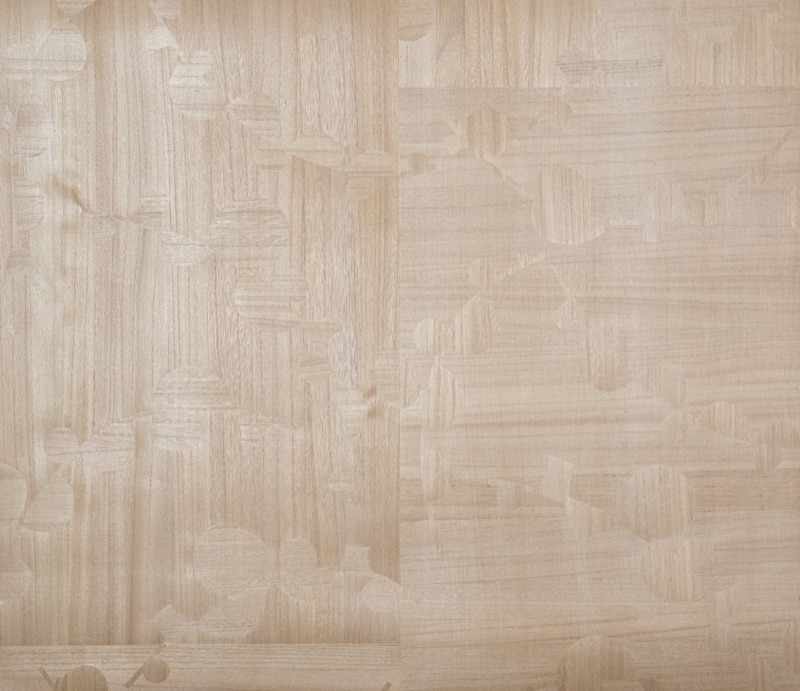
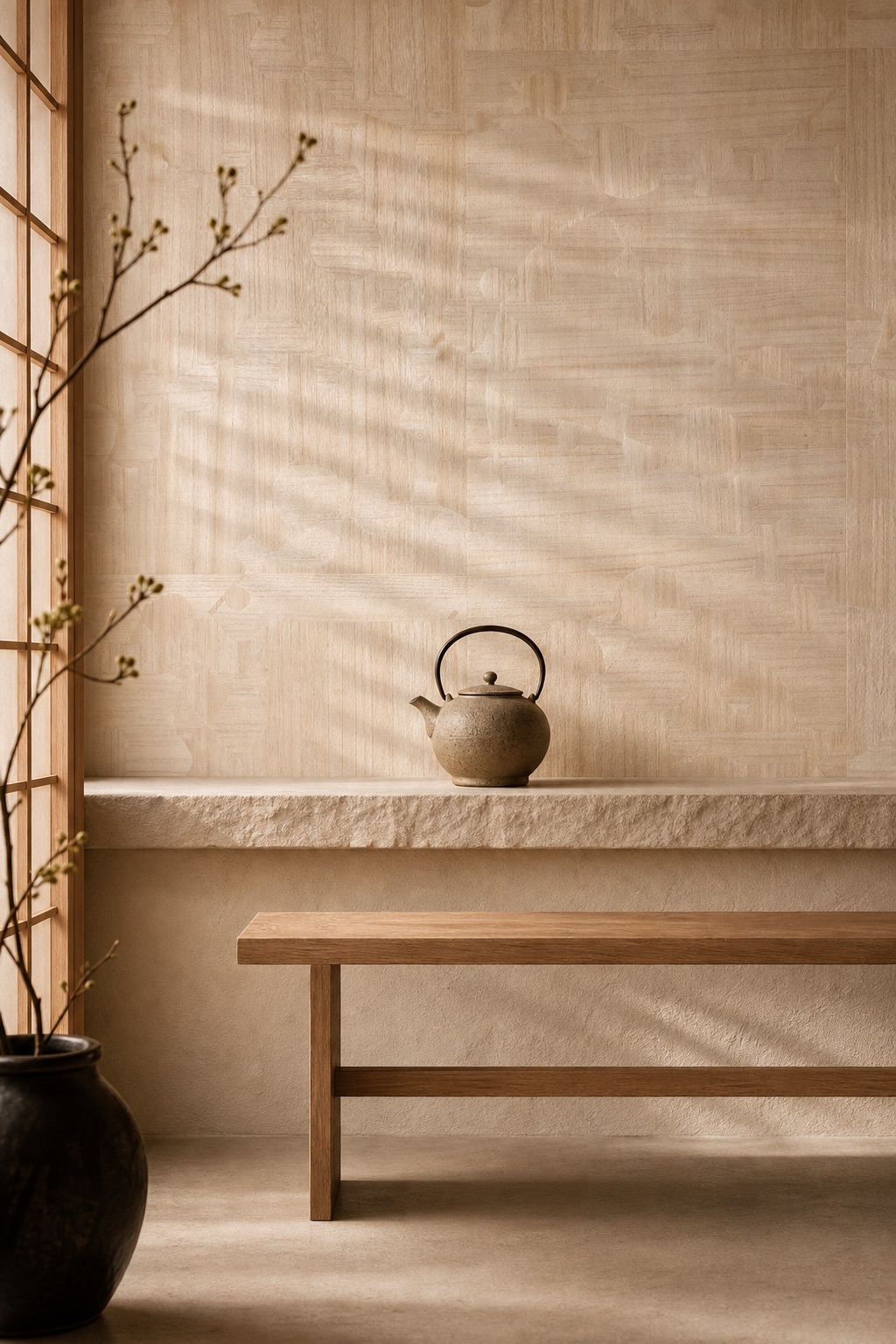
Ivory Parquet is a pale cream paperweave wallcovering built around a parquet block structure: rectangular patches of finely packed paper fibres laid in alternating orientations, so adjacent blocks catch ambient light at opposing angles and produce a quiet tonal mosaic across the wall. The surface is fully matte, warm in undertone, and restrained enough in pattern to anchor a Japandi, minimal, or wabi-sabi scheme without competing with furniture or textiles. Produced with partner mills to in-house studio specifications, this white paperweave wallcovering is supplied to interior designers and trade buyers from 50 rolls, with custom colourways available from the same minimum quantity.
Parquet Block Construction: How Alternating Fibre Orientation Shapes the Surface
- Each block is composed of finely packed paper fibres lying flat and parallel in the same horizontal direction; the adjacent block rotates 90 degrees, reversing the fibre direction.
- This alternation generates the tonal variation between patches: fibres at different orientations reflect ambient light at slightly different angles, producing a mosaic of pale cream and warm ivory without any change in dye.
- Block edges are clean and straight, giving the pattern a precise, considered quality without appearing mechanical or printed.
- At close range, individual paper strips and their fine flat texture are visible; at normal room-viewing distance, the surface resolves into an even, restrained geometric field.
- The medium block scale reads clearly on walls of all proportions without overpowering companion materials or architectural detail.
- The fully matte finish carries no specular glare across large wall areas, so the colour reads consistently from any viewing angle.
Each block in this pattern is composed of finely packed paper fibres lying flat and parallel in the same direction. Rotate 90 degrees to the next block and the fibre direction reverses: this alternation is what generates the tonal shift between patches, because fibres at different orientations reflect ambient light at slightly different angles. The joins between blocks sit at clean straight edges, giving the mosaic a graphic precision without appearing mechanical or printed. At close range, individual paper strips are visible; at normal room-viewing distance, the surface resolves into an even, restrained geometric field. The medium block scale means the pattern reads clearly on a three-metre wall without competing with furniture or other material layers.
Pale Cream Through the Day: Undertone Behaviour from Morning to Evening
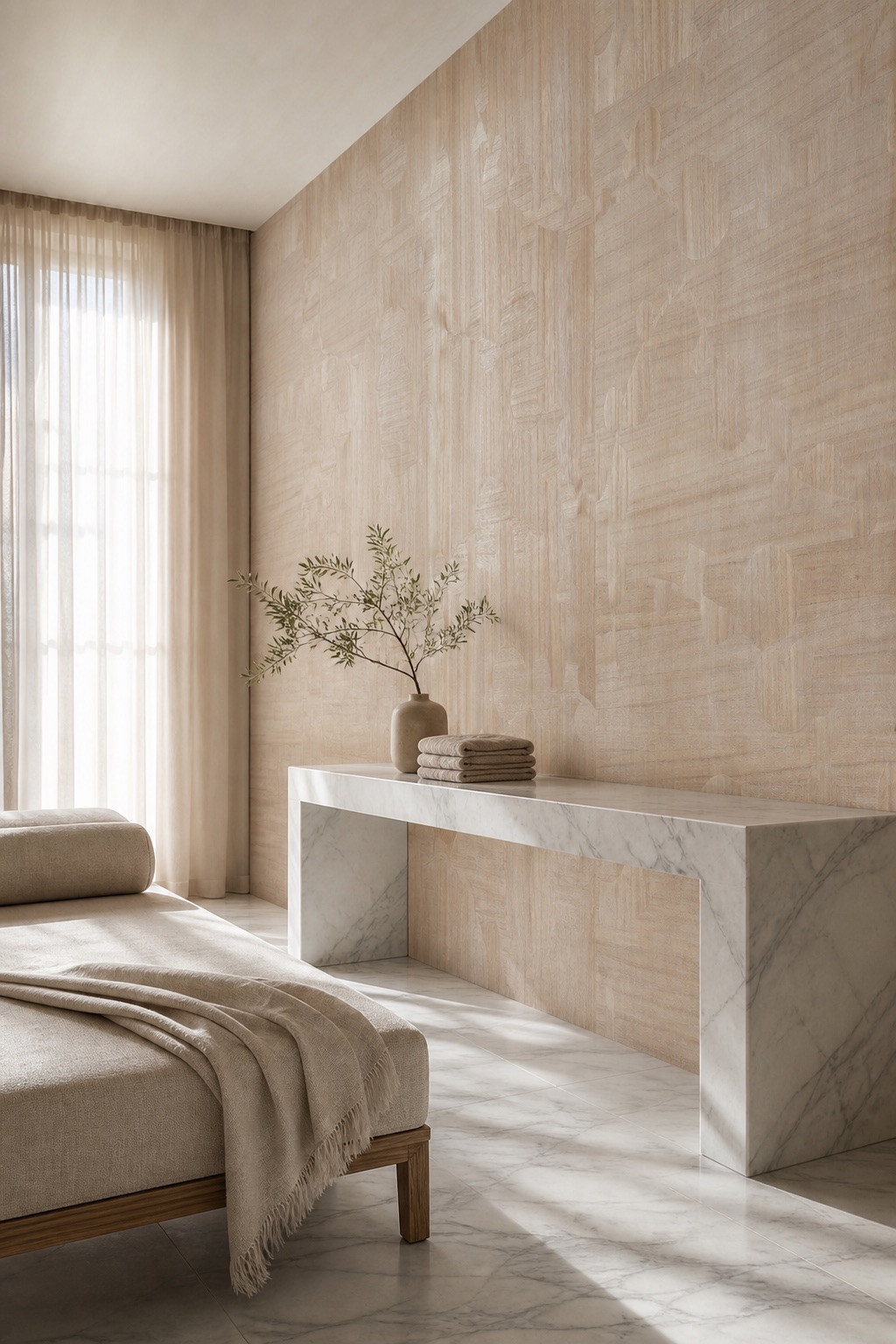
- Under cool northern daylight, the pale cream and linen registers are most prominent, reading as fresh and neutral.
- In warm afternoon or incandescent light, the same surface draws out a softer parchment quality, perceptibly creamier without any chromatic shift in the material.
- The fully matte finish means no specular component: colour reads consistently across wide wall areas regardless of viewing angle.
- Under raking sidelight, the tonal contrast between alternating blocks increases noticeably, adding quiet depth to the surface.
- In evening lamp conditions the block mosaic partially recedes, the wall reading as an even warm field.
- Pairs naturally with materials that share its warmth band: travertine, raw or limed oak, unbleached linen, rough plaster, and ivory or natural bouclé.
The warm ivory base of this white paperweave wallcovering responds distinctly to different light temperatures. Under cool northern daylight, the pale cream and linen registers are most prominent, reading as fresh and neutral. As afternoon or tungsten light warms the room, the same surface draws out a softer parchment quality, perceptibly creamier without any chromatic shift in the material. Because the finish is fully matte, there is no specular component: the colour reads consistently across wide wall areas at any viewing angle. The slight tonal difference between alternating blocks becomes more readable under raking sidelight, adding quiet depth. In evening settings lit by warm lamps, the block mosaic partially recedes and the surface reads as an even warm field.
Specifying White Paperweave Wallcovering: Room Applications and Companion Materials
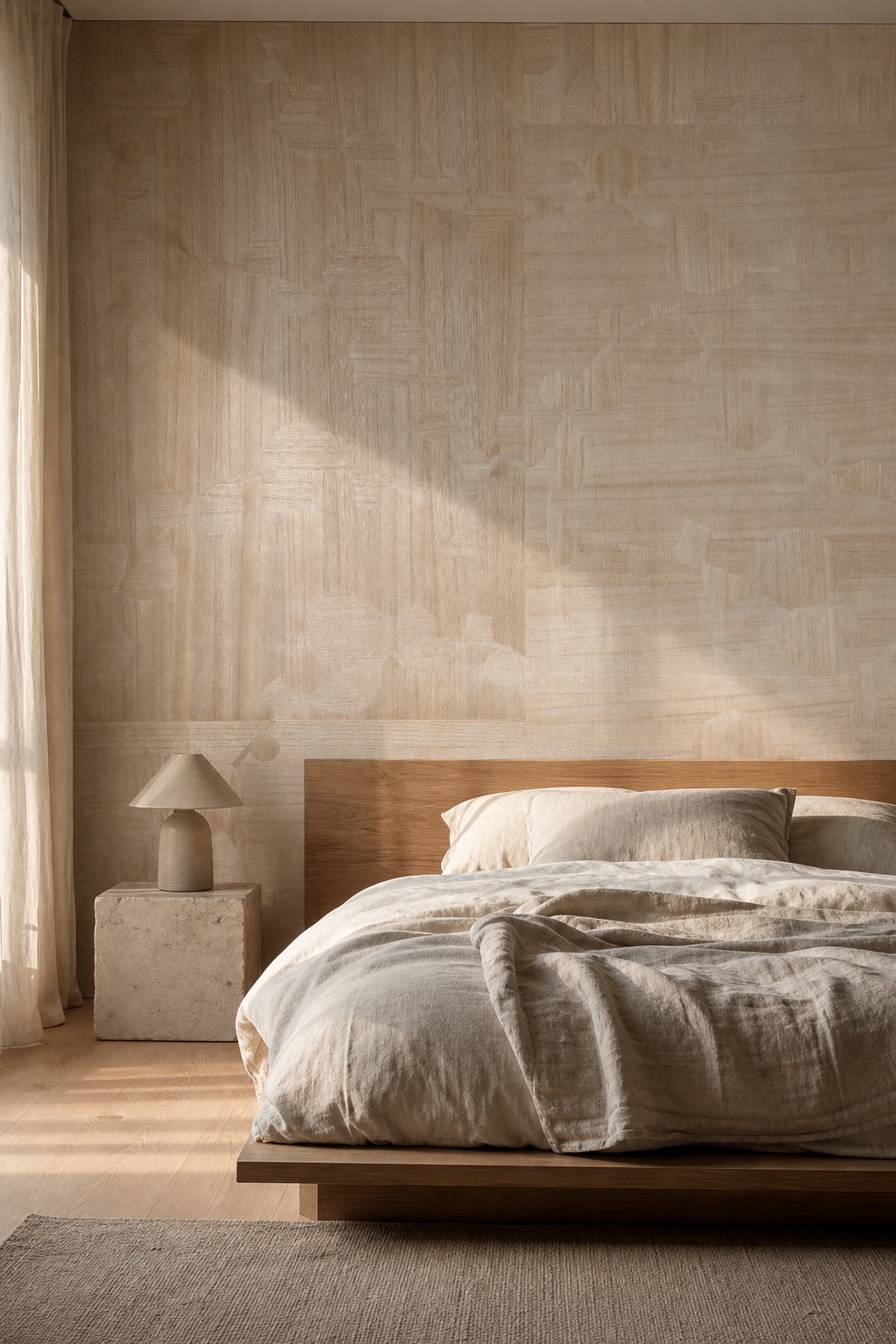
- Performs well in hotel suite bedrooms as a full-height wrap, creating a restrained backdrop that lets furniture, lighting, and textiles advance.
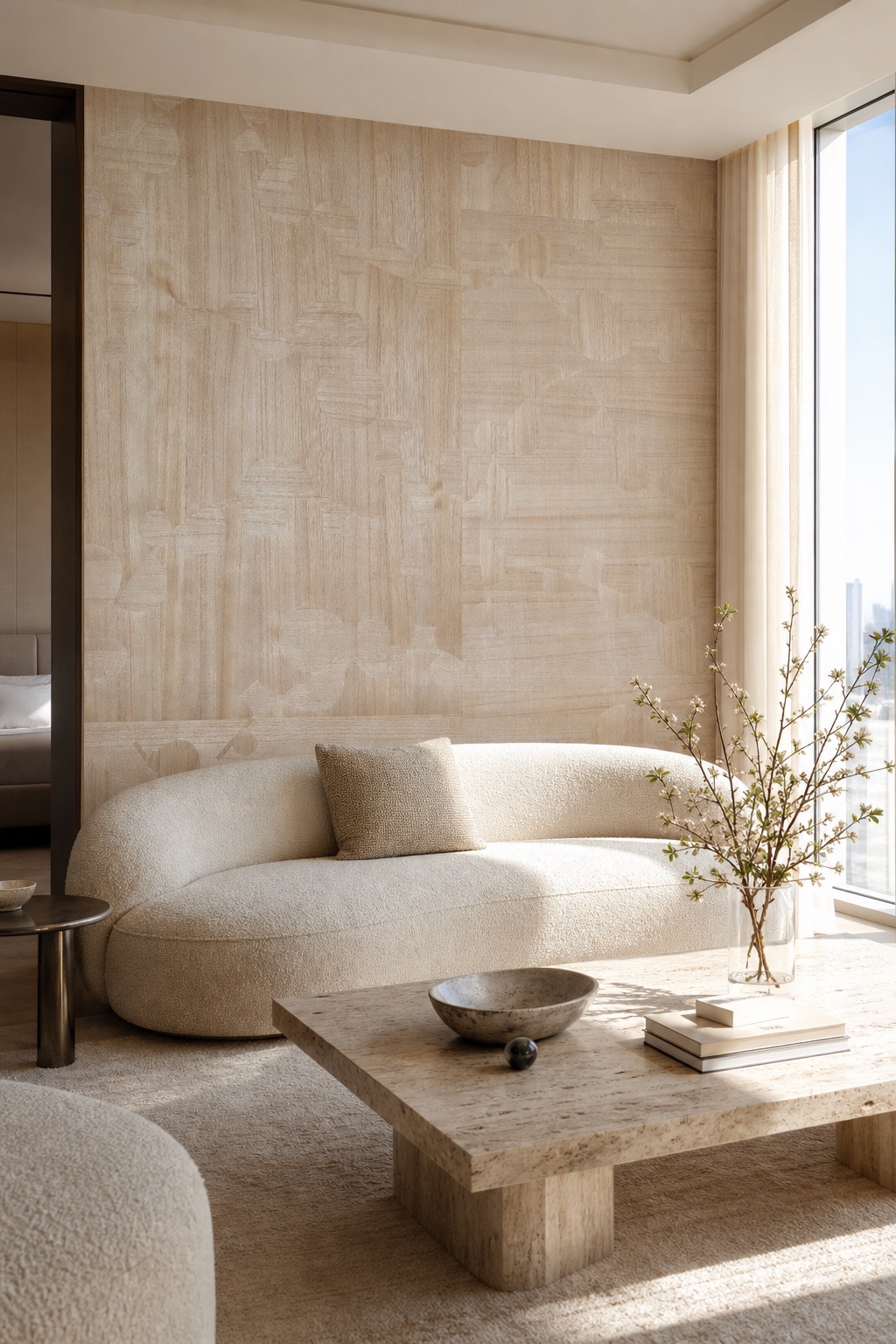
- Spa reception areas and wellness corridors benefit from the way the pale ground integrates with stone, linen, and organic material without competing for attention.
- The parquet block texture gives a Japandi or wabi-sabi scheme enough surface interest to feel resolved rather than sparse.
- For residential bedrooms, the colour and texture scale work on all four walls as well as on a single feature wall behind the bed.
- Not recommended for high-humidity environments such as bathrooms or wet-rooms without appropriate vapour-management preparation.
- Natural companion materials: travertine, raw or limed oak, unbleached linen, rough plaster, and ivory or natural-toned bouclé.
The matte, warm-neutral surface is particularly effective in spaces where calm is the primary design outcome. In hotel suite bedrooms, a full-height application of Ivory Parquet creates a restrained backdrop that lets the furniture, lighting, and textile layers advance. Spa reception areas and wellness corridors benefit from the way its pale ground integrates with stone, linen, and organic material without competing for attention. The parquet block texture introduces enough surface interest for a Japandi or wabi-sabi scheme to feel resolved rather than sparse. For residential bedrooms, the colour and texture scale work on all four walls as well as on a single feature wall behind the bed. Love this weave but need your own colour or scale? Our design studio engineers custom colourways from your reference, produced with our partner mills from 50 rolls.
Installation Notes for Natural Paperweave: Seams, Adhesive, and Humidity
- Professional installation is required; an installer experienced with natural-fibre wallcoverings will understand paper substrate behaviour.
- Seam placement: trim panel edges so block boundaries (not mid-block) fall at each join, maintaining mosaic continuity across the full wall.
- Paste-the-wall technique is recommended; over-wetting the back of paper-based wallcoverings can cause the substrate to expand unevenly.
- The pale cream ground is sensitive to adhesive bleed-through at seams; use a light, appropriate-weight adhesive applied evenly to the wall surface.
- Roll dimensions: 0.915 m x 5.5 m (approximately 5 m² per roll); all rolls in a single production order are drawn from the same dye lot.
- Paperweave performs best in well-ventilated rooms at standard indoor humidity; prolonged moisture exposure is not suitable for this material.
Paperweave wallcovering requires a professional installer experienced with natural-fibre materials. Because the parquet block structure has a directional grain, seam edges should be trimmed so that block boundaries (not mid-block) fall at each join, keeping the mosaic visually continuous across the full wall. Paste-the-wall technique is recommended: over-wetting the back of paper-based wallcoverings can cause the substrate to expand unevenly. The pale cream ground is sensitive to adhesive bleed-through at seams, so a light, appropriate-weight adhesive applied evenly to the wall surface is preferred. Standard roll dimensions are 0.915 m x 5.5 m (approximately 5 m² per roll); all rolls in a single production order are drawn from the same dye lot. Paperweave performs best in well-ventilated rooms at typical indoor humidity; prolonged exposure to moisture is not suitable.
From Sample to Final Batch: The Grasscloths Working Process for Natural Paperweave
- Physical sample books are available on request; the cost is credited against a subsequent production order.
- Once a sample is confirmed, a paid proof is quoted and produced from the actual batch before any full production run begins.
- All rolls in a single production run are drawn from the same dye lot, with a lot certificate issued for each batch.
- Three full-time in-house designers handle custom colourway development: they translate mood boards, paint chips, or material samples into CAD specifications coordinated with partner mills.
- Standard production lead time is 4 to 6 weeks; ocean freight is quoted separately and is at the buyer's cost.
- Our founder has been working in the natural wallcovering supply chain since 2018, with a consistent focus on batch reliability and transparent lead times.
Our process is designed to let specifiers verify the material in their project conditions before committing to a full order. Physical sample books are available on request, with the cost credited against a subsequent order. Once a sample is confirmed, a paid proof is quoted and produced before any production run begins, giving you a pre-production reference from the actual batch. All rolls in a single run are drawn from the same dye lot, and each batch is accompanied by a lot certificate for your records. Three full-time in-house designers manage custom colourway development: they translate mood boards, paint chips, or material references into CAD specifications and coordinate production with our partner mills. Standard production is 4 to 6 weeks; ocean freight is quoted separately and is at the buyer's cost. Our founder has been working in the natural wallcovering supply chain since 2018, with a consistent focus on batch consistency and lead-time transparency.
Buying paperweave for a project or a brand?
- Minimum order
- 50 rolls (about 250 m²) catalog · 100 rolls custom / private label
- Lead time
- 4–6 weeks standard · 5–8 weeks specialty, after sample approval and payment
- Terms
- EXW Chengdu · FOB, CIF, DDP on request
- Samples
- Free digital kit in 24 h · paid swatch pack, credited in full on your first order
- Reply
- Within 24 hours
Frequently asked
- Will pale cream paperweave show fading or yellowing over time?
- Paper fibre is sensitive to prolonged direct UV exposure. In rooms with strong direct sunlight, UV-filtering glass significantly extends the life of the pale ground. Indirect or diffused light environments such as hotel corridors, interior bedrooms, and spa areas carry lower risk for this colourway, and we can supply reference swatches to support fade assessment in your specific project conditions.
- How should seams be managed so the parquet block pattern remains visually continuous?
- Because adjacent blocks have alternating fibre directions, panel edges should be trimmed so that block boundaries (not mid-block) fall at each seam. A professional installer familiar with natural-fibre wallcoverings will confirm the correct drop and alignment before hanging the first panel. Requesting a sample to verify the block scale against your planned panel width before specifying is strongly recommended.
- Is white paperweave wallcovering suitable for bathrooms or high-humidity rooms?
- Paper fibre is moisture-sensitive and is not recommended for bathrooms or wet-rooms without controlled ventilation and appropriate vapour-barrier preparation. Standard well-ventilated residential and commercial rooms at normal indoor humidity levels (typically 40 to 60 percent RH) are suitable environments for this material.
- How does Grasscloths ensure colour remains consistent across a large hotel or commercial specification?
- All rolls in a single production run are produced from the same dye lot, and a lot certificate accompanies each batch. For projects requiring multiple production runs, reference samples from the initial batch are used to verify colour continuity before subsequent runs are approved.
- What is the minimum order for a custom colourway and where can I find full ordering details?
- Custom colourways and OEM runs start from 50 rolls (approximately 250 m²); full details on sampling, proofing stages, and order terms are on our process page (/process).