Teal Grasscloth Wallpaper
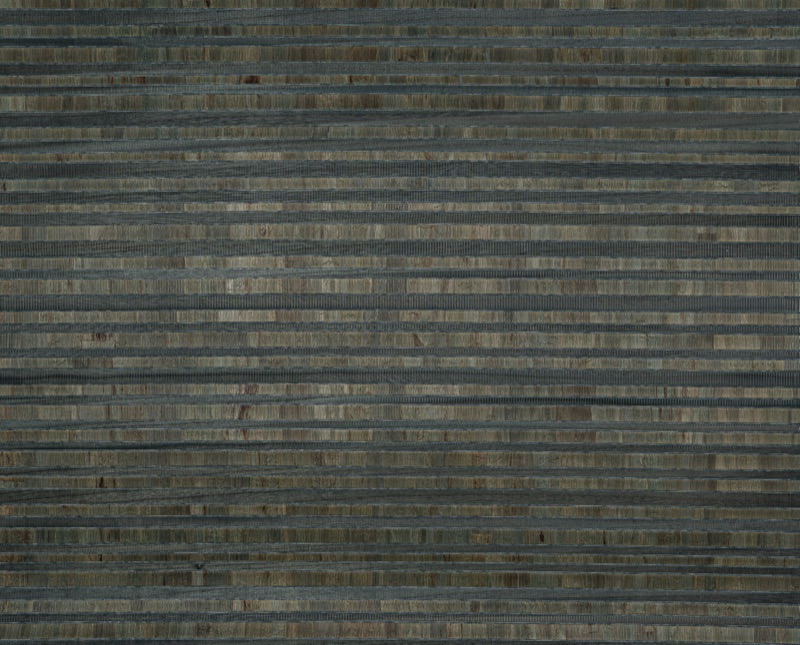
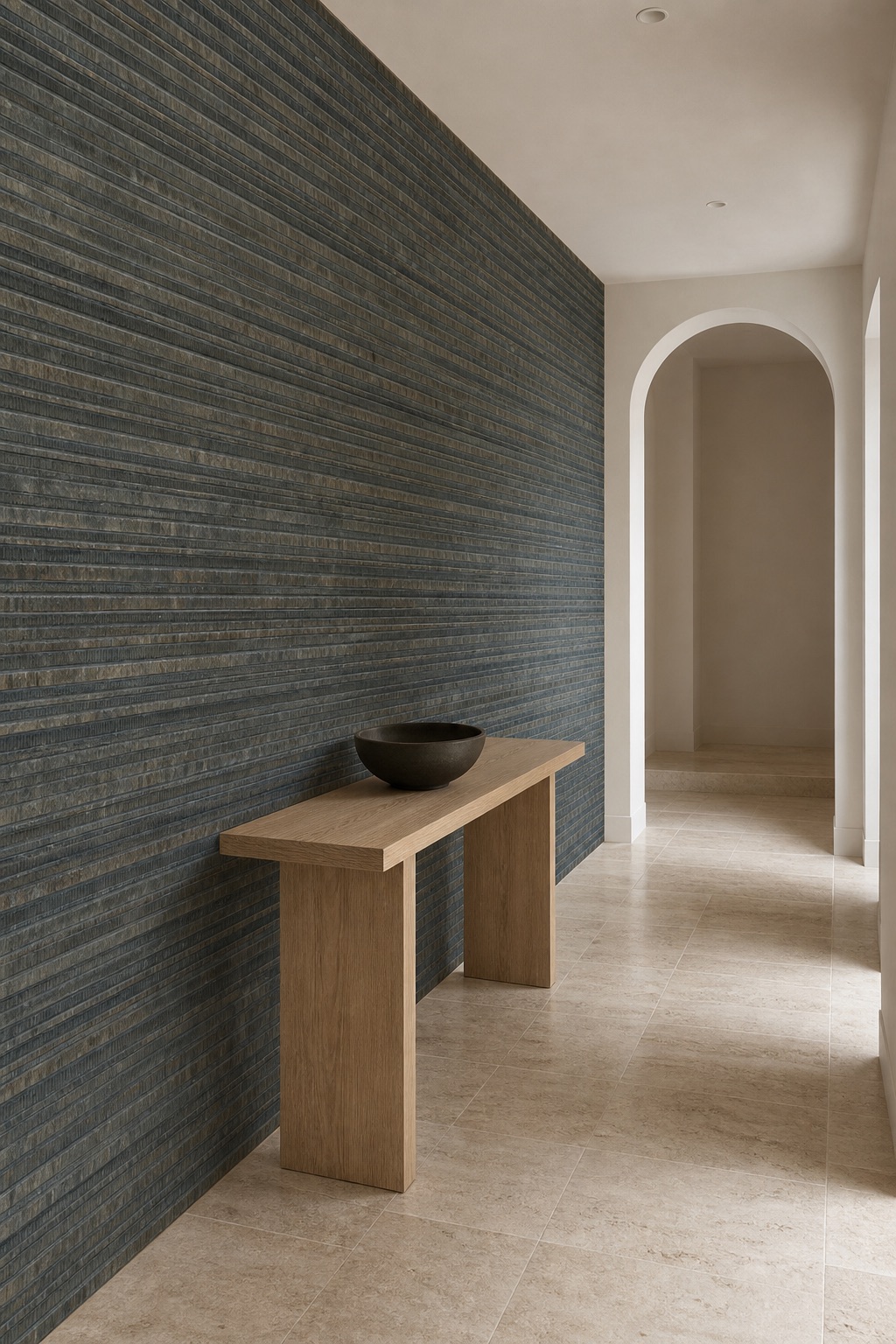
Slate Tide is a teal grasscloth wallpaper built from a precise alternating band structure: thick, dense reed rows step against narrower weft-heavy lines to produce a surface that reads as a single cool tone at distance and reveals its natural construction up close. The primary colour sits in the slate blue-grey range with warm khaki-tan reed tones woven through, giving this teal colourway a grounded, material depth rather than a flat decorative hue. Produced with our partner mills to our in-house design specifications, Slate Tide is supplied to interior designers, architects, and trade buyers from 50 rolls, making it a practical specification for hotel suites, spa corridors, and residential feature walls alike.
Alternating Band Rhythm: How Thick and Thin Reed Rows Build This Teal Grasscloth Wallpaper
- The surface alternates between wider, denser reed bands and narrower weft-heavy rows, creating a measurable horizontal stripe without any printing or dyeing.
- Individual filaments are visible within each band at close range; the colour effect is optical, generated by the interplay of slate blue-grey and warm khaki-tan fibres across the weave structure.
- At 1 to 2 metres viewing distance, the alternating registers unify into a single cool mid-tone; the two-register construction becomes apparent only at close inspection.
- The fully matte finish absorbs rather than scatters light, so the surface reads consistently under both natural daylight and artificial lighting.
- Medium texture scale means the weave reads as refined rather than rustic, appropriate for four-star and five-star hospitality specifications as well as private residential use.
What distinguishes Slate Tide from simpler grasscloth constructions is the intentional alternation of band width and density across the horizontal register. Thick reed strips, tightly packed with visible individual filaments, alternate with thinner weft-dominant rows to produce a rhythmic horizontal stripe that is structural rather than printed. This means no two rolls will be perfectly identical in fine detail, which is characteristic of natural handcrafted weave, but the banding rhythm and overall colour tone remain consistent within a single dye lot. The matte surface handles ambient light predictably, with no hot spots or sheen variation across the wall plane.
How Slate Tide's Blue-Grey Reads from Morning Daylight to Lamplight
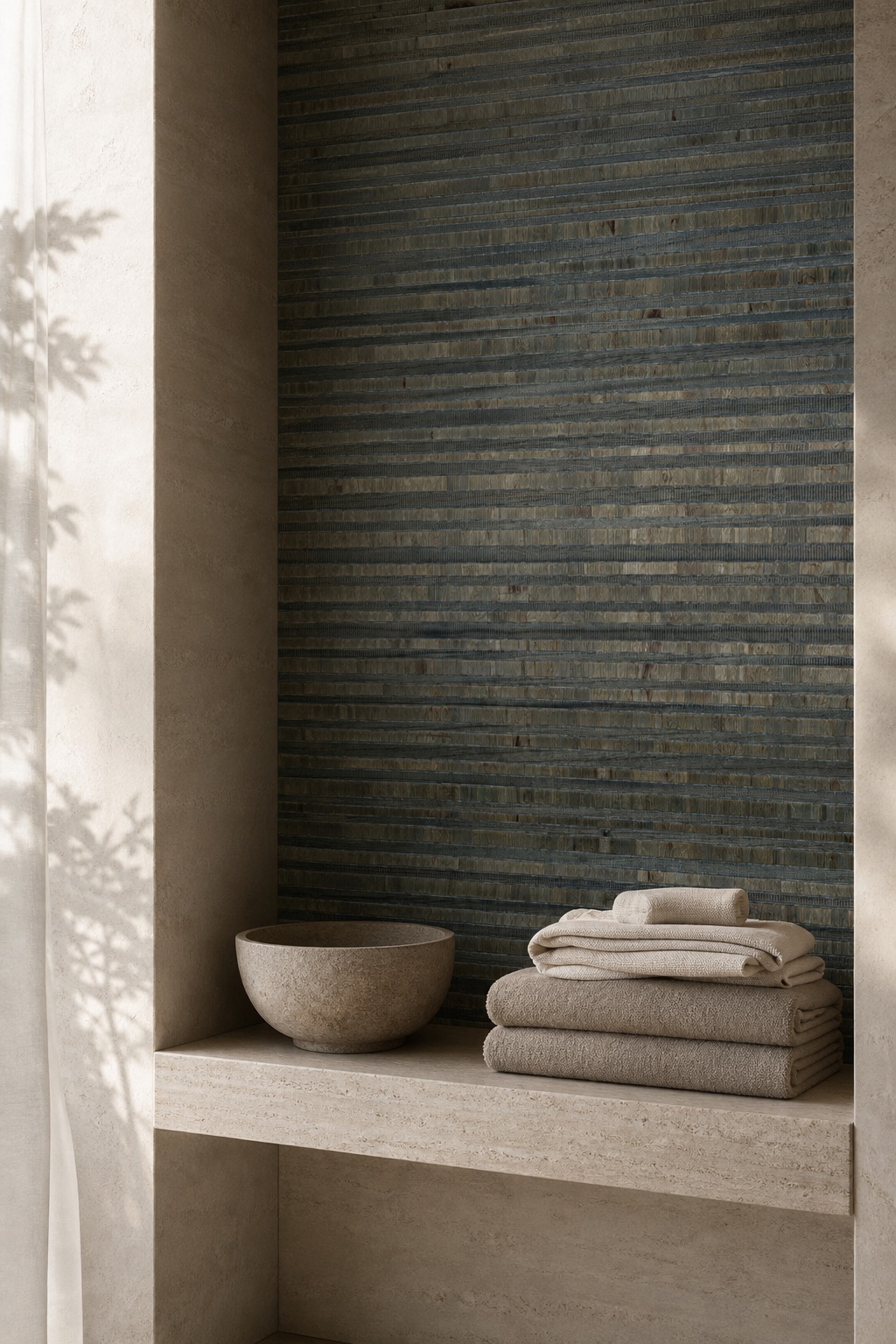
- In north or east-facing daylight, the cool undertone is most legible: the slate blue reads clearly against plaster, travertine, or white oak.
- Under western afternoon light, the warm khaki-tan secondary tones draw forward slightly, softening the overall colour temperature toward a greyed teal-green.
- Under tungsten or warm-white LED lighting, the blue recedes and the natural fibre warmth becomes more apparent, shifting the surface toward a neutral mid-tone.
- This tonal range makes Slate Tide workable across both cooler Scandinavian-influenced palettes and warmer Japandi schemes without requiring a different base material.
- The matte weave surface produces no glare or light reflection at any angle, which is an advantage in rooms with mixed or shifting light sources.
The slate blue-grey ground of this teal grasscloth wallpaper is not a fixed, paint-like colour. It shifts measurably as the angle of light and the light source change through the day. In strong northern daylight, the cool undertone dominates and the blue reads with clarity; as afternoon warmth enters from the west, the khaki-tan filaments become more visible and the overall effect softens. After dark, under warm artificial light, the surface takes on a more neutral character, the blue retreating behind the natural fibre warmth. Specifiers should review a physical sample in the actual room's lighting conditions, particularly for hospitality projects where multiple light sources are in play simultaneously.
Coastal, Japandi, and Hospitality: The Brief This Teal Grasscloth Wallpaper Answers Best
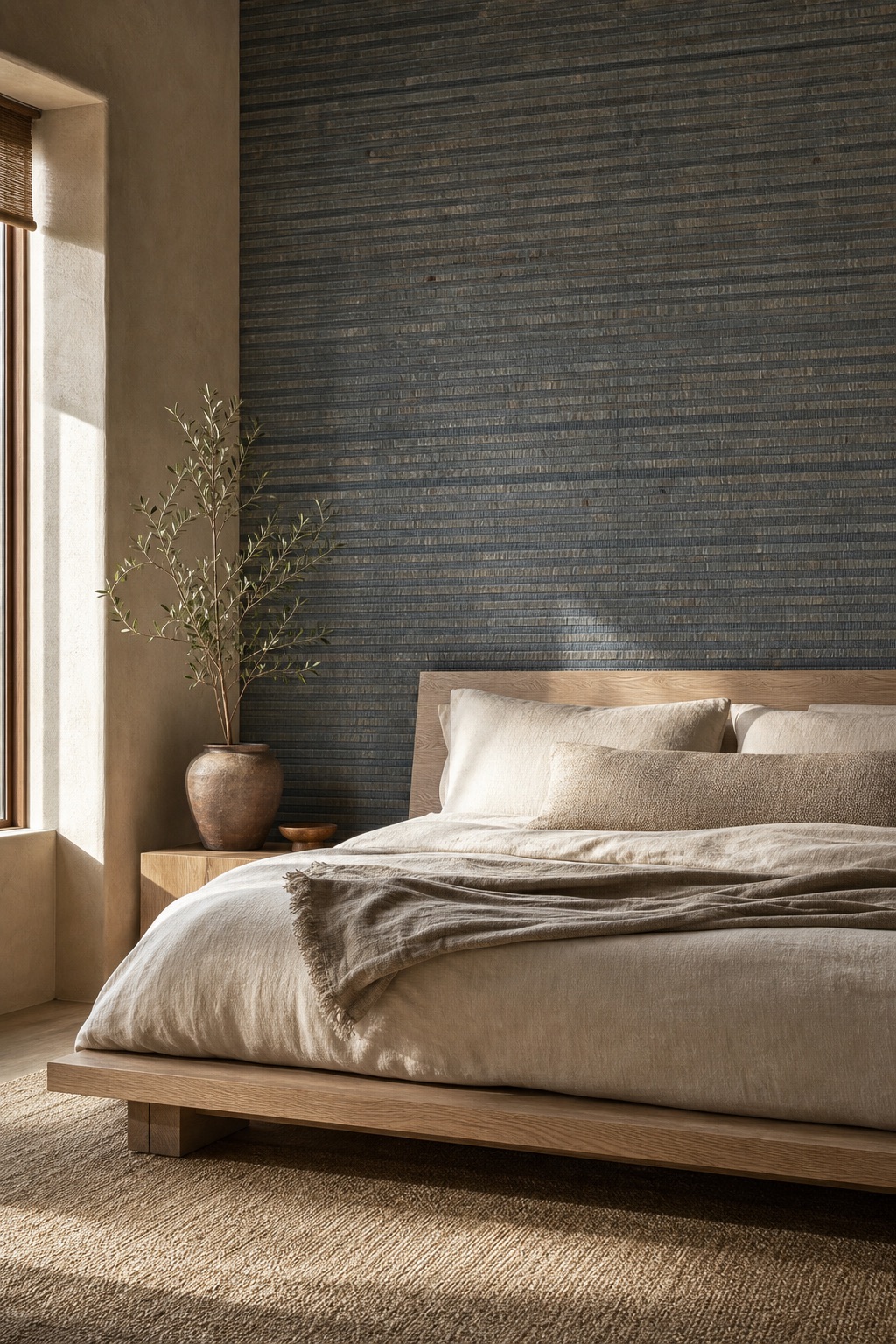
- The cool blue-grey reads as spatially recessive and calming, making it well-suited to sleeping environments, wellness spaces, and any room where reduced visual stimulation is the design goal.
- In hospitality applications, the matte reed surface contributes modest acoustic softness on feature walls and corridor runs; no quantified acoustic performance data is available or claimed.
- Coastal scheme designers find the slate-blue-meets-natural-fibre combination resolves the tension between cool coastal palettes and warm natural material references without relying on paint.
- The horizontal band rhythm reads as width-emphasising on a wall, making it particularly effective on the short end-wall of a narrow suite, corridor, or apartment entry.
- Japandi and wabi-sabi briefs are natural fits: the uneven natural filaments, the quiet alternating rhythm, and the muted teal colourway support a restrained, material-honest aesthetic.
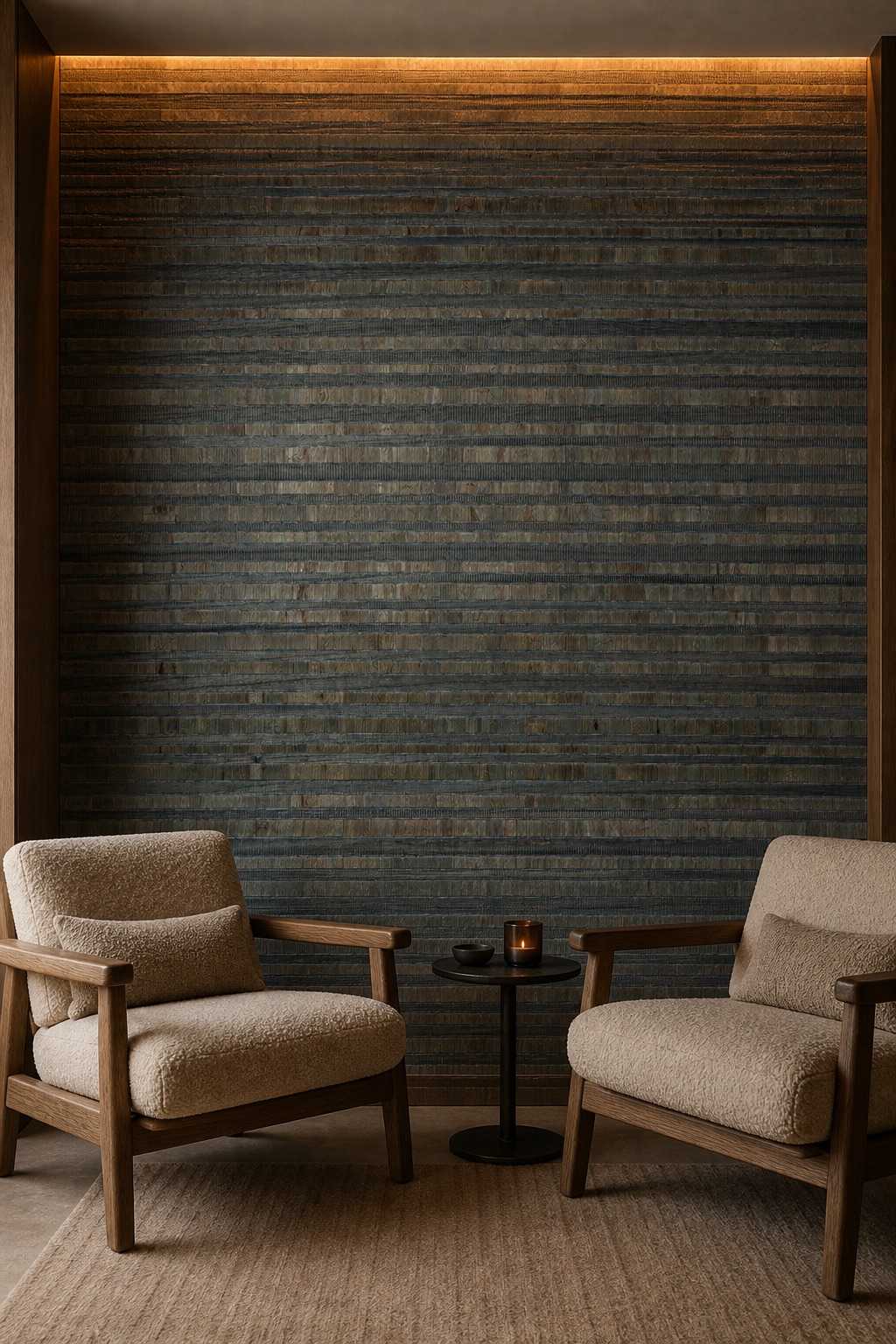
Slate Tide is at its most effective where the brief calls for a wall surface that anchors a room without dominating it. Hotel suite headwalls, spa alcove surrounds, and residential feature walls in bedrooms or sitting rooms are its primary applications. The horizontal banding encourages the eye across the wall plane, reinforcing a sense of width and calm rather than height and drama. In coastal and resort contexts, the slate blue-grey connects easily to sea, stone, and driftwood palettes without the harshness of a painted blue wall. For hospitality procurement teams, the consistent matte surface and predictable dye-lot behaviour mean this colourway photographs reliably for room imagery and holds its specification value across a multi-room project.
Roll Planning and Seam Alignment for Horizontal Reed: What Specifiers Need to Brief
- Horizontal banded weaves require precise seam planning: adjacent drops must align the band register so the horizontal rhythm continues uninterrupted across the join.
- Roll dimensions of 0.915 m wide by 5.5 m long (approximately 5 m² per roll) should be factored against ceiling height and pattern register when calculating quantity.
- A 10 to 15 percent waste allowance is prudent for horizontal pattern registration in rooms with ceiling heights above 2.8 m.
- Our design studio provides written installation guidance notes with sample orders, which can be passed directly to the installing contractor at the briefing stage.
- A professional installer with specific experience in natural grasscloth and banded-weave alignment is strongly recommended; our installation guide covers the key preparation steps.
Natural grasscloth with a defined horizontal banding pattern demands more careful planning at the estimation and installation stage than plain-weave grasscloth. The horizontal register must align across every seam, which affects waste calculation and the sequence in which drops are hung. Our standard roll of 0.915 m by 5.5 m gives approximately 5 m² per roll; for rooms with ceiling heights above 2.8 m, pattern register trimming will increase waste meaningfully. We recommend using our wallcovering calculator to arrive at a precise roll count for your project, and we include written installation notes with every sample order to support the briefing conversation with your installer.
Sampling, Proofing, and Batch Control: The Grasscloths Studio Process for This Teal Weave
- Paid sample books are available and credited against your qualifying order (up to 10% of order value).
- Paid proofing is quoted before any production commitment and typically completes in 1 to 2 weeks for standard natural-material colourways.
- Production runs 4 to 6 weeks for standard natural materials from approved sample and payment; all freight is at buyer's cost, with FOB, CIF, and DDP options available.
- Every production batch ships with a single dye-lot lot certificate, ensuring traceability for multi-phase project deliveries.
- Three in-house designers work from your colour reference or mood board to produce CAD-matched custom colourway specifications; our founder has operated in natural wallcovering supply since 2018.
Love this weave but need your own colourway? Our design studio engineers custom grasscloth colourways from your reference, whether that is a fabric swatch, a paint chip, or a digital file. The standard process begins with a paid sample book so you can review the material and dye lot in your project context. If the colourway or band scale needs to be adjusted, a paid proof stage is quoted upfront before any production commitment is made. Once a proof is approved, payment confirmed on the pro-forma invoice starts the production run. Every batch leaves with a lot certificate, giving you a documented record of the dye lot for ongoing or phased specifications. Full commercial terms, including proofing fee structure and freight options, are detailed on our process and FAQ page.
Buying grasscloth for a project or a brand?
- Minimum order
- 50 rolls (about 250 m²) catalog · 100 rolls custom / private label
- Lead time
- 4–6 weeks standard · 5–8 weeks specialty, after sample approval and payment
- Terms
- EXW Chengdu · FOB, CIF, DDP on request
- Samples
- Free digital kit in 24 h · paid swatch pack, credited in full on your first order
- Reply
- Within 24 hours
Frequently asked
- Will the teal colour in Slate Tide fade near windows?
- Natural reed fibres can shift gradually under prolonged direct UV exposure; for long-term colour stability, position Slate Tide away from unfiltered south-facing light or specify UV-filtering glazing. Our guide to fading prevention covers the practical steps for natural wallcovering installations at /guides/fading-prevention.
- How visible are seams on a wide horizontal banded weave?
- Seam visibility on a horizontal band pattern depends almost entirely on installer precision in aligning the band register across adjacent drops. An installer experienced in natural grasscloth seaming technique can keep joins tight and nearly invisible; we include written installation notes with every sample order to support that conversation.
- Is Slate Tide suitable for spa environments or hotel corridors with moderate humidity?
- Natural grasscloth performs well in controlled-humidity environments such as hotel spa corridors and ventilated suite bathrooms, but is not appropriate for wet-room or high-splash applications. Our humidity risks guide at /guides/humidity-risks provides detailed guidance for specifiers planning wellness or hospitality installations.
- Can I specify Slate Tide in a custom colourway or adjusted band scale?
- Yes. Custom colourways require a minimum order of 50 rolls (approximately 250 m²); our design studio works from your colour reference and produces a paid proof for approval before production begins. Adjustments to banding width are also possible at the proofing stage.
- What are the minimum order quantities and lead times for a trade order?
- Full details on minimum quantities, proofing fees, payment terms, and lead times are on our process and FAQ page at /faq.