Teal Bamboo Wallcovering
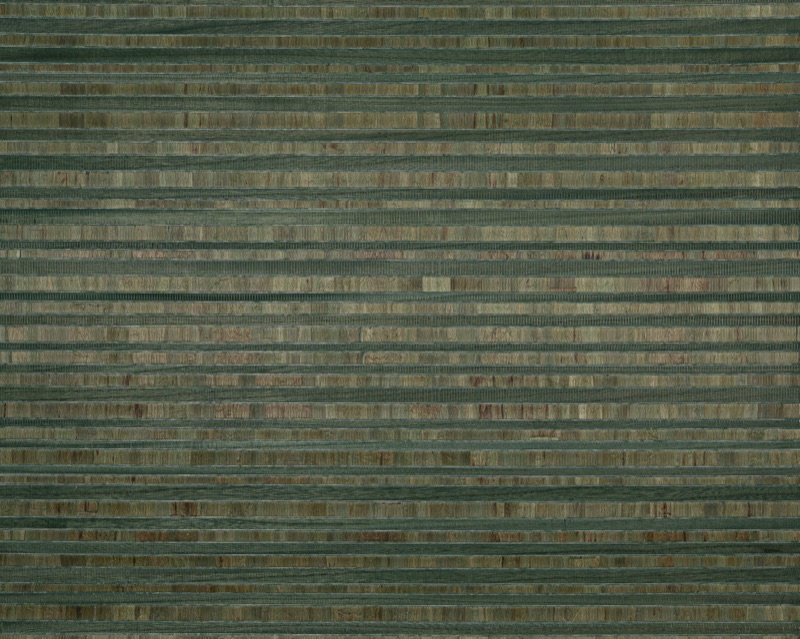
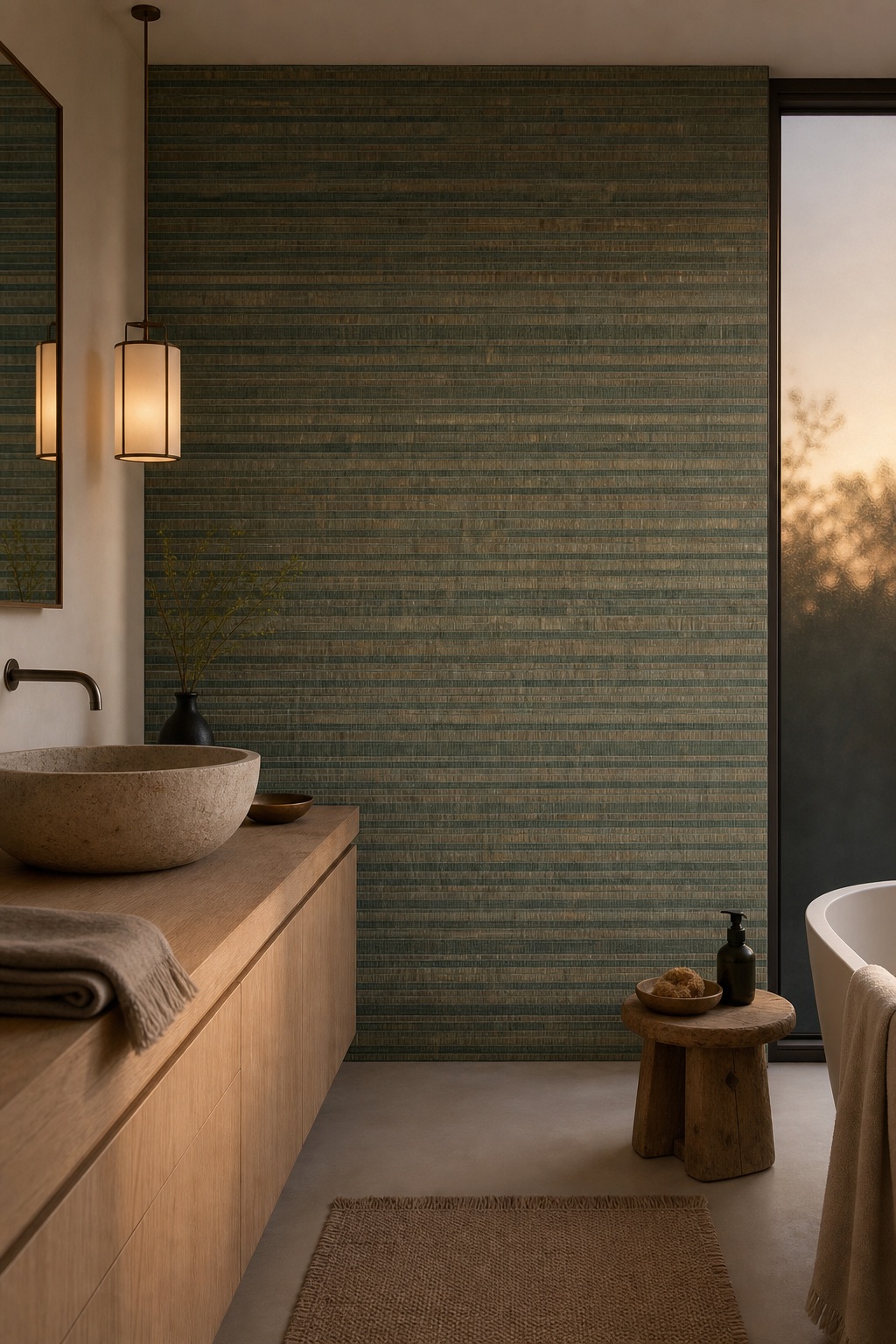
Lagoon Reed is a horizontal-banded teal bamboo wallcovering composed of wide natural-fibre strips — segmented reed in warm straw-tan — alternating with narrow rows of tightly-twisted teal yarn wefts that deliver the surface its defining cool blue-green reading. The construction is entirely matte, so the colour speaks through texture rather than sheen: at distance the wall reads as a unified muted teal; at arm's length the straw, sage, and cool-blue registers emerge distinctly from the weave. Supplied to interior designers and trade buyers from 50 rolls, it is produced with our partner mills to in-house studio specifications.
Reed Strip and Yarn Weft: What Makes This Teal Bamboo Wallcovering Distinctive
- Wide flat strips of segmented natural fibre form the primary visual band, reading warm straw-tan with occasional golden and sage variation from one strip to the next.
- Narrow rows of tightly-twisted teal yarn wefts separate each strip, providing the cool blue-green colour that governs the overall wall impression from across the room.
- The scale is bold: each combined band is clearly legible at standard viewing distance, giving a strong horizontal architectural register to any wall.
- Because the natural-fibre strips are flat and the yarn wefts are twisted-round in cross-section, raking light catches a subtle relief difference between the two elements.
- No two adjacent strips are tonally identical; the natural variation in fibre grain reads as craft rather than mechanical repeat.
The surface of Lagoon Reed is built from two distinct elements working in strict alternation. Wide flat strips of segmented natural fibre (reading warm straw-tan with occasional golden and sage undertones) form the primary band. Between each strip, a narrow row of tightly-twisted teal yarn weft provides the cool blue-green character that defines the overall colour from across the room. This two-register construction is entirely matte: neither element carries gloss or sheen, so depth comes from texture rather than reflection. At normal viewing distance the teal wefts set the overall tone; at close range the warmth and grain of the natural strips become the visual story.
Muted Teal in Moving Light: Colour Behaviour from Diffuse Daylight to Lamplight
- Under diffuse northern light Lagoon Reed reads as a flat, cool blue-green with dusty sage character; the teal wefts dominate and the straw strips recede.
- Under direct afternoon sun the straw-tan strips catch the angle and release their warmth, pulling the overall reading toward a softer sage-green.
- Under evening lamp or pendant lighting the warm straw register takes the lead; the teal recedes and the wall settles into a warm green-jade tone.
- The cool undertone prevents the surface going muddy at any light temperature; the teal always holds its clarity even when the balance shifts warm.
- Companion materials affect the reading: dark oak and blackened steel push the teal cooler, while pale linen and travertine draw the warmth from the natural strips.
- Specifiers should evaluate the physical sample under the actual lighting conditions of the target space; the shift from north daylight to warm tungsten is significant for this palette.
Because Lagoon Reed is fully matte it does not bounce light; it absorbs and shifts with it. In diffuse northern daylight the teal yarn wefts dominate and the wall reads as a calm, cool blue-green. As afternoon light rakes across the surface the flat fibre strips catch the angle and release their straw warmth, pulling the overall colour reading toward sage. Under lamp and pendant lighting the straw-tan component becomes the lead voice; the teal recedes and the wall settles into a warm green-jade that reads very differently from its daytime self. This behaviour is a feature, not a liability: the surface changes register through the day without feeling restless or unpredictable.
A Wallcovering That Earns Its Place: Living Rooms, Spa Walls, and Hospitality Suites
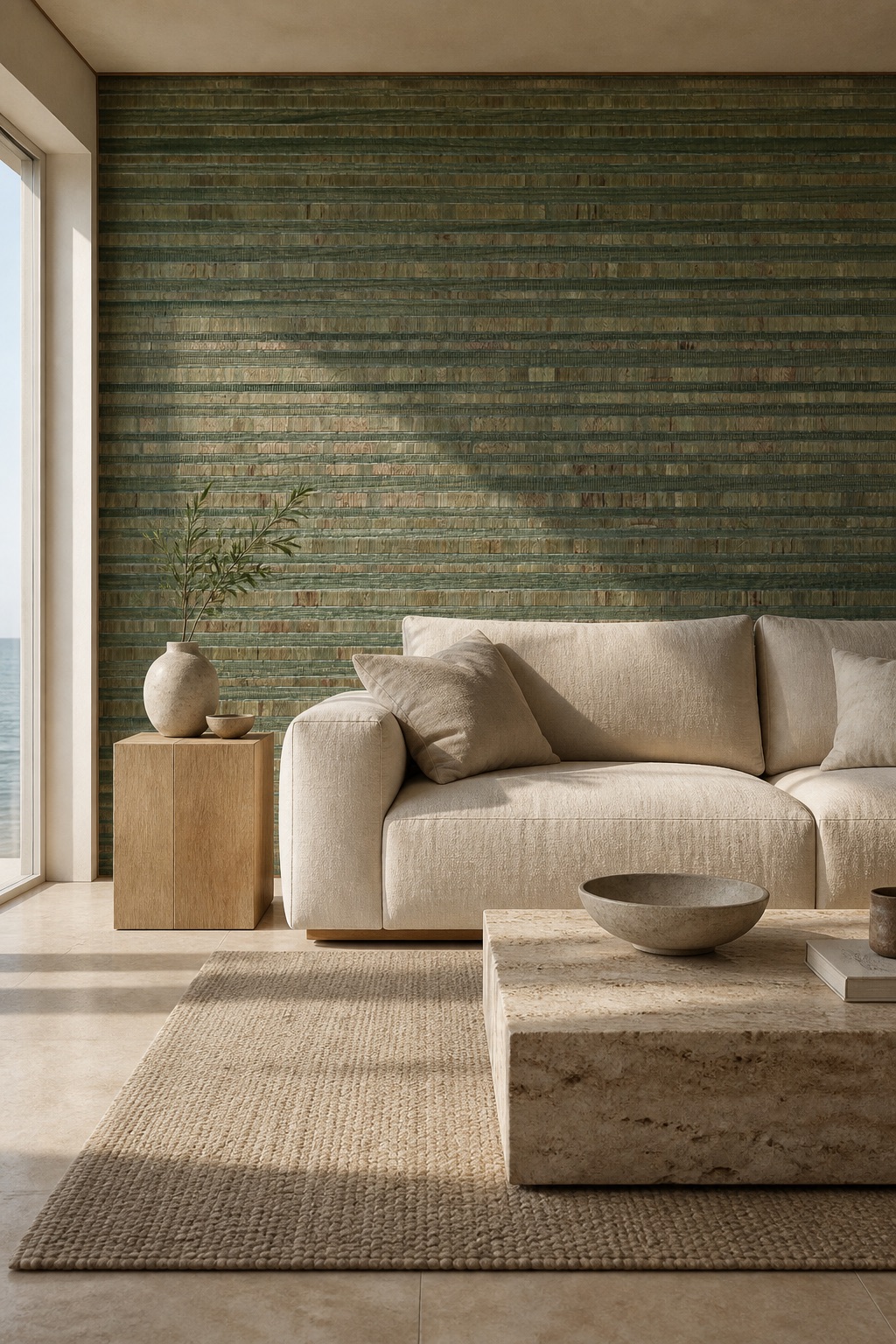
- Feature walls in living rooms and sitting rooms: the horizontal banding registers as a calm architectural line and the muted teal works with most neutral or warm companion schemes without dominating.
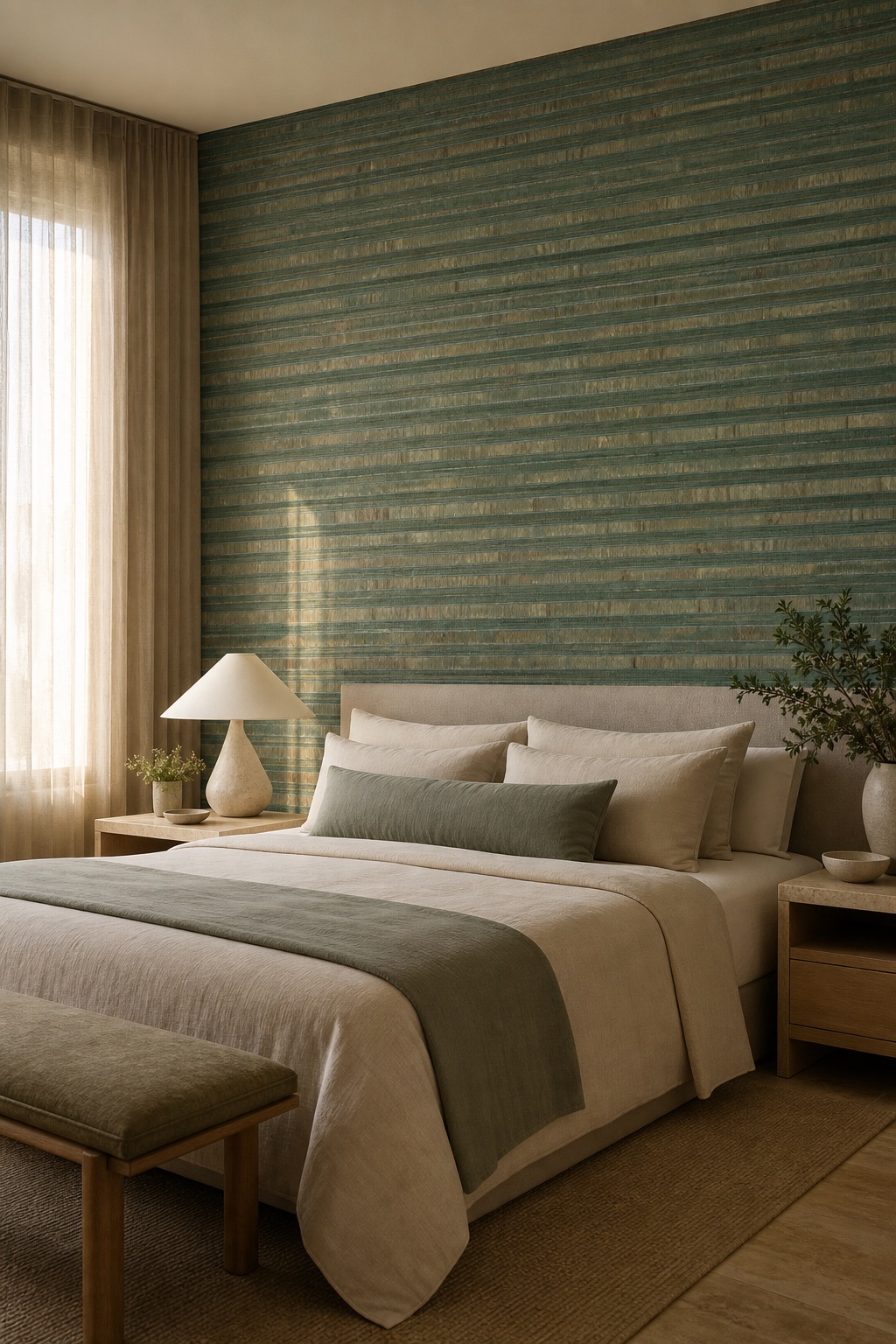
- Hotel suite and bedroom feature walls: mid-value teal is not assertive enough to feel oppressive in a sleeping space, and the matte natural-fibre surface absorbs sound marginally versus smooth plaster.
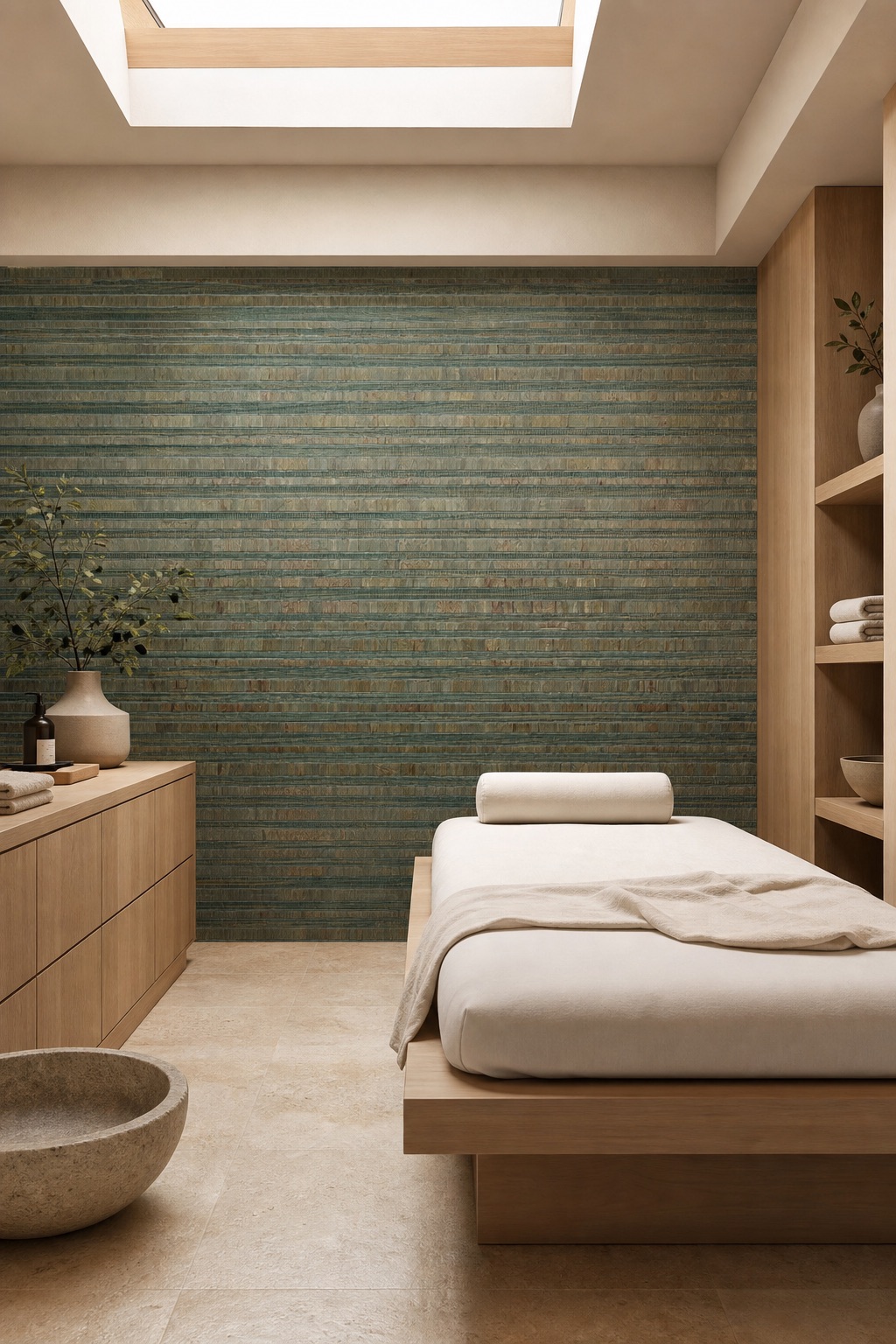
- Spa corridors and treatment-room feature walls: the muted blue-green and bamboo-reed fibre tone map directly to biophilic and wellness-design languages.
- Boutique hotel reception and lobby feature walls: brings a defined natural texture and a fresh palette without the visual weight of charcoal or dark-brown grasscloth.
- Less suited to direct-steam or condensation-heavy environments without a protective moisture-barrier lining; consult the humidity-risks guide before specifying in those conditions.
The muted mid-value teal sits in a range that interior designers consistently find versatile: it reads as genuine colour without overpowering companion materials, and the horizontal banding reinforces perceived room width rather than competing with architecture. In living rooms, this teal bamboo wallcovering functions as a feature-wall material that brings organic texture where smooth plaster would feel underdressed. In hospitality suites and bedrooms the teal reads as restful rather than stimulating. Spa and wellness corridors are a particularly strong match, and the natural-fibre texture and blue-green tone map directly to the biophilic and Japandi references that define most current wellness briefs. For high-humidity environments, consult our humidity-risks guide before specifying without a barrier lining.
Japandi and Organic-Modern Briefs: Why a Natural Reed Wallcovering Fits Both Languages
- Japandi interiors require natural materials with quiet colour: Lagoon Reed's muted teal and bamboo-reed fibre construction satisfies both criteria without requiring any styling compromise.
- The horizontal banding carries the wabi-sabi principle of visible craft and natural variation; no two strips are tonally identical.
- Biophilic design principles recommend natural-texture wallcoverings to introduce material warmth into spaces otherwise governed by hard finishes.
- Companion-material alignment is direct: oak, linen, travertine, plaster, and bouclé all sit comfortably alongside the muted teal without the combination feeling busy or flat.
- The fully matte finish reads as a recessive background material, consistent with the understated Japandi aesthetic where surfaces support rather than demand attention.
- Love this weave but need your own colour or scale? Our design studio engineers custom colourways from your reference.
Japandi and organic-modern briefs demand two things from a wallcovering: a genuine natural-material identity and a colour palette that does not compete. Lagoon Reed delivers both. The natural-fibre strips carry the grain, variation, and warmth of a grown material; the teal yarn wefts supply the quiet saturated colour that prevents the wall from disappearing into plain neutrals. Every strip varies slightly, a quality that reads as artisan character rather than mechanical repeat. The surface pairs directly with the materials that define these design languages: pale-toned oak, undyed linen, travertine slab, and textured bouclé all hold their own alongside the muted teal without the combination feeling either too busy or too sparse.
How a Lagoon Reed Specification Comes Together: Studio Process and Batch Control
- Sample books are available for trade buyers; the cost is credited against a qualifying order (up to 10% of order value), giving specifiers a low-risk entry point.
- A paid proof is quoted and agreed before production is committed; clients see an accurate colour and weave rendering at the specified dimensions before any rolls are produced.
- Three full-time in-house designers translate client references and mood-board inputs into CAD-ready specifications for the partner mills.
- Every production run uses a single dye-lot; each batch ships with a per-batch lot certificate for specification records and future reorder matching.
- Standard production runs 4 to 6 weeks from proof approval; Lagoon Reed uses standard materials so extended specialty timelines do not apply.
- The studio's founder has worked in natural wallcovering trade since 2018; that depth of sourcing experience informs both material selection and quality-control practice across partner mills.
Every Lagoon Reed specification begins with a physical sample. Trade buyers receive a sample book (the cost is credited against a qualifying order) and a paid proof is quoted and agreed before production is committed. In-house designers manage the translation from a buyer's reference or mood-board to a partner-mill specification, working in CAD to confirm the colour and weave match before the first roll is produced. Production runs at 4 to 6 weeks for this standard-material construction, and every batch ships on a single dye-lot with a lot certificate for specification records. The studio's founder has worked in natural wallcovering trade since 2018, and that background informs how materials are selected and how quality is controlled at partner mills.
Buying grasscloth for a project or a brand?
- Minimum order
- 50 rolls (about 250 m²) catalog · 100 rolls custom / private label
- Lead time
- 4–6 weeks standard · 5–8 weeks specialty, after sample approval and payment
- Terms
- EXW Chengdu · FOB, CIF, DDP on request
- Samples
- Free digital kit in 24 h · paid swatch pack, credited in full on your first order
- Reply
- Within 24 hours
Frequently asked
- Will the teal colour in Lagoon Reed fade in a sun-exposed room?
- Natural teal-dyed yarn wefts are susceptible to UV fading over time in south- or west-facing rooms with prolonged direct sunlight exposure. Positioning the wallcovering away from unfiltered direct sun, or specifying UV-filtering glazing in the project, will significantly extend colour stability. Our guide to fading prevention covers protective specification in detail.
- How visible are the seams on a bold horizontal banded weave?
- Because the bands run perfectly horizontal, professional installation requires aligning band lines precisely across every join. When edge-trimming and double-cut seaming are executed correctly, seams on a horizontal-banded wallcovering are considerably less visible than on a random-texture grasscloth; the strong horizontal register guides the eye along the wall rather than toward the join.
- Is Lagoon Reed appropriate for a spa treatment room or hotel wellness corridor?
- Natural bamboo-reed wallcovering tolerates moderate ambient humidity; hotel-corridor and spa-anteroom conditions are generally within an acceptable range. For spaces with active steam, condensation, or wall-level moisture contact, a moisture-barrier lining is strongly recommended before installation. Refer to our humidity-risks guide for full specification thresholds.
- Can we commission this in a deeper teal or a warmer sage-green colourway?
- Yes. Our in-house design studio works from your colour reference to engineer a custom colourway, available from an MOQ of 50 rolls (approximately 250 m²), with a paid proof quoted and agreed up front. Reach out through our contact page to start the conversation.
- Where can I find MOQ, lead-time, and payment-terms details?
- Full commercial terms, including MOQ, sampling credits, payment terms, and production timelines, are set out on our process page.