Striped Wood Wallpaper
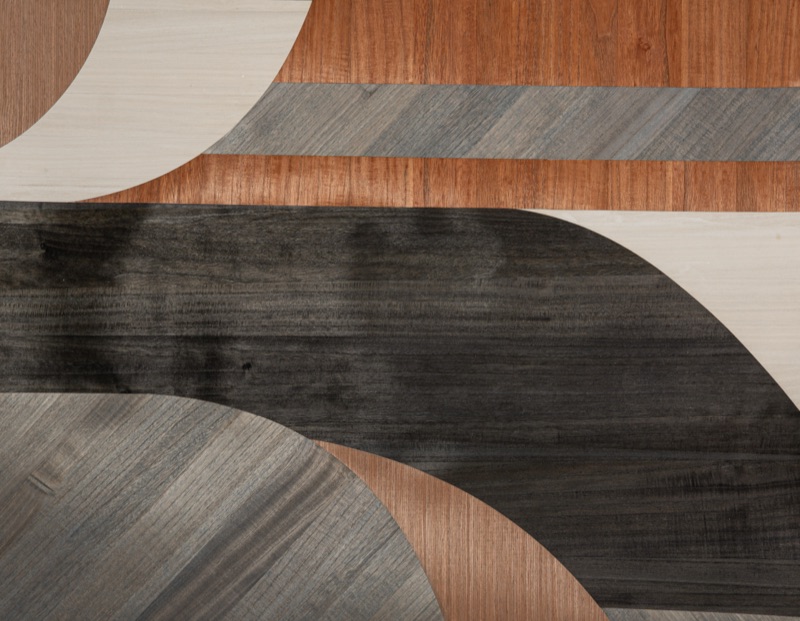
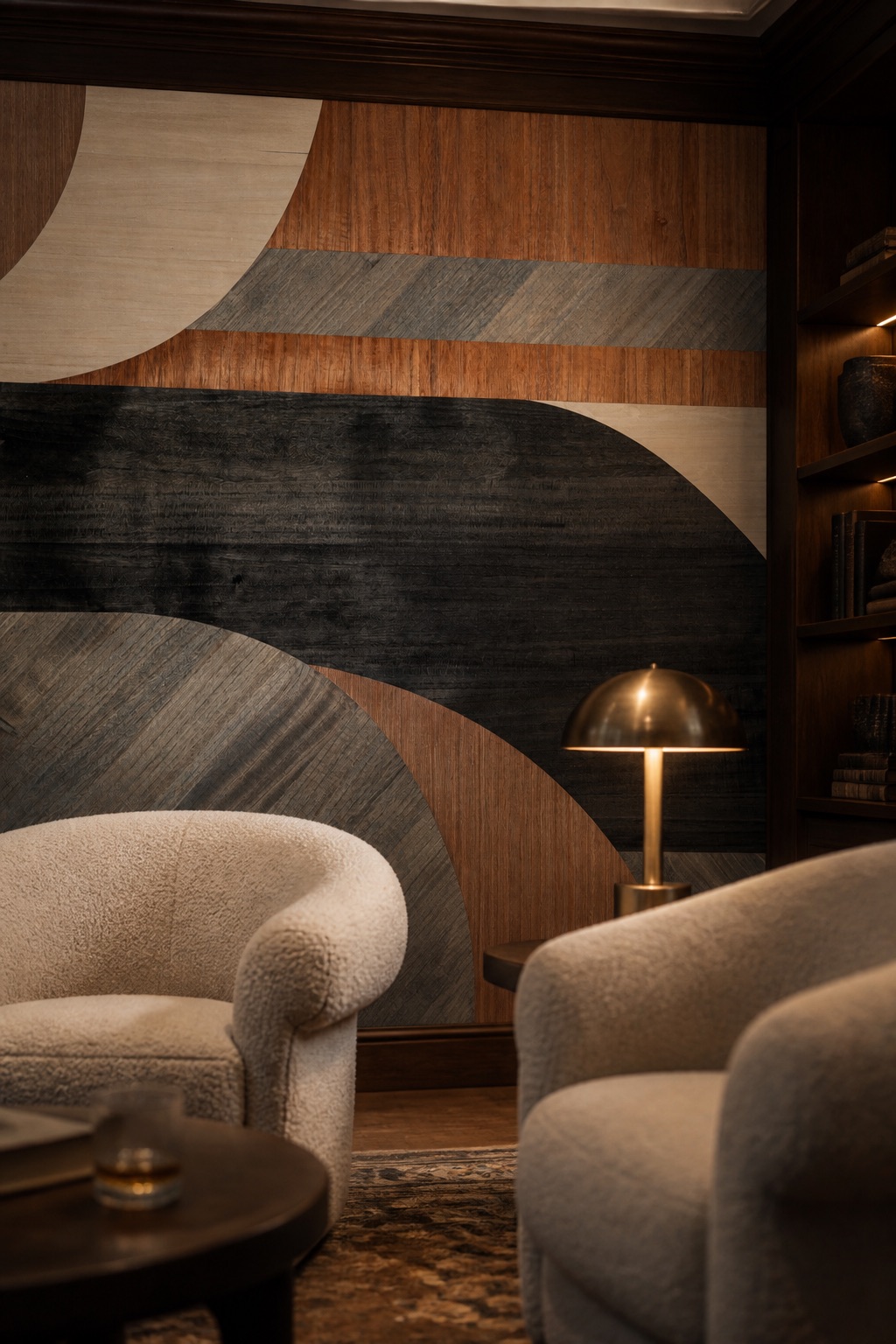
The arc-shaped inlay panels in this striped wood wallpaper span four wood tones (dark charcoal, terracotta-rust, medium ash, and bleached cream), each carrying the same tight horizontal linear grain across curved boundaries. At distance, the composition reads as bold striped banding; at close range, the individual wood-grain character of each panel resolves into surface detail. Ebony Arc Inlay is produced with our partner mills to our Chengdu design studio's specifications and supplied to interior designers, architects, and trade buyers from 50 rolls.
Arc Boundaries and Linear Grain: Reading This Striped Wood Wallpaper From Across a Room
- Arc boundaries between inlay panels are designed junctions, not installation seams, so the striped banding is inherent to the wallcovering surface itself
- All four tones (dark charcoal, terracotta-rust, medium ash, bleached cream) share the same tight horizontal linear grain direction, visually binding the composition
- At a standing distance of three metres, the eye resolves the surface as bold horizontal striped geometry; individual grain detail becomes legible at closer range
- The dominant dark charcoal panel occupies the lower visual register of the composition, anchoring the arrangement and giving it a grounded, weighted feel
- Matte-satin surface finish keeps reflectance even across all panels, preventing any single tone from dominating through glare
- Roll format: 0.915 m wide by 5.5 m long, approximately 5 m² per roll
Multi-tone striped wood wallpaper achieves its effect here through the arc inlay format: each arc boundary is a designed junction between two different wood-veneer tones, so the pattern itself generates the stripe. At a standing distance of three metres or more, the eye resolves the composition as horizontal banding, with dark charcoal dominating the lower field, terracotta and ash crossing the midpoint, and pale cream arcing across the upper register. Closer inspection reveals the tight linear grain running identically through every panel, binding the four tones into a single, coherent surface.
Four Tones in Shifting Light: How Charcoal, Terracotta, Ash and Cream Behave Through the Day
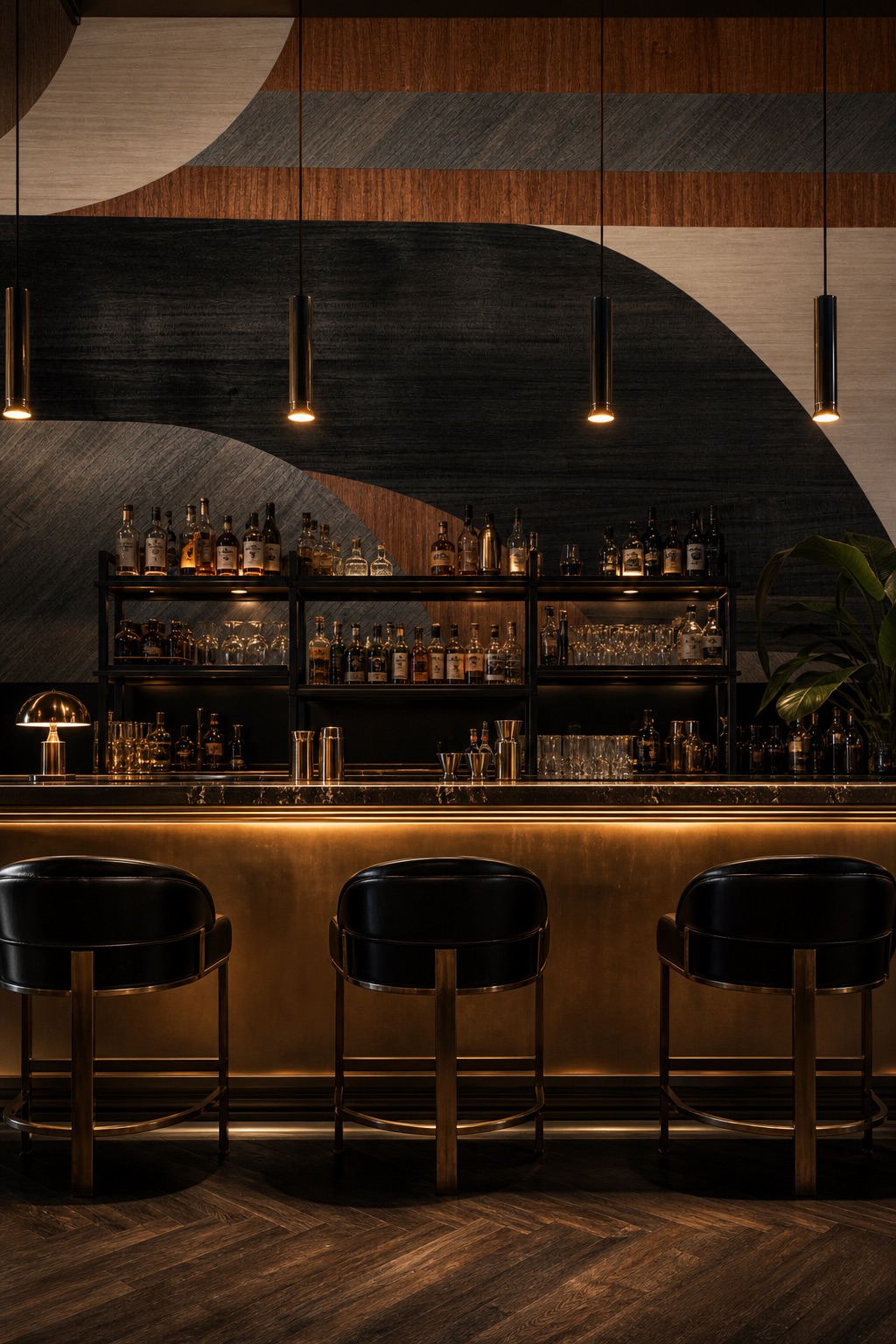
- Dark charcoal panels absorb ambient light and deepen toward near-black in low-illumination conditions, suiting evening-use spaces
- Terracotta-rust sections warm perceptibly under incandescent or warm-spectrum LED, pulling the overall composition toward amber
- Ash-grey and bleached-cream panels provide tonal lift and visual punctuation, preventing the dark ground from reading as heavy
- Under flat north-facing daylight, all four tones settle into a calm mid-value palette where grain texture rather than colour contrast carries the surface interest
- The tonal shift between daytime and evening makes this material particularly well-suited to spaces with intentional, layered lighting design
The dark charcoal ground absorbs light and deepens toward near-black in low-illumination conditions, which suits evening-use spaces such as hotel bars, dining rooms, and members' lounges. The terracotta-rust panels warm further under incandescent or warm-spectrum LED, pulling the composition toward amber in that light. Ash and cream panels provide visual punctuation, lifting the overall value of the wall and preventing the charcoal from reading as oppressive. By contrast, in even north-facing daylight all four tones settle into a calm mid-value palette, with grain texture rather than colour contrast carrying the surface interest.
Hotel Lobbies, Bars, and Residential Feature Walls: Where Ebony Arc Inlay Lands Best
- The bold arc scale and four-tone palette read best on uninterrupted wall planes with ceiling heights of 2.8 metres or above; lower heights compress the arc geometry
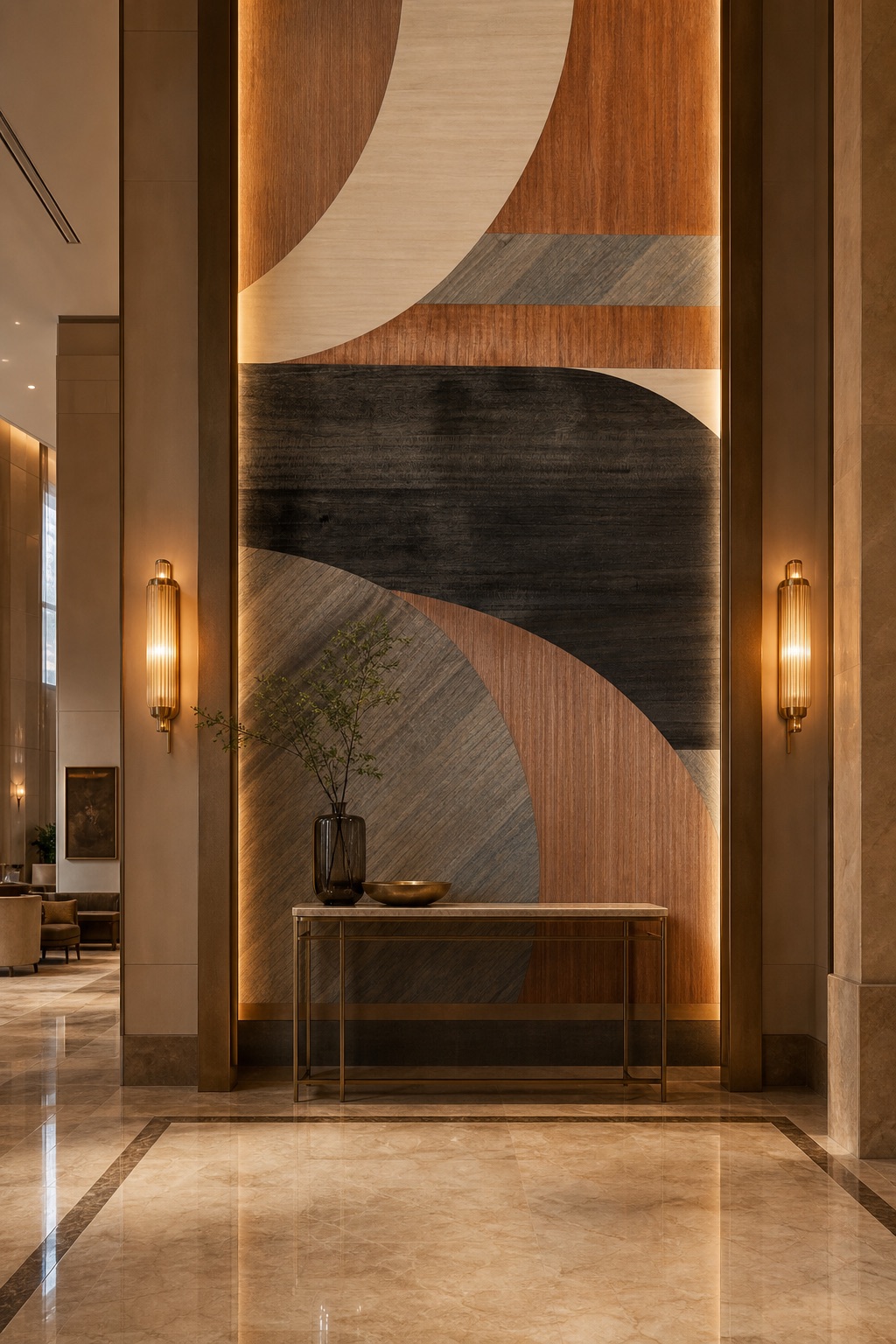
- Hotel lobby feature walls, bar back-walls, and restaurant alcoves are natural applications where the pattern's dual-scale legibility works as a spatial device
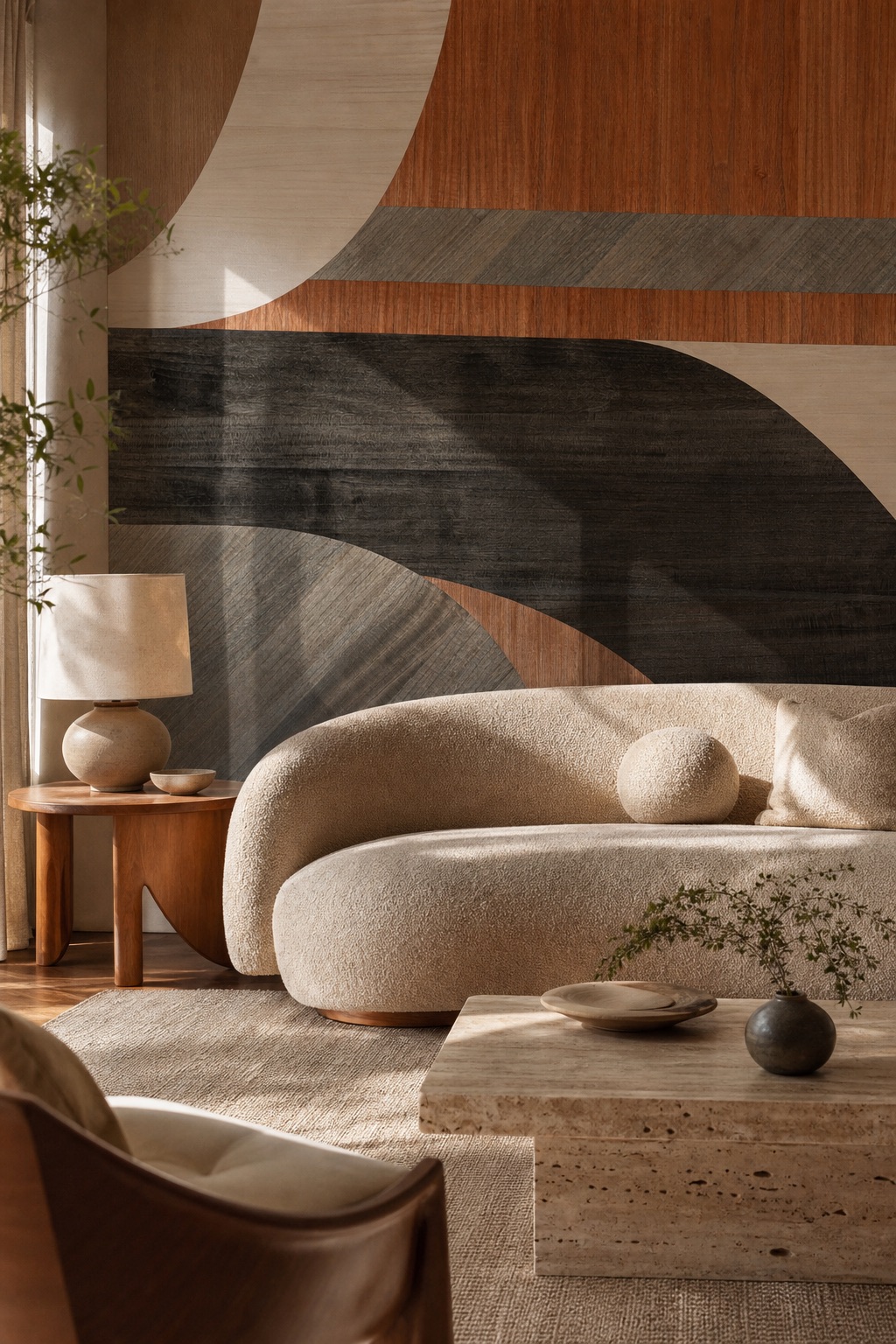
- Residential use typically concentrates on a single feature wall behind a sofa or bed head to anchor a room without competing with furniture
- Companion materials well-matched to this palette: polished brass, blackened steel, travertine, dark stained oak, marble
- The art-deco arc language is period-legible without being literal, making it work in contemporary hospitality interiors as readily as in classically styled residential schemes
- Custom arc-tone balance available through studio proofing; minimum order for custom colourways is 50 rolls (approximately 250 m²)
The bold arc scale and four-tone palette make Ebony Arc Inlay most legible on uninterrupted wall planes of 2.8 metres ceiling height or above; lower ceiling heights compress the arc geometry and reduce its design impact. Hotel lobby feature walls, bar back-walls, and restaurant alcoves are its natural applications, where guests approach and recede and the striped wood wallpaper geometry works at two scales simultaneously: bold pattern at entry, grain detail at the table. Residential use concentrates on a single feature wall or alcove, typically anchoring a living room or sleeping space. Love this arc structure but need your own tone balance? Our design studio engineers custom colourways from your reference, rebalancing the four-panel composition to any wood-tone brief.
What Specifiers Need to Know About Wood Veneer Wallcovering Production and Lead Times
- Specialty wood veneer format; production at our partner mills follows a 5-8 week window, longer than standard grasscloth or paperweave (4-6 weeks)
- Rolls supplied at 0.915 m wide by 5.5 m long (approximately 5 m² per roll)
- Custom colourway minimum order is 50 rolls (approximately 250 m²); stock pattern minimums are lower for first trials
- All orders ship with per-batch dye-lot certificates for incoming-batch colour verification
- All rolls within a single order are cut from the same dye lot, ensuring consistency across the installation
- Technical documentation (data sheets, lot certificates) supplied on request to support buyers' own fire, VOC, or sustainability certification processes — we do not hold these certifications ourselves
Unlike woven natural-fibre wallcoverings, wood veneer formats are produced as specialty materials, which means production at our partner mills follows a 5-8 week window rather than the standard 4-6 weeks for grasscloth and paperweave. Rolls are 0.915 m wide by 5.5 m long (approximately 5 m² per roll), and custom colourway orders require a minimum of 50 rolls. Each order ships with per-batch dye-lot certificates, ensuring colour consistency can be verified and re-ordered against a documented lot. Professional installation by a tradesperson experienced with veneer-backed panel wallcoverings is strongly recommended; the arc-boundary pattern alignment requires careful planning before installation begins.
Sample Book to Shipment: The Studio Workflow Behind Every Ebony Arc Inlay Order
- Paid physical sample book is the entry point; its cost is credited against your order value (up to 10%)
- Three in-house designers convert your reference images or mood boards into CAD layout proofs
- Paid proofing is quoted up front and typically takes 1-2 weeks to completion
- Production proceeds on a payment terms confirmed on the pro-forma invoice basis; FOB, CIF, and DDP terms available
- Every order ships with per-batch lot certificates for on-site incoming-batch verification
- Studio founder active in natural wallcovering and specialty veneer supply since 2018
Every Ebony Arc Inlay specification moves through the same sequence. A paid physical sample book is the starting point, with its cost credited against your order value up to 10 percent. Once a colourway and scale are confirmed, our three in-house designers translate your reference or mood board into CAD layout proofs; paid proofing is quoted up front and typically completes in 1-2 weeks. Production follows on a payment terms confirmed on the pro-forma invoice basis, with FOB, CIF, and DDP terms available. Every order ships with per-batch lot certificates so incoming batches can be verified on site. Our founder has been active in the natural wallcovering and specialty veneer supply chain since 2018.
Buying wood for a project or a brand?
- Minimum order
- 50 rolls (about 250 m²) catalog · 100 rolls custom / private label
- Lead time
- 4–6 weeks standard · 5–8 weeks specialty, after sample approval and payment
- Terms
- EXW Chengdu · FOB, CIF, DDP on request
- Samples
- Free digital kit in 24 h · paid swatch pack, credited in full on your first order
- Reply
- Within 24 hours
Frequently asked
- Will the four wood-tone panels in this wallpaper fade at different rates?
- All four veneer tones (charcoal, terracotta, ash and cream) share the same surface treatment, so UV exposure affects the overall surface rather than individual panels selectively. The primary risk is prolonged direct sunlight accelerating colour shift in the lighter terracotta and cream areas first. East- or north-facing walls, or interiors with UV-filtered glazing, minimise that risk considerably. Our fading prevention guide at /guides/fading-prevention covers the full range of mitigation strategies.
- How do roll-to-roll seams read on a large-format arc inlay pattern like this?
- The arc boundaries in this inlay format are intentional design junctions, so roll-to-roll seams are engineered to align with those junctions rather than fall across a solid field of colour. Correct pattern-matching at installation is essential; our installation guide at /guides/installation-guide covers the alignment approach for geometric panel wallcovering formats.
- Can this wood veneer wallcovering be used in spa corridors or wellness reception areas?
- Wood veneer is more moisture-sensitive than woven or paper-backed wallcovering formats. Well-ventilated wellness corridors or spa reception areas with controlled humidity are feasible installation contexts; direct-steam or high-humidity enclosures such as shower rooms, steam rooms, and saunas are not suitable. Our humidity risks guide at /guides/humidity-risks covers the full range of specialty wallcovering contexts.
- Is it possible to commission this arc pattern with a different wood-tone palette?
- Yes. The arc-panel structure can be re-engineered in alternative tone combinations through our studio proofing process. Minimum order for custom colourways is 50 rolls (approximately 250 m²); proofing is paid and quoted before production begins. Contact us with your reference image or board to begin the conversation.
- Where can I find the full details on sample books, ordering terms, and minimum quantities?
- Full details on sample books, proofing fees, payment terms, and shipping terms are on our process page at /process.