Material Comparison
Grasscloth vs Wood Veneer: Which Delivers More Impact?
Two luxury natural wallcoverings — woven plant fiber versus real timber veneer. Compared on texture, visual drama, installation, cost and ideal applications by a sourcing partner that supplies both.
Key Takeaways
- Grasscloth = woven plant fiber; wood veneer = ultra-thin real timber (0.3–0.6 mm).
- Wood veneer wins on visual drama — grain patterns command attention on feature walls.
- Grasscloth wins on color range — dye-receptive fibers accept virtually any hue.
- Price gap: grasscloth $8–18/m² vs wood veneer $15–35/m² (FOB).
- Installation cost: wood veneer requires specialist installers (30–50% premium).
- Both are sustainable: biodegradable, FSC-certifiable, low VOC.
- Best combo: wood veneer feature wall + grasscloth on surrounding walls.
At a Glance: Grasscloth vs Wood Veneer
| Feature | Grasscloth | Wood Veneer |
|---|---|---|
| Raw Material | Woven plant fibers (jute, seagrass, hemp) | Real timber slices (teak, walnut, oak, elm) |
| Thickness | 0.5–1.0 mm | 0.8–1.5 mm (including backing) |
| Visual Impact | Subtle, organic warmth | Dramatic grain, high luxury |
| Color Range | Extensive (dye-receptive fibers) | Limited to natural timber tones |
| Durability | Moderate | Moderate–High (scratch-resistant surface) |
| Moisture Resistance | Low | Low (wood is hygroscopic) |
| Standard Width | 0.91 m (36″) | 0.60–1.22 m (varies by species) |
| Installation Difficulty | Moderate | High (requires specialist) |
| Price Range (FOB) | $8–18 /m² | $15–35 /m² |
| Custom color MOQ | 100 rolls | 100 rolls |
| Fire Rating | Class B1 (GB 8624) | Class B1 (with fire-retardant treatment) |
| Best For | Living rooms, bedrooms, hotel lobbies | Executive offices, luxury lobbies, feature walls |
How Do Grasscloth and Wood Veneer Differ in Texture?
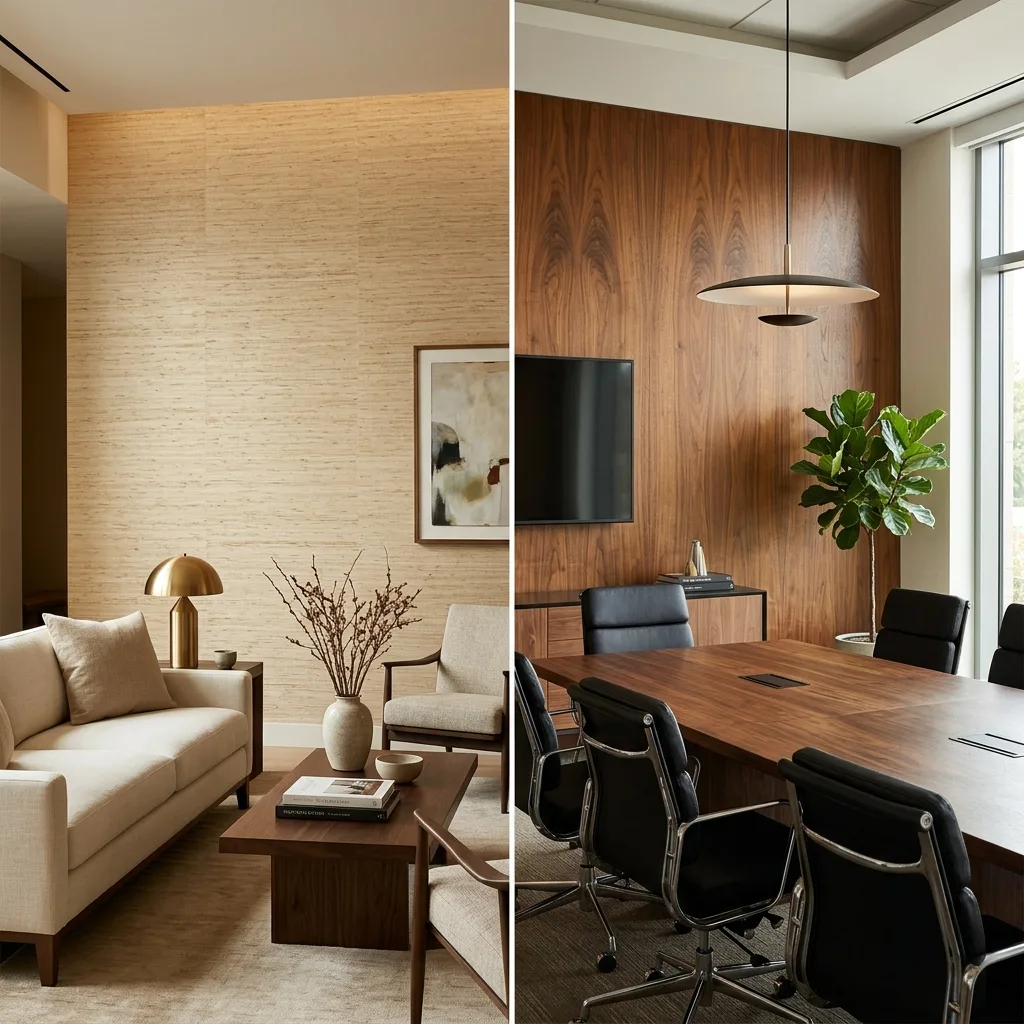
Grasscloth creates a soft, textile-like surface. The horizontal weave patterns are subtly irregular, giving walls a gentle, handcrafted warmth. It reads as "natural fabric on the wall" — inviting and organic, but understated. Grasscloth works best as a background texture that enhances furnishings without competing.
Wood veneer is fundamentally different — it's architecture, not decoration. Ultra-thin slices of real timber (0.3–0.6 mm) are laminated to flexible backing, retaining the full richness of natural wood grain. Every sheet is unique: figured walnut, cathedral-grain oak, and burled elm create dramatic visual patterns that command attention. Wood veneer reads as "luxury paneling without the construction".
When to Choose Grasscloth
- Spaces where walls should provide warm background texture
- Projects requiring a specific dyed color (blues, greens, neutrals)
- Bedrooms, living rooms and hospitality environments
- Budget-conscious projects that still need a premium natural finish
When to Choose Wood Veneer
- Feature walls and focal points that need maximum visual drama
- Executive offices, boardrooms and luxury retail
- Projects where the wall IS the design statement
- Spaces that would benefit from traditional wood paneling but can't accommodate the thickness or weight
What Makes Wood Veneer Installation More Complex?
Installation complexity is a critical difference. Grasscloth follows standard wallcovering installation techniques — experienced wallpaper hangers can install it with proper adhesive and reverse-hanging technique.
Wood veneer wallcovering is more demanding. The material is stiffer, less forgiving of wall imperfections, and requires:
- Perfectly smooth substrate — even minor bumps telegraph through the veneer
- Specialized adhesive — standard wallpaper paste is insufficient; contact or PVA adhesive is required
- Climate control — wood is hygroscopic and requires stable humidity (40–60% RH) during and after installation
- Grain matching — adjacent sheets must be book-matched or slip-matched for visual continuity
For these reasons, wood veneer installation typically costs 30–50% more per square meter than grasscloth installation.
How Much Does Grasscloth vs Wood Veneer Cost?
Wood veneer is the most premium-priced natural wallcovering category, typically 40–60% more expensive than grasscloth:
| Material | Standard | Mid-Range | Premium Species |
|---|---|---|---|
| Grasscloth | $8–12 /m² | $12–15 /m² | $15–18 /m² |
| Wood Veneer | $15–20 /m² | $20–28 /m² | $28–35 /m² |
However, cost per impression is arguably lower for wood veneer. A single wood veneer feature wall can define an entire space — clients and visitors notice it immediately. Grasscloth requires full-room coverage to achieve comparable impact.
Prices are EXW Chengdu as of May 2026. Species (teak vs walnut vs oak), grain figure and finish significantly affect wood veneer pricing. Contact us for a project-specific quote. See our pricing guide for landed-cost calculations.
Which Is More Sustainable?
Both are genuinely sustainable choices compared to vinyl or synthetic wallcoverings:
- Grasscloth: made from rapidly renewable annual crops (jute, seagrass, hemp). Biodegradable. Very low VOC. Oeko-Tex certifiable.
- Wood veneer: uses timber far more efficiently than solid wood paneling — one log yields hundreds of m² of surface material. FSC-certified sourcing ensures responsible forestry. Biodegradable.
Grasscloth has a slight edge on renewability (annual vs multi-decade growth cycle), while wood veneer wins on longevity — a well-installed veneer wall can last 20+ years with minimal maintenance.
Which Is Right for Your Project?
Choose Grasscloth If:
- You want full-room wallcovering at a reasonable budget
- The design calls for specific colors (grasscloth accepts dyes)
- Your installer has general wallcovering experience (no specialist needed)
- The space is residential, hospitality or well-ventilated commercial
Choose Wood Veneer If:
- You want a single high-impact feature wall
- The budget allows for premium materials + specialist installation
- Natural wood grain and warmth are central to the design concept
- The space needs an architectural upgrade without structural changes
Use Both:
A highly effective combination: wood veneer for one feature wall + grasscloth on surrounding walls. The wood veneer draws the eye as a focal point, while grasscloth provides complementary natural texture without competing. Both materials share the same organic material family, creating a harmonious but layered interior.
Frequently Asked Questions
Is wood veneer wallcovering real wood?
Yes. Wood veneer wallcovering uses ultra-thin slices (0.3–0.6 mm) of real timber — typically teak, walnut, oak, or elm — laminated to a flexible fabric or non-woven backing. This makes it pliable enough to install like wallpaper while retaining the authentic grain, color variation and tactile warmth of solid wood.
Which is more expensive, grasscloth or wood veneer?
Wood veneer is typically 40–60% more expensive than grasscloth. Standard grasscloth ranges from $8–18/m² FOB, while wood veneer ranges from $15–35/m² FOB. The higher cost reflects the precision slicing, species sourcing and lamination process required for wood veneer production.
Can wood veneer wallcovering be used in high-humidity areas?
Wood veneer is not recommended for high-humidity environments like bathrooms or pools. Real wood is hygroscopic — it absorbs and releases moisture, which can cause warping, delamination or mold growth. For humid spaces, consider vinyl wood-look alternatives or properly sealed cork wallcovering.
Related Guides
Grasscloth Guide
Complete reference on grasscloth wallcovering.
Wood Veneer Guide
Complete reference on wood veneer wallcovering.
Grasscloth vs Cork
Acoustic performance and texture compared.
Real vs Faux Grasscloth
How to tell the difference.
Grasscloth Pros & Cons
Honest advantages and drawbacks.
Installation Guide
How to install natural wallcoverings.
See Both Materials
Request grasscloth and wood veneer samples together — feel the difference in texture, weight and grain before specifying.
Request Samples