Sage Grasscloth Wallpaper
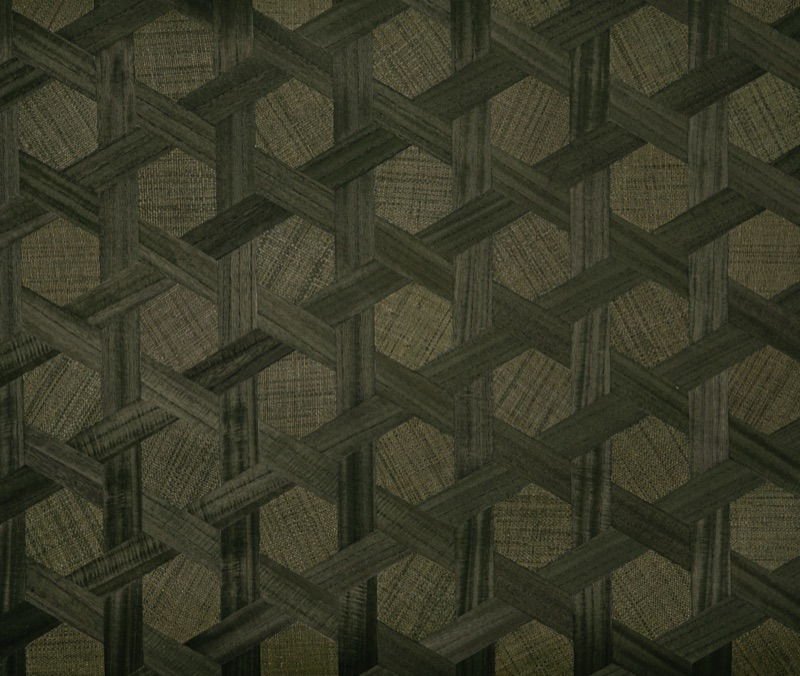
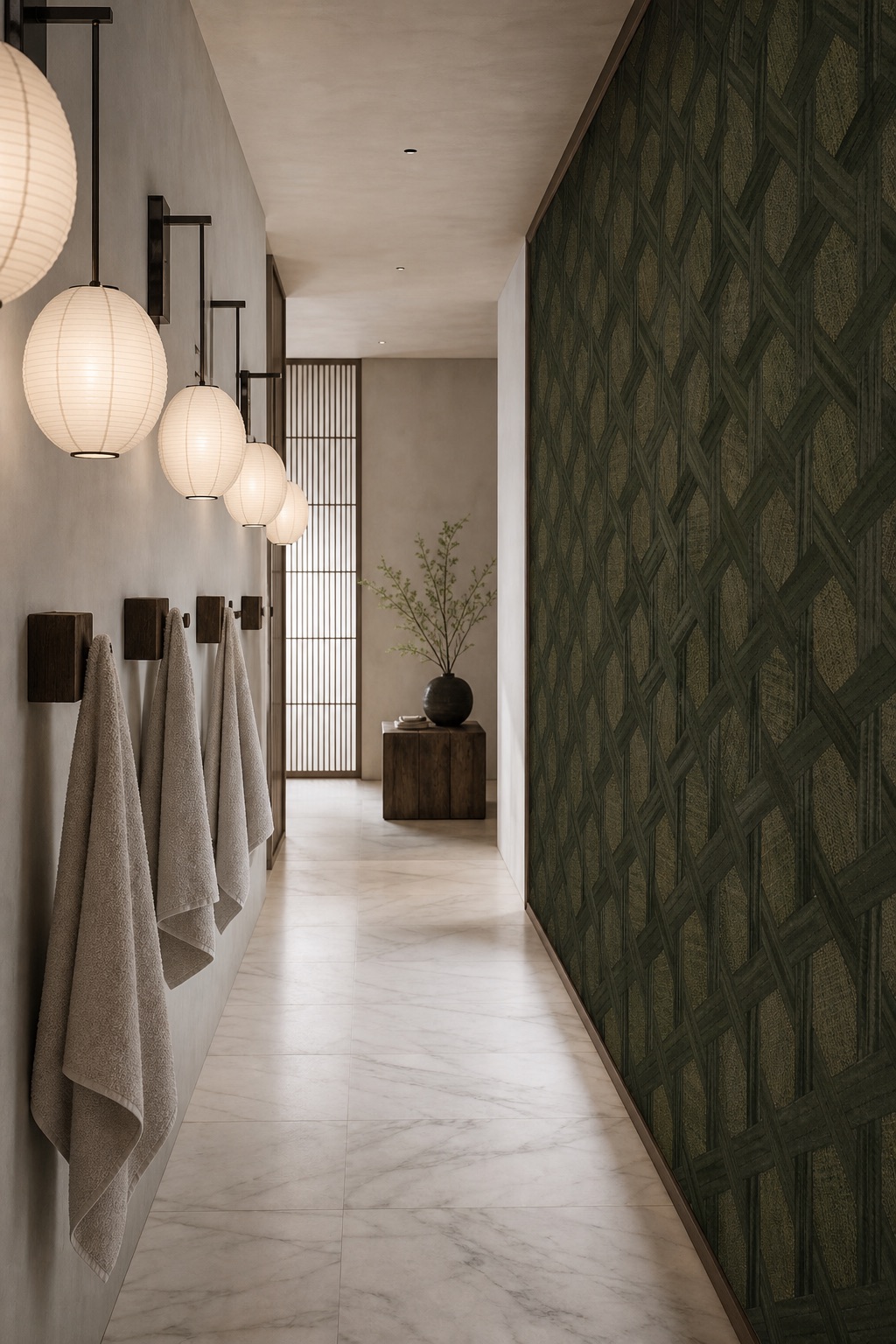
Forest Lattice is a deep sage-olive grasscloth wallpaper overlaid with a bold hexagonal lattice print, building a two-layer surface where a fine natural-fibre ground reads beneath brushed, geometric dark bands. The colour is sage deepened toward olive, warm in undertone, and turns near-charcoal once ambient light drops. Produced with our partner mills and specified by our in-house design studio in Chengdu, it is supplied to designers and trade buyers from 50 rolls.
Lattice Over Grasscloth: How Two Layers Build Unusual Surface Depth
- Fine grasscloth ground provides the substrate; natural-fibre texture is visible within each hexagonal cell.
- Bold diagonal bands overlaid in deep charcoal green form interlocking hexagons across the repeat.
- Lattice scale is bold: the hexagonal cells read legibly from across the room.
- At close range, the woven fibre within each cell is clearly visible; at four to five metres the wall becomes a dense geometric field.
- Entirely matte finish keeps the pattern flat and graphic, with no reflective interruption at any distance.
Forest Lattice is constructed in two visible layers: a fine grasscloth ground provides the substrate, its short natural fibres catching faint texture within each hexagonal cell, while deep charcoal-green bands are overlaid in a bold repeating geometry. The result has more visual depth than a flat-printed wallcovering. From four to five metres the wall reads as a field of interlocked dark hexagons; moving to within a metre reveals the fine woven ground beneath each band. Both readings are present simultaneously, which gives the design its architectural quality without relying on any surface sheen.
Deep Olive by Daylight, Near-Charcoal by Evening: How Forest Lattice Shifts Across the Hours
- In cool north or east-facing light the surface holds a medium-dark grey-green; the khaki cell centres are visible but subdued behind the charcoal bands.
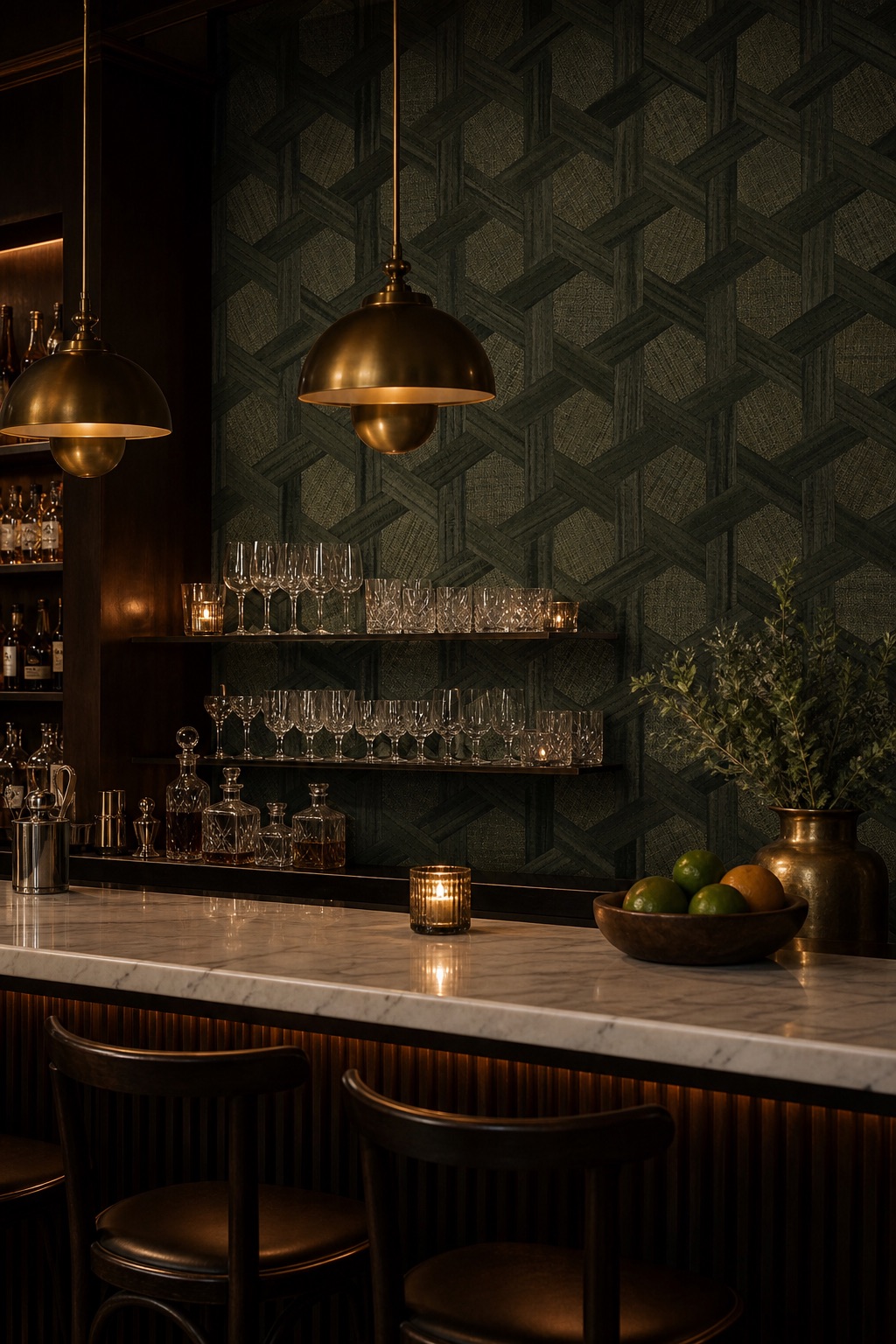
- Under warm incandescent or halogen downlighting the warm undertone asserts itself and the olive deepens, advancing the wall in the room.
- Proximity of pale plaster or travertine allows the khaki-green cells to separate visually from the charcoal bands.
- A fully matte surface means all colour movement is tonal; there is no metallic bounce to manage in the lighting scheme.
- Specifiers should evaluate a sample under actual site lighting conditions before finalising the specification, particularly in very low-light rooms.
In cool north-facing daylight, Forest Lattice holds a medium-dark grey-green; the khaki undertone in the hexagonal cell centres remains visible but recedes behind the charcoal lattice. Under warm incandescent or halogen downlighting the warm undertone asserts itself, the olive deepens, and the wall appears to advance. Because the surface is entirely matte, colour behaviour is purely tonal, with nothing to bounce or scatter light unpredictably. Specifiers should request a sample and observe it under the actual site lighting before finalising the scheme; in very dark or north-facing rooms without considered artificial lighting, the surface can read almost black.
Hotels, Bars, and Private Studies: Where Sage Grasscloth Wallpaper Performs Best
- Hotel and restaurant bars, private dining rooms, club lounges, and intimate suites are the strongest hospitality applications.
- Full-room treatment in compact volumes (powder rooms, lift lobbies, corridors) creates a contained, enveloping mood.
- In larger spaces a single feature or headwall application grounded by lighter travertine or plaster balances the dark value.
- The japandi and wabi-sabi style profile works across East Asian-influenced interiors and quieter organic-modern palettes.
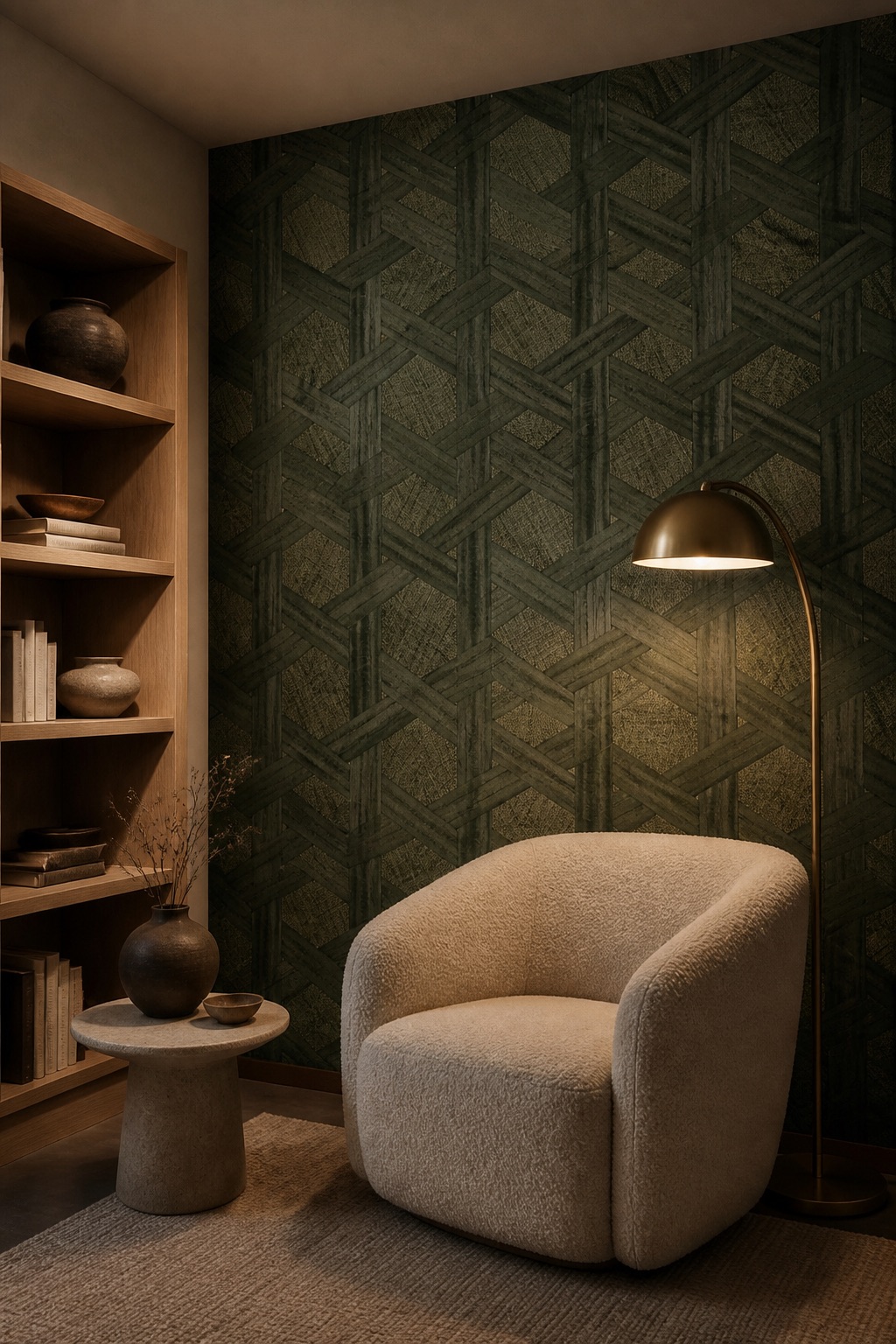
- Residential studies and private libraries benefit from the focused, enclosing quality of a deep-value geometric wallcovering.
- Rooms with deliberate artificial lighting hold the design best; spaces reliant on uncontrolled ambient light may absorb the pattern entirely.
The dark value and bold geometric character of this sage grasscloth wallpaper suit spaces where enclosure and mood are deliberate design goals. In hospitality, hotel bars, restaurant private rooms, club lounges, and intimate hotel suites are the strongest applications. In residential projects, studies, libraries, and single feature walls all place the pattern well. As a full-room treatment in compact volumes its enveloping quality becomes an asset rather than a liability. In larger rooms a single headwall application, paired with pale travertine, plaster, or unbleached linen, keeps the scheme balanced. The japandi and organic-modern style profile means Forest Lattice reads with equal confidence in East Asian-influenced interiors and quieter natural-palette schemes.
Grounding the Green: Companion Materials and Custom Colourway Options for Forest Lattice
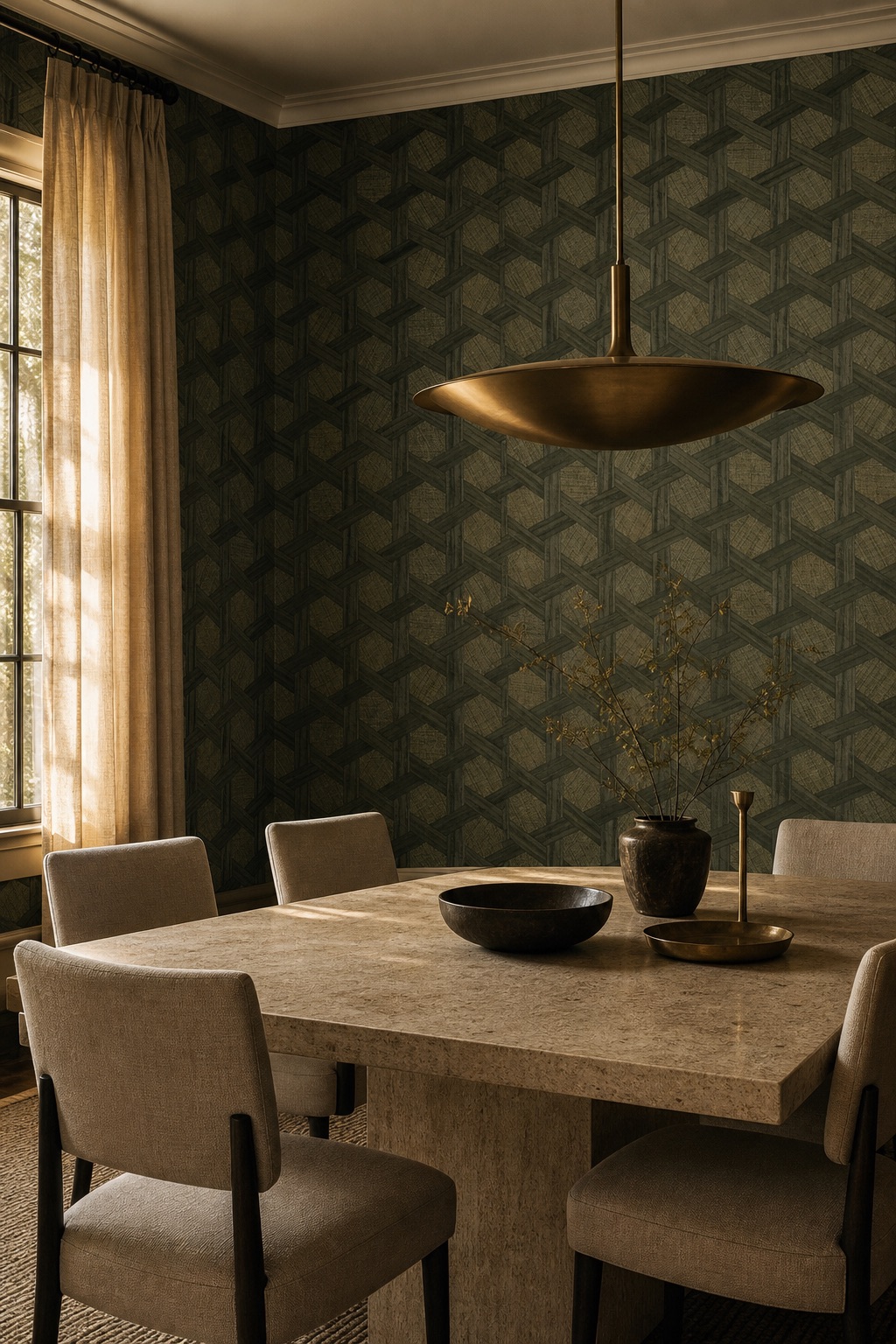
- Travertine, pale plaster, and undyed linen register as the lightest contrast without competing with the lattice.
- Raw or dark-stained oak adds warmth in the same tonal register as the olive green.
- Matte brass and bronze sit naturally against the warm undertone; polished chrome and cool silver read as jarring.
- Companion textiles should be plain or lightly textured: oat and ivory bouclé or linen allow the lattice to lead the composition.
- Custom colourways on the hexagonal grasscloth ground (lighter sage, eucalyptus, bespoke corporate greens) are available from 50 rolls MOQ through the design studio.
Travertine, pale plaster, and undyed linen register as the lightest points in the palette, creating contrast without competition. Raw or dark-stained oak adds warmth in the same tonal family as the green. For metallic accents, matte brass and bronze sit naturally against the warm olive undertone; avoid polished chrome and cool silver, which read as too cold against this colour. In soft furnishings, keep companions in plain or lightly textured oat and ivory bouclé or linen so the lattice leads the composition. Love this geometry but need a lighter sage, a eucalyptus green, or your own colour reference? Our design studio engineers custom colourways from your specification, produced with our partner mills on the same hexagonal grasscloth ground.
From the First Sample to a Certified Dye Lot: The Grasscloths Studio Process
- Paid sample books are produced per enquiry and credited against confirmed orders (up to 10%).
- Paid proofing is quoted before commencement and completed in approximately one to two weeks.
- Production orders are placed against a deposit; balance is settled before shipment.
- Standard lead time is four to six weeks; specialty materials run five to eight weeks.
- Every production run is single dye-lot; each batch ships with a lot certificate for specification documentation.
- Three full-time in-house designers translate client references into mill-ready CAD, backed by a founder active in natural wallcovering sourcing since 2018.
Orders begin with a paid sample book, credited against the confirmed order (up to 10%), so specifiers can evaluate colour under real site conditions before committing to the full specification. Paid proofing is then quoted and completed in approximately one to two weeks. Production orders are placed against a deposit, with balance settled before shipment; standard lead time is four to six weeks. Every production run is single dye-lot and ships with a batch lot certificate, simplifying documentation for specification packages and procurement records. Three full-time in-house designers translate client references and drawings into mill-ready CAD, and our founder has been active in natural wallcovering sourcing since 2018.
Frequently asked
- Will Forest Lattice's deep olive colouring shift noticeably in a south- or west-facing room?
- Natural-fibre wallcoverings can fade in tone under prolonged direct sunlight. For rooms with unfiltered south- or west-facing glazing, fitting UV-reducing window film is standard practice. Request a sample, hang a test panel in the actual location, and observe it over several weeks before finalising the specification. Our fading prevention guide at /guides/fading-prevention covers further practical measures.
- On a bold hexagonal pattern of this scale, how noticeable are the seams between drops?
- The large geometric repeat requires careful drop-matching at each seam join; adjacent lengths must be aligned precisely to maintain the continuous lattice across the wall. Dark-coloured wallcoverings generally conceal seam edges better than pale colourways, but a professional installer experienced with pattern-matching on natural-fibre wallcoverings is essential. Dry-fitting a test length before paste application allows seam placement to be reviewed on the actual wall surface.
- Is this sage grasscloth wallpaper appropriate for a commercial bar or restaurant environment with higher humidity and regular cleaning?
- Natural-fibre wallcoverings are moisture-sensitive and should be specified above the splash zone, away from steam sources and direct condensation. Light surface dusting is the recommended maintenance; sustained damp-wiping will damage the fibre ground. If the specification requires a wipeable surface, discuss a protective top-coat option with the installing contractor, noting that any coating will modify the matte finish and the visual character of the surface.
- Can I order Forest Lattice in a lighter sage or a completely different green colourway?
- Yes. Custom colourways on the hexagonal grasscloth ground are available from 50 rolls MOQ. Submit a colour reference (such as a Pantone chip, a paint fan-deck swatch, or a fabric sample) to our design studio and we will engineer the colourway with our partner mills on the same geometric ground. The full workflow is covered in our custom colourway guide at /guides/custom-colorway.
- What are the minimum order quantities and lead times for Forest Lattice?
- Custom colourways start from 50 rolls; stock patterns carry lower minimums for first trials; full ordering terms, deposit structure, proofing fees, and freight details are on our process page at /process.