Natural Beige Bamboo Wallcovering
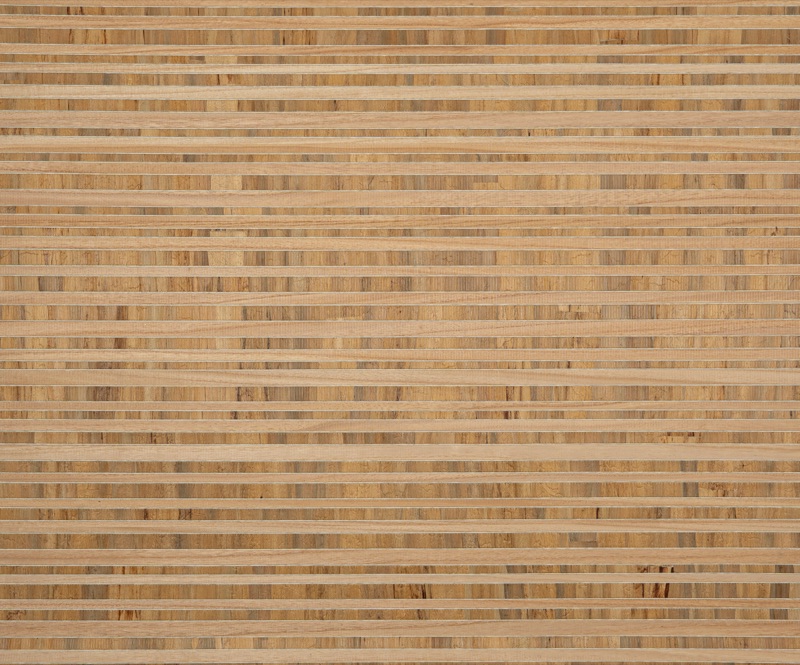
Honey Reed is a wide-reed natural beige bamboo wallcovering produced with our partner mills to a warm honey-tan ground: horizontal bands of coarse reed fibre, each separated by a narrow shadow gap that brings a quiet, measured rhythm to the surface. The colour reads unmistakably warm — golden straw at band centre, deepening to amber at the edges and near-charcoal within the recessed gaps. Supplied to interior designers, hospitality buyers, and trade specifiers from 50 rolls, it suits settings where natural warmth is the brief rather than pale neutrality.
Band and Gap: The Horizontal Rhythm This Natural Beige Bamboo Wallcovering Brings to a Wall
- Each reed course runs the full width of the roll, bordered above and below by a narrow shadow gap where the backing briefly shows
- Individual fibre irregularity (colour variation, slight strand fraying at band edges) is legible at arm's length
- At normal room-viewing distance of 2.5–3 m, the gap-and-band alternation reads as a clean, architectural horizontal cadence
- Consistent rhythm rather than random weave suits clean-lined Japandi and organic-modern interior languages
- Horizontal emphasis elongates the perceived width of a wall — useful in corridors, narrow bedrooms, or low-ceilinged rooms
- Matte finish means the surface is read entirely through texture rather than reflectance, stable at all lighting angles
Each course of reed fibre runs the full width of the roll, bordered above and below by a narrow shadow gap where the backing becomes briefly visible. At arm's length, the individual fibres (irregular in diameter, lightly fraying at the edges of each band) give the surface an unmistakably organic character. From across a room, the eye reads the gap-and-band alternation as a continuous horizontal cadence: architectural without being industrial, tactile without being rough. Because the rhythm is consistent rather than random, Honey Reed integrates naturally with clean-lined Japandi and organic-modern schemes, where weave repetition complements rather than competes with furniture geometry. The horizontal emphasis also elongates the perceived width of a wall, a practical quality in corridors, bedrooms, or any space where proportion matters.
Honey-Tan in Natural and Artificial Light: How the Warm Undertone Holds Through the Day
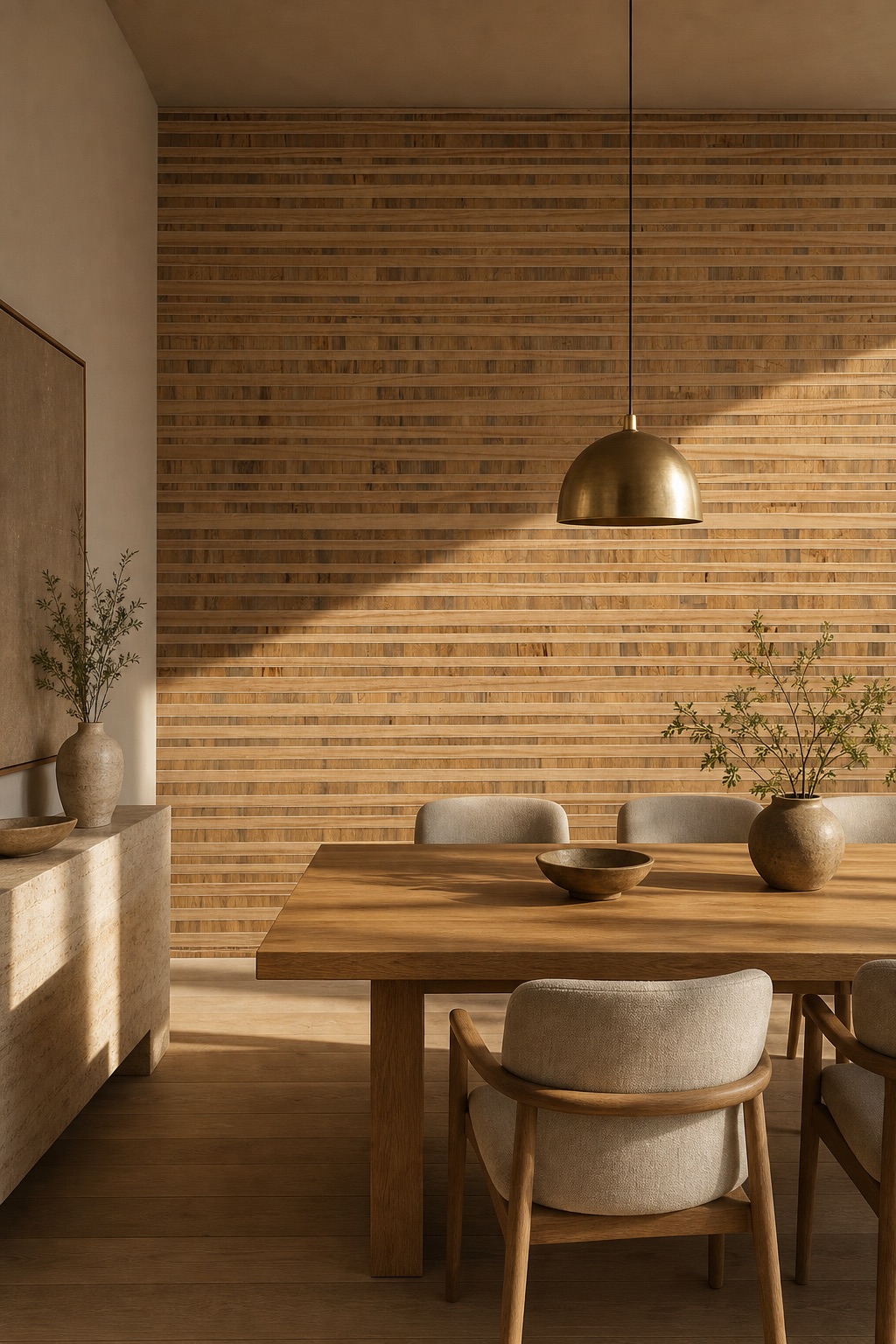
- Primary colour is warm honey-tan: amber-influenced rather than grey-leaning, distinctly richer than sand or pale-straw alternatives
- Morning diffuse daylight: golden straw component advances, shadow gaps read warm brown — bright without being pale
- Under warm-white LED at 2700–3000K, the amber register intensifies and the whole surface reads golden
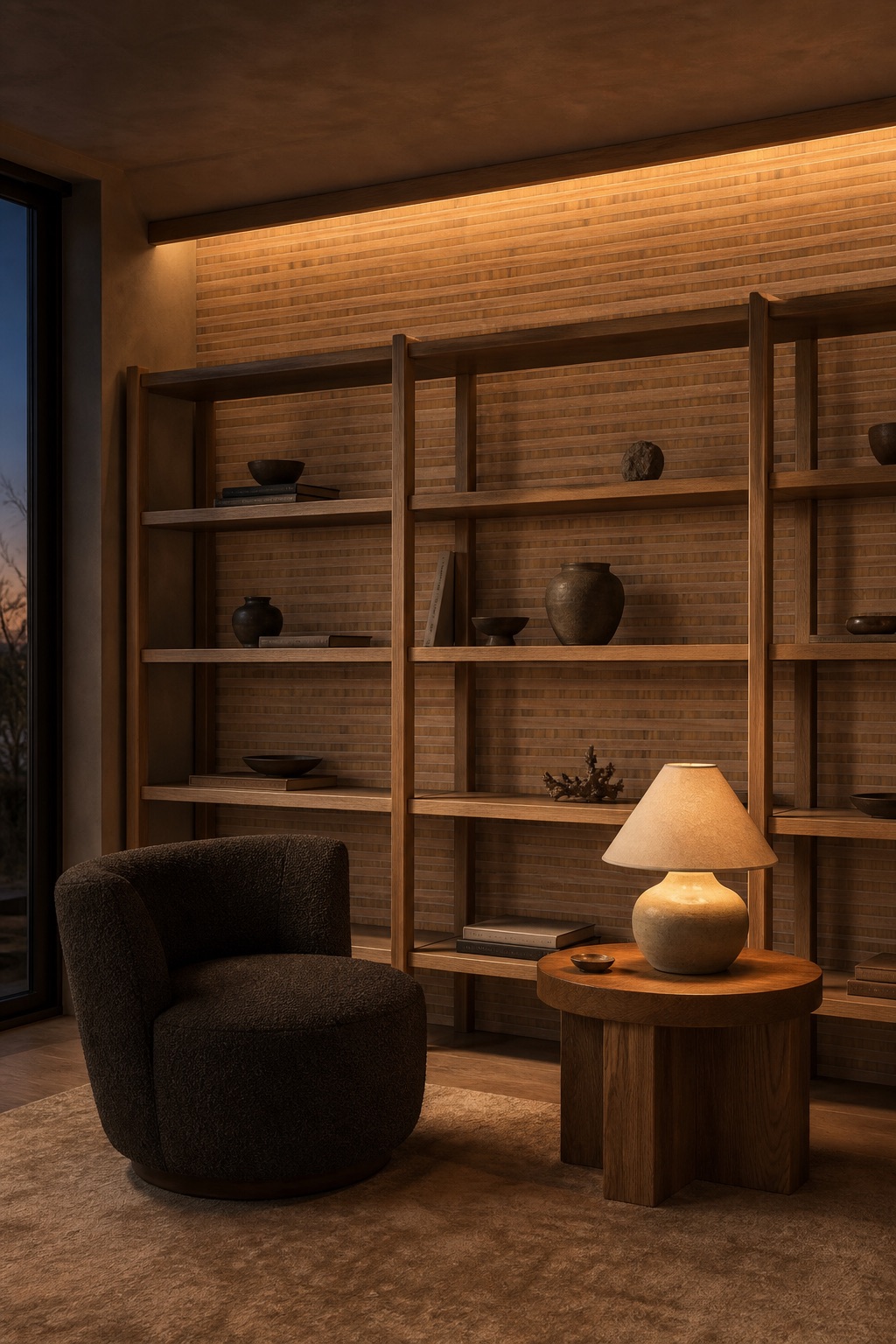
- Evening lamplight: bands deepen toward amber, shadow gaps darken to near-charcoal, sharpening horizontal definition
- North-facing or cool daylight: honey tone shifts gently toward buff — remains warm beside travertine, plaster, or linen
- Matte finish eliminates glare at all lighting angles, an advantage in rooms with multiple direct sources
The ground colour is a warm honey-tan: amber-influenced rather than grey-leaning, and distinctly richer than pale-straw or sand-toned siblings. Under morning diffuse daylight, the golden straw component comes forward and the shadow gaps read as warm brown — the surface feels bright without being pale. As daylight reduces and warm lamps take over, the whole wall deepens: bands glow amber and the gap shadows cool slightly toward charcoal, sharpening the horizontal rhythm and adding visual depth. Warm-white LED sources at 2700–3000K bring out the amber register most fully and are the recommended specification for evening-use dining rooms or hotel suites. In a north-facing room under cool daylight, the honey tone desaturates gently toward buff, remaining warm beside stone, plaster, or linen but calmer and less saturated than under direct sun.
Dining Rooms, Hotel Suites, and Study Walls: Where This Natural Beige Bamboo Wallcovering Performs
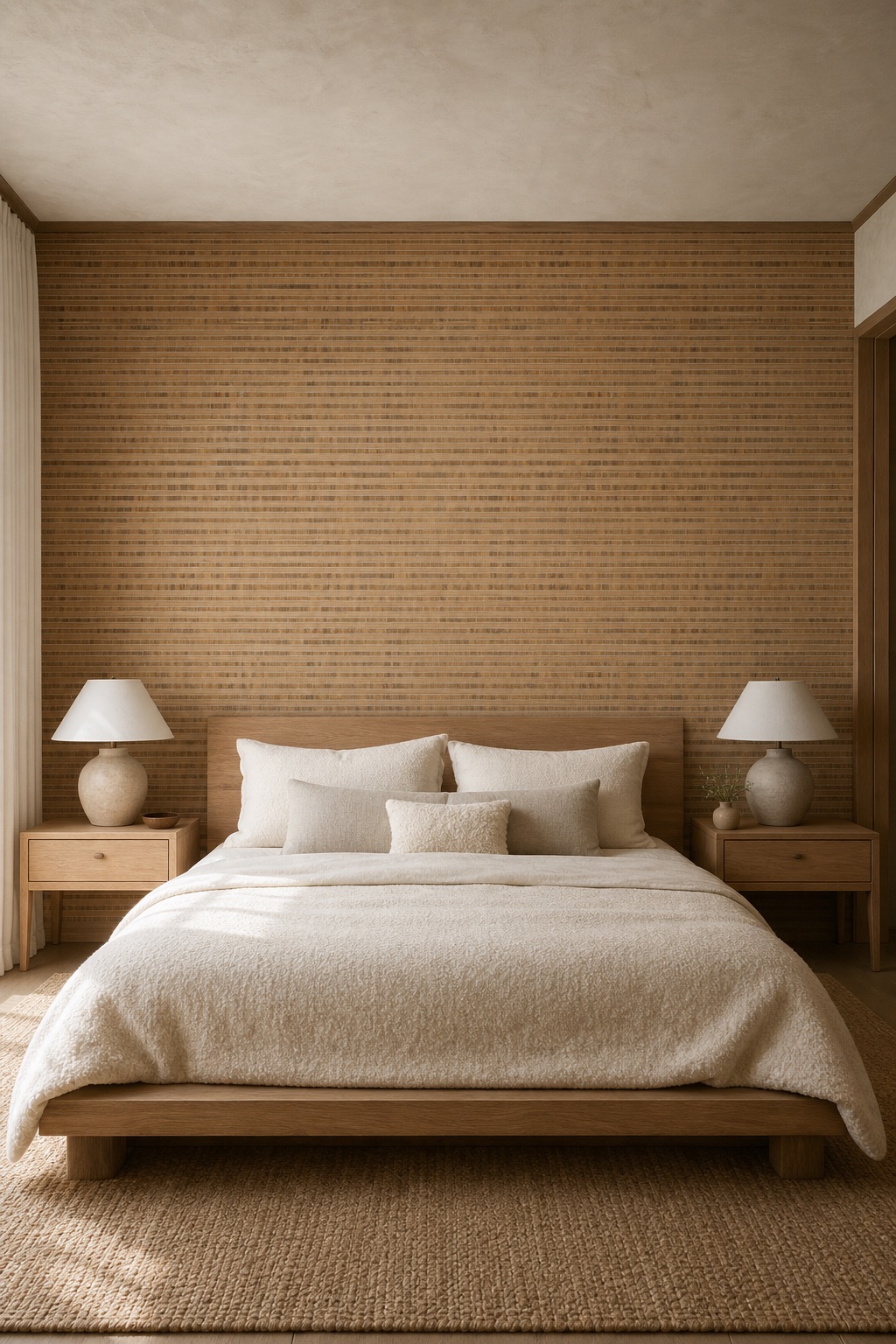
- Dining rooms: amber register deepens under evening pendant or candlelight, wrapping the space in quiet, grounded warmth
- Hotel suites and boutique hospitality: wide-reed surface delivers tactile interest that photographs well without relying on pattern
- Study and library walls: earthy tone and horizontal rhythm provide a calm backdrop behind shelving with enough presence on bare sections
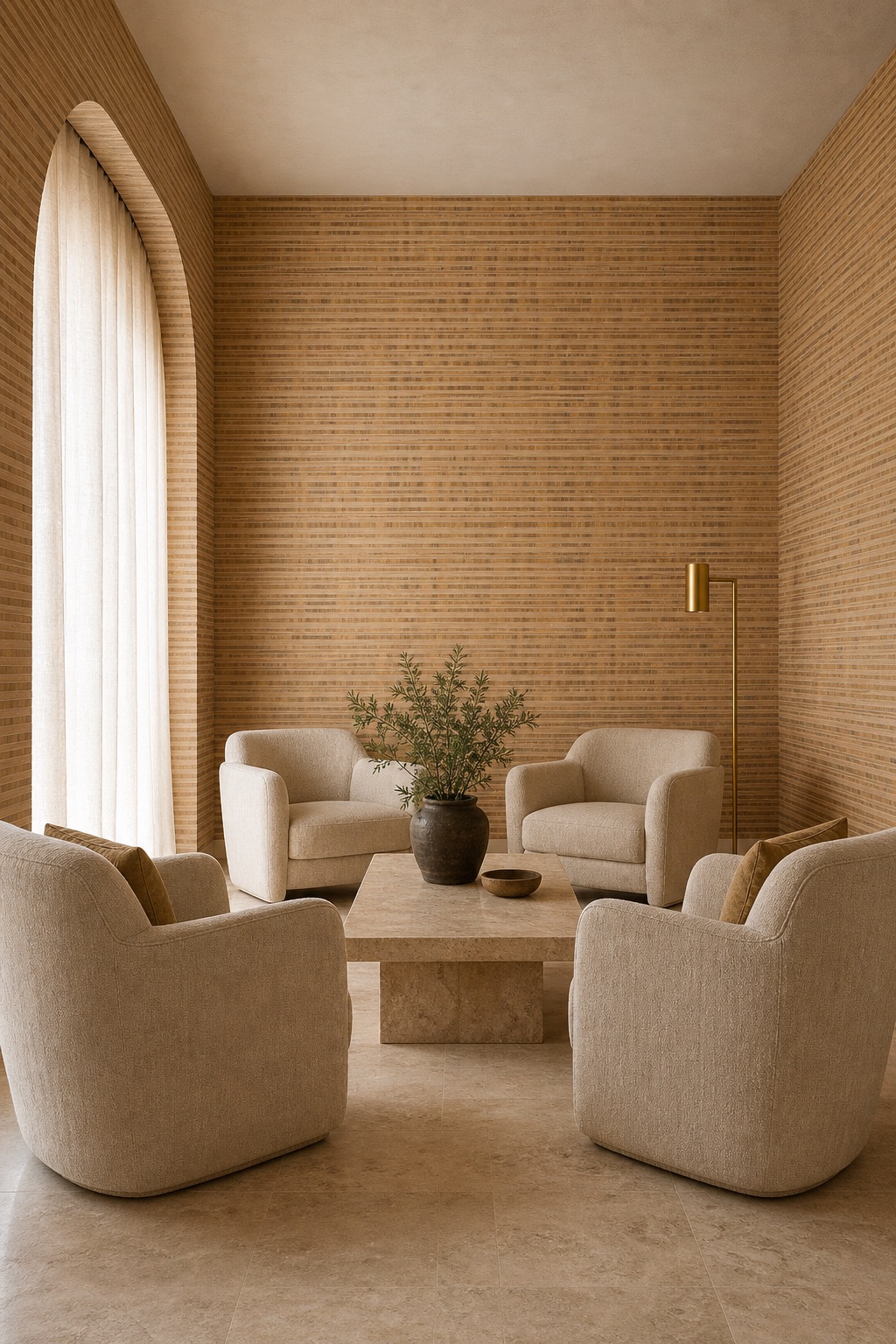
- Best companion materials: oak and plaster for Japandi registers, travertine and linen for organic-modern, unlacquered brass for evening dining
- Works best as the primary textured surface; restraint in companion pattern selection lets the reed rhythm read clearly
- Less suited to heavy pattern-layering; the bold horizontal cadence needs breathing room
The combination of warm honey-tan colour and bold horizontal relief makes Honey Reed a natural backdrop for spaces that need character without dramatic intervention. In dining rooms, the amber register deepens under candlelight or warm pendant lighting, wrapping the space in quiet, grounded warmth. In hotel suites and boutique hospitality settings, the wide-reed surface delivers tactile interest that photographs well and holds the eye without relying on pattern or colour contrast. Study walls and private libraries benefit from the earthy tone and horizontal rhythm: the surface is calm enough to recede behind open shelving yet present enough to hold a bare wall section. Companion materials that work particularly well include oak and plaster for Japandi registers, travertine and linen for organic-modern schemes, and unlacquered or aged brass for evening dining atmospheres.
Natural Fibre Variation and Seam Planning: What Specifiers and Installers Need to Brief
- Colour shifts within each band, slight thickness irregularities, and occasional darker strands are characteristic of natural bamboo — not quality defects
- Brief end-clients on natural variation before sample approval to set accurate expectations
- Horizontal wide-reed wallcovering requires deliberate seam planning: seams are visible at close range and should align with natural wall junctions
- Each roll is 0.915 m × 5.5 m (approximately 5 m²); a 10–15% waste allowance is standard for seam trimming and length matching
- The wallcovering calculator supports quantity estimation; complex layouts benefit from a site measure by a qualified installer
- Heavy-duty wheat starch or pre-mixed heavy-duty paste is appropriate for natural fibre applications
Natural bamboo wallcovering carries inherent variation: colour shifts along each reed band, slight differences in strand thickness, and occasional darker filaments are all part of the material's character rather than defects, and specifiers should brief end-clients on this before samples are approved. For installation, horizontal wide-reed construction requires deliberate seam planning. Seams are visible at close range (within approximately one metre) and should be positioned at natural wall junctions such as inside corners or door reveals, where the slight surface step draws the least attention. Each roll is 0.915 m wide by 5.5 m long (approximately 5 m²); a 10–15% waste allowance is standard for seam trimming and length matching. Our wallcovering calculator at /tools/wallcovering-calculator provides a starting quantity estimate; for complex room layouts, a site measure by an experienced commercial wallcovering installer is advisable.
From Reference to Certified Roll: How the Grasscloths Studio Delivers Honey Reed to Specification
- 3 in-house designers, founder active in natural wallcovering since 2018 — specification support is built into the process from first contact
- Paid sample book lets you evaluate the physical material; credit from the book is applicable against any resulting order
- Paid proof quoted upfront; proofing takes approximately 1–2 weeks from confirmed reference
- Bulk production confirmed on the pro-forma invoice: 4–6 weeks standard materials; 5–8 weeks specialty construction
- Single dye-lot per production run, with a per-batch lot certificate provided with every order
- Love this weave in a different colour or scale? The studio engineers custom colourways from your colour reference — CAD from mood board or paint chip, validated at proof stage before full production commits
Our studio runs three in-house designers and has been working with natural fibre wallcovering since the practice was founded in 2018. The specification process is structured in four stages: a paid sample book gives you the physical material to evaluate, with a returnable credit applicable against any order that follows. Once a sample is approved, a paid proof is quoted and produced — proofing typically takes one to two weeks from confirmed reference. Bulk production follows payment confirmed on the pro-forma invoice; standard materials ship in four to six weeks, specialty constructions in five to eight weeks. Every production run is assigned a single dye-lot designation, and a per-batch lot certificate is provided with each order, supporting specifiers' documentation requirements. Love this weave but need your own colour or a different scale? Our design studio engineers custom colourways from your colour reference — we turn a mood board or paint chip into CAD and validate the result at proof stage before full production commits.
Buying grasscloth for a project or a brand?
- Minimum order
- 50 rolls (about 250 m²) catalog · 100 rolls custom / private label
- Lead time
- 4–6 weeks standard · 5–8 weeks specialty, after sample approval and payment
- Terms
- EXW Chengdu · FOB, CIF, DDP on request
- Samples
- Free digital kit in 24 h · paid swatch pack, credited in full on your first order
- Reply
- Within 24 hours
Frequently asked
- Will honey-tan bamboo wallcovering fade in a south-facing room with strong direct sunlight?
- Natural bamboo fibres can warm and lighten over time with prolonged UV exposure. South-facing walls with unobstructed sunlight are the highest-risk placement; UV-filtering glazing substantially slows the process. See our fading prevention guide at /guides/fading-prevention for practical installation and maintenance steps.
- How visible are the seams in wide horizontal reed wallcovering once it is installed?
- Seams are detectable at close range (within about one metre) where the slight surface step between rolls is perceptible, but they largely disappear at normal viewing distance of two to three metres. Planning seams into inside corners or positioning them behind vertical furniture lines minimises their visual presence further.
- Is this natural bamboo wallcovering suitable for a hotel bathroom or other humid environment?
- Natural fibre wallcoverings are sensitive to prolonged elevated humidity. A well-ventilated hotel bathroom with controlled ambient humidity is workable with appropriate installation preparation; a steamy residential bathroom without mechanical ventilation is not recommended. Our humidity risks guide at /guides/humidity-risks covers conditions and installation precautions in detail.
- Can the honey-tan tone be matched to a specific wood finish or paint colour for a coordinated scheme?
- Yes. Our in-house design studio can engineer a custom colourway from a physical reference sample or a specified paint code. The proof stage confirms the match before bulk production begins. Contact us at /contact to discuss your reference.
- What are the minimum order requirements and payment structure for a trade order?
- Full order minimums, payment stages, and lead times are covered on our process page at /process.