Green Herringbone Grasscloth Wallpaper
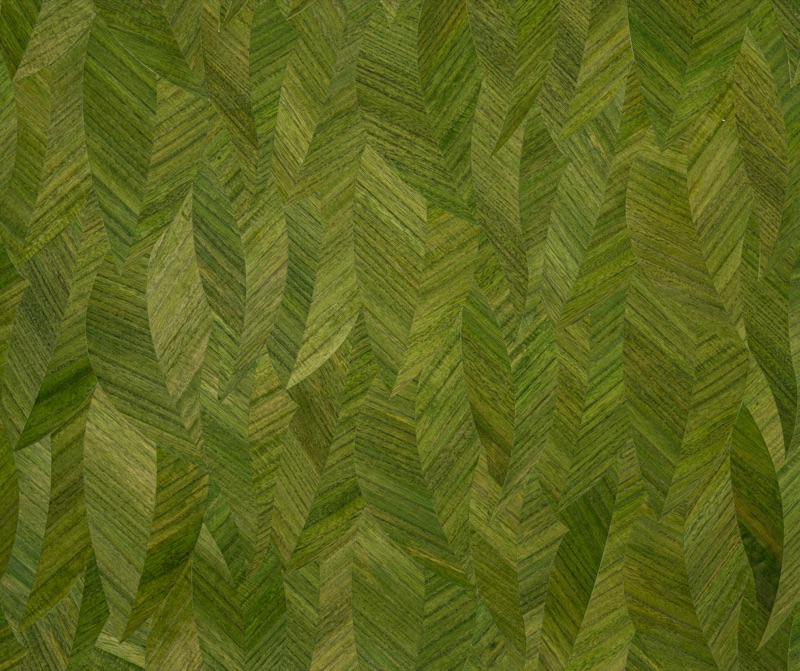
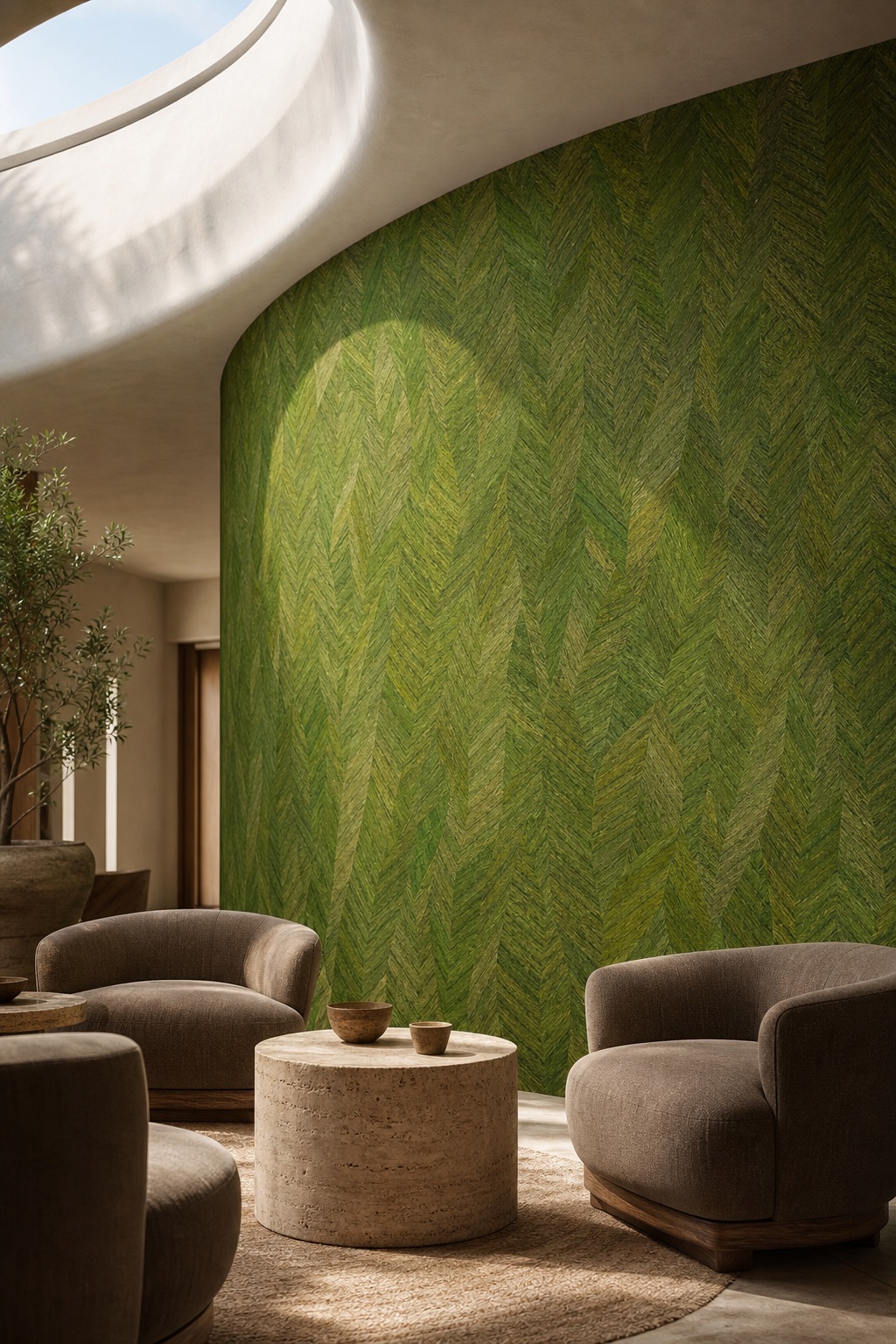
Wide flat reed bundles, arranged into overlapping leaf-shaped panels against a warm olive-green ground, give Canopy Chevron a surface reading that is less strictly geometric than botanical. Supplied to designers and trade buyers from 50 rolls, it presents in three natural tones of green (yellow-green, mid olive, and deep forest) that shift with the striations of each individual reed rather than through uniform dye variation. The fully matte finish absorbs light rather than reflecting it, making this green herringbone grasscloth wallpaper a reliable performer on feature walls where organic richness without glare is the brief.
Wide Reed, Leaf-Panel Logic: How Canopy Chevron Reads Across a Full Feature Wall
- Individual reed bundles are wide and flat, not yarn-twisted; each shows visible lengthwise striations that distinguish this material from fine-weave or seagrass alternatives.
- In the chevron orientation, alternating panels fan outward into shapes the eye reads as interlocking leaves rather than strict V-grooves, giving the surface an organic character that softens at distance.
- At a typical 3-metre viewing distance, the geometric structure dissolves into a continuous botanical rhythm that reads comfortably beside upholstery and artwork without competing.
- The bold texture scale registers clearly on walls wider than 3 metres without becoming restless or repetitive, making it well suited to double-height hotel panels and large open-plan living features.
- Because the finish is fully matte, the relief between reed bundles reads through shadow depth alone; there is no glare from window-facing installations, and the surface holds its character under both natural and artificial sources.
The reed bundles in Canopy Chevron are wide and flat, closer in character to a woven ribbon than a twisted yarn, and each carries visible lengthwise striations that give the surface its grain. When these bundles are set at the chevron angle, alternating panels fan outward to form interlocking leaf shapes rather than the uniform ridges of a narrower herringbone. From viewing distance, the pattern reads as organic surface texture rather than a repeating geometric motif. This makes the weave valuable for specification: it is bold enough to anchor a large feature wall without resolving to conventional wallpaper pattern in the way that printed alternatives do. The matte finish reinforces the botanical reading and eliminates glare concerns for window-adjacent walls.
Three Greens, One Ground: How Canopy Chevron's Palette Shifts With Changing Light
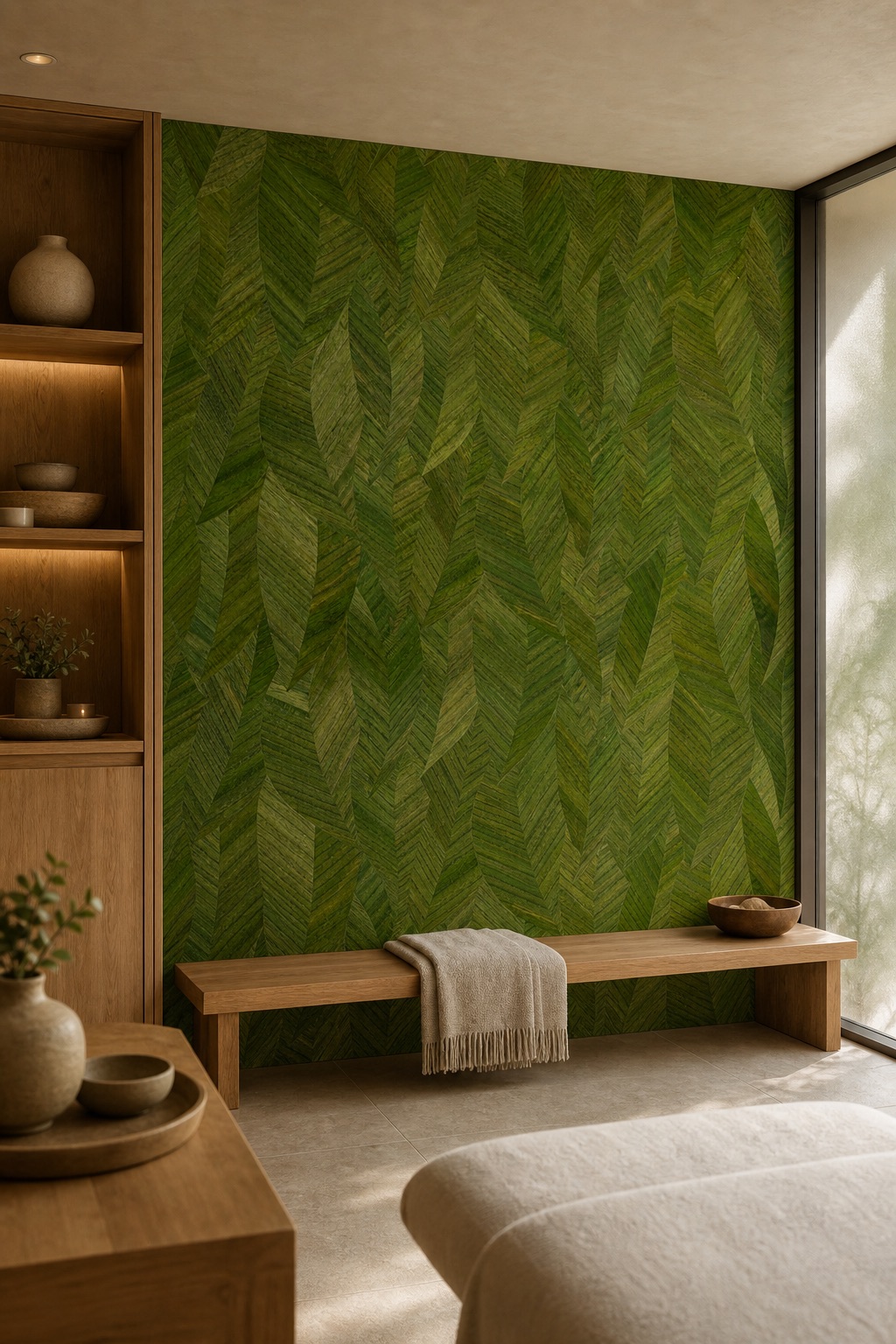
- In morning and afternoon daylight, the yellow-green secondary tone activates and the surface reads as vivid, fresh olive.
- Under warm-white LED or incandescent sources (2700K to 3000K), the deep forest-green component strengthens and the overall cast becomes richer and more verdant.
- North-facing or cool-daylight rooms will push the olive toward a greyed sage; specifiers should compensate with warmer fixture temperatures and companion materials in brass or warm oak.
- The warm undertone prevents the colour from crossing into blue-derived or grey-derived greens under common light sources tested at our studio.
- A site sample review across morning and late-afternoon light before committing to the full quantity is recommended wherever colour accuracy is critical to the scheme approval.
Canopy Chevron carries three tones on a single ground. The mid olive holds the field; yellow-green highlights run along the raised reed faces; deep forest green settles into the shadow lines between bundles. Under morning and afternoon daylight the yellow-green brightens and the surface feels fresh and alive. As daylight fades and warm artificial sources take over, the forest component strengthens and the palette turns richer. In cool or north-facing light the warm undertone remains visible but the olive can edge toward sage, which is worth noting in scheme planning. Companion materials in brass, aged oak, and warm ivory plaster reliably bring the olive back toward its warmer register regardless of ambient light source.
Spa and Wellness, Living Rooms, and Dining Interiors: Where Green Herringbone Grasscloth Wallpaper Performs
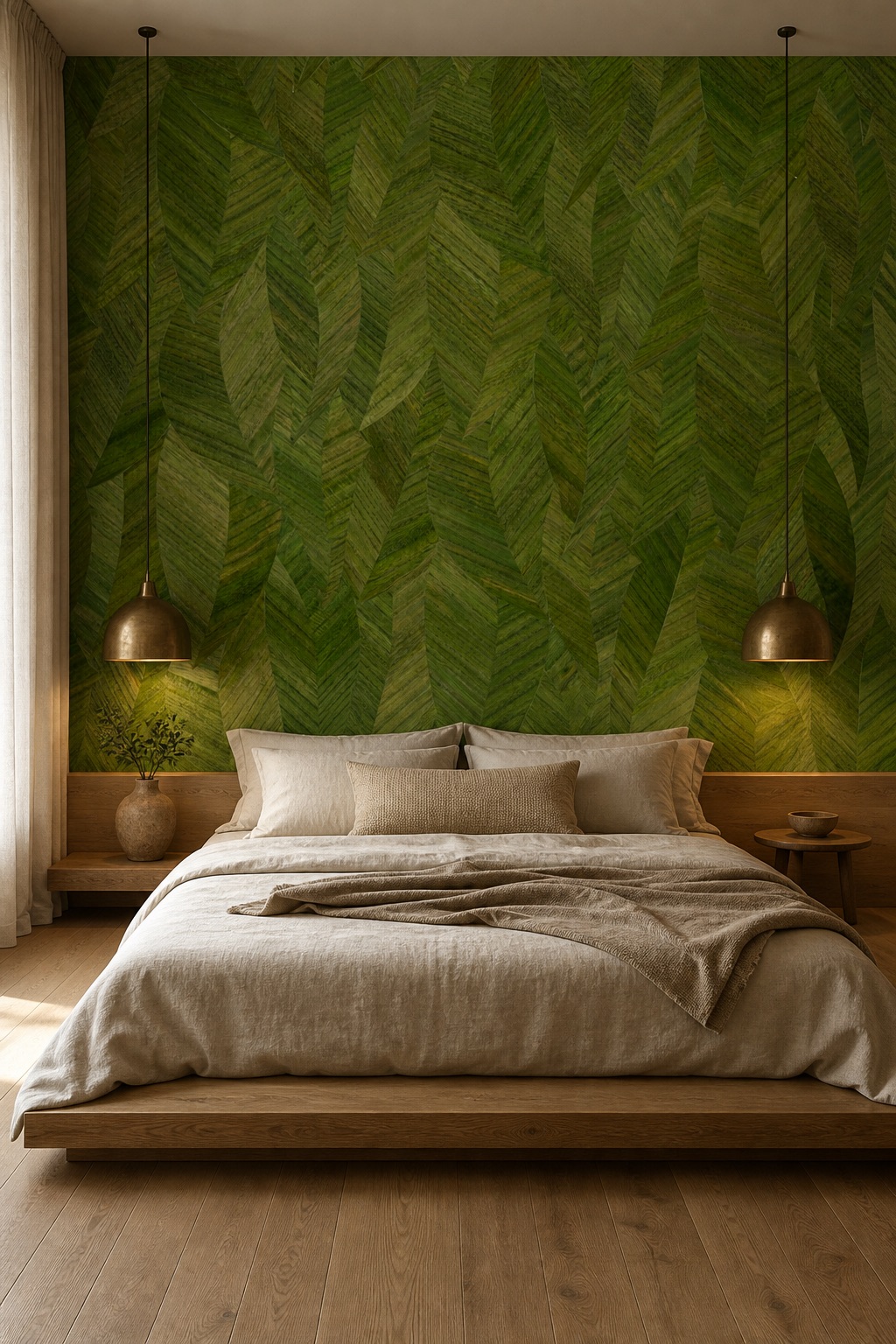
- Spa and wellness reception, corridors, and consultation rooms: warm olive reads as living foliage without referencing any specific botanical print, providing a biophilic quality suited to wellness environments.
- Residential living rooms and dining features where a natural material needs to serve as the primary scheme anchor.
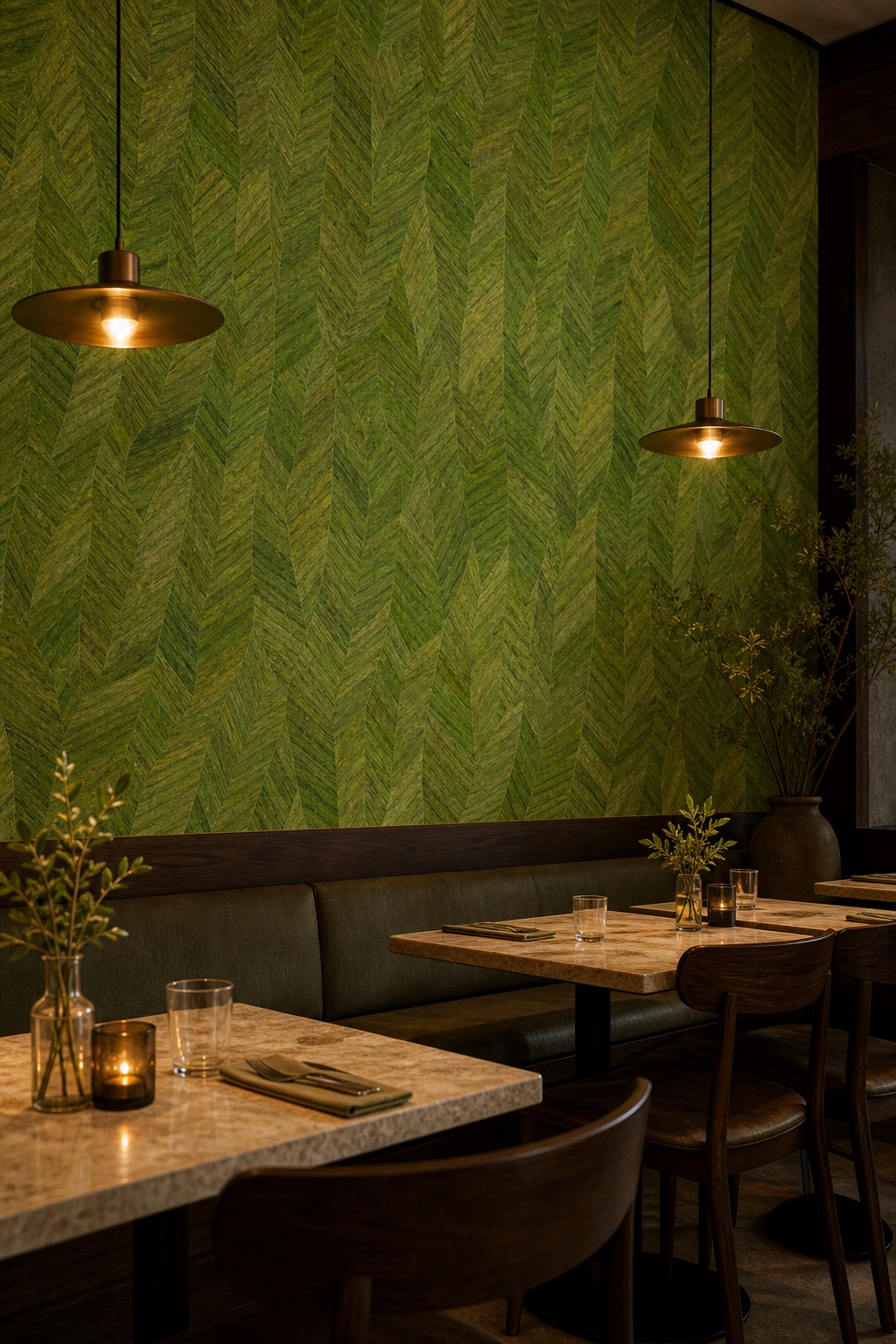
- Restaurant feature walls and hotel lobby panels where bold pattern scale holds legibility at distance without requiring directional lighting to be appreciated.
- Coastal and organic-modern projects: the yellow-green warmth keeps this material clearly in the earthy-botanical register, well away from blue-derived nautical greens.
- Full-room wraps in eco-lodges, spa suites, or boutique hotel rooms where the natural grasscloth is the dominant material statement rather than one element among several.
The botanical character of this green herringbone grasscloth wallpaper makes it a strong fit for interiors where organic warmth is the primary brief. In spa and wellness environments it delivers a foliated quality without a literal print, which tends to date faster than a structural textile surface. In residential living rooms and dining areas it anchors open-plan schemes that need a grounded, natural focal point. For hospitality specifiers, the bold pattern scale carries across the volume of a room without requiring close-range inspection to be appreciated, which matters for double-height lobbies and restaurant panels. The warm yellow-green undertone keeps it clearly in the earthy-organic register and away from the cool, blue-derived greens that read as nautical rather than botanical in coastal settings.
From Sample Request to Dye-Lot Certificate: How a Canopy Chevron Order Is Built
- Paid sample books are credited against subsequent orders (up to 10%), keeping speculative material assessment commercially appropriate for both parties.
- When a colourway or scale modification is required, a paid proof is quoted upfront and completed in approximately 1 to 2 weeks, establishing the colour gate before payment is confirmed on the pro-forma invoice.
- Orders proceed on the terms confirmed on the pro-forma invoice; production of standard natural grasscloth materials from this pattern family runs 4 to 6 weeks from confirmation.
- Each production run carries a single dye-lot; per-batch lot certificates are provided so site teams and procurement managers can document material traceability across a project.
- Three full-time in-house designers translate client colour and scale references into mill-ready CAD specifications; our founder has worked directly in the natural wallcovering trade since 2018, with sourcing relationships across 1 to 3 partner mills.
- Ocean freight, air freight, and courier costs are quoted separately at the buyer's cost; FOB, CIF, and DDP terms are available depending on destination and order volume.
A Canopy Chevron specification begins with a paid sample book, credited against the order value once the material is approved and a quantity is committed. When a colourway adjustment is needed, a paid proof is quoted upfront and returned in approximately 1 to 2 weeks, so the design programme timeline is clear before production funds are placed. Production runs on the terms confirmed on the pro-forma invoice; standard natural grasscloth takes 4 to 6 weeks from order confirmation to ready-to-ship. Every production batch ships with a dye-lot certificate, giving project documentation a clear material traceability record. Our three in-house designers handle the translation from client reference to mill specification directly, and our founder's relationships with partner mills since 2018 mean that material queries are answered by people who know these textiles, not by intermediaries.
Canopy Chevron in Your Reference: Commissioning a Custom Colour on This Weave
- Love this weave structure but need it in sage, deep hunter, or a different ground entirely? Our design studio engineers custom colourways from your reference — whether a paint chip, fabric swatch, or digital hex value.
- Custom colourways require a minimum of 50 rolls (approximately 250 m²) per colourway; first-trial orders on stock patterns may carry lower minimums.
- The paid proof stage (1 to 2 weeks) is the critical colour gate: the match is reviewed under your specified light source before full production begins and payment is confirmed on the pro-forma invoice.
- OEM and private-label supply is available from 50 rolls; the chevron geometry, reed width, and structural scale of this weave remain consistent across any ground colour.
- Our custom colourway guide covers the full commissioning process, including how to submit a reference, what to expect from the proof, and how dye-lot management works across multiple production batches.
The wide-reed herringbone structure of Canopy Chevron can be produced across a range of ground colours beyond the stock olive-green. Our design studio takes client references (a paint chip, a fabric swatch, a digital hex value) and manages the translation into a mill-ready specification for production with our partner mills. The minimum for a custom colourway is 50 rolls (approximately 250 m²). A paid proof, completed in approximately 1 to 2 weeks, validates the colour match before production begins. For OEM or private-label requirements, the same weave geometry and reed scale are maintained across any ground colour, giving importers and specification teams a consistent structural reference across colour ranges. Full process details are in our custom colourway guide.
Buying grasscloth for a project or a brand?
- Minimum order
- 50 rolls (about 250 m²) catalog · 100 rolls custom / private label
- Lead time
- 4–6 weeks standard · 5–8 weeks specialty, after sample approval and payment
- Terms
- EXW Chengdu · FOB, CIF, DDP on request
- Samples
- Free digital kit in 24 h · paid swatch pack, credited in full on your first order
- Reply
- Within 24 hours
Frequently asked
- Will the olive-green in Canopy Chevron fade noticeably in a south-facing room with strong direct sunlight?
- Natural grass reeds are susceptible to UV-induced fading, particularly in the yellow-green range that gives Canopy Chevron its brightness. We recommend UV-filtering glazing or installation on walls away from direct sun exposure for south-facing rooms, and we can provide sample-based fade guidance on request. Our fading prevention guide covers this in detail at /guides/fading-prevention.
- How visible are the seams on a herringbone pattern at this bold scale?
- The wide reed bundles and strong diagonal structure of this weave make seam alignment more exacting than with fine-weave alternatives. A professional installer with grasscloth experience is strongly recommended; our studio can advise on reverse-hanging technique, which reduces visible seam contrast on bold herringbone patterns. See /guides/handle-seams for a full overview.
- Is green herringbone grasscloth wallpaper suitable for humid environments such as spa bathrooms or wellness rooms?
- Natural grasscloth performs reliably in controlled-humidity environments such as spa reception areas, corridors, and treatment rooms, but it is not recommended for wet rooms or surfaces with direct moisture contact. For spaces where ambient humidity regularly exceeds 70% RH, we advise testing a sample in situ before committing to a full order.
- What are the minimum order quantity and payment terms for this wallpaper?
- Full details on MOQ, proof costs, payment structure, and lead times are on our process page at /process.