Green Grasscloth Wallpaper
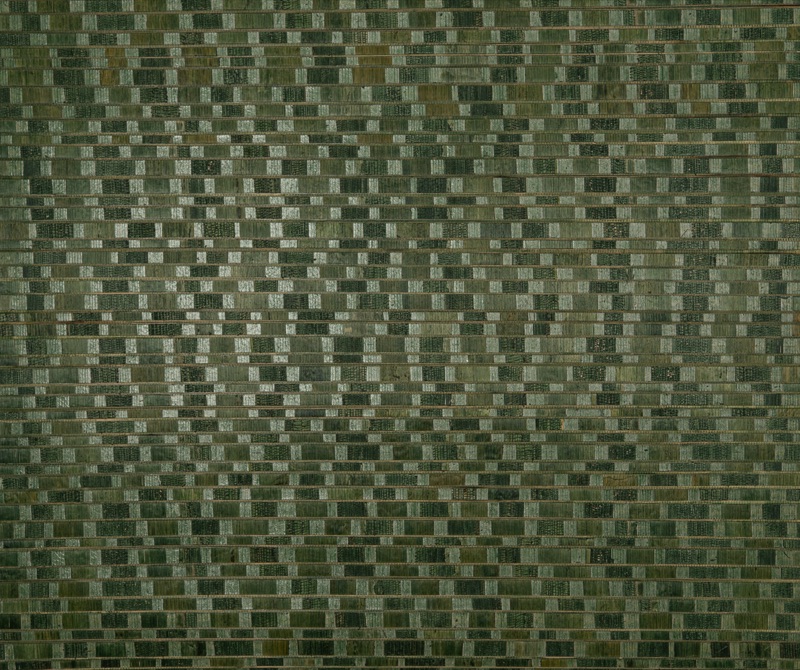
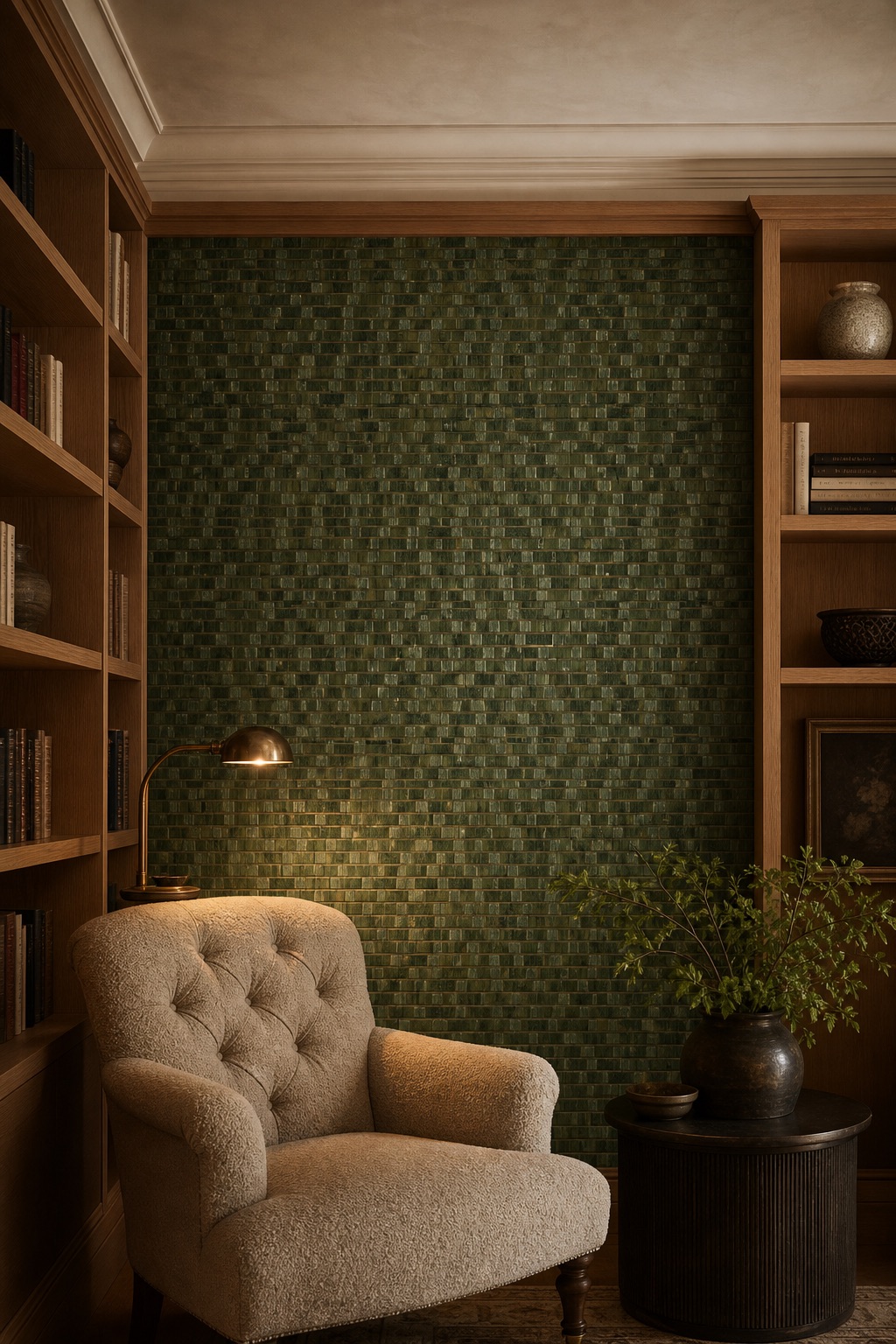
Moss Grid is a deep olive-green grasscloth woven in a tight block basket-weave: small rectangular reed units set in a near-uniform grid, with natural khaki and forest-green variation across the surface that keeps the wall from reading as flat. Produced with our partner mills to our design studio's specification, this green grasscloth wallpaper is supplied to interior designers and trade buyers from 50 rolls. The warm olive undertone holds in both artificial and natural light, making it equally at home on a hotel-suite feature wall or a residential bedroom accent.
A Grid of Living Colour: How Moss Grid's Block Weave Reads at Wall Scale
- Small rectangular block units alternate warp and weft orientation across the grid, creating micro-scale light and shadow variation that prevents the surface from reading as flat or printed.
- Deep olive ground is punctuated by lighter khaki and pale celadon catches where lighter weft strands surface; at room distance the wall reads as a unified mid-green with quiet internal depth.
- The block-by-block colour variance produces a living, organic quality that becomes more pronounced as viewing distance decreases — detail that repays close attention without demanding it at scale.
- Texture scale is fine; from across a room the grid registers as a dense woven field, then resolves into legible individual block units when approached.
- Single dye-lot production minimises inter-roll colour variation within an order, which matters for multi-drop feature walls where consistency across the full installed width is critical.
The surface works because no single block carries exactly the same colour as its neighbour. Deep forest units sit alongside warmer khaki ones, with occasional pale celadon catches on lighter weft strands; the effect at room scale is a wall that reads as green, but never as uniform. Fine texture scale means the weave disappears into quiet texture from across the room, then resolves into legible structure as you move closer: the kind of surface that rewards attention without demanding it.
Olive in Different Light: How This Green Grasscloth Wallpaper Shifts Through the Day
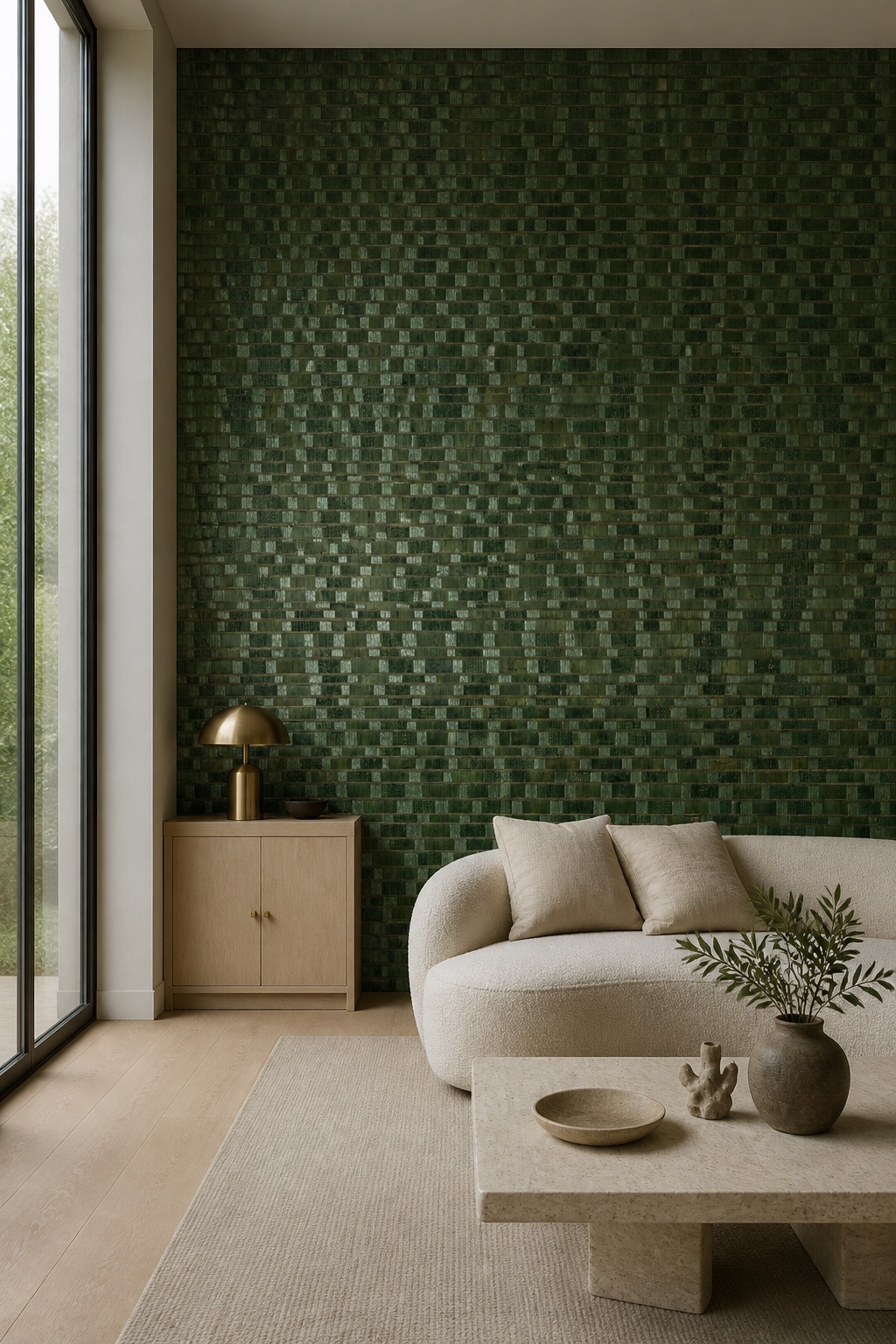
- Warm incandescent or candlelight pulls the khaki and amber notes forward; the wall reads as golden-green, slightly warmer than the swatch viewed under neutral conditions.
- Cool daylight (north-facing rooms, overcast conditions) suppresses the warm undertone, letting the forest-green and pale celadon notes read more clearly for a quieter, more restrained surface.
- The low sheen means no hot spots or glare at any angle; the surface absorbs and scatters light rather than reflecting it, keeping the wall legible under both raking and directional sources.
- For hospitality and residential specification: test the sample under the room's actual light source before committing to an order, as the colour shifts meaningfully between warm and cool fixtures.
This is a wallcovering with a genuinely split character: warm-sourced light warms it toward khaki and sage, cool light deepens it toward muted forest. Neither reading is wrong — both are latent in the weave. The absence of significant sheen keeps the transitions gradual rather than abrupt, which is why this green grasscloth wallpaper reads comfortably in rooms with mixed or changing light conditions. A proper sample test under the installed fixture type is recommended before finalising an order.
Hotel Suites, Spa Interiors, and Japandi Residential Walls: Where Green Grasscloth Wallpaper Performs
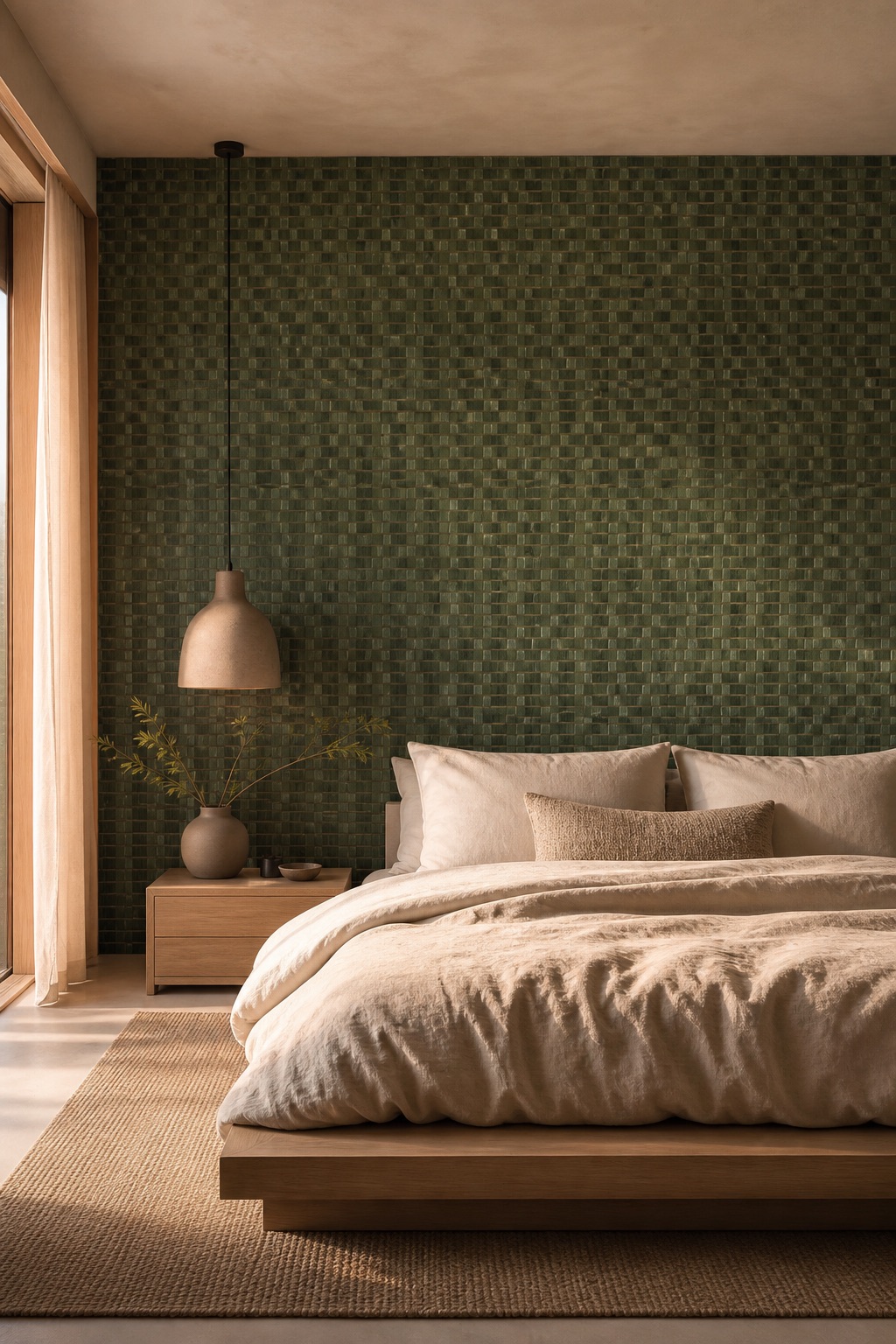
- Bedroom feature wall: deep olive creates enclosure and warmth without compressing perceived room volume; pairs naturally with undyed linen, pale oak, and plaster.
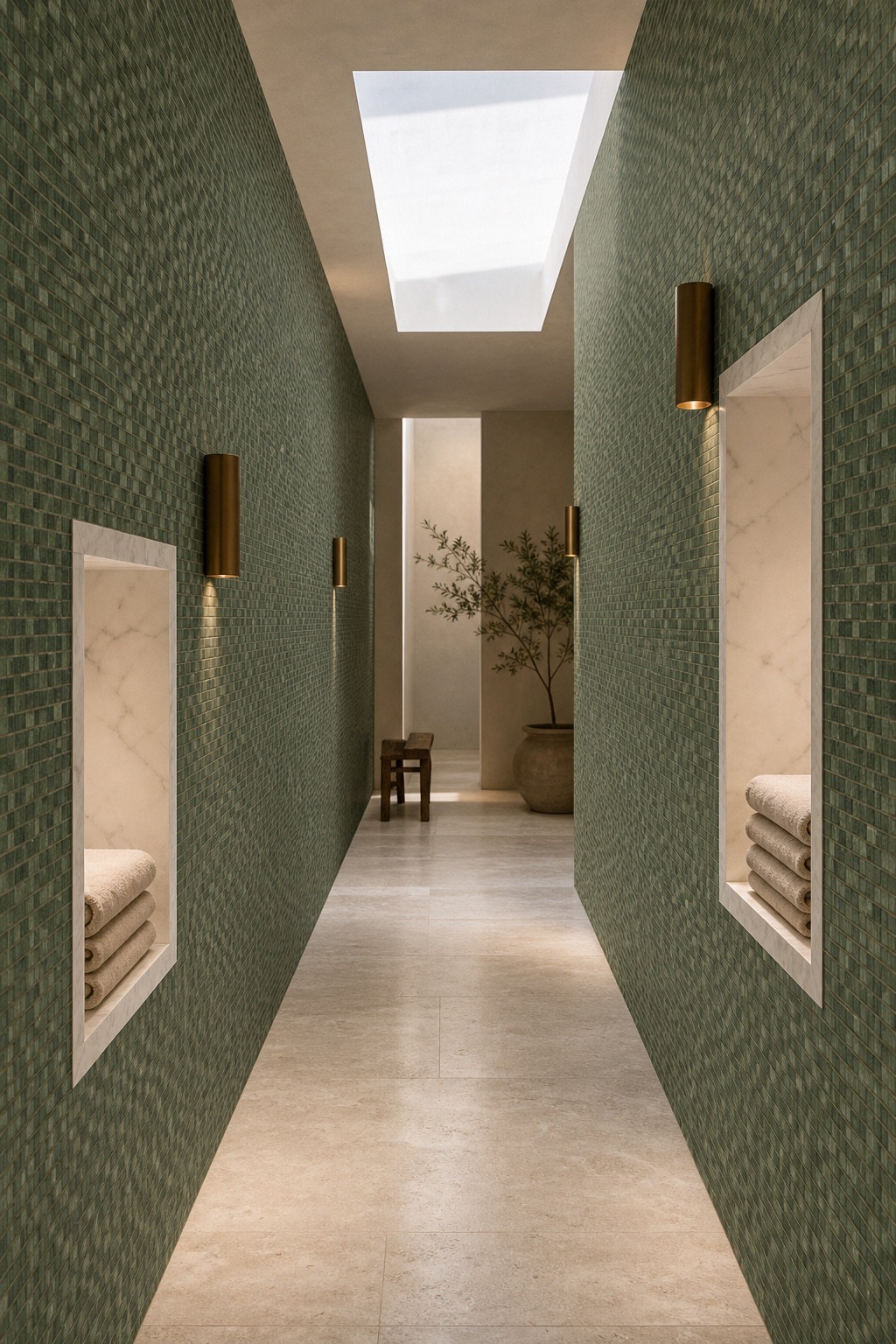
- Hotel suite and spa: the japandi and organic-modern style coding aligns with current wellness-hospitality design direction; the colour reads as grounding rather than stimulating.
- Study or home library: the mid-dark value and fine weave provide visual richness appropriate to a focused working or reading environment; natural fibre has some inherent sound-absorbing quality (no independent quantitative test data for this specific product).
- Biophilic design applications: the olive-to-forest colour range references foliage and moss without requiring literal botanical motifs, appropriate for projects targeting wellbeing-led design briefs.
- Not recommended for direct-moisture areas (splash zones, steam rooms, unventilated bathrooms); our humidity guide sets out the specific conditions to assess before specifying.
The japandi and wabi-sabi style coding of this green grasscloth wallpaper is deliberate: the block weave and olive palette speak to hand-craft, restraint, and the natural world, which aligns with the direction premium hotel wellness and residential projects are moving. It is a surface that makes a room feel considered rather than decorated — the right register for a spa suite headwall or a residential feature wall that does not want to compete with the furniture.
Your Colour Reference on This Structure: Custom Colourways on the Moss Grid Weave
- The block basket-weave structure can be reproduced in custom colourways from a reference swatch, paint chip, or brand colour file.
- Our three in-house designers translate the reference into a production-ready CAD specification before any proofing begins, ensuring the brief does not drift between concept and loom.
- Custom colourways carry a minimum order of 50 rolls (approximately 250 m²); a paid proof round is quoted individually before any production commitment is made.
- Proofing turnaround is approximately 1 to 2 weeks; standard production follows at 4 to 6 weeks for natural materials.
Love this weave but need your own colour or scale? Our design studio engineers custom colourways from your reference (paint chip, Pantone, or physical swatch). Three resident designers work in CAD, so the brief travels from concept to loom specification without leaving the team; custom colourway MOQ is 50 rolls, with a paid proof round quoted before any order commitment. Our custom colourway guide has the full process detail.
Sample Approval to Lot Certificate: How a Moss Grid Specification Moves Through Our Studio
- Sample books are available for a paid fee, credited against a confirmed order (up to 10% of order value); they are the correct starting point before committing to a proof round.
- Paid proofing is quoted individually and confirmed before work begins; approximately 1 to 2 weeks turnaround from brief sign-off.
- Production runs on the terms confirmed on the pro-forma invoice; order terms (FOB, CIF, or DDP) are discussed and confirmed at the quote stage.
- Every production batch ships with a per-batch lot certificate documenting dye-lot consistency; single dye-lot production is standard practice, critical for multi-roll feature-wall and corridor specifications.
- Our founder has worked in natural wallcovering sourcing and supply since 2018; three full-time in-house designers support specification, custom colourway development, and technical documentation throughout each order.
The sequence is always the same: paid sample book, then a firm decision to proof, then production confirmed on the pro-forma invoice. It is a structure built around dye-lot integrity: every run produces a single lot, certified and documented, so what you approved in the sample matches what arrives on site. For full commercial terms our process page has the complete detail; if you have a specific project timeline in hand, contact us directly.
Buying grasscloth for a project or a brand?
- Minimum order
- 50 rolls (about 250 m²) catalog · 100 rolls custom / private label
- Lead time
- 4–6 weeks standard · 5–8 weeks specialty, after sample approval and payment
- Terms
- EXW Chengdu · FOB, CIF, DDP on request
- Samples
- Free digital kit in 24 h · paid swatch pack, credited in full on your first order
- Reply
- Within 24 hours
Frequently asked
- Will the olive-green colour fade over time, and should I take precautions for a sun-exposed room?
- Natural plant fibres (including the flat-cut reed in this weave) will shift gradually toward khaki or straw tones with prolonged direct sunlight, which is an expected and natural ageing characteristic of organic materials. For rooms with significant south- or west-facing solar exposure, UV-filtering window film or positioning the feature wall away from direct beam slows this process considerably. Our fading prevention guide covers practical mitigation measures in detail.
- How visible are seams on a large wall with this block-weave pattern?
- Because the block grid has no strong directional linear pattern and warp and weft units are close in scale and tone, seams are generally less conspicuous than on a bold horizontal rib or herringbone. A trained installer using a clean butt-join technique and consistent vertical plumb on each drop will achieve results where seams recede into the weave. Reverse-hanging alternate drops is not typically necessary for this structure but can be specified if tone variation between rolls is a concern.
- Is this grasscloth suitable for a hotel spa or wellness area with elevated ambient humidity?
- Natural grasscloth performs well in rooms with elevated ambient humidity provided mechanical ventilation (standard HVAC) is present; a hotel spa corridor or wellness suite with climate control is generally an appropriate application. Direct moisture contact, steam, or splash zones are not suitable for any unsealed natural fibre. Our humidity guide sets out the specific conditions and mitigation measures to assess during the specification stage.
- Where do I find full ordering terms including MOQ, payment terms, and lead times?
- Complete commercial detail, including MOQ structure, payment terms, and standard production lead times, is on our process and FAQ page.