Charcoal Grasscloth Wallpaper
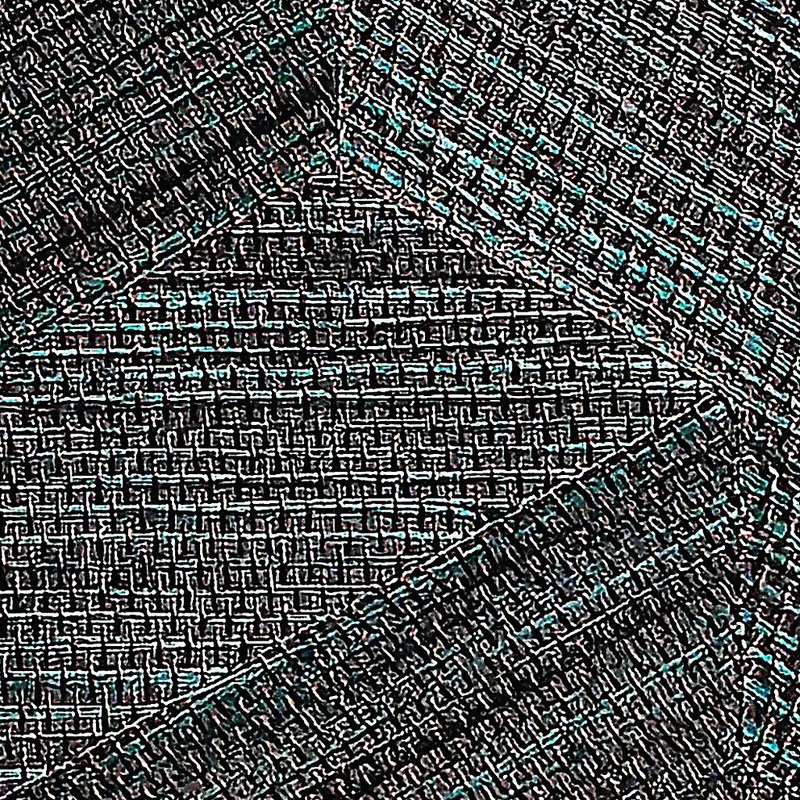
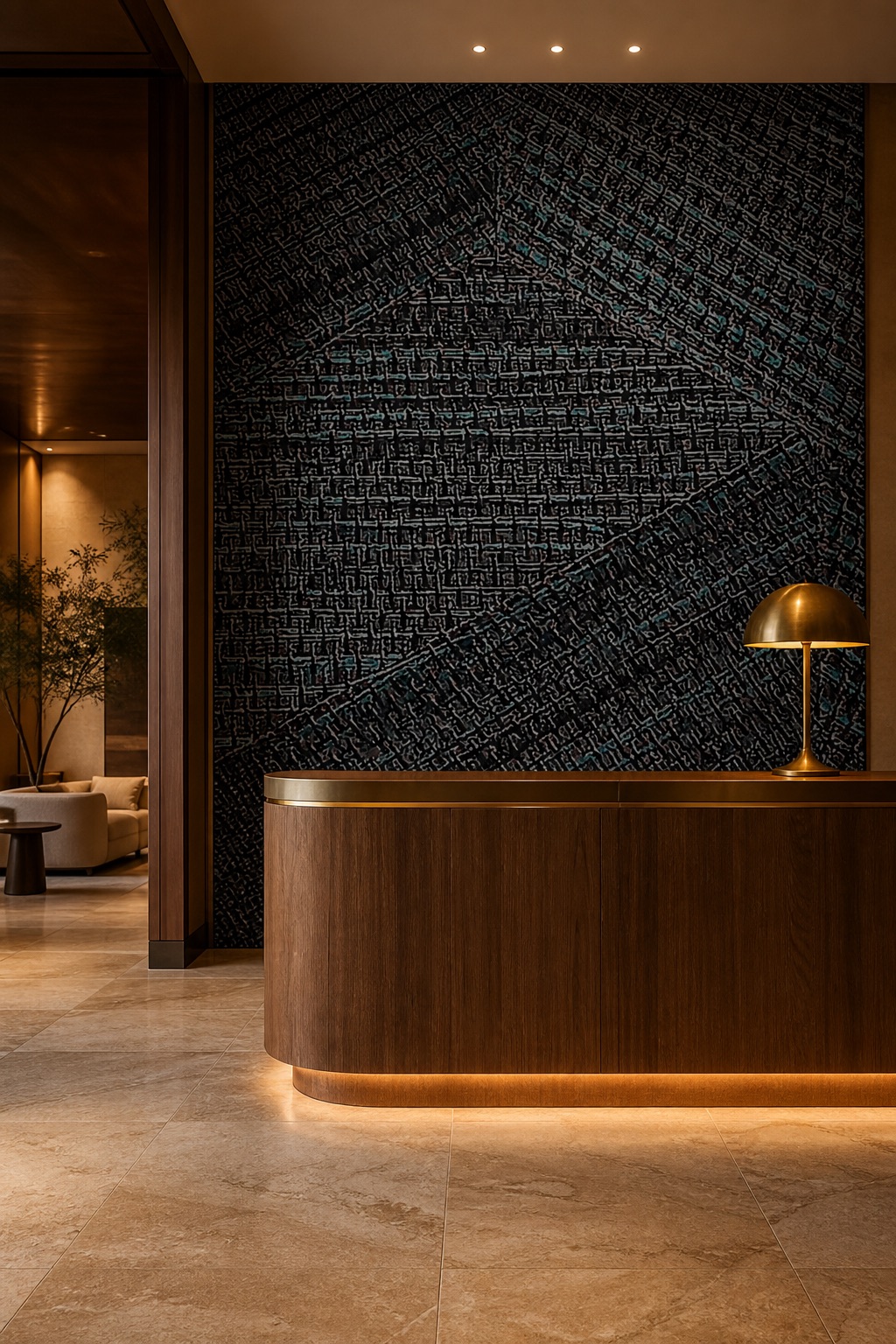
Teal Ember is a deep charcoal grasscloth built from flat twisted natural strands woven into an open plain-weave grid, its panels set in alternating diagonal runs to produce a herringbone rhythm across the wall. Threads of muted teal surface at the warp-weft intersections — invisible at a glance from across a room and quietly present at close range, a material detail that rewards the kind of attention a well-considered interior invites. Produced with our partner mills to a consistent open-grid specification and supplied to interior designers, hospitality buyers, and trade specifiers from 50 rolls (≈250 m²), it brings the tactile weight of natural fibre together with a graphic geometry that reads differently under every light condition.
Weft Grid and Herringbone Direction: How This Weave Is Structured
- The base construction is an open plain-weave grid: flat twisted natural strands cross at right angles, leaving visible intersections that give the surface its tactile honesty and prevent the darkness from reading as flat or painted.
- The herringbone geometry is not a woven pattern but a structural result of panel orientation — adjacent panels are applied in opposing diagonal directions, creating a V-rhythm that spans the full wall when correctly hung.
- Because the herringbone arises from how panels are laid rather than from a woven repeat, the installer must plan the hanging sequence from a centre axis; an even number of panels per wall ensures the pattern completes without an orphan half-panel.
- At a roll width of 0.915 m, each roll contributes one herringbone unit — sharing reverse-hang guidance with the contractor at specification stage is strongly recommended.
- The medium texture scale means the grid reads clearly under both ambient and directional lighting without competing with finer furnishing details.
The weave structure of Teal Ember is an open plain-weave grid — flat twisted natural strands crossing at right angles, leaving the intersection points visible and tactile. The herringbone effect across a hung wall is not a pattern embedded in the weave itself but emerges from how panels are oriented during installation: each panel runs diagonally in one direction; the adjacent panel reverses it. The resulting V-rhythm is a property of the installation sequence, which means the hanging contractor must plan from a centre axis and maintain an even panel count per wall to complete the geometry cleanly. At 0.915 m roll width, the scale of the herringbone unit is substantial — directional and graphic at distance, clearly hand-woven at close range.
Teal in the Dark: Reading the Accent Threads at Distance
- At close inspection, teal-turquoise accent threads appear at the warp-weft intersections, introducing a quiet chromatic note against the charcoal ground.
- At normal viewing distance — two metres and beyond — the teal recedes and the wall reads as near-uniform deep charcoal; the material rewards close attention without announcing itself from across the room.
- Under warm filament or amber lighting the teal cools slightly toward sage; under cool northern daylight it reads more clearly as turquoise.
- The dual character — deep-dark at distance, chromatically complex close up — suits environments where guests move through a space: hotel corridors, restaurant booths, bar back-walls.
- Love this weave but need your own accent colour or a different scale? Our design studio engineers custom colourways from your reference — send a Pantone, a RAL code, or a material chip and the team turns it into a production specification.
The teal accent is the subtlest feature of Teal Ember and arguably its most characterful one. At close reading distance the teal-turquoise threads appear at the warp-weft intersections — a faint jewel note against the darkness. Step back to a normal viewing distance and the wall flattens to a near-solid deep charcoal; the accent is present but not performing. Light temperature shifts the reading: warm amber light draws the teal toward sage; cool northern daylight clarifies it toward turquoise. This dual behaviour makes the material well suited to spaces where guests approach and move away — hotel corridors, bar back-walls, restaurant booths — because the wall offers a different experience at each distance.
The Spatial Effect of Deep Charcoal: Volume, Mood, and Light Absorption
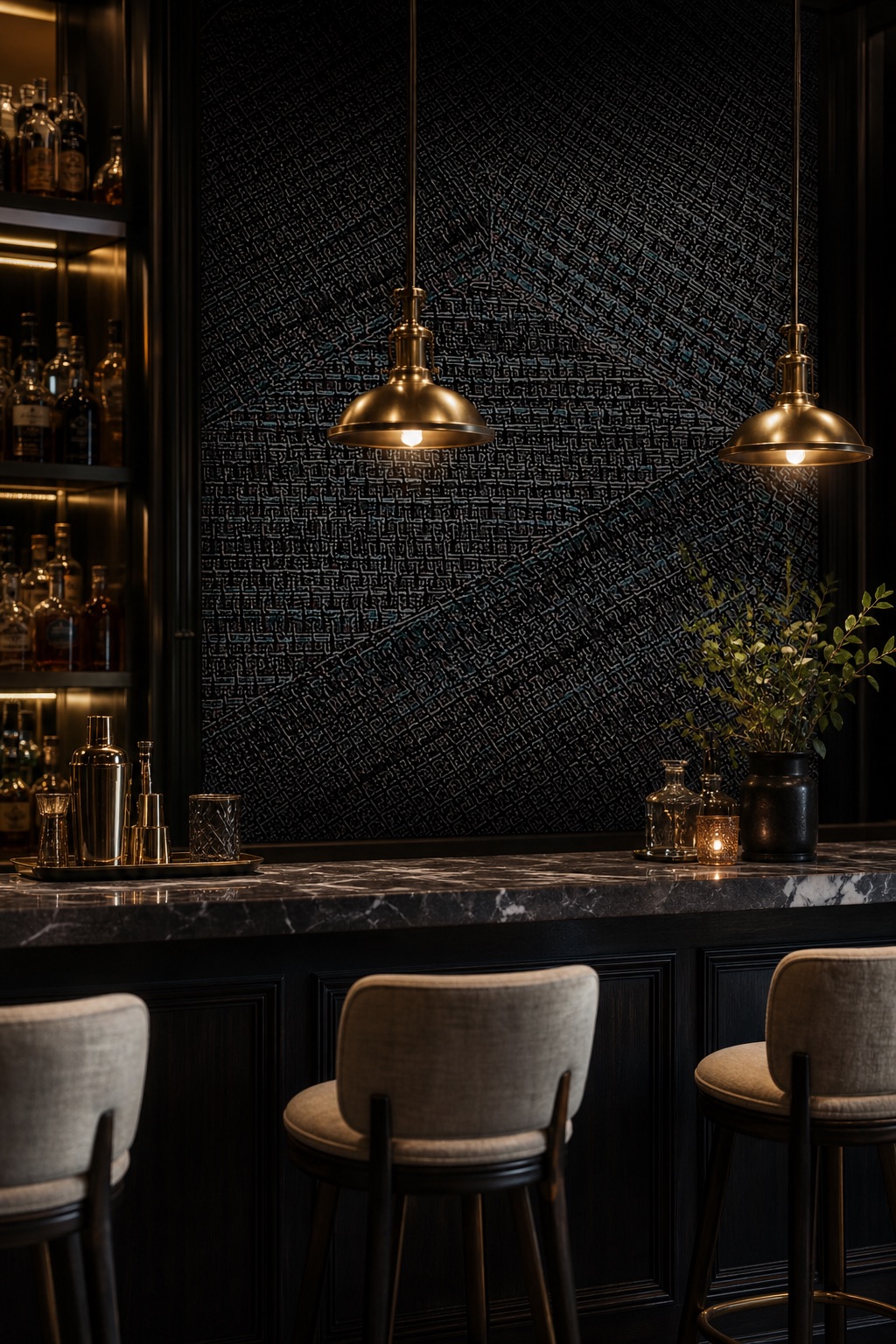
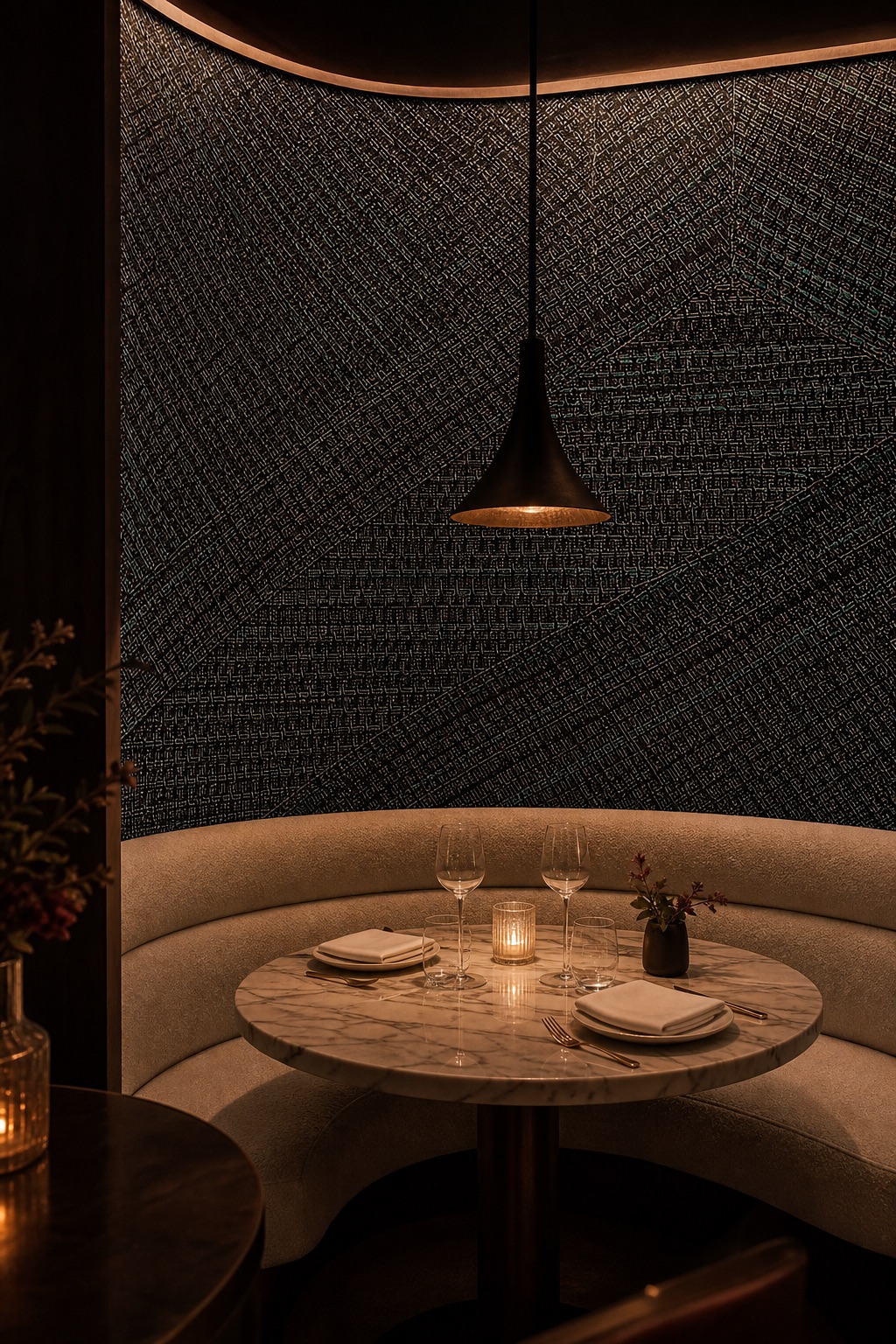
- Dark walls absorb ambient light and reduce perceived room volume, making spaces feel more enclosed, focused, and intimate — a deliberate compositional tool in hospitality and residential design.
- Light-coloured materials — travertine, ivory linen, bleached oak, marble — stand forward against a charcoal ground with heightened presence; the dark wall acts as a stage rather than a backdrop.
- The open grasscloth grid ensures the darkness has tactile depth; unlike a painted or smooth dark wallcovering, the surface's visible warp-and-weft energy prevents the wall from reading as flat or heavy.
- Under directional downlighting, the diagonal texture of the herringbone creates micro-shadows that shift as the viewer moves, giving the surface gentle animation across the day.
- In daylight rooms the colour runs from near-black at dawn and dusk to a warmer dark charcoal at midday, when the cool teal undertone reads most clearly.
- A single accent wall in a neutral-toned room delivers strong contrast; full-room installation in larger spaces — lobbies, restaurant dining rooms — creates enveloping atmosphere without requiring additional layers.
Dark walls work by controlling the visual weight of a room, and Teal Ember does this with a natural material's honesty. The charcoal ground absorbs ambient light and draws perceived volume inward, lending intimacy to larger spaces and focused gravity to smaller ones. What prevents the depth from feeling oppressive is the open weave: the plain-weave grid keeps the surface tactile and porous-looking, and the herringbone geometry introduces subtle shadows under directional light that animate the wall through the day. Light-coloured companion materials — travertine, bleached oak, marble, ivory bouclé — gain clear presence against the dark ground, so the colour choice that can seem restrictive in a sample book becomes a liberating compositional tool at full installation scale.
Hospitality, F&B, and the Statement Commercial Wall: Where Teal Ember Belongs
- Hotel lobbies, cocktail bars, private dining rooms, and members' clubs are the primary commercial contexts: the dark ground reads refined under warm pendant and downlighting, and the natural fibre surface provides modest acoustic absorption.
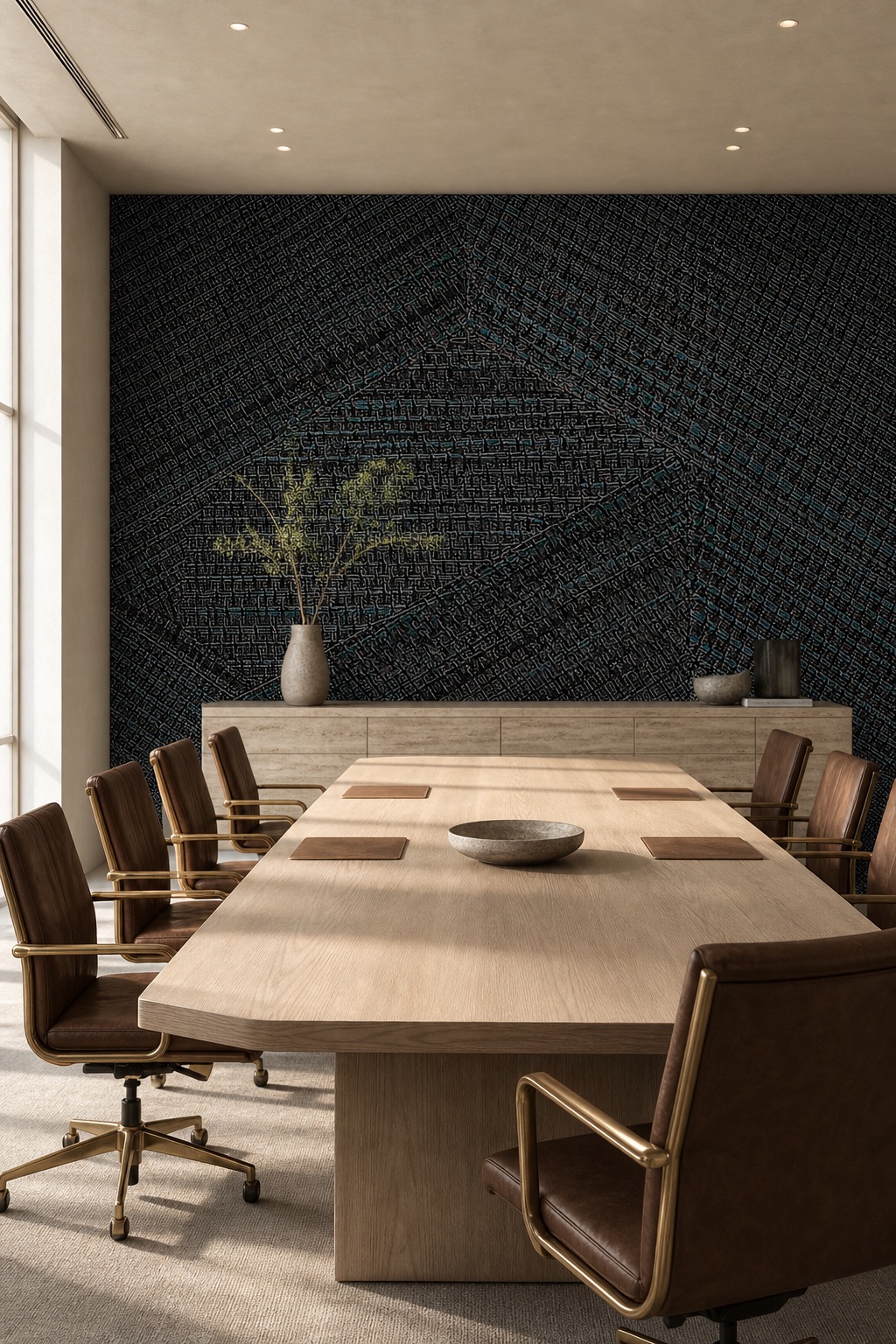
- Corporate reception areas and executive boardrooms benefit from the pairing of graphic strength and material restraint — the herringbone reads architectural rather than decorative.
- In residential use, primary bedrooms and home bars or wine rooms are optimal placements; the material is not recommended for bathrooms, kitchens, or any persistently humid environment.
- The medium texture scale suits full-height walls above 2.5 m; floor-to-ceiling installation maximises the herringbone geometry's visual impact and is preferred over wainscoting applications for this weave.
- Dark grasscloth requires professional hanging: seams are more visible against a dark ground than a light one, and correct adhesive, plumb lines from a centre axis, and rolled seams immediately after hanging are all essential.
The environments where Teal Ember performs best are those designed around atmosphere rather than daylight. Hotel lobbies and bars derive the most from the dark herringbone — pendant lighting casts warm pools across the textured surface, the grasscloth modestly absorbs reflected sound, and the teal accent threads read as a detail that guests discover rather than a feature that announces itself. Corporate reception areas and boardrooms benefit from the combination of graphical weight and natural material credibility. In residential contexts, primary bedrooms and home bars are the strongest fits; the material should not be installed in kitchens, bathrooms, or any space with persistent humidity or condensation risk.
Behind the Batch: Sampling, Dye-Lot Control, and How We Operate
- Our sample programme begins with a paid sample book — physical material in hand before any production commitment — and the cost is credited against your confirmed order value, up to 10%.
- Paid proofing follows: a production-scale sample confirming your specified colourway and weave, quoted individually before you commit, with a typical turnaround of one to two weeks.
- Orders proceed on the terms confirmed on the pro-forma invoice; FOB, CIF, and DDP terms are available depending on destination and volume.
- All grasscloth produced for a given order runs as a single dye lot; each batch ships with a per-batch lot certificate that links your project records to the specific production run — essential for specifications requiring documented material traceability.
- Three in-house designers translate client colour references — Pantone codes, RAL numbers, material chips, mood boards — into technical CAD specifications for the mill, so what you brief is what gets woven.
- Grasscloths was built on experience in natural wallcovering stretching back to 2018; grasscloth MOQ is 50 rolls (approximately 250 m² at 0.915 m × 5.5 m per roll), with production running approximately one month before ocean freight.
The process behind every batch of Teal Ember starts with a paid sample book — physical material in hand before any production decision. If the direction is right, paid proofing confirms the exact colourway and weave specification against a production sample, quoted before you commit. Orders then proceed on the terms confirmed on the pro-forma invoice; FOB, CIF, and DDP terms are available. Each production run is a single dye lot, and every batch ships with a lot certificate that links your project records to the specific run. Our three in-house designers handle the translation from client brief to mill specification, so a Pantone reference or a material chip becomes a precise technical instruction rather than an approximation. The practice was founded on experience in natural wallcovering that reaches back to 2018.
Buying grasscloth for a project or a brand?
- Minimum order
- 50 rolls (about 250 m²) catalog · 100 rolls custom / private label
- Lead time
- 4–6 weeks standard · 5–8 weeks specialty, after sample approval and payment
- Terms
- EXW Chengdu · FOB, CIF, DDP on request
- Samples
- Free digital kit in 24 h · paid swatch pack, credited in full on your first order
- Reply
- Within 24 hours
Frequently asked
- Will the teal accent threads fade at a different rate from the charcoal ground?
- Natural plant-fibre weft and dyed accent threads can respond to UV exposure differently. We recommend installing in low-to-moderate UV environments; in rooms with sustained direct sun, window film or UV-filtering glazing will meaningfully extend the colour stability of both the ground and the accent threads. Our guides on fading prevention cover this in more detail.
- How visible are the seams on dark charcoal grasscloth?
- Seams are more visible on dark grasscloth than on mid or light colourways because the panel edge can show as a faint pale line against the deep ground. Professional installation with correct adhesive, plumb lines established from a centre axis, and seams rolled immediately after hanging minimises this; we do not recommend DIY installation for this colourway.
- Does the herringbone pattern appear automatically, or does it require pre-planning before ordering and installation?
- It requires planning. The herringbone geometry is created by alternating panel orientation from a centre axis during installation — it does not appear automatically from the roll. Your installer should plan the hanging sequence and confirm the panel count before the first strip goes up. An even number of panels per wall ensures the pattern completes symmetrically, and we recommend sharing a reverse-hang brief with your contractor at specification stage.
- Can this material be used in a bathroom or in a climate with high ambient humidity?
- Natural grasscloth is not suitable for bathrooms, kitchens, or any space with persistent condensation or elevated relative humidity. It performs well in air-conditioned hotel rooms, restaurants, bars, and climate-controlled residential living areas. For humid-climate projects requiring a natural aesthetic, ask our studio about alternative weave options that may carry better moisture tolerance.
- What are the minimum order quantities and payment terms?
- Full details on MOQ, proofing costs, payment structure, and lead times are covered on our process and FAQ page at /faq.