Black Grasscloth Wallpaper: Espresso Chevron Reed
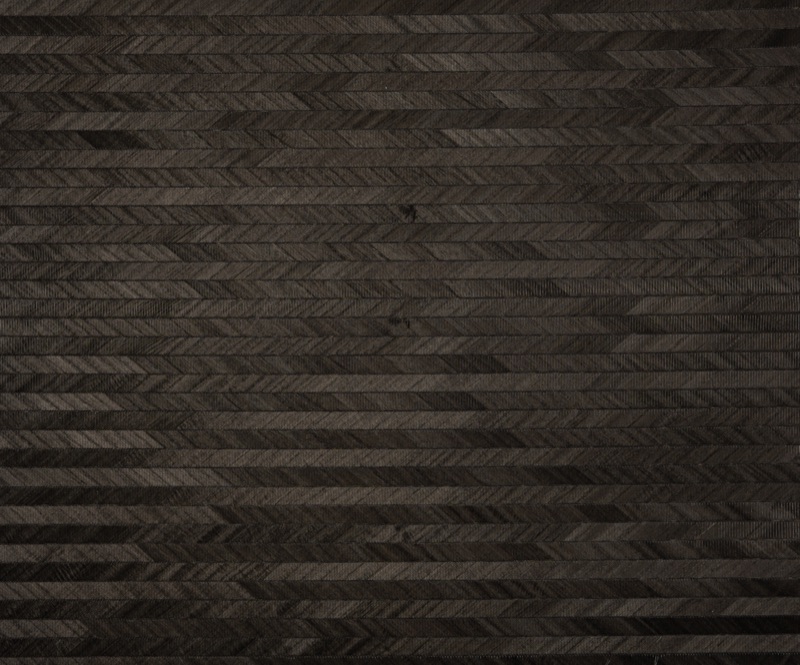
Espresso Chevron is a tightly woven, matte-finish grasscloth in deep espresso brown, its flat-pressed reed strands laid in a continuous herringbone that resolves into clean horizontal bands at wall scale. The colour sits between rich brown and near-black, with a warm undertone that deepens further under incandescent light. This black grasscloth wallpaper is supplied to interior designers and trade buyers from 50 rolls, and is specified for hospitality feature walls, private dining rooms, and residential master suites where a moody, material-led finish is the brief.
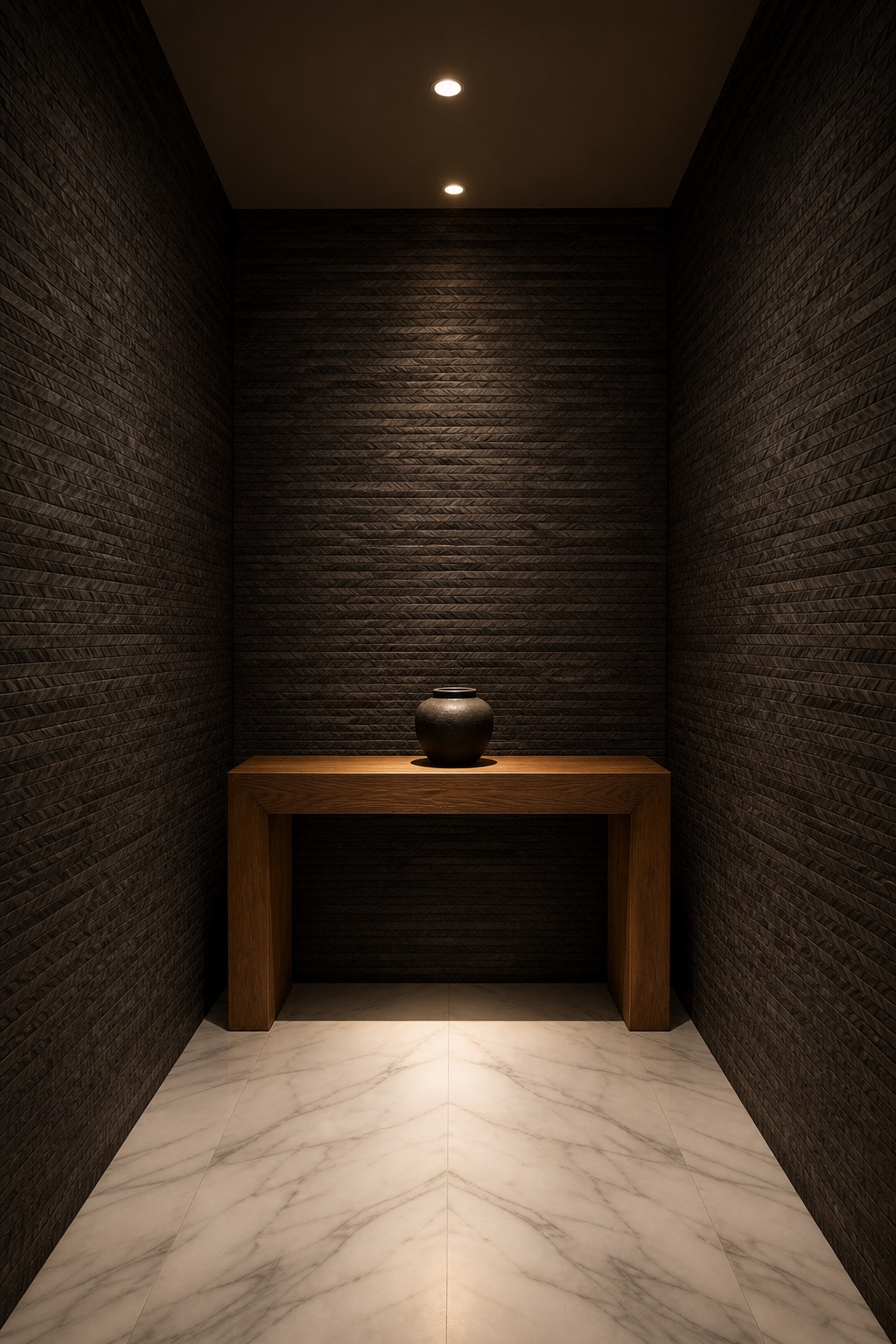
Near-Black in Shifting Light: Warmth, Depth, and How This Colour Transforms a Room
- The primary colour reads closest to black under cool northern daylight but reveals a distinctly warm espresso-brown undertone under tungsten or amber LED light.
- In daylit rooms the dark value advances the wall plane slightly, making a large space feel more contained and deliberate.
- Under evening lighting from pendants or sconces, the warm undertone opens and the angled herringbone strands catch directional light, producing depth without gloss.
- Adjacent pale surfaces (travertine, plaster, white marble) are sharpened by contrast against this depth, making each material read with greater definition.
- North-facing and artificially lit rooms suit this tone best; strong south-facing sun should be assessed via a full-panel sample before specifying.
Espresso Chevron's primary colour reads as near-black under cool northern daylight and shifts perceptibly toward a warm brown as the light source moves toward amber. Under incandescent or warm LED fittings, the herringbone strands catch light across their angled faces and produce quiet, directional depth without introducing any sheen. The practical consequence is a wall that performs differently morning to evening: structured and matte by day, textured and warm at night. Pale companion materials in travertine, plaster, or white marble are made more legible by contrast, each surface reading with greater precision against this depth.
Herringbone in the Horizontal Register: How the Chevron Pattern Is Built
- Each strand is flat-pressed reed of consistent width, woven at alternating diagonals to form the chevron unit.
- Those chevron units run in continuous horizontal registers across the roll, so the pattern resolves at viewing distance into clean banded rows rather than a restless diagonal grid.
- Alternating rows carry a micro-contrast in value, producing subtle visual movement as the viewer or the light source shifts.
- At 0.915 m roll width, the horizontal band rhythm tiles across wide walls without optical interruption, making broad continuous runs straightforward to plan.
- The entirely matte surface means no glare or hot spots across a large installation, regardless of how the rolls are butted.
The herringbone in Espresso Chevron is built from flat-pressed reed strands of consistent width, woven at alternating diagonals to create the chevron unit. Those units run in horizontal registers across the roll width, resolving at a normal viewing distance into clean banded rows that are structured without being loud. Alternating rows carry a slight tonal contrast, giving the wall quiet movement as lighting conditions change. Because the banding runs horizontally, wide continuous wall runs tile predictably, and the full-matte surface eliminates any concern about glare across large installations.
Black Grasscloth on the Feature Wall: Bars, Dining Rooms, and Hospitality Suites
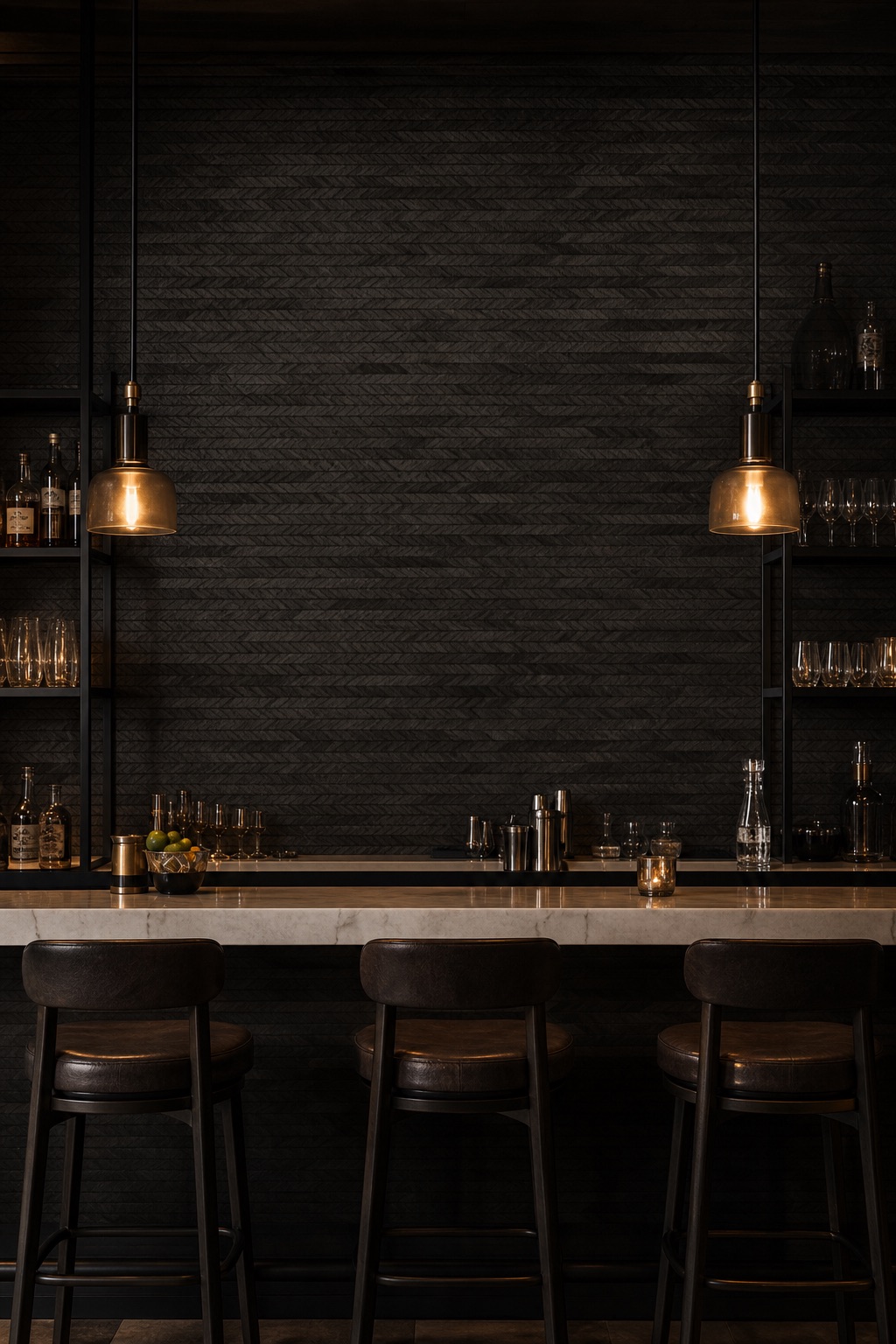
- Cocktail bars and wine bars: the dark matte depth recedes in low light, letting lighting design, glassware, and art carry the scene without the wall competing.
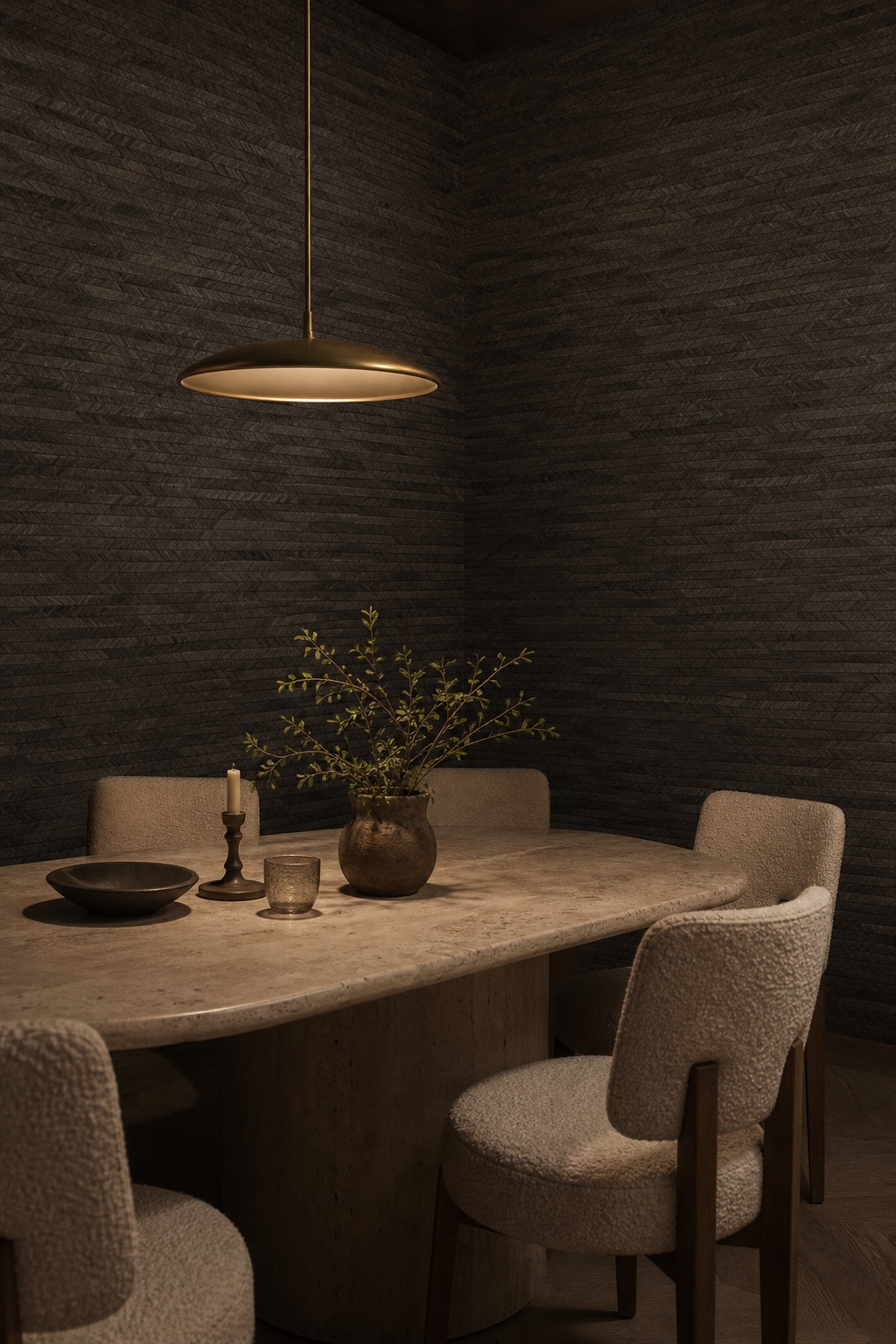
- Private dining rooms: wrapping four walls in this black grasscloth wallpaper creates an immersive enclosure; travertine or bouclé adds material warmth alongside the reed.
- Hotel suites and corridor alcoves: the herringbone texture provides visual interest in spaces where pattern-free finishes feel stark.
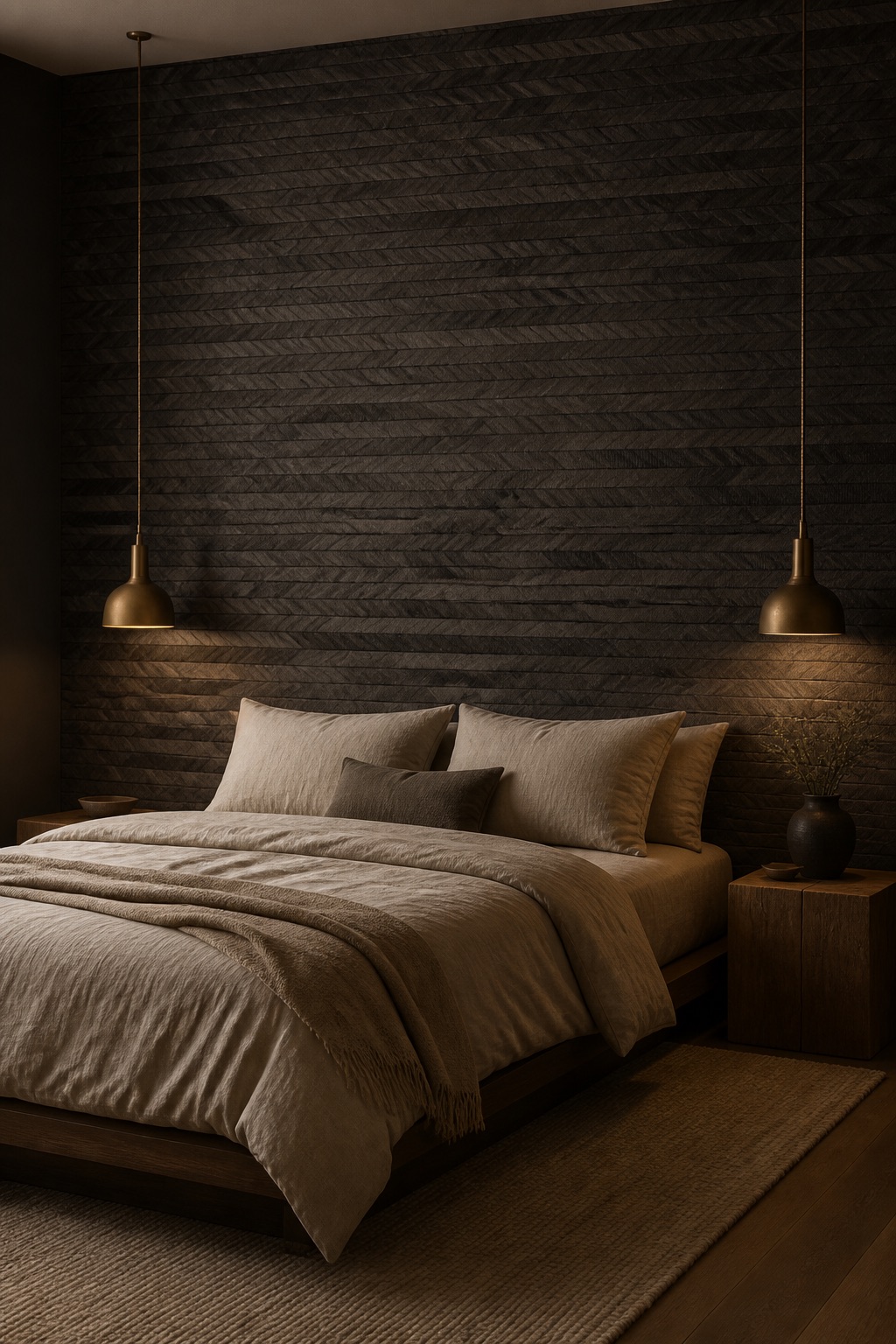
- Residential master bedrooms and dressing rooms: the colour anchors the space without requiring a dark ceiling or heavy curtain treatment to complete the mood.
- Single feature walls: the horizontal herringbone banding prevents the panel from reading as a paint substitute, delivering the material quality that justifies the specification.
Black grasscloth wallpaper in this herringbone performs best in spaces that control their own light: cocktail bars, private dining rooms, hotel suites, and residential bedrooms away from harsh direct sun. In hospitality settings, the matte, non-reflective surface cooperates with low ambient and accent lighting rather than competing. Paired with travertine, bouclé, or warm brass fittings, the espresso depth grounds companion materials without flattening them. For installations where a full-room wrap is too committed, a single feature wall behind a bed, banquette, or bar back is sufficient to shift the room's register entirely.
Colour Stability and Surface Care: What to Expect from a Dark Reed Grasscloth
- Deeply dyed dark colourways carry inherent UV sensitivity; sustained direct sunlight produces perceptible lightening over time, more visible on dark tones than on neutrals.
- In interior environments without direct UV ingress, the colour is stable across the expected lifespan of the installation.
- Dry dusting with a soft natural-bristle brush is the correct cleaning method; water or solvent cleaners applied directly will cause localised staining.
- Minor surface scuffs are less visible on dark-toned reed than on pale grasscloth, but concentrated stains require careful spot treatment.
- Natural grasscloth is not suitable for sustained relative humidity above approximately 70%; rolls should be acclimatised for 48 hours before installation.
Dark colourways in natural grasscloth are more susceptible to visible UV fading than neutral ones, and this is a genuine consideration for south-facing or conservatory applications. In controlled interior environments without direct sun ingress, the warm espresso brown is stable. For cleaning, dry dusting with a soft brush is the standard method; water or solvent cleaners will cause localised staining and should not be used. Natural grasscloth is also sensitive to sustained high humidity: environments above approximately 70% relative humidity are not appropriate, and rolls should be allowed to acclimatise for 48 hours before hanging.
From First Sample to Certified Batch: How the Grasscloths Studio Delivers Consistent Dark Colourways
- A physical sample from the sample book is the correct starting point for assessing a near-black colourway; screen reproductions are unreliable for dark tones.
- Paid proofing (quoted up front, typically ready in 1-2 weeks) is available when a custom colourway or scale adjustment is required; cost is agreed before work begins.
- Production orders are fulfilled on the terms confirmed on the pro-forma invoice, produced with our partner mills as a single dye-lot.
- Each batch ships with a per-batch lot certificate for the specifier's project documentation.
- Three in-house designers work from colour references (paint codes, fabric swatches, image files) to specify colourways for production; the founder has been working in natural wallcovering supply since 2018.
Colour accuracy on a near-black grasscloth is harder to judge from a screen than almost any other tone. A physical sample from the Grasscloths sample book is the right first step, and the place to confirm how the warm espresso undertone reads against your lighting and companion materials. If the standard colourway needs adjustment, our three in-house designers will spec a custom colourway from your reference and arrange a paid proof, with cost agreed up front and the result typically ready in 1-2 weeks. Confirmed orders proceed on the terms confirmed on the pro-forma invoice, are produced with our partner mills as a single dye-lot, and ship with a per-batch lot certificate. Love this weave but need a different colourway or scale? Our design studio engineers custom colourways from your reference. The founder has been working in natural wallcovering supply since 2018, and batch consistency is the studio's primary commitment.
Buying grasscloth for a project or a brand?
- Minimum order
- 50 rolls (about 250 m²) catalog · 100 rolls custom / private label
- Lead time
- 4–6 weeks standard · 5–8 weeks specialty, after sample approval and payment
- Terms
- EXW Chengdu · FOB, CIF, DDP on request
- Samples
- Free digital kit in 24 h · paid swatch pack, credited in full on your first order
- Reply
- Within 24 hours
Frequently asked
- Will the deep espresso colour fade noticeably in a room with strong sunlight?
- Yes, deeply dyed dark grasscloth is more susceptible to visible UV fading than neutral tones, and the shift will be more perceptible here than on a pale or mid-tone wallcovering. For south-facing rooms or spaces with sustained direct sun, we recommend assessing a full-panel sample in situ and factoring in window treatments. Our guide to fading prevention covers mitigation options in detail.
- How visible are seams when installing a dark herringbone grasscloth wallpaper?
- On a dark, matte grasscloth, seams are less optically prominent than on pale or reflective wallcoverings, because the deep colour and matte surface absorb rather than highlight the seam edge. Correct wall preparation and straight, tight hanging by an experienced installer are still essential for a clean result across a full wall run.
- Is this grasscloth appropriate for a restaurant environment or a spa with occasional moisture?
- Natural grasscloth is not suitable for wet or high-splash environments. Commercial kitchen extraction zones and bathrooms with direct water exposure are outside the recommended range. Hospitality back-of-house corridors and spa reception areas with adequate ventilation and no direct moisture contact can be assessed on a case-by-case basis during the sample stage.
- Can I order this in a cooler, truer black rather than the warm espresso tone?
- Yes. Our in-house design team specifies custom colourways with our partner mills from your colour reference: a paint code, physical swatch, or image file works equally well. A cooler near-neutral black is achievable via a paid proofing stage before production is confirmed. See our process page for how custom colourways come together from reference to roll.
- What are the minimum order quantities and lead times for a trade specification?
- Stock colourways may suit smaller first trials, and custom colourways start at 50 rolls (approximately 250 m²); all lead times, sampling steps, and commercial terms are covered in full at /process.