Sustainability
Sustainable Manufacturing of Natural Wallcovering
From renewable fiber harvest to finished roll — how natural wallcovering is manufactured with sustainability at every stage. Fiber sourcing, dyeing, weaving, backing and waste management practices.
Key Takeaways
- See detailed sections below.
What Are the Manufacturing Stages?
| Stage | Process | Sustainability Practice |
|---|---|---|
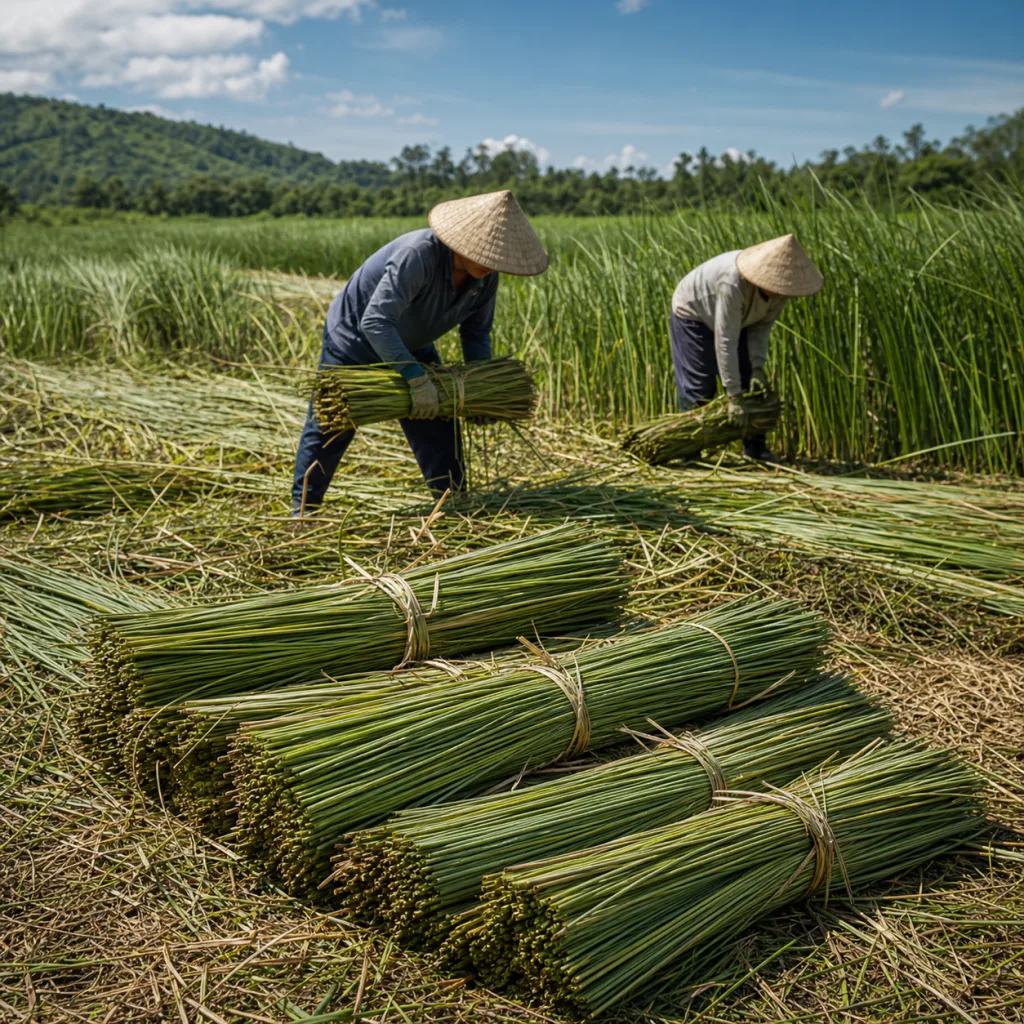
| 1. Fiber sourcing | Harvest renewable plant fiber | Annual harvest, no deforestation, carbon-negative growth |
| 2. Fiber processing | Clean, dry, sort fibers | Sun-drying (low energy), minimal water use |
| 3. Dyeing | Color application | Water-based dyes, closed-loop water recycling |
| 4. Weaving | Hand or semi-automated loom | Low-energy process vs PVC extrusion |
| 5. Backing | Adhere to paper or non-woven | Water-based adhesive, recyclable backing |
| 6. Finishing | Optional coatings — see finishes guide | Water-based, low-VOC options |
| 7. Quality control | 5-stage inspection | Reduces waste through early defect detection |
How Does Natural Compare to Vinyl Manufacturing?
| Factor | Natural Wallcovering | PVC Vinyl |
|---|---|---|
| Raw material | Renewable plant fiber | Petrochemical (non-renewable) |
| Energy intensity | Low (hand weaving, sun drying) | High (extrusion, calendering) |
| Water use | Moderate (dyeing) | High (cooling, washing) |
| Chemical inputs | Minimal (water-based dyes) | Significant (plasticizers, stabilizers) |
| End of life | Biodegradable, compostable | Not recyclable, landfill persistent |
| Carbon footprint | Low to negative | High |
What Should You Ask Your Supplier?
- Fiber origin: Where are the raw fibers grown? Is the harvest sustainable?
- Dye process: Water-based or solvent-based dyes? Is water recycled?
- Waste management: How are production waste and offcuts handled?
- Worker conditions: Fair labor practices in fiber harvesting and weaving?
- Certifications: OEKO-TEX, FSC (for paper backing), ISO 14001 (environmental management)?
- Supply chain transparency: Can they trace from fiber to finished product?
At Grasscloths, we provide full supply chain transparency — see our direct sourcing guide for our direct-source model.
Frequently Asked Questions
Are natural wallcovering fibers sustainably sourced?
Yes — grasscloth fibers (arrowroot, jute, sisal, seagrass) are fast-growing renewable plants harvested annually without killing the plant. No deforestation, no petrochemicals, minimal irrigation. Cork is harvested from bark without cutting the tree.
What is the carbon footprint of natural vs vinyl wallcovering?
Natural wallcovering has a significantly lower carbon footprint. Plant fiber is carbon-negative during growth. Manufacturing uses low-energy hand weaving. Vinyl production requires petrochemical extraction, PVC polymerization and plasticizer addition — all carbon-intensive processes.
Can natural wallcovering be recycled at end of life?
Natural fiber is biodegradable and compostable. Paper backing decomposes naturally. This contrasts with PVC vinyl which is not recyclable in most systems and persists in landfill for hundreds of years.