Buyer Guide
Peel & Stick vs Traditional Grasscloth
Peel-and-stick "grasscloth" is always faux — a printed film that mimics the look. Traditional grasscloth is hand-woven from real plant fibers. Here's an honest comparison on durability, appearance, cost and when each makes sense.
Key Takeaways
- Peel-and-stick grasscloth = faux. It's always a printed or embossed film, not real woven fibers.
- Traditional grasscloth = real. Hand-woven natural fibers on paper backing, unique per roll.
- Durability: Traditional lasts 15–25 years; peel-and-stick typically 3–5 years before edges lift.
- Installation: Peel-and-stick is DIY-friendly; traditional requires professional installation.
- Removability: Peel-and-stick comes off cleanly; traditional is semi-permanent.
- Best for rentals: Peel-and-stick. Best for forever homes: Traditional.
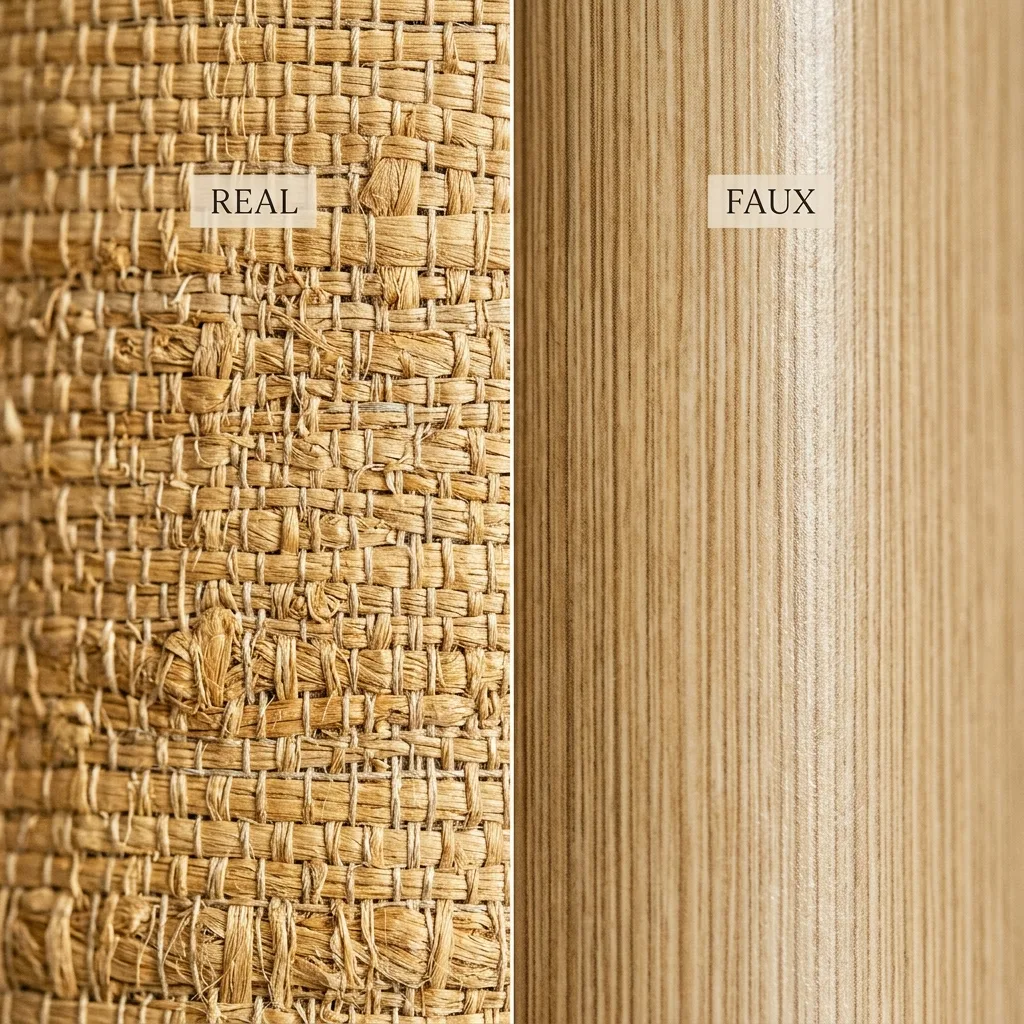
- The "touch test" never lies — real grasscloth feels fibrous and organic; peel-and-stick feels smooth and plastic.
What Is the Difference Between Peel & Stick and Traditional Grasscloth?
| Feature | Peel & Stick (Faux) | Traditional (Natural) |
|---|---|---|
| Material | Printed vinyl or polyester film | Hand-woven plant fibers (jute, sisal, hemp) |
| Texture | Smooth, uniform print | Organic, tactile, unique per roll |
| Installation | DIY — self-adhesive backing | Professional — paste-the-wall |
| Removability | Peels off cleanly | Semi-permanent — requires steaming/soaking |
| Durability | 3–5 years (edges may lift) | 15–25 years |
| Moisture resistance | Good (vinyl surface) | Low — avoid wet areas |
| Color variation | Perfectly uniform (printed) | Natural panel-to-panel variation |
| Visual depth | Flat, 2D printed pattern | 3D fiber texture with light play |
| Price | $3–8 /m² | $8–18 /m² (FOB manufacturer) |
| Sustainability | PVC/polyester, not biodegradable | Biodegradable, renewable fibers |
When Should You Choose Peel & Stick?
Peel-and-stick grasscloth makes sense in specific situations where removability and ease of installation are priorities:
- Rental apartments — landlord requires no permanent modifications
- Accent walls for staging — quick visual upgrade for property sales
- Children's rooms — expect to change decor every 3–5 years
- DIY weekend projects — no tools, no paste, no professional needed
- Budget-constrained refreshes — the "grasscloth look" at 30–50% of the cost
- Temporary commercial spaces — pop-up stores, trade show booths
Important limitation: Peel-and-stick adhesive fails in high humidity (bathrooms, kitchens) and on textured walls. The self-adhesive backing needs a smooth, clean, primed surface to bond properly.
When Should You Choose Traditional Grasscloth?
Traditional grasscloth is the right choice when quality, longevity and authentic aesthetics matter more than convenience:
- Permanent residences — a 15–25 year investment in a home you own
- Luxury interiors — living rooms, dining rooms, master bedrooms where texture is the focal point
- Hospitality projects — hotel lobbies, guest rooms, spas where tactile quality drives guest perception
- Design-forward commercial — boutique offices, high-end retail, wellness centers
- Biophilic design — LEED/WELL projects requiring natural, low-VOC materials
- Discerning clients — anyone who will touch the wall and notice the difference
Can You Tell the Difference on the Wall?
Yes — immediately. The difference between peel-and-stick and traditional grasscloth is apparent in three ways:
- Touch: Real grasscloth feels fibrous, textured and warm. Peel-and-stick feels smooth, flat and slightly plastic — even high-quality embossed versions.
- Light play: Real woven fibers create a three-dimensional light interaction that shifts as you move. Printed patterns are flat and static regardless of viewing angle.
- Panel consistency: Real grasscloth has subtle color variation between panels — each strip is unique. Peel-and-stick is perfectly uniform across every panel.
At arm's length on a distant accent wall, a quality peel-and-stick can approximate the look. But in any space where people touch walls, sit close to them, or where natural light plays across the surface, the difference is unmistakable.
How Does Durability Compare Long-Term?
| Durability Factor | Peel & Stick | Traditional |
|---|---|---|
| Typical lifespan | 3–5 years | 15–25 years |
| Edge adhesion | Edges may lift within 1–2 years | Permanent bond with paste |
| Heat tolerance | Adhesive softens in direct sun | Unaffected by heat |
| Humidity tolerance | Adhesive fails in moisture | Fibers absorb moisture (avoid wet areas) |
| Abrasion resistance | Vinyl surface resists scratches | Natural fibers can snag |
| Fading | Printed inks may fade | Natural fibers mellow (age gracefully) |
| Repairability | Replace entire panel | Spot repair possible with matching material |
What About Environmental Impact?
This is where traditional grasscloth has an unambiguous advantage:
- Traditional: Made from renewable annual crops (jute, sisal, hemp, seagrass). Fully biodegradable. Very low VOC emissions. Suitable for green building certifications (LEED, WELL, Living Building Challenge).
- Peel-and-stick: Made from PVC or polyester film. Not biodegradable. Some products release VOCs from the adhesive layer. Not eligible for most green building credits.
For projects with sustainability requirements or clients who value environmental responsibility, traditional grasscloth is the clear choice.
Frequently Asked Questions
Is peel-and-stick grasscloth real grasscloth?
No. Peel-and-stick "grasscloth" is always a faux product — a vinyl or polyester film printed or embossed to mimic the appearance of natural grasscloth. Real grasscloth is too thick, porous and fibrous to function with self-adhesive backing. If a product says "peel and stick grasscloth," it is a synthetic imitation.
Can I use peel-and-stick in a bathroom?
Not recommended. The self-adhesive backing is sensitive to moisture and humidity. In a bathroom, the edges will lift and the adhesive will eventually fail. Traditional grasscloth also shouldn't be used in bathrooms. For wet areas, consider moisture-rated vinyl wallcovering instead.
Which is better for resale value?
Traditional grasscloth adds more perceived value to a home because it signals premium materials and professional craftsmanship. Peel-and-stick is seen as a temporary, budget solution. However, for staging a home for sale, peel-and-stick is practical because it creates visual impact without permanent modification.
Related Guides
Grasscloth vs Vinyl
Natural vs synthetic comparison.
Real vs Faux
How to tell the difference.
Installation Guide
Full 7-step installation process.
DIY vs Professional
When to hire a pro.
Best Adhesive
Choosing the right paste.
Grasscloth Guide
Complete grasscloth reference.
Feel the Real Thing
Request free grasscloth samples and experience the texture, weight and organic warmth that no peel-and-stick can replicate.
Request Samples