Yellow Grasscloth Wallpaper
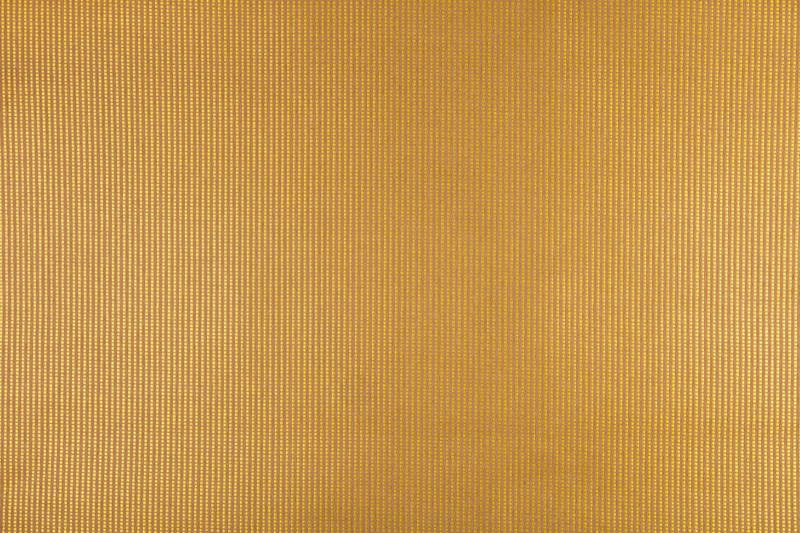
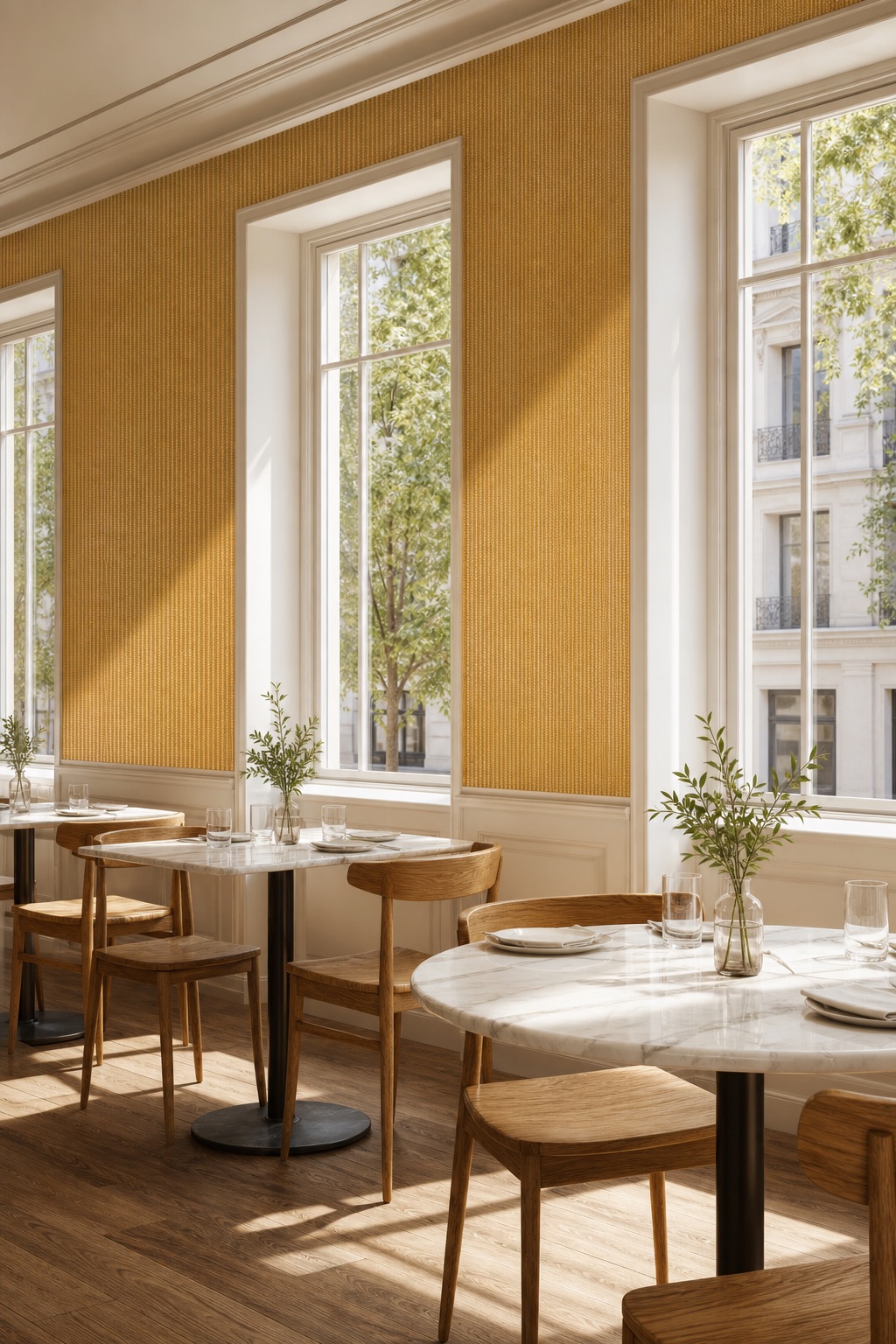
A warm mustard amber yellow grasscloth wallpaper built on a fine paperweave grid, Amber Cord delivers even, saturated colour across large walls without the heavy texture of coarser woven grass. Supplied to designers and trade buyers from 50 rolls (≈250 m²), it sits naturally in dining rooms, hotel suites, and residential living rooms where a warm, settled tone is the brief. The semi-matte finish diffuses light gently, holding the amber steady across incandescent, daylight, and LED sources without shifting chalky or brassy.
Mustard Amber at Distance and Close: What the Node Grid Does to a Wall
- At normal viewing distance the cream-white nodes at every warp-weft crossing dissolve into the amber field, and the wall reads as warm, even colour.
- Step closer and a disciplined dot grid emerges at every intersection, adding quiet structure without introducing a pattern that must be managed across panels.
- The fine vertical strand emphasis in the weave subtly elongates wall height, a useful quality in rooms with lower ceilings.
- The semi-matte finish holds the amber steady across natural and artificial light sources, without hotspots or sheen bands that shift the tone by time of day.
- In evening incandescent or candlelight the tone deepens toward a rich turmeric; under cool northern daylight it reads as a clean, warm mid-yellow.
The interplay between the visible node grid at arm's length and the even amber field at room distance is what makes this surface work for large installations. Most wallcoverings with small-scale texture read noisily up close and flatten to nothing at room scale; this weave holds structure in both registers without catching the eye. The shift in evening light is particularly useful in dining and bar applications, where the amber warming toward a deeper turmeric under tungsten adds atmosphere without requiring a second material.
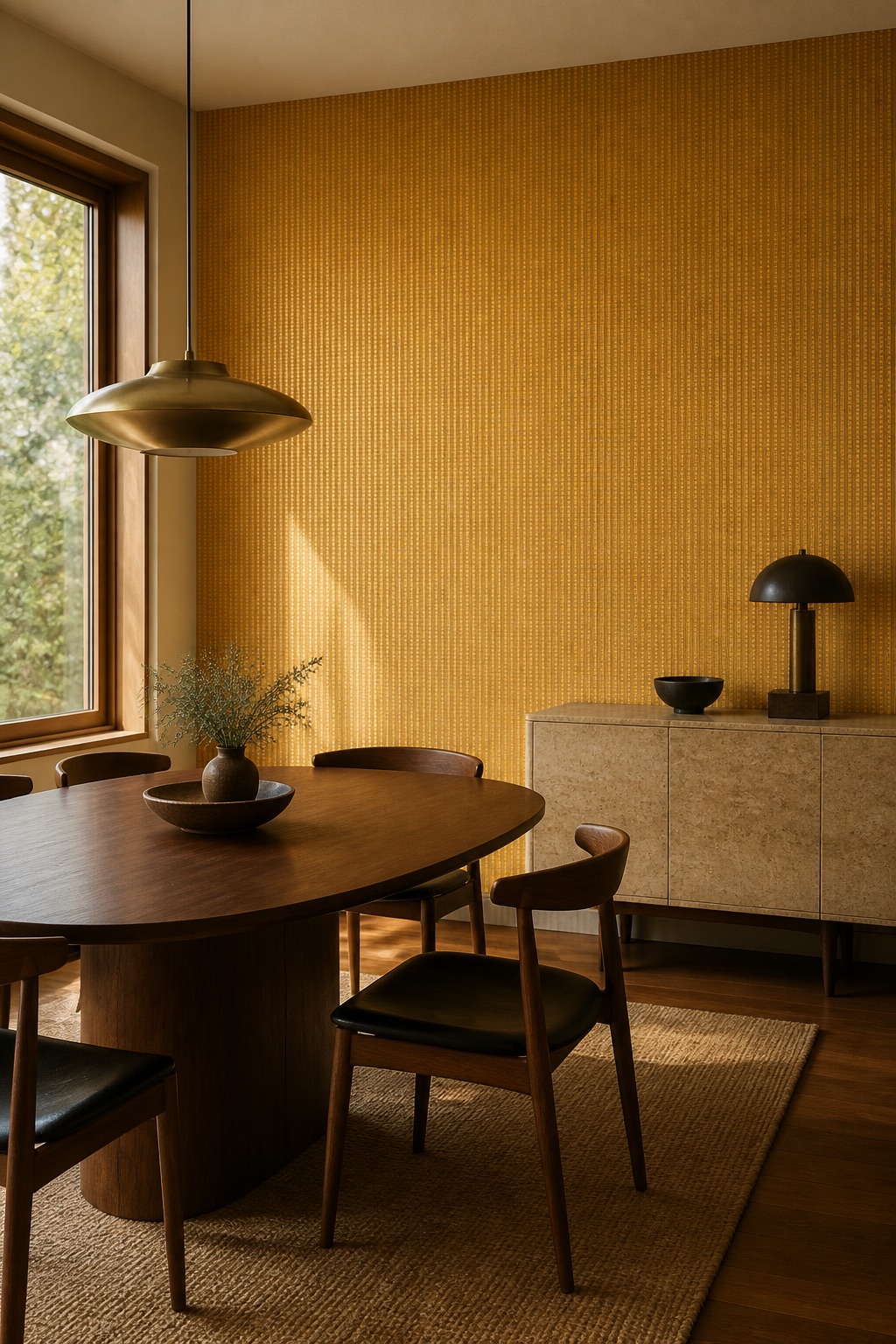
Warm Yellow in Dining Rooms, Suites, and Living Spaces: Where Amber Cord Belongs
- Dining rooms gain the most direct benefit: warm amber flatters skin tones and table settings, and deepens toward turmeric under candlelight.
- Hotel suite sitting areas benefit from the settled, unhurried quality the saturated mid-tone brings to controlled evening lighting schemes.
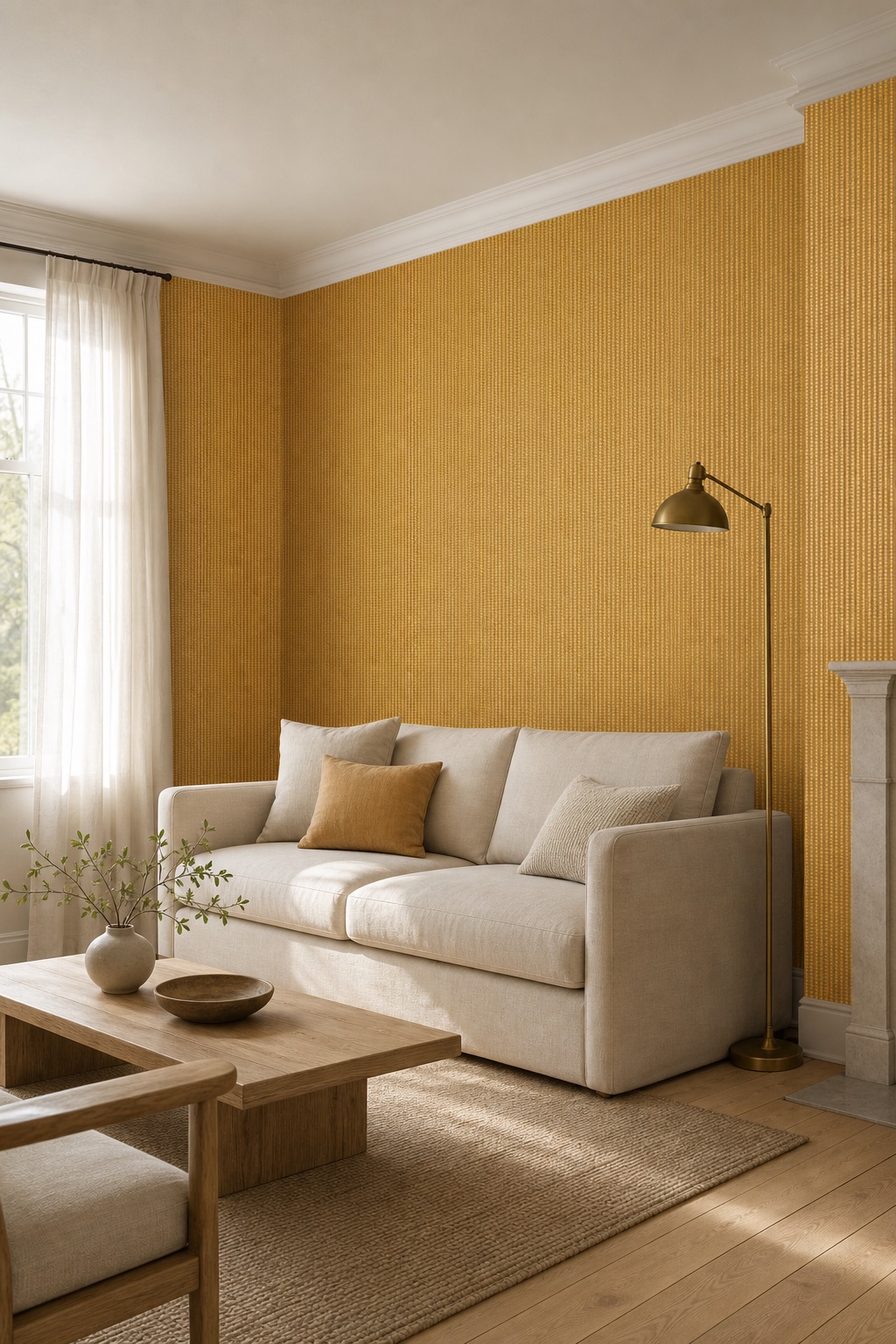
- North-facing living rooms in temperate climates gain warmth from the amber without requiring a warm-bulb workaround in the lighting design.
- Bar back-walls and restaurant feature walls where atmosphere is controlled by artificial lighting rather than sunlight are well-suited to this tone.
- Rooms anchored by dark furniture and rich textiles, where a warm mid-value wall holds its ground without competing.
Warm amber occupies a useful middle position between a true neutral and a statement colour: it reads as colour in a pale-walled scheme yet accepts deep furniture and textiles without tension. Dining rooms are where the tone earns its keep most visibly, flattering both the table setting and the people around it. For hotel environments with programmatic lighting, the amber provides a warm base tone that the lighting designer can hold steady or push deeper depending on the service period.
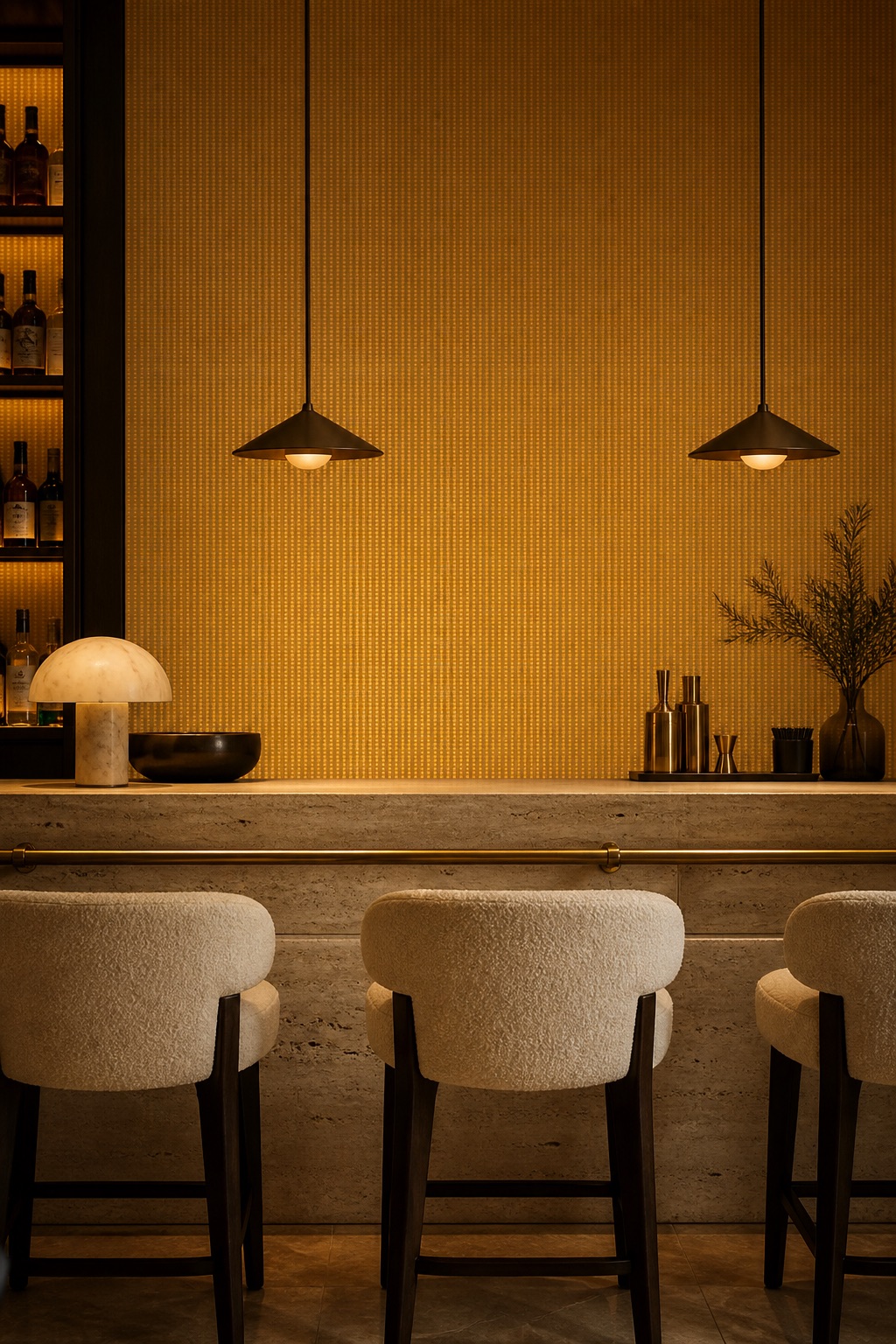
The Specifier's Palette: What to Put Alongside Warm Amber
- Dark walnut and oak in flooring or furniture anchor the amber without visual competition.
- Aged brass in pendants and hardware picks up the warm undertone and amplifies it rather than clashing.
- Cream plaster, ivory linen, and off-white painted trim recede around the amber without the tension a cool white creates.
- Travertine in counters, tabletops, or shelving introduces textural contrast while remaining in the warm-neutral range.
- Ivory or ochre bouclé upholstery echoes the amber family without matching it precisely.
- Avoid cool grey and blue-white companions, which flatten warm amber and make the yellow read chalky rather than rich.
The amber here sits in the warm yellow-orange range, so companion materials that share a warm undertone read harmoniously rather than competing for attention. The pairing of aged brass with this surface is particularly effective: the yellow in the brass and the yellow in the amber are close in hue, so the effect is layered warmth rather than accent clash. Dark wood grounds the scheme and prevents the warm palette from reading one-dimensional.
Yellow Grasscloth Wallpaper in Paperweave: How the Fine Strand Changes the Surface
- Paperweave uses processed cellulose strands rather than raw jute, seagrass, or sisal, producing a more uniform surface with less batch-to-batch variation.
- Dye uptake is consistent across the fine strand gauge, which is why the amber reads evenly panel to panel rather than varying across a broad width.
- Butt seams are less visible with paperweave than with coarser grasscloth because the fine grain offers no abrupt texture edge at the joint.
- There is no pattern drop to manage, simplifying installation planning and reducing material waste calculations.
- The smoother strand surface tolerates minor wall imperfections more gracefully than a thick, coarse-strand weave.
Traditional grasscloth carries a coarser, more variable strand that creates the characteristic colour variation specifiers either value or must manage. Paperweave is processed to a finer, more consistent gauge: the result is a surface that holds dye colour evenly across panels and reads as a controlled mid-tone field at scale. For hospitality buyers and designers specifying yellow grasscloth wallpaper at scale, this panel-to-panel consistency is a practical advantage that coarser weaves cannot reliably match.
Sample, Proof, and Lot Certificate: How a Yellow Paperweave Specification Comes Together
- Paid sample books provide physical reference material; the cost is credited against a confirmed production order.
- Paid proofing is quoted before any work begins, with a typical turnaround of one to two weeks.
- Production runs approximately one month at our partner mills; ocean freight is quoted and supplied separately.
- Each batch ships with a per-batch lot certificate for colour consistency documentation and future reorder matching.
- Three full-time in-house designers translate mood boards and colour references into technical mill specifications.
- Our founder has been in natural wallcovering since 2018; the Grasscloths studio has supplied the trade since 2023.
The process is designed to give specifiers control at each stage before committing to production quantities. A sample book lets you assess colour, texture, and handle in your project context. Paid proofing, quoted up front, resolves any colour or scale adjustment before the order is confirmed on the pro-forma invoice. Production batches at our partner mills carry individual lot certificates, supporting your documentation for dye-lot consistency and making future reorder matching traceable. Love this weave but need your own colour or scale? Our design studio engineers custom colourways from your reference.
Buying paperweave for a project or a brand?
- Minimum order
- 50 rolls (about 250 m²) catalog · 100 rolls custom / private label
- Lead time
- 4–6 weeks standard · 5–8 weeks specialty, after sample approval and payment
- Terms
- EXW Chengdu · FOB, CIF, DDP on request
- Samples
- Free digital kit in 24 h · paid swatch pack, credited in full on your first order
- Reply
- Within 24 hours
Frequently asked
- Will the mustard amber colour shift or fade in a south-facing room?
- Yellow tones in natural fibre wallcoverings can warm or lighten with prolonged UV exposure. We recommend UV-filtering window film or interior blinds for south and west-facing walls. Our guide on fading prevention covers practical mitigation steps for specifiers.
- How visible are butt seams with this fine-grid paperweave?
- Because the strand gauge is fine and the colour field is even, seams are generally less noticeable than with coarser grasscloth. There is no pattern drop to manage, which simplifies installation and panel planning considerably.
- Is paperweave suitable for a hotel restaurant or commercial dining room with daily use?
- Paperweave performs well in climate-controlled commercial dining environments. Sustained humidity above approximately 70% relative humidity is not advisable for any natural fibre wallcovering; good HVAC management makes hotel dining and restaurant applications straightforward.
- What is the minimum order quantity for yellow grasscloth wallpaper?
- Standard MOQ is 50 rolls (approximately 250 m², each 0.915 m x 5.5 m). Full ordering details including sampling, proofing, payment terms, and freight options are covered on our FAQ page.