White Parquet Paperweave Wallcovering
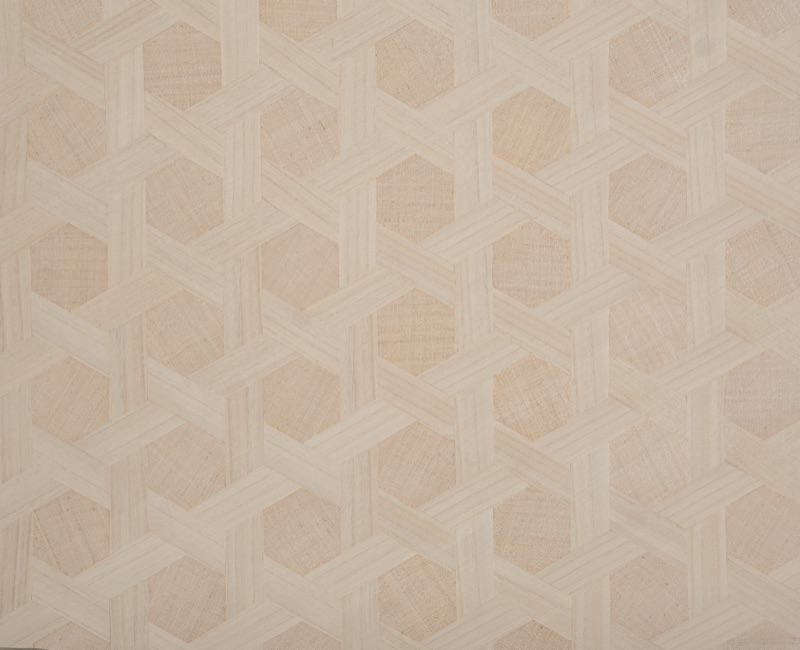
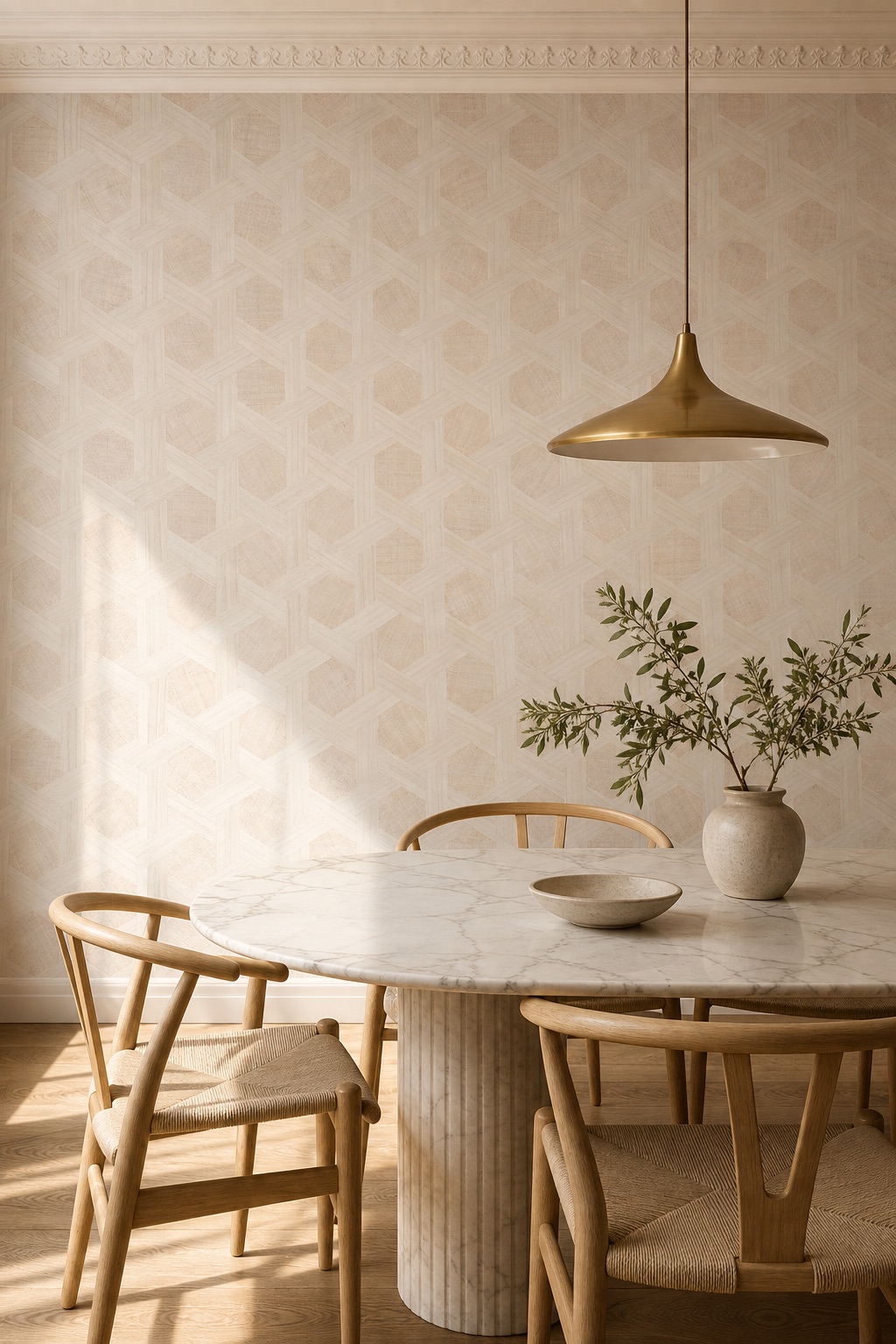
Ivory Cube Parquet is a white parquet paperweave wallcovering structured around a tumbling-cube repeat: hexagonal cells interlocked with rhombus connectors that project a quiet three-dimensional parquet illusion across the full wall plane. The ground is a warm ivory-cream with a faintly sandy secondary tone; at close range, fine horizontal micro-striations within each geometric cell confirm the natural fibre weave beneath the print-free surface. Produced with our partner mills to Grasscloths' in-house design specifications, it is supplied to interior designers, hospitality buyers, and trade partners from 50 rolls, with custom colourways available on the same hexagonal parquet structure.
Three Planes, One Surface: How Ivory Cube Parquet Reads Close and at Wall Scale
- The isometric cube repeat is built from hexagonal cells and rhombus connectors, generated entirely by the weave structure itself with no printing or embossing.
- At close range, fine horizontal micro-striations within each cell are visible, confirming natural fibre weave construction consistent with paperweave.
- At two to three metres, the tonal contrast between cell faces resolves the three-dimensional cube illusion; the individual fibre texture recedes into the overall field.
- The tonal shift between hexagons and connectors is subtle: both sit within the ivory-cream range, keeping the pattern sophisticated rather than graphic.
- The fully matte finish suppresses specular glare, so the surface reads consistently under both natural and artificial light sources.
Hold a panel at arm's length and the hexagonal cells read as textured fields of natural fibre, each one carrying fine horizontal micro-striations produced by the weaving process. Step back to three metres and the geometry resolves into a classic isometric cube illusion: three faces of each cube rendered in the tonal contrast between hexagon and connector, without a single printed line. This shift in reading makes the surface unusually versatile: a close-up material conversation for smaller rooms, a quietly architectural statement for corridor-length feature walls.
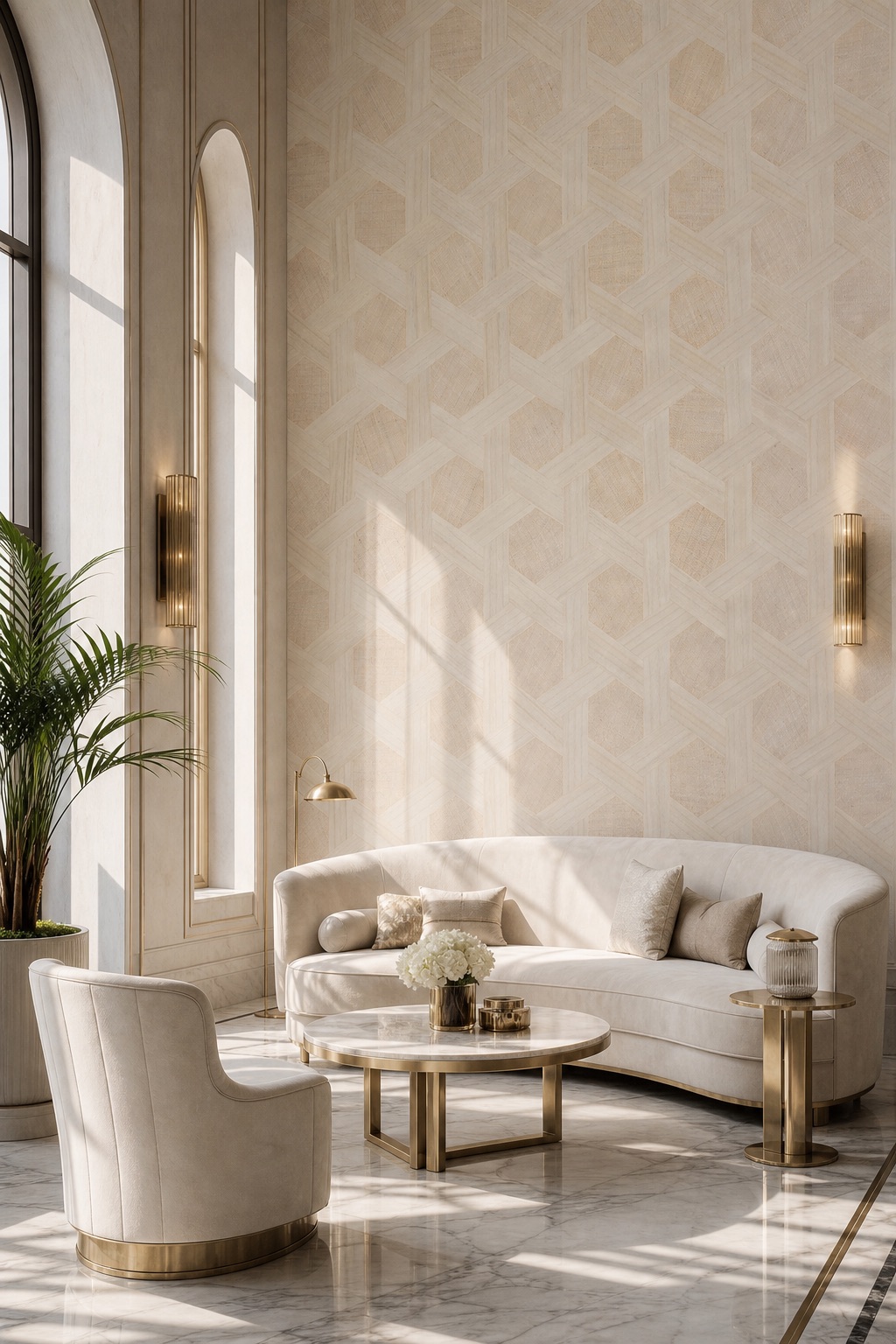
Pale Ivory in Shifting Light: Morning Crispness to Warm Amber Evening
- In cool or north-facing light, the ivory ground reads close to white with a barely perceptible warm lift, suitable for brightness-led schemes.
- Under warm afternoon or incandescent light, the sandy secondary undertone becomes perceptible, pulling the wall into a soft linen register.
- The fully matte surface absorbs and diffuses light rather than reflecting it, preventing surface flare under directional spotlighting.
- In low or raking evening light, the geometric relief of the weave becomes slightly more pronounced, adding subtle sculptural depth not visible at midday.
- The warm undertone allows this ivory ground to sit comfortably in both brass-and-travertine and grey-and-linen palettes without conflicting with either.
In cool morning light or a north-facing exposure, the ivory ground reads close to white, bright without clinical flatness. As daylight shifts warmer through the afternoon, the sandy secondary undertone becomes perceptible and the wall joins the amber register of timber and linen rather than contrasting with it. The wholly matte surface absorbs and diffuses rather than reflects, so the pattern never flares under directional spotlights; raking evening light gently activates the three-dimensional geometry of the weave, adding a degree of sculptural presence not visible at midday.
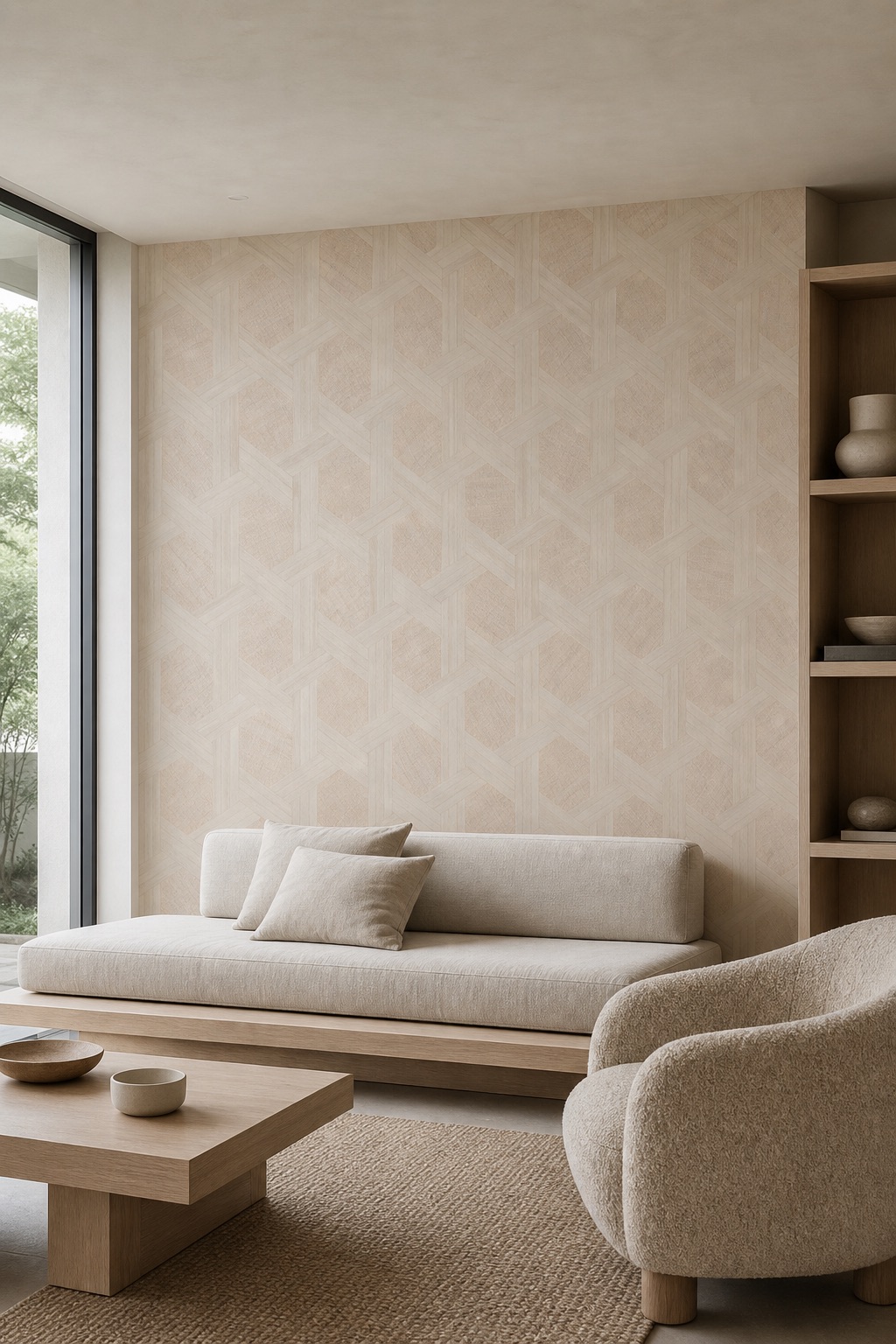
From Art Deco to Japandi: Where White Parquet Paperweave Wallcovering Belongs
- The tumbling-cube motif spans art-deco, Japandi, and organic-modern design languages, making it adaptable across a wide range of hospitality and residential briefs.
- Hotel suite headwalls and private dining rooms are natural applications: geometric enough to anchor a wall, pale enough to recede when furnishings take focus.
- In residential settings, it suits living rooms, bedrooms, and studies where specifiers want a considered surface without the dominance of a saturated or printed pattern.
- The medium-scale repeat handles standard wall heights without the complex drop-matching waste that larger repeats can generate.
- Natural fibre wallcoverings of this type are not suited to consistently humid environments; bathrooms and steam-prone areas should be avoided.
The tumbling-cube motif is one of the oldest conventions in decorative geometry, moving through art deco reception halls, contemporary Japandi interiors, and organic-modern hospitality with equal ease. In hotel applications, this white parquet paperweave wallcovering is a natural fit for suite headwalls and private dining rooms: geometric enough to give a wall presence and pale enough to retire gracefully when other materials take the lead. In residential work, it suits the living room, bedroom, and study where a considered surface is needed without the weight of a saturated or printed pattern. Natural fibre is not appropriate for bathrooms or areas exposed to cooking steam.
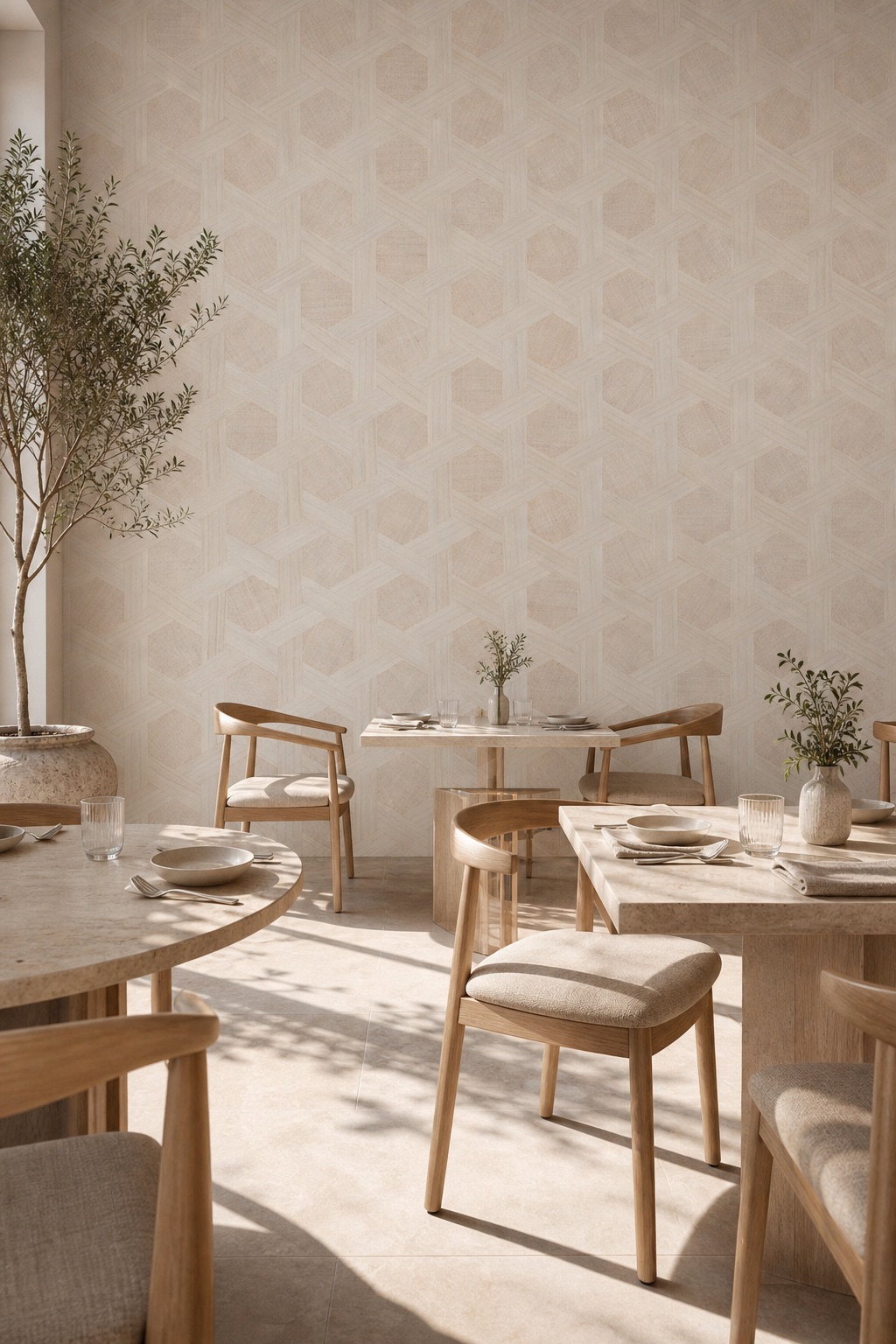
Stone, Bleached Timber, and Pale Metal: Companion Materials for Ivory Cube Parquet
- Honed travertine, white-oiled oak, unbleached linen, and off-white plaster are the most natural companions, sharing a similar light value range.
- Pale brass or unlacquered bronze adds warmth without competing with the weave's subtle tonal contrast.
- Bouclé upholstery in oat or off-white reinforces the tactile-textile theme and pairs naturally with the paperweave surface at close range.
- Blackened steel and dark walnut read as sharp counterpoints against the pale ground, effective for dining or hospitality contexts that require a degree of visual contrast.
- Saturated or competing geometric patterns on adjacent surfaces are best avoided; Ivory Cube Parquet performs as a refined neutral within a restrained palette.
The warm ivory ground sits most naturally against materials of comparable value: honed travertine, white-oiled oak, unbleached linen, plaster in limewash or off-white. Pale brass and unlacquered bronze introduce warmth without competing with the surface's own tonal range. For dining and hospitality contexts that require stronger contrast, blackened steel and dark walnut read as precise punctuation against the pale field — restrained but present. Avoid saturated accent colours on adjacent surfaces; the performance of this material depends on the surrounding palette remaining calm.
From Sample Request to a Single Dye Lot: How a White Parquet Paperweave Order Comes Together
- The process begins with a paid physical sample book, credited against a qualifying first order, allowing specifiers to assess weave character and tonal range before committing.
- Paid proofing is quoted upfront and completed in approximately one to two weeks; production of this standard material runs four to six weeks from proof approval.
- A single dye lot covers the entire order, with per-batch lot certificates issued for procurement documentation.
- Three full-time in-house designers handle colourway development, translating paint chips, fabric references, or Pantone callouts into CAD-accurate mill specifications.
- Our founder has been in the natural wallcovering trade since 2018; that depth of supply-chain knowledge informs every order from specification to delivery.
- Custom colourway and OEM labelling orders start from 50 rolls (approximately 250 m²).
The process opens with a paid sample book, credited against a qualifying order, so the weave and tonal range can be assessed in the actual project environment before production is committed. Paid proofing is quoted upfront and typically completes in one to two weeks; production of this standard material runs four to six weeks, with a single dye lot covering the full run and lot certificates issued per batch for procurement records. Three in-house designers manage colourway development from reference input to mill-ready CAD, and our founder's entry into the natural wallcovering trade in 2018 underpins the studio's sourcing continuity. Love this parquet weave but need a different tone or scale? Our design studio engineers custom colourways from your reference, from a cooler white to a deeper warm sand, on the same hexagonal parquet structure.
Buying paperweave for a project or a brand?
- Minimum order
- 50 rolls (about 250 m²) catalog · 100 rolls custom / private label
- Lead time
- 4–6 weeks standard · 5–8 weeks specialty, after sample approval and payment
- Terms
- EXW Chengdu · FOB, CIF, DDP on request
- Samples
- Free digital kit in 24 h · paid swatch pack, credited in full on your first order
- Reply
- Within 24 hours
Frequently asked
- Will the ivory ground discolour or yellow in a room with significant sunlight exposure?
- Direct, prolonged UV exposure will gradually amber any natural fibre wallcovering. In north-facing rooms or spaces with UV-filtering glazing, the ivory ground remains visually stable over a normal interior lifespan. Indirect or diffused natural light is the preferred exposure; see our [fading prevention guide](/guides/fading-prevention) for practical measures.
- How visible are seams in a geometric hex parquet pattern, and what installation approach minimises them?
- With a geometric repeat, panel joints fall within the regular pattern structure and are managed with a straight butt joint. An experienced installer should reverse-hang alternate drops to offset any subtle tonal variation across a wall. Seams are inherent to any roll-applied wallcovering and are not a material defect.
- Is white parquet paperweave wallcovering suitable for a bathroom or a room near cooking appliances?
- Natural fibre wallcoverings are not suited to consistently humid or steam-prone environments; bathrooms and areas adjacent to cooking appliances are not recommended. For full environment suitability criteria, see our [humidity risks guide](/guides/humidity-risks).
- Can the ivory tone be adjusted — for example, to a cooler white or a deeper warm sand?
- Yes. Our design studio works from paint chips, fabric swatches, or Pantone references to engineer a custom colourway on the same hexagonal parquet structure; custom colourway orders carry a minimum of 50 rolls (approximately 250 m²), with paid proofing for approval before production begins. See our [custom colourway guide](/guides/custom-colorway) for the full process.
- What is the minimum order quantity, and where can I find full sampling and payment details?
- Custom colourways begin at 50 rolls (approximately 250 m²), with lower minimums for stock patterns on first trials; full details on sampling, proofing, and payment terms are on our [process page](/process).