Walnut Brown Grasscloth Wallpaper
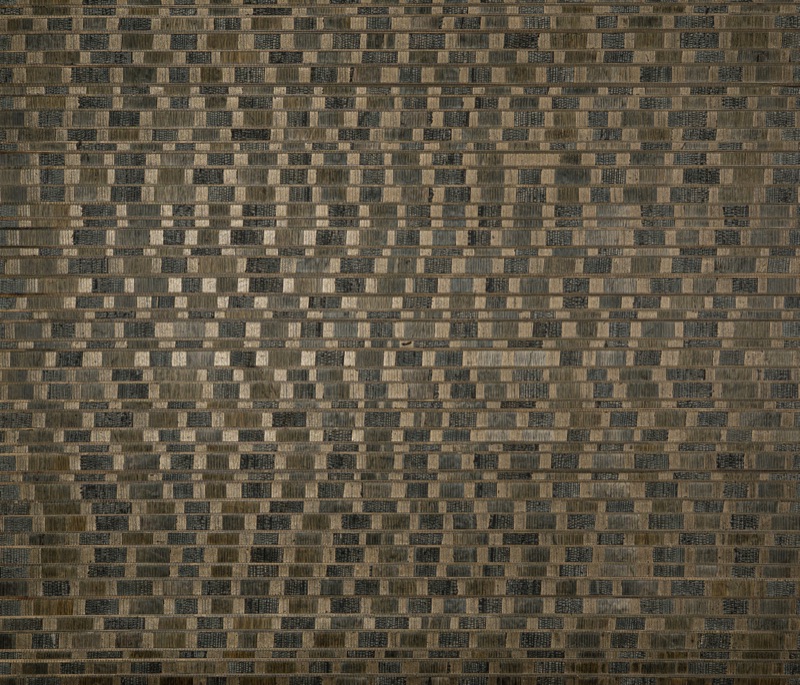
A dark, textured walnut brown grasscloth wallpaper built on a basket-block structure: flat reed bundles woven in alternating rectangles across an offset grid, producing a surface that reads at close range as fine woven craft and at distance as a steady, enveloping tone. The palette sits between warm olive-brown and charcoal grey, with a fully matte finish that absorbs light rather than catching it. Produced with our partner mills and supplied to interior designers and trade buyers from 50 rolls, Walnut Block suits any scheme where depth and organic warmth are both part of the brief.
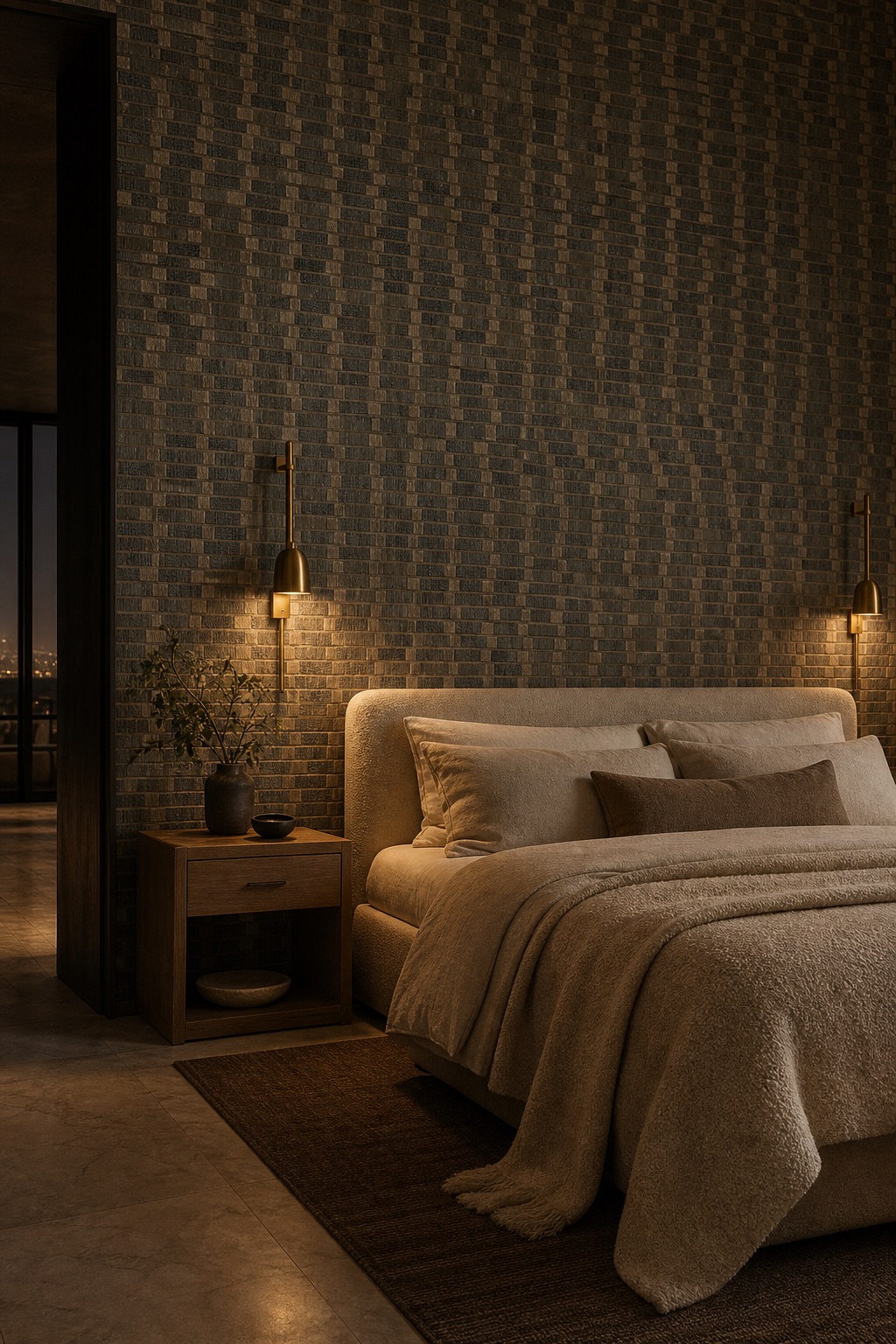
Depth and Enclosure: Why Dark Walnut Brown Grasscloth Commands Feature Walls and Intimate Rooms
- Dark value absorbs ambient light across an entire wall without creating visual noise or competing with furniture
- At full-wall scale, the block-check grid reads as a quiet, unified field rather than an active geometric pattern
- Works to reduce perceived volume in a considered way — useful in hotel suites, private dining rooms, and residential studies where enclosure is part of the brief
- The matte finish eliminates reflective hot-spots under directional spotlights and evening lamp
- Natural reed fibre brings a tactile quality that matte paint and synthetic fabric wallcoverings cannot match at this depth of tone
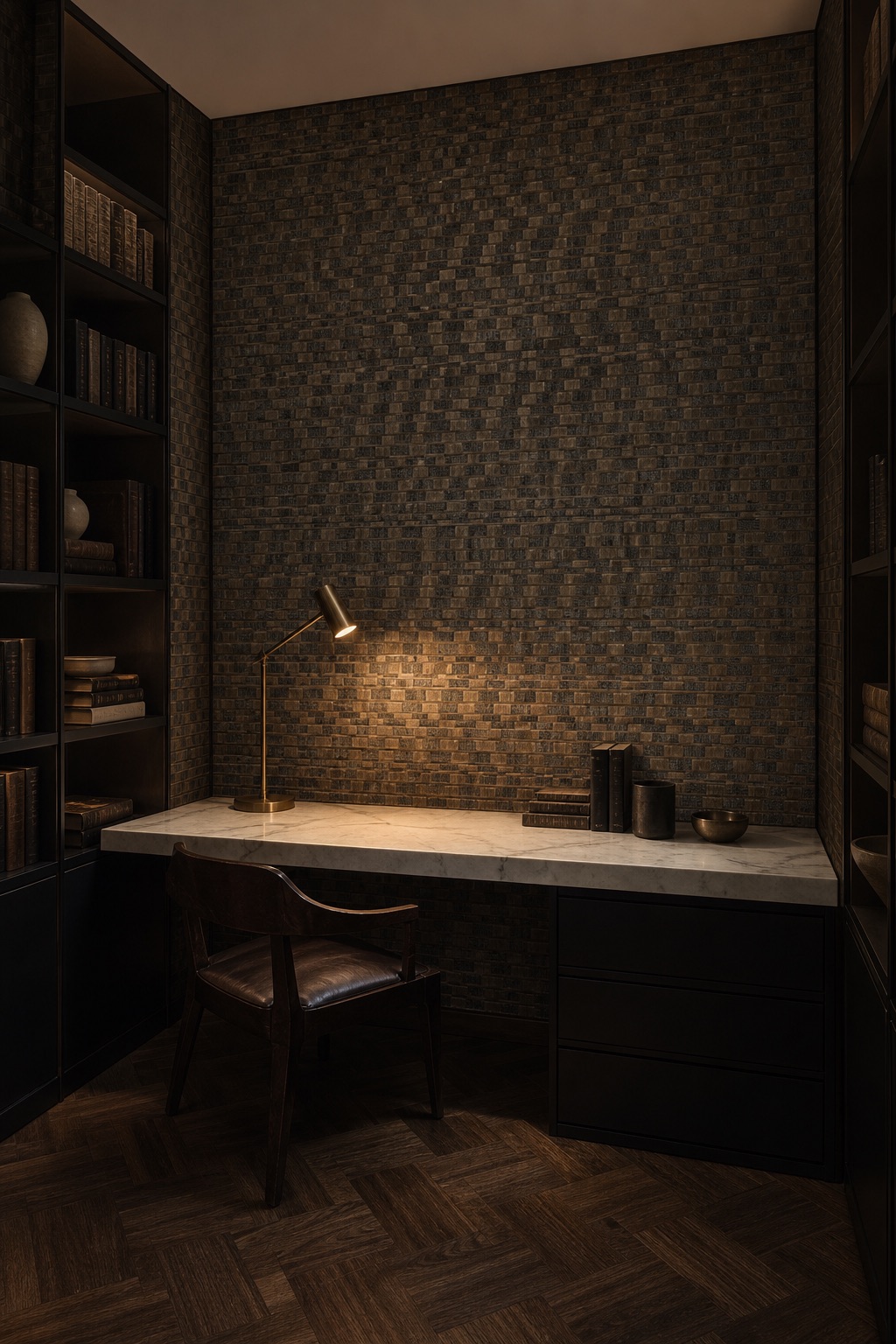
Dark grasscloth operates differently from mid-tone or pale alternatives. Rather than opening a space, Walnut Block closes it in a considered way: the eye settles on the surface texture rather than passing through to an implied depth, which produces the felt enclosure that specifiers are after in hotel suites, restaurant booths, and private studies. At full-wall scale the offset block grid becomes less visible as a distinct pattern and more present as a rich, unified ground — the weave texture still apparent, but reading as material quality rather than as graphic decoration. On a feature wall behind a headboard or a dining banquette, the matte finish ensures the surface holds its depth under both daylight and evening lamp, without the reflective compromise that flatwoven or metallic alternatives can introduce.
Block Grid in Relief: How the Alternating Reed Bundles Read from Close Range to Across the Room
- At arm's length: individual blocks are clearly visible, each carrying fine parallel striations running across the bundle face
- The offset (brick-bond) arrangement means no continuous horizontal or vertical lines run unbroken through the wall surface
- At 3 to 4 metres: the pattern softens to a tone-on-tone texture, charcoal and olive-brown blending into a unified dark field
- Medium texture scale is active enough to justify wallcovering over paint without competing with furnishings
- Adjacent block contrast between charcoal grey and warm taupe provides subtle two-tone depth even in flat, diffused lighting
At close range, Walnut Block is a lesson in small-scale craft: each rectangular block is formed from tightly bound flat reed strips, with fine linear striations running across the bundle face. The alternating orientation of adjacent blocks creates a clean perpendicular contrast in weave direction, which is the main generator of the pattern at near distance. Step back to three or four metres and the weave detail subordinates to tone. The charcoal grey and warm olive-brown blocks blend into a rich, unified dark surface — still clearly textured, still clearly natural, but no longer reading as a geometric check. This two-scale behaviour is practical for specifiers: it satisfies the close-inspection requirement of high-end interiors and the at-distance coherence requirement of large hospitality walls.
Olive-Brown by Day, Near-Black by Candlelight: How Walnut Block Shifts Across the Hours
- Under cool or overcast daylight: the olive-brown undertone reads with a slight earthy-green warmth, giving the surface a mineral quality
- Under warm artificial light (incandescent or warm LED): charcoal blocks deepen toward near-black, olive blocks shift toward amber-brown
- The fully matte weave maintains consistent depth under directional downlights with no specular hot-spots at any angle
- The warm reed undertone prevents the surface reading cold even when charcoal values dominate in evening conditions
- Two-tone block structure provides tonal interest across all lighting conditions, avoiding the flatness that can affect single-colour grasscloths
No matte grasscloth is colour-neutral across a full day, and Walnut Block's olive-brown primary reads differently as the light source changes. In north-facing or overcast conditions the green undertone in the olive-brown fibre comes forward, giving the surface an earthy, mineral quality. Under incandescent or warm LED artificial light, the charcoal blocks deepen significantly and the warm taupe-brown blocks shift toward amber, together producing something closer to a dark tobacco tone by evening. The fully matte weave ensures this shift happens through absorption rather than reflection: the texture remains consistent and the depth builds without any hot-spots or sheen. For hospitality interiors where the same space functions in both morning daylight and evening lamp, this tonal range is an asset rather than an inconsistency.
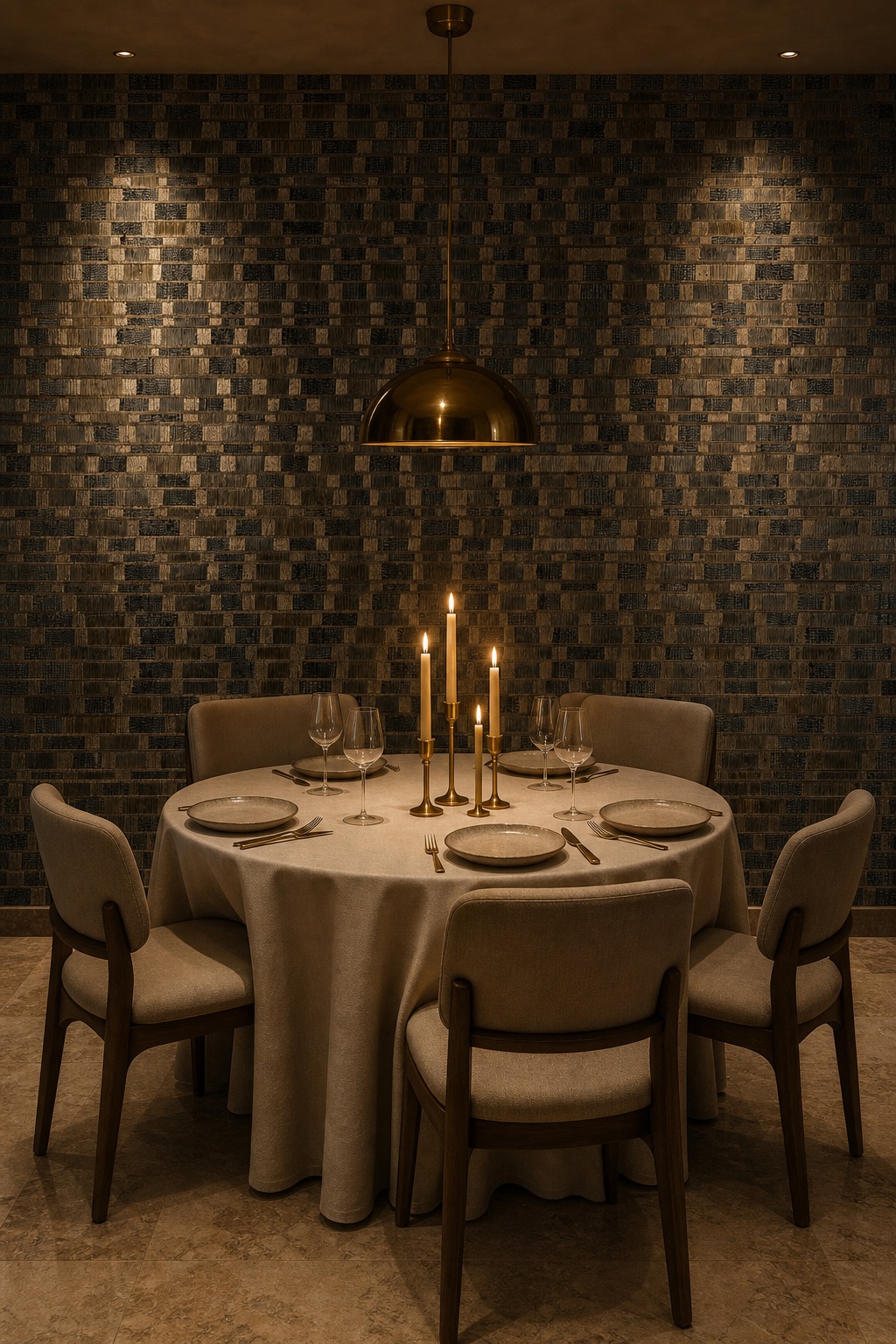
Building a Dark Scheme: Companion Materials That Let Walnut Brown Grasscloth Lead
- Brushed brass: the warm undertone of the reed reads naturally against brass without competing — well-suited for sconces, handles, and trim
- Honed travertine: introduces the same warm mineral quality in flooring or cladding; white veining provides counter-relief against the dark wall
- Blackened steel: the charcoal block value bridges to blackened steel frames, shelving, and fittings without tonal conflict
- Bouclé or heavy undyed linen upholstery: textile softness counterbalances the structured weave grid without clashing in tone
- Pale oak or bleached timber flooring: lighter value balances the dark wall surface while maintaining the warm register
- High-gloss surfaces placed directly opposite can undermine the matte grasscloth ground; avoid polished lacquer or mirror panels adjacent to the feature wall
The palette of Walnut Block narrows the companion-material choices in a useful way. The warm olive-brown undertone runs toward brass and honey-toned stone rather than cool platinum or white marble. A scheme built around honed travertine flooring, brushed brass fixtures, and upholstered pieces in oatmeal bouclé or undyed linen will feel coordinated rather than assembled. Blackened steel is the one cool material that works here: its value matches the charcoal block and its surface reads as industrial restraint against the organic weave, a combination well-used in residential studies and members-club interiors. The material to avoid is high gloss placed directly adjacent. Mirror panels, lacquered furniture, or polished marble surfaces opposite a matte grasscloth wall tend to flatten the texture by contrast rather than frame it.
From Reference to Dye Lot: The Studio Process Behind a Walnut Brown Grasscloth Wallpaper Order
- Physical sample books available before any order commitment; credited against qualifying orders
- Paid proofing quoted up front, turnaround approximately 1 to 2 weeks, colourway confirmed before production begins
- Orders proceed on the terms confirmed on the pro-forma invoice; FOB, CIF, and DDP terms available
- Every production run executed as a single dye lot; per-batch lot certificates issued as standard
- Three full-time in-house designers manage client references through to CAD and production brief
- Founder has been active in natural wallcovering sourcing and specification since 2018
Grasscloths has operated in natural wallcovering since 2018, and the studio process is built around the two things specifiers rely on: colour fidelity and batch consistency. A physical sample book is the entry point, available before any order commitment. When the sample confirms the direction, a paid proof is quoted and produced (approximately 1 to 2 weeks from sign-off), locking the colourway before production begins. Orders proceed on the terms confirmed on the pro-forma invoice, and every production run is executed as a single dye lot with a per-batch lot certificate issued as standard. Three full-time in-house designers manage the pipeline from client reference through to CAD and production brief. If you love the basket-block structure of Walnut Block but need your own colourway or a different scale, our design studio engineers custom colourways from your reference, typically from 50 rolls.
Buying grasscloth for a project or a brand?
- Minimum order
- 50 rolls (about 250 m²) catalog · 100 rolls custom / private label
- Lead time
- 4–6 weeks standard · 5–8 weeks specialty, after sample approval and payment
- Terms
- EXW Chengdu · FOB, CIF, DDP on request
- Samples
- Free digital kit in 24 h · paid swatch pack, credited in full on your first order
- Reply
- Within 24 hours
Frequently asked
- Will the dark walnut-brown colour fade near windows or under prolonged artificial lighting?
- Natural reed grasscloth in deeper tones can experience gradual lightening with sustained UV exposure over several years. UV-filtering glazing significantly extends the surface life, and we recommend positioning this weave away from walls that receive unfiltered prolonged direct sunlight. See our guide to fading prevention at /guides/fading-prevention for detailed installation notes.
- How visible are seams with a basket-block weave at this medium texture scale?
- Block-check structures are more seam-tolerant than continuous-stripe or herringbone weaves because the pattern interrupts regularly across the roll width. With a competent installer using grasscloth-appropriate adhesive and correct plumb alignment, seams fall into the grid rather than reading as a separate vertical line. We recommend a test strip in the specific space before committing to a full installation.
- Is walnut brown grasscloth wallpaper suitable for humid climates or hotel bathrooms?
- Natural grasscloth is moisture-sensitive and is not recommended for wet rooms or steam-adjacent walls. In controlled interior environments with air conditioning or humidity management it performs reliably over many years. Our humidity risks guide at /guides/humidity-risks outlines the acclimatisation steps and installation conditions that protect natural wallcovering in challenging climates.
- What is the minimum order for a custom colourway on this basket-block weave?
- Custom colourways are available from 50 rolls (approximately 250 m²); full details on MOQ, proofing, and payment terms are on our FAQ and process page at /faq.