Terracotta Bamboo Wallcovering
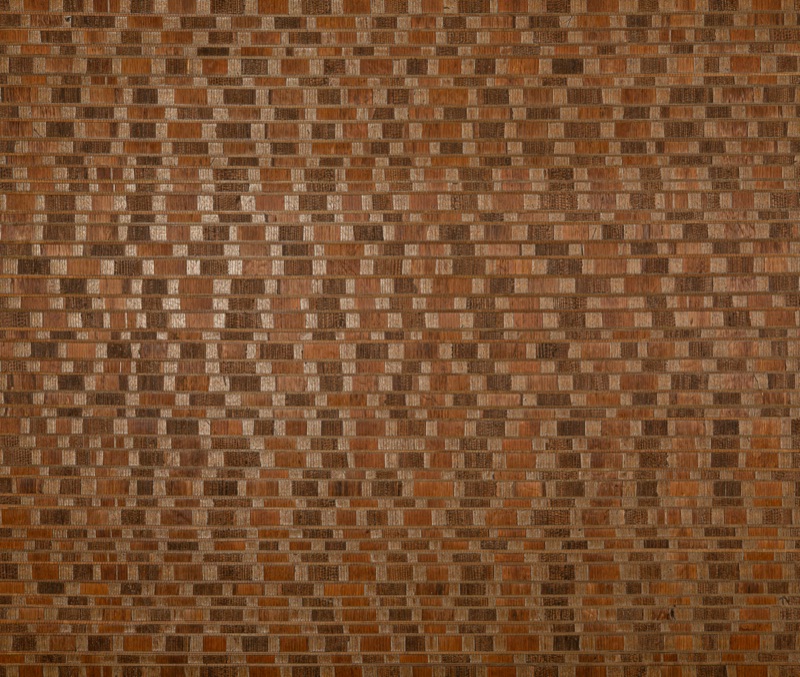
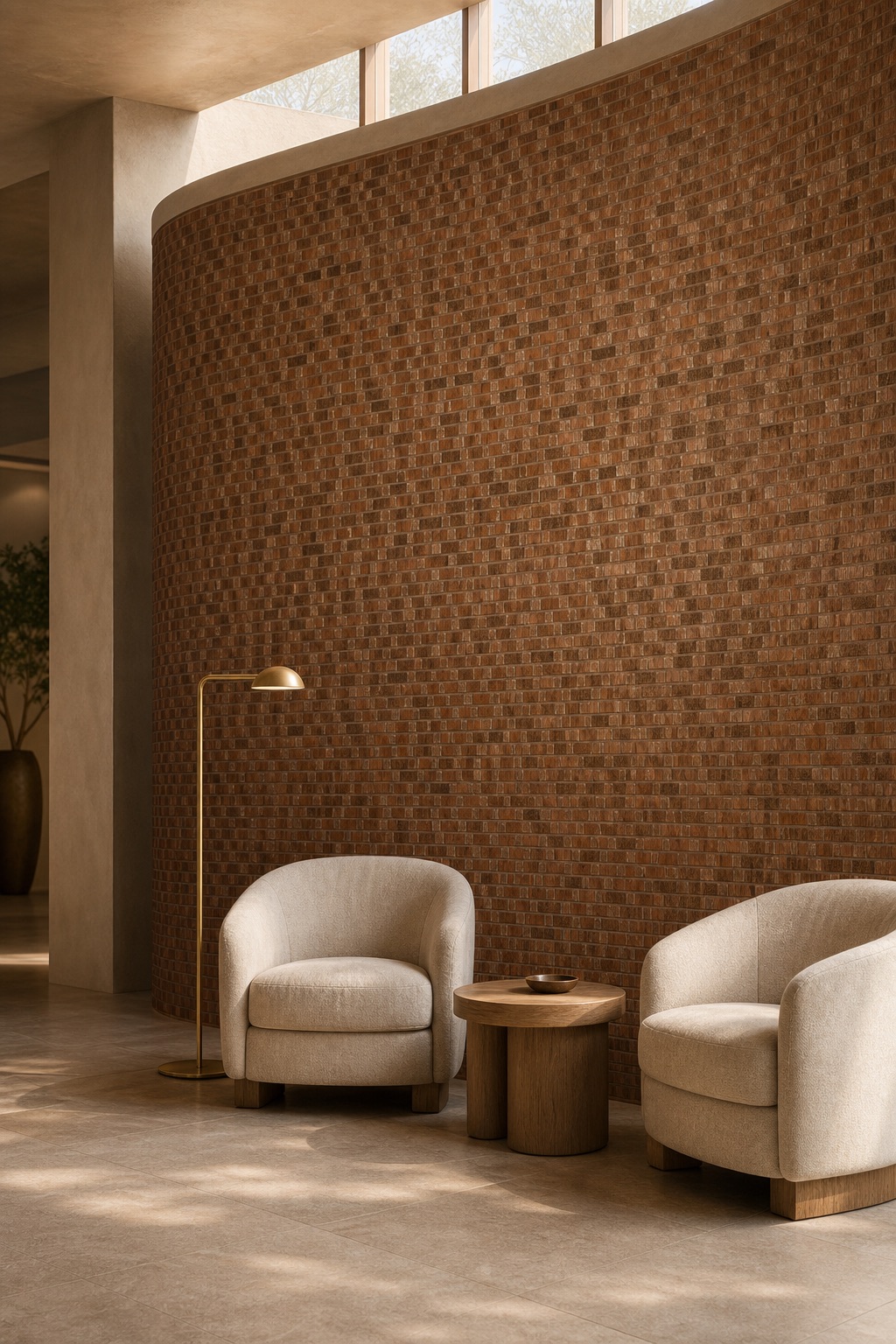
Adobe Stack is a terracotta bamboo wallcovering structured in a staggered running-bond offset pattern, its warm rust-orange ground interspersed with dark chocolate brown units and pale buff cream where the warp surfaces at each joint, producing a surface that reads like fired earth from across the room. The brick-bond structure creates a quiet, repeating rhythm of horizontal and vertical joint lines that adds low-relief depth without visual noise. Produced with our partner mills to in-house studio specifications, it is supplied to interior designers, architects, and hospitality buyers from 50 rolls, making it a practical specification for feature walls, dining rooms, and restaurant interiors.
Running-Bond Relief: How the Offset Block Structure Gives Adobe Stack Its Depth
- Each flat reed strip is staggered by half a unit against the row above, creating a continuous running-bond grid of fine horizontal and vertical joint shadows across the full wall surface.
- In raking side-light from low-hung pendants or angled track spots, those joint lines deepen and the surface reads as architecturally grounded, with a quiet sculptural quality.
- In soft diffused daylight, the surface flattens and the terracotta mid-tone becomes more uniform and enveloping across the wall plane.
- The fully matte finish eliminates glare points under directional or theatrical lighting, making this weave well suited to mixed-light hospitality environments.
- At oblique angles, a faint inherent natural lustre from the smooth-cut reed face keeps the surface visually alive without introducing any sheen or hot-spot.
The staggered offset of each reed strip generates a continuous network of fine horizontal and vertical joint lines across the wall. In raking side-light from low-hung pendants or directional spots, those joints cast shadow and the surface takes on a low-relief, sculptural quality that shifts as the light source moves. In diffused daylight the modular pattern flattens slightly, and the terracotta ground reads more uniformly warm and enveloping. Because the finish is entirely matte, there are no glare points under theatrical or mixed-source lighting, which makes Adobe Stack a sound specification for restaurant, bar, and hospitality interiors where lighting rigs change between day and evening service.
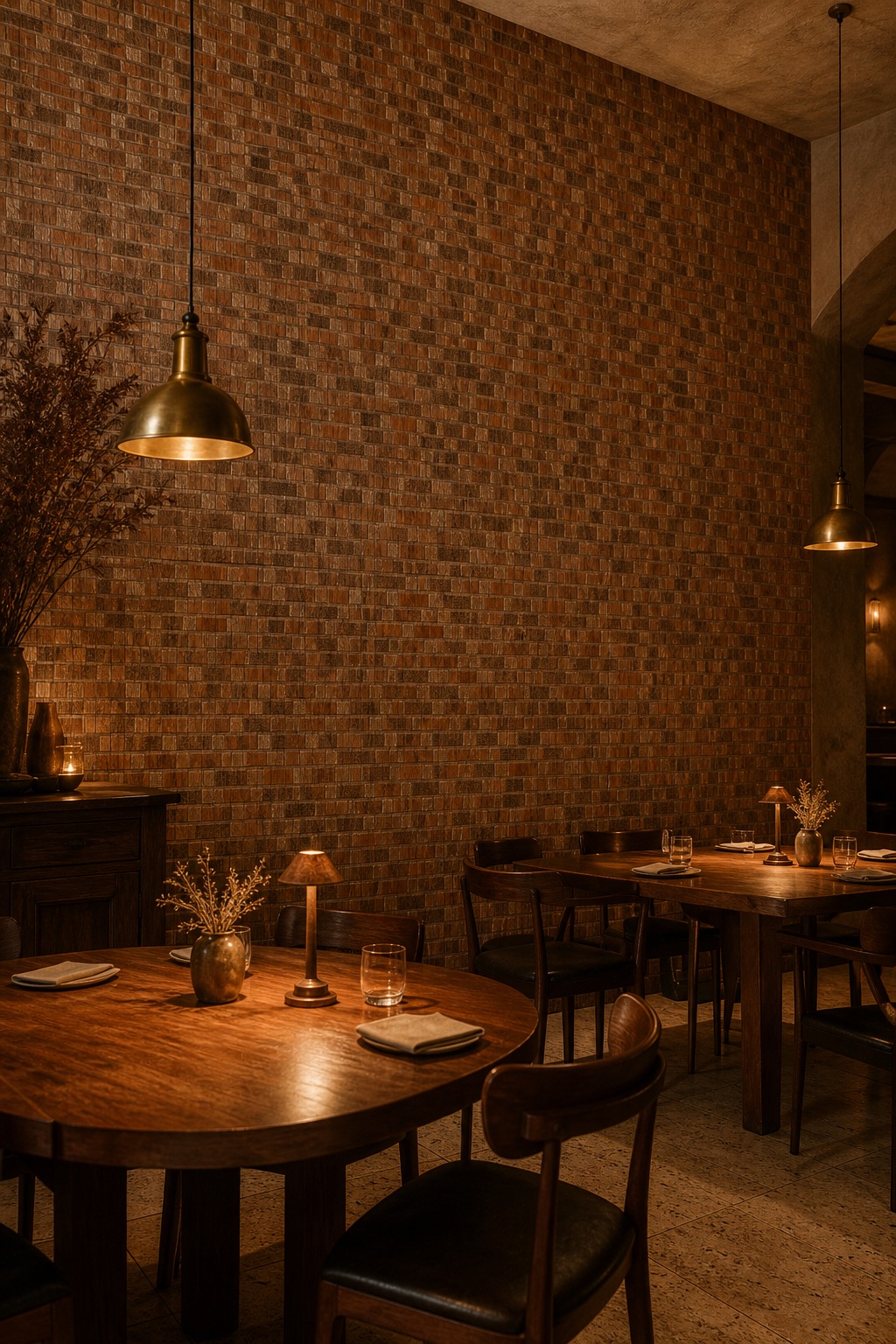
Warm Earth Across the Clock: Adobe Stack's Terracotta in Natural and Artificial Light
- The rust-orange ground is a mid-value hue with strongly orange-red undertones; it advances slightly in a room, making walls feel closer and spaces feel enveloping rather than expansive.
- Dark chocolate units scattered through the weave lower overall visual brightness and prevent the terracotta from reading as raw or saturated at wall scale.
- In north-facing rooms lit by cool daylight, the colour holds its warmth because there is no pink or burgundy in the undertone to shift it cold.
- Under warm tungsten-equivalent or halogen lighting, the chocolate browns deepen and the rust-orange intensifies, suiting evening dining and bar environments particularly well.
- Companion materials: travertine, brushed brass, unbleached linen, and coarse plaster. Avoid pure-white trims, which generate excessive contrast against the mid-dark ground.
The rust-orange ground is a mid-value, strongly orange-red hue. The dark chocolate units woven throughout suppress overall brightness and prevent the colour from reading as raw or oversaturated at wall scale. In north-facing rooms with cool daylight, the colour holds its warmth because there is no pink or burgundy in the undertone to drag it cold. Under warm artificial light in the evening, the chocolate browns deepen and the terracotta intensifies, which is why this bamboo wallcovering performs particularly well in restaurant dining rooms, hotel bars, and evening hospitality spaces. Build a companion palette around travertine, brushed brass, unbleached linen, and coarse plaster; avoid pure-white trims, which create too much contrast with the mid-dark ground.
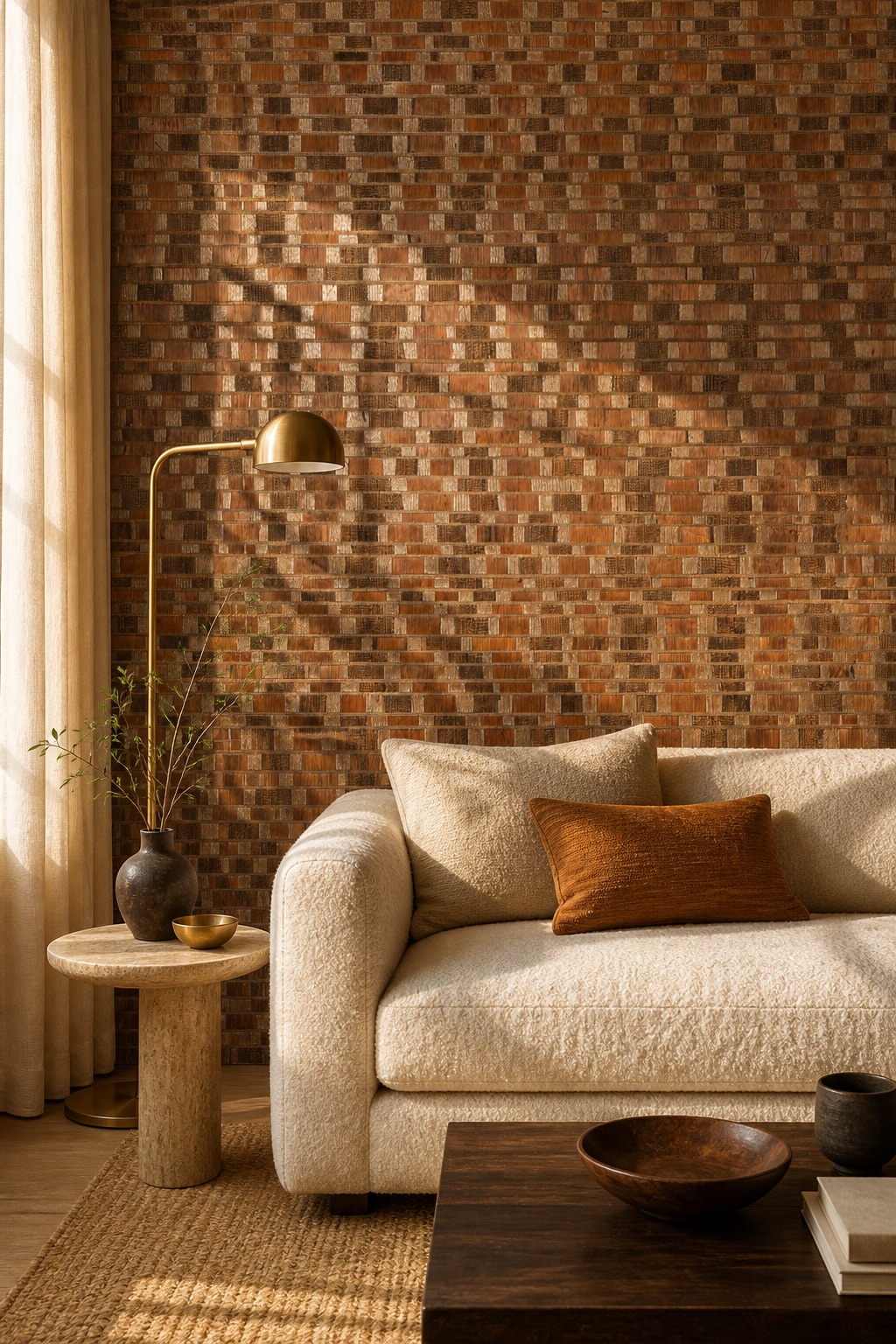
Restaurants, Hotel Bars, and Residential Feature Walls: Where Terracotta Bamboo Wallcovering Finds Its Best Setting
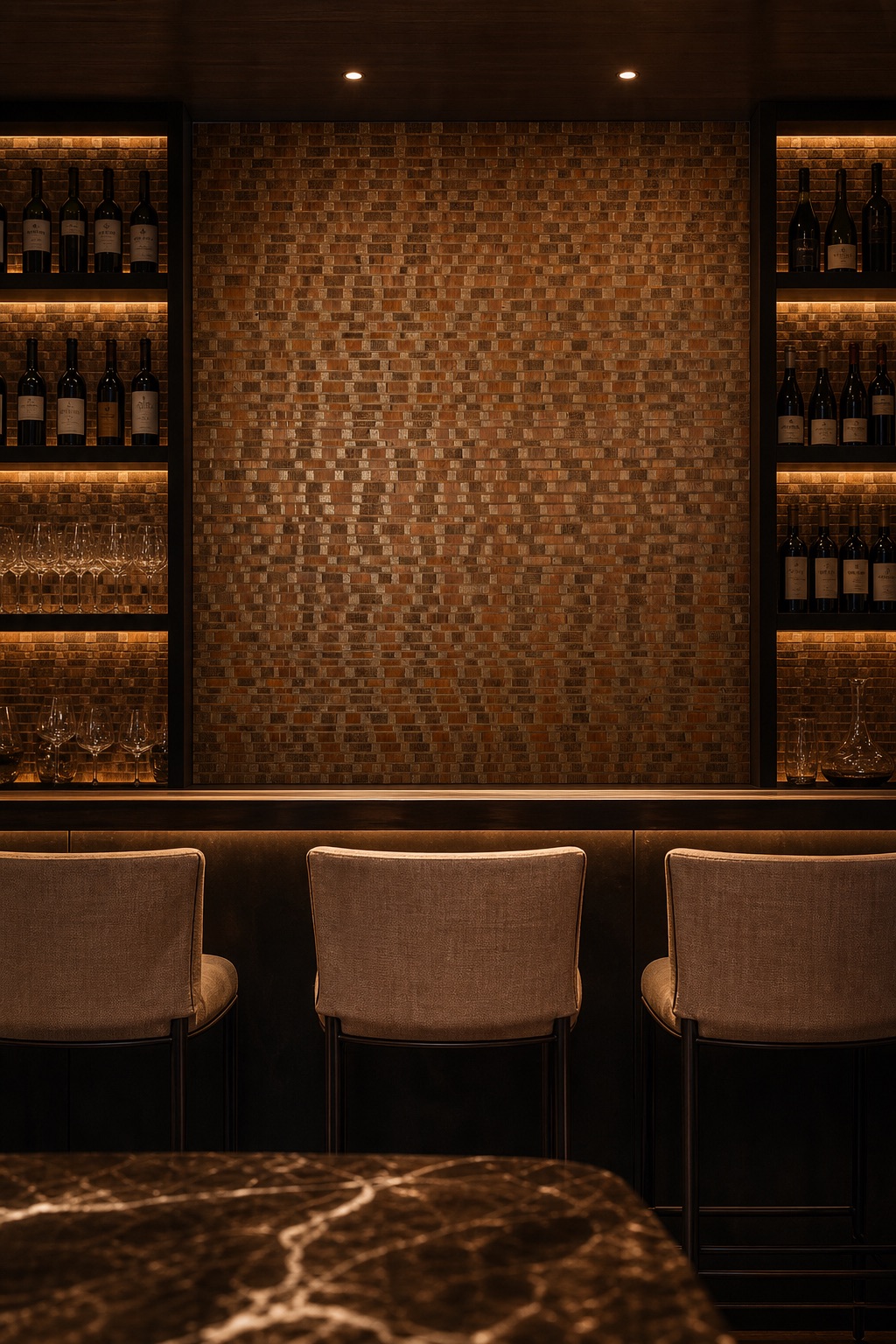
- The terracotta-and-chocolate palette suits rooms where warmth and enclosure are deliberate: private dining rooms, restaurant feature walls, hotel bars, and wine lounges.
- On a full accent wall behind a dining table, the brick-bond texture registers clearly at seated eye-level without overwhelming the table setting or the ceiling line.
- In residential living rooms, the earthy mid-value tone layers naturally with dark-stained oak, aged brass hardware, and bouclé upholstery.
- As a boutique-hotel headwall it reads as grounded and organic, fitting wabi-sabi and organic-modern design briefs without requiring additional warm accents.
- The medium texture scale makes seam management straightforward for a skilled paperhanger using standard wheatstarch or heavy-duty cellulose paste.
The terracotta-and-chocolate palette suits spaces where warmth and enclosure are a deliberate design choice. Private dining rooms, restaurant feature walls, hotel bars, and wine-bar back walls all benefit from the enveloping depth of the rust-orange ground, particularly under low-hung brass pendants. For residential projects, Adobe Stack anchors a living-room accent wall behind a sofa or serves as a headwall in a wabi-sabi or organic-modern bedroom brief. The medium texture scale keeps seam management straightforward for a skilled paperhanger. If the brick-bond structure suits the brief but the terracotta palette needs to change, our design studio engineers custom colourways directly from your reference swatch or paint code.
Flat-Cut Reed Construction: Material Behaviour and Long-Term Care
- The strips in this wallcovering are flat-cut natural reed with smooth faces and fine longitudinal grain lines running along each unit's length, bound at every warp intersection.
- Performs reliably in conditioned, humidity-controlled interiors; sustained ambient humidity above approximately 70% can cause dimensional movement in natural fibre wallcoverings.
- The matte surface does not attract fingerprint smears; routine maintenance is light dry-dusting with a soft brush.
- Wet-wiping and steam-cleaning are not suitable; for stubborn marks, test a barely damp cloth on a concealed section before any broader attempt.
- A quality sizing coat and a flat, well-prepared substrate will give the best seam result and the longest service life.
The flat-cut reed strips visible in Adobe Stack carry smooth faces with fine longitudinal grain lines running along each unit's length, bound together at every warp intersection. This wallcovering performs reliably in conditioned, humidity-managed interiors; sustained ambient humidity above roughly 70% can cause dimensional movement in natural fibre materials, so air-conditioned dining and hospitality spaces are the appropriate application. The matte surface resists fingerprint smearing; routine care is light dry-dusting with a soft brush. Wet-wiping and steam-cleaning are not suitable — for stubborn marks, test a barely damp cloth on a concealed section first. For a full cleaning and care protocol, our guide to maintaining natural wallcoverings covers the detail.
Studio Process and Dye-Lot Integrity: Ordering Terracotta Bamboo Wallcovering with Confidence
- Three in-house designers at the Chengdu studio review every brief; for custom colourway work they produce CAD drawings and colour separations before any proofing begins.
- The workflow runs from paid sample book (credited against the order) to paid proofing quoted upfront (approximately one to two weeks) to production confirmed on the pro-forma invoice (four to six weeks for standard materials).
- Every production batch is logged under a single dye-lot, and each shipment includes its lot certificate to support multi-room or phased commercial project documentation.
- The founder has worked in the natural wallcovering supply chain since 2018; the studio's documentation package is structured around the sample-approval stages buyers encounter on commercial specifications.
- Full process details, proofing structure, and commercial terms are on our process page.
Each Adobe Stack order follows a documented path. A paid sample book, credited against any subsequent order, lets specifiers confirm colour and texture under real site conditions before committing. Paid proofing is quoted upfront and typically turns around in one to two weeks; standard production runs four to six weeks from confirmed payment. Three in-house designers at the Chengdu studio translate colour references into CAD separations and coordinate with our partner mills throughout, maintaining consistency across the batch. Every production run carries a single dye-lot, and each shipment includes its lot certificate for the sample-approval and project documentation stages common on commercial briefs. The founder has worked in the natural wallcovering supply chain since 2018. Full commercial terms and process detail are on our process page.
Buying grasscloth for a project or a brand?
- Minimum order
- 50 rolls (about 250 m²) catalog · 100 rolls custom / private label
- Lead time
- 4–6 weeks standard · 5–8 weeks specialty, after sample approval and payment
- Terms
- EXW Chengdu · FOB, CIF, DDP on request
- Samples
- Free digital kit in 24 h · paid swatch pack, credited in full on your first order
- Reply
- Within 24 hours
Frequently asked
- Will the terracotta colour fade noticeably in a west-facing room with strong afternoon sun?
- All natural reed and bamboo wallcoverings are susceptible to UV-driven fading. The rust-orange in Adobe Stack will shift toward a paler, more buff tone over several years of unprotected direct afternoon exposure. West-facing walls receiving strong sunlight benefit from UV-filtering window film to slow the process. Our fading prevention guide covers the options in detail: /guides/fading-prevention.
- How visible are the vertical seams in a brick-bond weave at room scale?
- The running-bond offset means vertical seam lines fall at half-unit offsets across the wall, distributing the visual rhythm and often making seams less conspicuous than in a straight horizontal weave. Seam visibility depends primarily on wall flatness, hanger technique, and the angle of the main light source. A well-prepared substrate and an experienced installer will minimise any disruption. Our seam-handling guide covers preparation and hanging technique in full: /guides/handle-seams.
- Is this reed wallcovering durable enough for a restaurant feature wall or hotel corridor?
- Adobe Stack is well suited to dining-room feature walls and hotel-room accent walls in low-to-moderate traffic zones. High-abrasion corridors with frequent luggage transit or coat-and-bag contact carry a higher risk of snag damage to the flat reed face; in those locations a wainscoting or chair-rail system protecting the lower 900 mm is advisable.
- Can this bamboo wallcovering be used in a humid coastal property or near a restaurant kitchen?
- Natural bamboo and reed wallcoverings are best suited to air-conditioned, humidity-controlled interiors. Coastal properties with open-plan sea-facing rooms and walls adjacent to kitchen extraction or other high-humidity service areas carry a meaningful risk of dimensional movement or mould growth. Testing a sample in situ and fitting a moisture barrier are both advisable in those conditions. Our humidity risks guide covers the full assessment: /guides/humidity-risks.
- What is the minimum order for a custom colourway on this structure?
- Custom colourway orders start at 50 rolls; full proofing costs, payment terms, and lead times are on our process page: /process.