Sand Bamboo Wallcovering
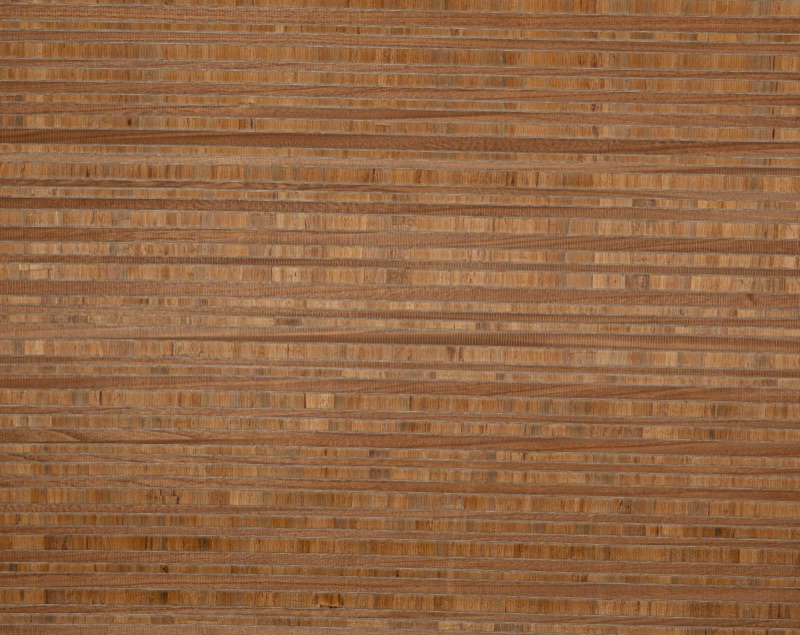
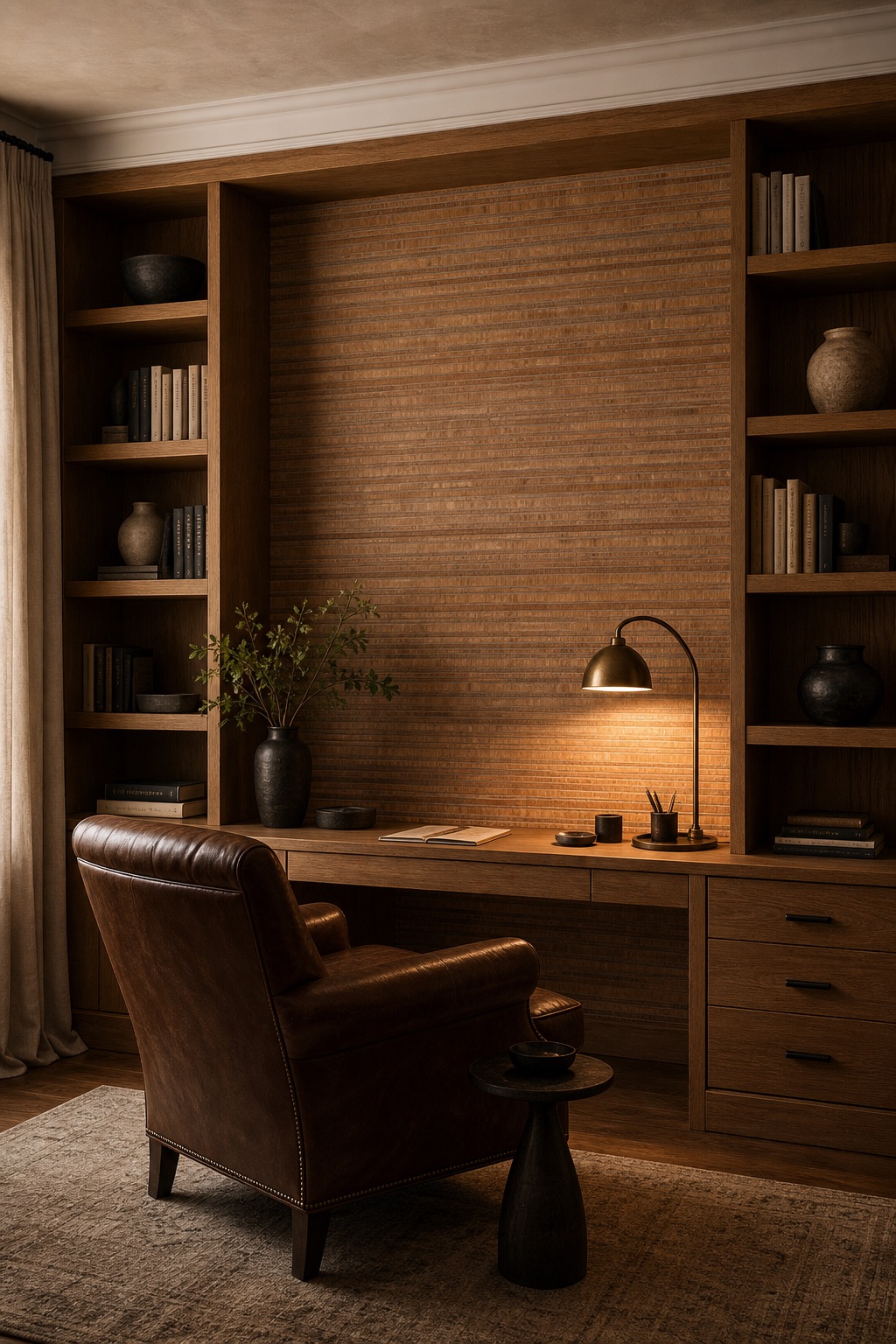
Honey Loom is a wide-reed sand bamboo wallcovering built from broad flat bamboo strips alternating with narrower segmented bands; the horizontal rhythm reads clearly from across a room while the cellular surface detail rewards closer inspection. Produced with our partner mills to Grasscloths studio specification, it arrives in warm medium brown with honey-tan and dark caramel variation that shifts subtly as daylight moves across the wall. Supplied to designers and trade buyers from 50 rolls, this material suits living rooms, dining rooms, and hospitality suites where a grounded wabi-sabi sensibility guides the brief.
Flat Strip and Segmented Band: Reading the Wide-Reed Surface Up Close
- Each horizontal course alternates a broad flat bamboo strip with a narrower band of cellular, segmented reed material.
- The segmented bands show the natural node structure of the bamboo, giving each narrow course a micro-grid character distinct from the smoother broad strip.
- Cross-binding threads are faintly visible running at regular intervals across the surface, holding the strips in alignment without interrupting the horizontal read.
- At wall scale the alternating rhythm creates confident linear order; natural variation in strip grain and caramel toning prevents any mechanical regularity.
- The finish is fully matte with no reflective surface layer, so the material holds its character under both direct daylight and artificial light without glare.
The surface of Honey Loom is defined by its alternating horizontal courses: broad flat bamboo strips set alongside narrower bands of cellular, segmented reed. The broad strips carry the warm honey-brown ground tone; the narrow segmented bands introduce a darker caramel shadow that reads at normal viewing distance as a fine horizontal accent line. Close-up, the individual cellular structure of each segmented band becomes visible, and faint cross-binding threads that run across the surface can be seen holding the whole construction together. At wall scale the combined effect is a confident linear pattern with the natural warmth and irregularity that only a plant-fibre surface produces.
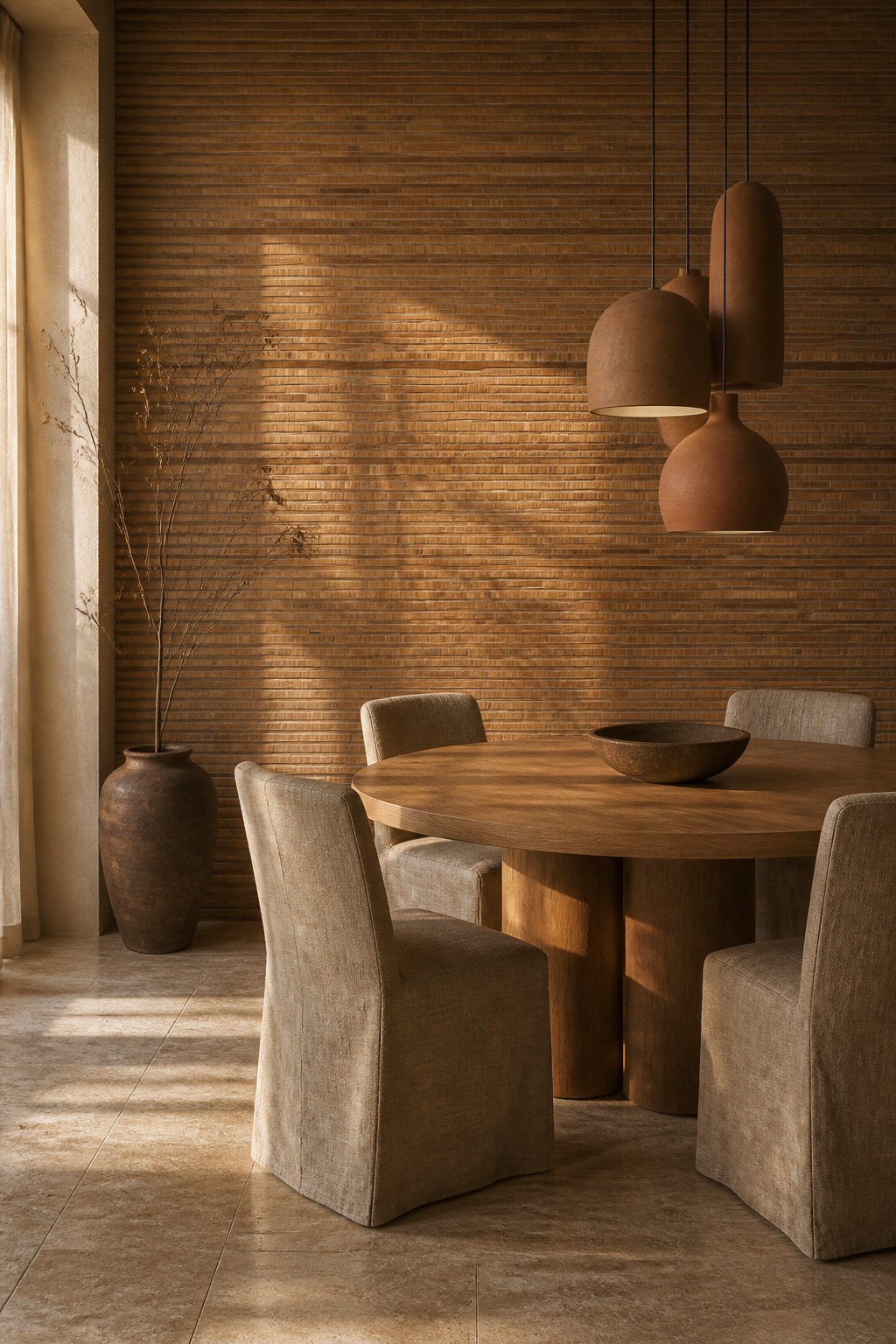
Warm Honey-Brown Through the Day: Light Behaviour on a Matte Reed Wall
- In direct morning sunlight the broad bamboo strips lighten toward golden tan; the segmented bands remain a grounding caramel, increasing tonal contrast between the two band types.
- Under diffused overcast daylight the surface unifies to a steady medium brown with very little variation, giving the most legible reading of the overall pattern.
- Under warm artificial evening light both honey and caramel tones deepen and the wall reads with amber richness.
- In north-facing or lower-light interiors the material holds its warmth rather than shifting grey, a behaviour consistent with its warm undertone throughout.
- The fully matte finish produces no glare shift and no surface reflection to manage between bright and dim lighting conditions.
The warm undertone running through every component of Honey Loom means the surface behaves consistently across lighting conditions, reading warm rather than drifting grey. Morning light draws out the golden register in the broader strips; an overcast afternoon produces the most even reading of the sand bamboo wallcovering pattern, revealing the full tonal relationship between honey-tan strips and the darker caramel segmented bands. Under warm artificial evening light the palette deepens toward amber. This predictable warmth is practically useful when specifying for rooms that transition between natural and artificial light across the course of a day.
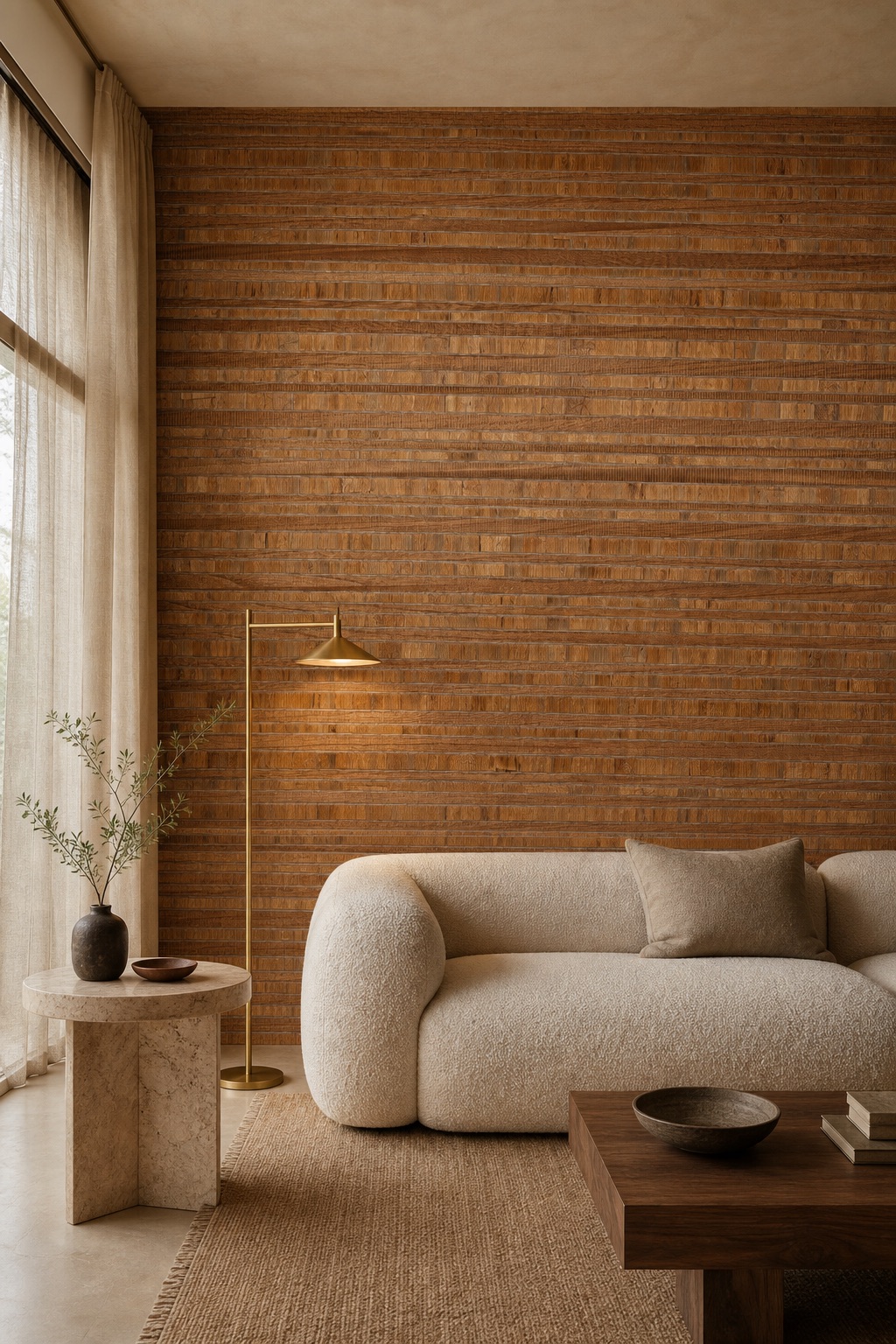
Living Rooms, Dining Rooms, and Study Walls: Where Sand Bamboo Wallcovering Holds Its Own
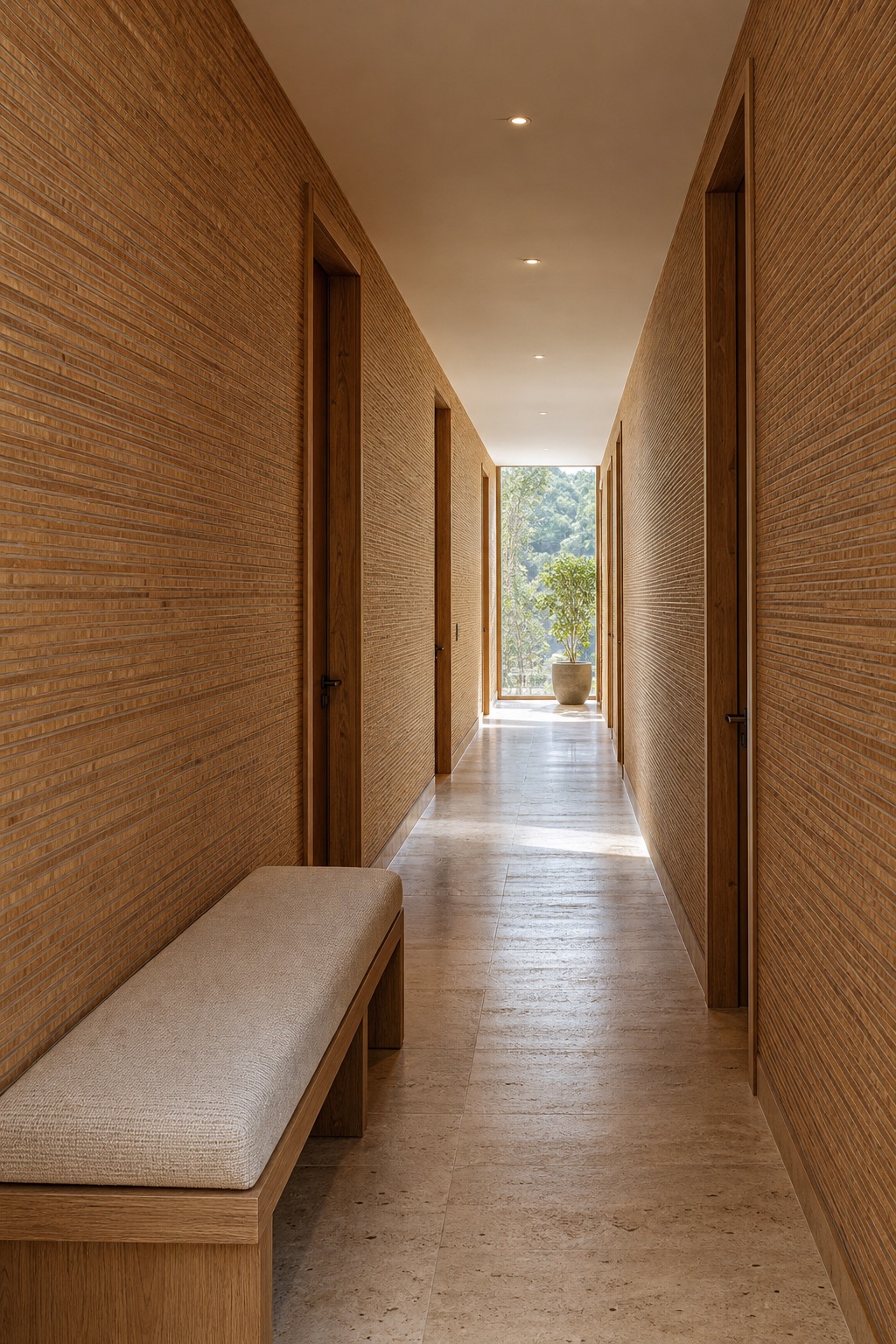
- The bold horizontal linearity makes this material well-suited to feature walls and full-room installations in spaces with generous ceiling heights.
- In living rooms it sits naturally alongside travertine, oak millwork, linen upholstery, and bouclé seating without competing with any of them.
- For dining rooms the textured surface provides a degree of acoustic softening that a smooth painted wall cannot offer.
- In hospitality briefs the matte finish photographs without glare and ages gracefully, meeting the practical demands of hotel suites and boutique lobby walls.
- Study and library walls benefit from the warm brown ground, which creates a contained and focused atmosphere suited to book-lined or panelled rooms.
- The wabi-sabi and japandi style registers of this weave make it appropriate for briefs calling for organic texture without pattern or colour distraction.
Sand bamboo wallcovering at this scale and warmth works across a wider range of room types than most specifiers initially plan for. The strong horizontal linearity suits feature walls in living rooms and dining rooms, where it establishes visual structure without pattern or colour competition. Companion materials (travertine flooring, oak millwork, natural linen upholstery, bouclé seating) sit comfortably against the warm brown ground of Honey Loom without visual tension. In hospitality briefs, the matte finish holds its appearance under the warm lamps of an evening dining setting and the cooler daylight of a morning suite with equal composure. Study and library walls benefit from the material's grounding warmth, which draws focus inward rather than outward. Love this weave but need your own colour or a different strip scale? Our design studio engineers custom colourways from your reference; send us a sample and we will quote a proof from your specification.
Surface Care and What to Expect From a Natural Bamboo Strip Wall
- Natural bamboo strip wallcovering performs best in climate-controlled interiors with stable humidity; persistent condensation or steam will degrade the natural fibre backing.
- Spot-clean with a barely damp cloth and allow the surface to air-dry; wet wiping and chemical cleaners are not appropriate.
- The matte finish does not attract fingerprints prominently and settles dust evenly, keeping day-to-day maintenance low-effort.
- Some natural colour variation between rolls is a characteristic of the material, not a defect; single dye-lot production minimises variation within an order.
- In rooms with prolonged direct UV exposure, gradual lightening of natural plant-fibre surfaces is expected; window film or sheer screening slows this process significantly.
Honey Loom, like all natural bamboo strip wallcoverings, performs best in climate-controlled interiors where humidity is stable and condensation does not form on walls. Direct steam or persistent moisture will degrade the natural fibre backing and is outside the material's appropriate use range; bathrooms with poor ventilation and kitchen splashback zones are not suitable applications. Day-to-day maintenance is minimal: spot-clean with a barely damp cloth and allow the surface to air-dry naturally. The matte finish resists fingerprint visibility and settles dust evenly, so routine care amounts to occasional dry brushing or a light cloth pass. In rooms with strong direct sunlight, window film or interior sheer screening will slow the gradual lightening that occurs in any natural plant-fibre wall surface over time.
How Grasscloths Works: Sample, Proof, and Certified Batch
- The process begins with a physical sample book; the cost is credited against a confirmed order, up to 10% of the order value.
- A paid colourway or material proof is quoted and agreed before any production run begins; proofing typically takes one to two weeks.
- Standard-material production runs, including this sand bamboo wallcovering specification, typically complete in four to six weeks.
- Every batch ships with a per-batch lot certificate confirming the dye lot and production run, providing the documentation specifiers need for their own project files.
- Three full-time in-house designers translate client references and mood-board directions into technical CAD specifications that the partner mills work from directly.
- Commercial structure: sample book credited against the order, paid proof quoted upfront, payment confirmed on the pro-forma invoice, FOB or CIF or DDP to the buyer's preference.
Every Grasscloths specification follows the same structured sequence: a physical sample book, a paid colourway or material proof, and a production run confirmed on the pro-forma invoice. Freight terms (FOB, CIF, or DDP) are quoted separately and remain at the buyer's cost. Three full-time in-house designers translate client references and mood-board directions into technical CAD specifications that the partner mills work from directly, which is how the studio can ensure that what ships matches what was approved at the proof stage. Each production batch arrives with a lot certificate confirming the dye lot and run, giving specifiers the documentation they need for their own project records. Our founder has worked in the natural wallcovering trade since 2018 and is the primary point of contact for all specification and supply-chain questions.
Buying grasscloth for a project or a brand?
- Minimum order
- 50 rolls (about 250 m²) catalog · 100 rolls custom / private label
- Lead time
- 4–6 weeks standard · 5–8 weeks specialty, after sample approval and payment
- Terms
- EXW Chengdu · FOB, CIF, DDP on request
- Samples
- Free digital kit in 24 h · paid swatch pack, credited in full on your first order
- Reply
- Within 24 hours
Frequently asked
- Will the warm brown in Honey Loom fade noticeably in a south-facing room?
- Natural bamboo fibres will lighten gradually under sustained direct UV exposure. South-facing rooms with large unscreened glazing should plan for window film or interior sheer screening, which slows colour change significantly. The matte finish does not accelerate fading relative to a coated surface. We can supply a sample for your own UV-exposure assessment if your project specification requires it.
- How do seams read in a horizontal wide-reed pattern like this?
- The strong horizontal linearity means seams run vertically across the pattern. When hung by an experienced installer using a reverse-hang technique, vertical seams are typically hidden by the eye's natural tendency to follow the horizontal reed lines. A skilled installer will dry-fit strips and confirm seam placement before committing adhesive.
- Is this bamboo wallcovering suitable for a bathroom or kitchen wall?
- Honey Loom is not recommended for rooms with persistent humidity, condensation, or steam. Bathrooms, en-suites, and kitchen splashback areas are outside its appropriate use range. A well-ventilated powder room is borderline; we recommend ordering a sample and assessing your specific conditions before specifying.
- What is the minimum order quantity for a custom colourway of this sand bamboo wallcovering?
- Custom colourways start at 50 rolls; full proof and order terms are on our process page at /process.