Red Grasscloth Wallpaper
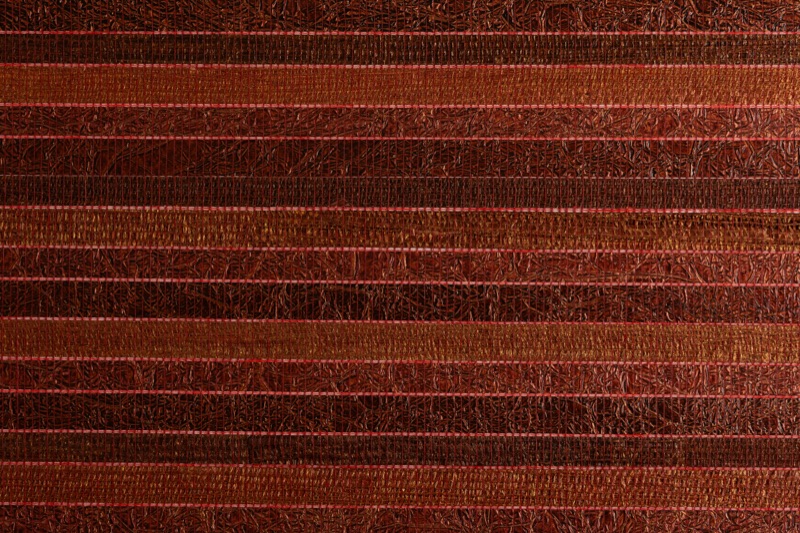
Garnet Reed is a deep burgundy-red grasscloth with a bold horizontal reed weave: wide, tightly bundled bands separated by thin crimson accent stripes that read as a continuous horizontal register across the full wall. The surface is matte with only a faint natural lustre, giving this red grasscloth wallpaper an organic weight that flat paint cannot replicate. Produced with our partner mills to our studio specifications, it is supplied to interior designers, hospitality buyers, and trade importers from a 50 rolls (≈250 m²) minimum order, with single dye-lot consistency and per-batch lot certification.
Crimson Volume: What a Deep Reed Wall Does to Architectural Space
- Deep burgundy-red visually advances, making a room feel intimate and contained rather than expansive.
- The matte reed surface absorbs rather than reflects light, holding warmth without the aggression of a glossy red.
- Horizontal banding draws the eye laterally, lending perceived width to narrower rooms such as bar alcoves or corridor dining.
- In F&B and hospitality contexts, deep red has a long-established association with appetite and conviviality.
- Because no two reed bundles are identical, the wall carries a lived-in depth that solid-colour finishes cannot replicate.
- On a single accent wall set against travertine, plaster, or dark oak, Garnet Reed anchors the room without competing with furnishings.
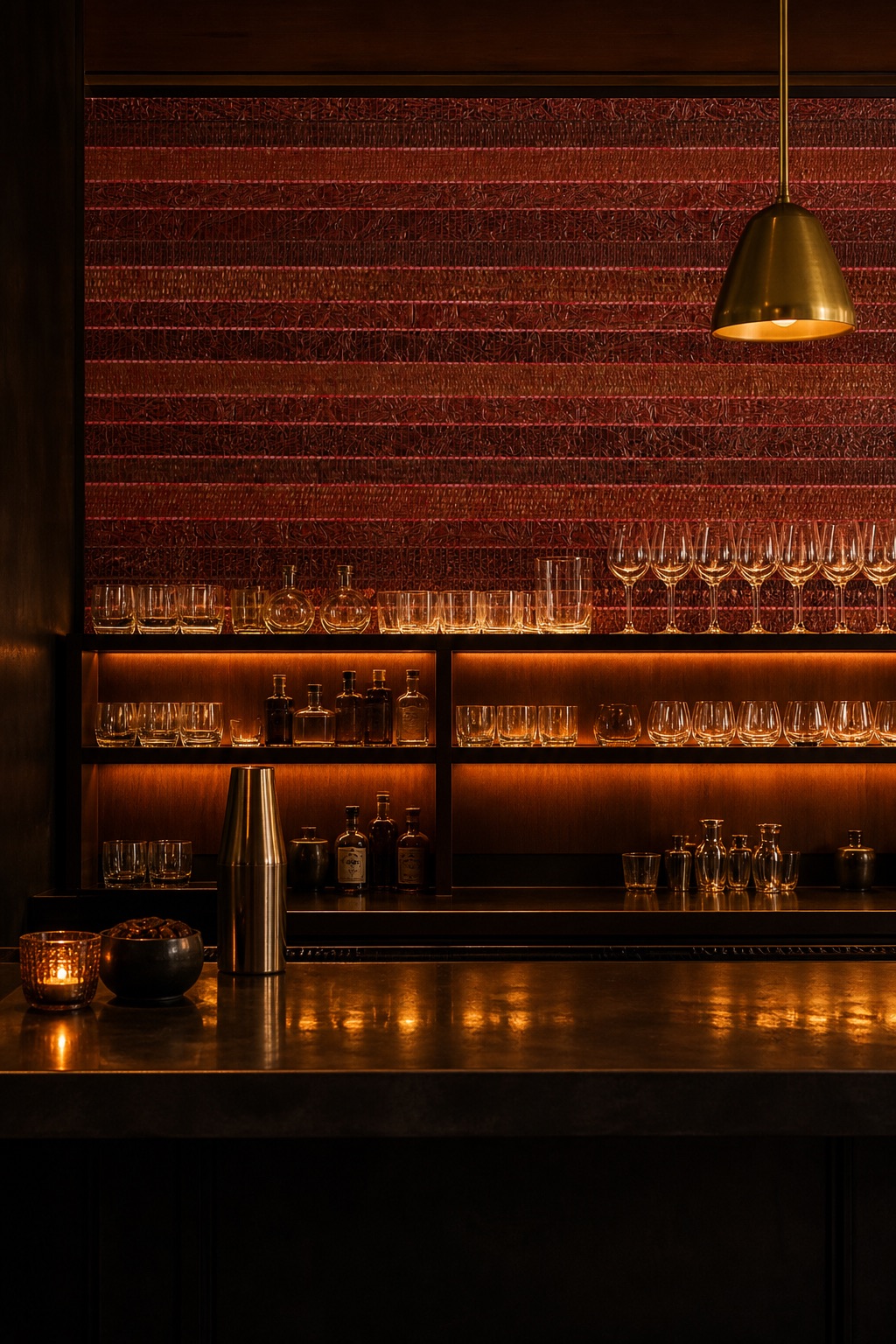
A full wall of deep burgundy-red performs differently from a deep neutral: it advances, containing the room and drawing occupants toward the centre rather than expanding outward toward the perimeter. Because the surface is matte, the red holds its warmth under lamplight without crossing into aggression. Interior designers working with Garnet Reed often apply it to a single feature wall, setting it against plaster, travertine, or dark oak, and letting the grasscloth carry the room's emotional register while companion materials remain quiet. At distance, the horizontal banding registers as continuous warm striping that reads wide rather than tall, giving narrower dining rooms or bar alcoves a sense of width without structural intervention.
Reed Bands and Accent Stripes: How the Alternating Pattern Reads at Wall Scale
- Wide reed bands consist of tightly bundled natural filaments, slightly crinkled along their length.
- Thin accent stripes in bright crimson run horizontally between the wide bands, providing structural cadence rather than a decorative motif.
- The crinkled filament surface within each band creates micro-shadow when light rakes obliquely across the wall.
- Bold texture scale: the pattern reads clearly from three or more metres away.
- The accent stripes are a genuine weave element, not a print or overcoat.
- Panel seams must be aligned so reed bands and accent stripes continue unbroken across joins; hanging notes and a seam-planning guide are provided with each order.
Each wide band consists of tightly bundled natural reed filaments, slightly crinkled along their length, which produces a micro-shadow when light rakes obliquely across the surface. Between the wide bands, thin accent stripes in a brighter crimson run as continuous horizontal lines (a genuine weave element, not a print), giving the pattern a structural cadence rather than a decorative motif. At wall scale, the overall effect reads as bold horizontal striping, a register that a specifier can use to direct eye-line and add apparent width to a room. Panel seams require careful alignment so the reed bands continue unbroken across joins; a seam-planning guide and hanging notes accompany every order.
Burgundy by Incandescent Light, Near-Black by Shade: Colour Behaviour Across the Day
- Under warm incandescent or pendant lighting, wide reed bands shift toward deep terracotta and accent stripes brighten to a clear crimson.
- In cool northern daylight, the surface reads darker and more burgundy-brown, with secondary dark-brown tones becoming more prominent.
- The undertone is warm with no grey or purple base, so the red reads as an earthy crimson rather than wine or aubergine.
- This tonal behaviour makes Garnet Reed particularly suited to rooms lit primarily by warm artificial light: bars, dining rooms, hotel suites.
- In rooms with significant north-facing or cool ambient light, warm-temperature LED fixtures help preserve the surface's intended richness.
- The textural dimension of the reed weave prevents the red from reading as flat or oppressive even under lower light levels.
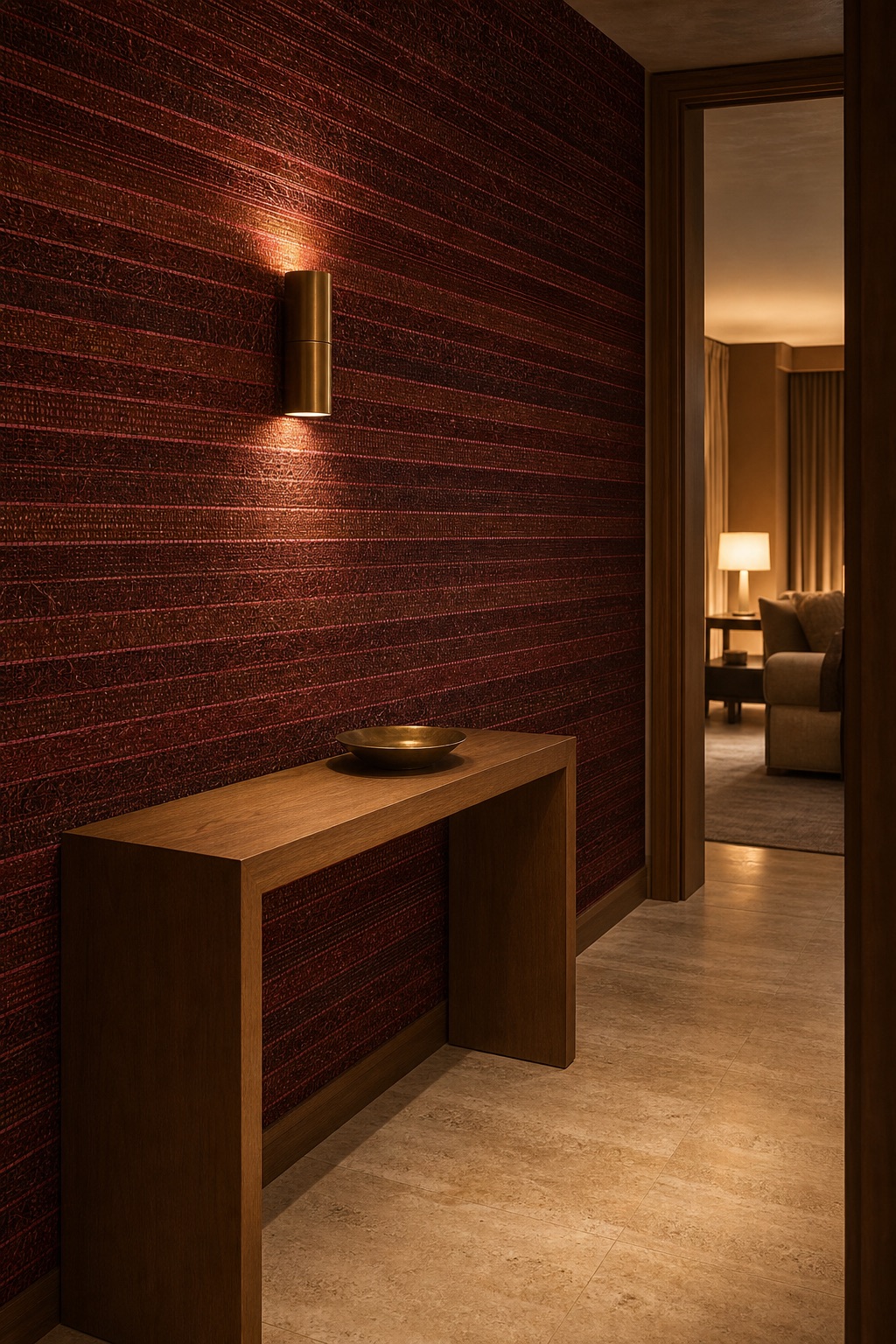
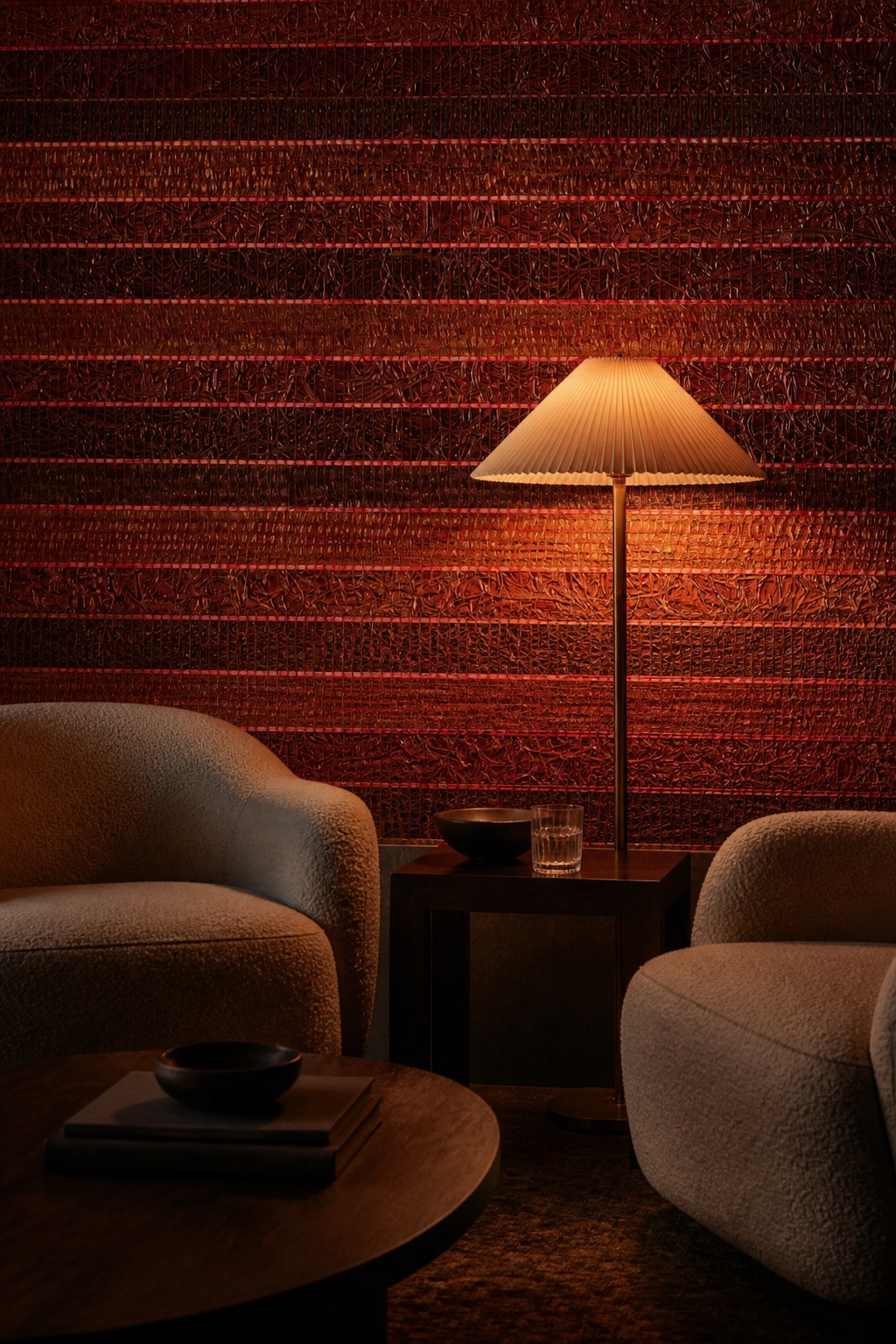
Under warm incandescent or pendant lighting, the wide reed bands shift toward a deep terracotta and the accent stripes brighten to a clear crimson; the whole wall appears to hold contained warmth. In cool northern daylight, the same surface reads closer to dark burgundy-brown, with the secondary dark-brown tones of the reed becoming more pronounced. The warm undertone means there is no purple or grey base to this red; it reads as a genuine earthy crimson rather than wine or aubergine. Designers specifying Garnet Reed for rooms with significant cool or north-facing light should plan for warm-temperature LED fixtures to preserve the surface's full richness.
Private Dining, Hospitality Bars, and Statement Feature Walls: Where Red Grasscloth Wallpaper Belongs
- Dining rooms: the enclosing warmth of deep red aligns with conviviality; the matte natural surface avoids the self-consciousness of a high-gloss feature wall.
- Bar and lounge environments: low-output pendant or ambient lighting plays to this material's colour depth; brass fixtures, dark oak joinery, and bouclé seating share a tonal register that reads cohesively.
- Hotel suites: effective as a single feature wall behind a headboard or as a continuous corridor-alcove treatment.
- Private study or reading room: the enclosing quality creates focus; leather, plaster, and travertine all read well beside it.
- Classification-confirmed room fits: dining, study, bar, hotel-suite.
- Less suited to rooms with sustained high moisture or spaces where a visually expansive effect is the primary goal.
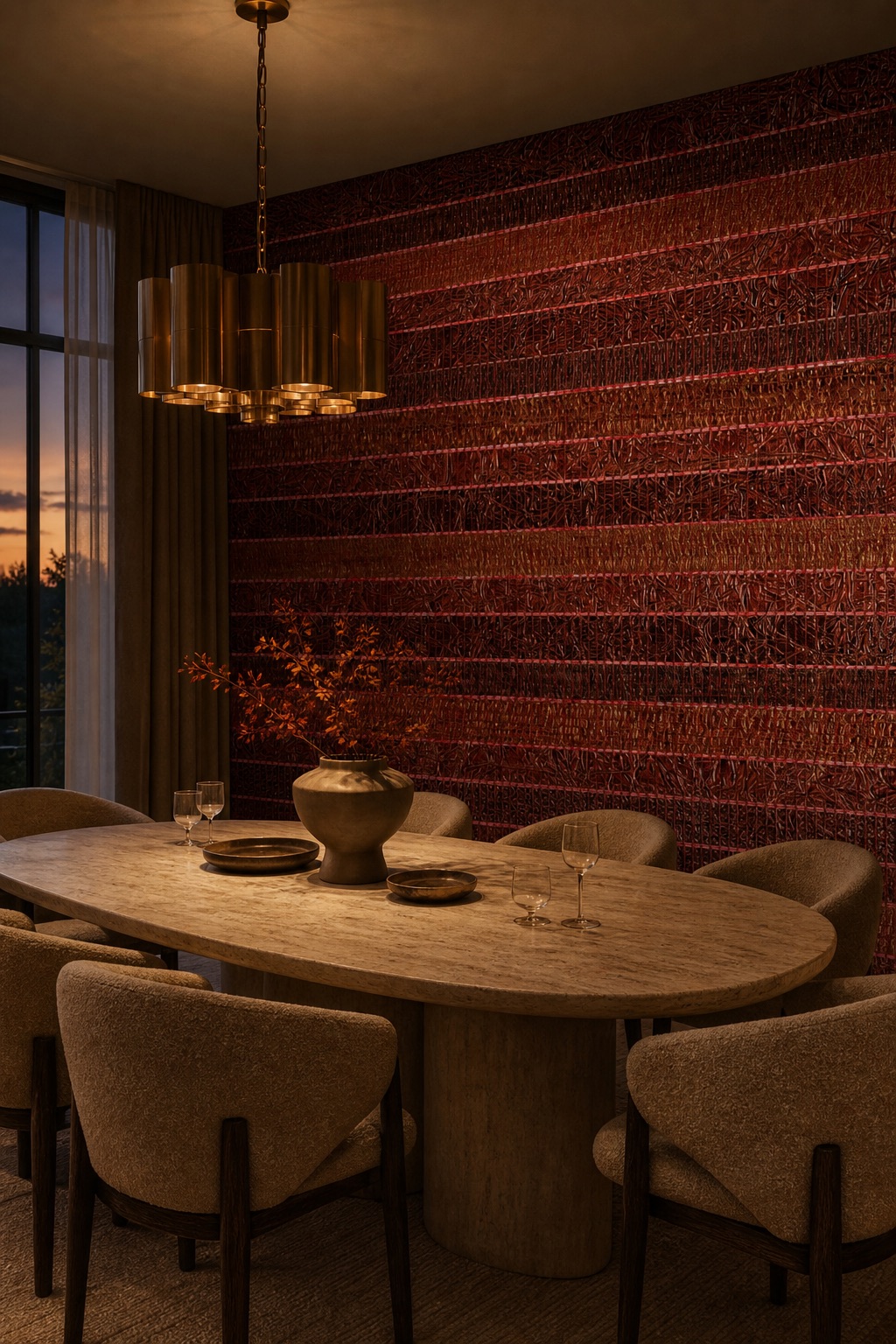
Dining rooms remain the canonical home for red grasscloth wallpaper. The enclosing warmth aligns with how these spaces are meant to feel, and the matte natural surface avoids the self-consciousness of a high-gloss feature wall. Bar counters and lounge environments suit Garnet Reed equally well: low-output pendant or ambient lighting brings out the warmth in the reed bands, and companion materials such as brass fixtures, dark oak joinery, and bouclé seating share a tonal register that reads cohesive rather than assembled. In hospitality settings, this wallcovering works as a feature wall behind a hotel-suite headboard or as a continuous corridor-alcove material, creating a distinct moment without requiring a full room treatment. A private study or reading room benefits from the same enclosing quality; plaster, travertine, and dark leather all read naturally beside it.
Natural Fibre, Deep Dye: Humidity, Care, and What to Expect Over Time
- Reed grasscloth should not be installed in rooms with sustained high humidity (wet rooms, steam showers, direct pool adjacency).
- In conditioned interiors (dining rooms, hotel corridors, studies), ambient humidity is within normal operating parameters for natural reed.
- Cleaning: soft dry brush for dust; barely damp cloth for minor marks; no chemical cleaners or wet scrubbing.
- Deep-dyed reds are more susceptible to UV fading than lighter or undyed natural grasscloth; direct sustained sunlight from west-facing windows should be avoided or filtered.
- UV-filtering window film or lined drapery on sun-exposed windows significantly extends the lifespan of a deep-coloured wallcovering.
- In a properly conditioned interior without direct sunlight, the wallcovering's character should remain consistent over a decade of normal use.
Reed grasscloth tolerates the ambient humidity of a conditioned interior comfortably, but direct moisture, steam, and sustained humidity above roughly 70% will cause reed fibres to swell, seams to show, or backing to release over time. For care, a soft dry brush handles dust and light debris; a barely damp cloth addresses minor marks, and chemical cleaners should be avoided entirely. Deep-dyed colours are worth flagging to clients: significant direct sunlight, particularly from west-facing windows receiving afternoon exposure, will accelerate fading. UV-filtering window film or lined drapery on sun-exposed windows is the most practical protective measure. In a conditioned space without direct sun, Garnet Reed should hold its character over many years of normal use.
Three Designers, One Standard: The Studio Process Behind Every Garnet Reed Order
- Specifications begin with a physical sample from our sample book, credited against any subsequent order.
- Paid proofing is quoted up front; typical turnaround is one to two weeks.
- Orders proceed on the terms confirmed on the pro-forma invoice; production runs approximately one month, with ocean freight quoted and scheduled separately.
- Three full-time in-house designers translate client references and CAD files into production-ready specs for our partner mills.
- Each batch ships with a per-lot certificate providing full traceability for contractor and client.
- Our founder has been working with partner mills in natural wallcovering since 2018.
Every Garnet Reed specification begins with a physical sample from our sample book, credited against any subsequent order. If a custom proof is required (a specific colourway, an adjusted stripe scale, or a different backing weight), our studio quotes that work up front; typical proofing runs one to two weeks. Once a design is confirmed and payment is settled on the pro-forma invoice, we produce to a single dye-lot against the confirmed specification and ship with a per-batch lot certificate providing complete traceability. Our three full-time in-house designers handle everything from reference translation to final production files, and our founder has been working with partner mills in natural wallcovering since 2018. Love this weave but need your own colour or stripe scale? Our design studio engineers custom colourways directly from your reference.
Buying grasscloth for a project or a brand?
- Minimum order
- 50 rolls (about 250 m²) catalog · 100 rolls custom / private label
- Lead time
- 4–6 weeks standard · 5–8 weeks specialty, after sample approval and payment
- Terms
- EXW Chengdu · FOB, CIF, DDP on request
- Samples
- Free digital kit in 24 h · paid swatch pack, credited in full on your first order
- Reply
- Within 24 hours
Frequently asked
- Will the deep red colour fade over time?
- Deep-dyed reds are more susceptible to UV fading than lighter or undyed natural grasscloth. We recommend keeping Garnet Reed away from direct, sustained sunlight; UV-filtering window film or lined drapery on west-facing windows significantly extends the wallcovering's colour life. In rooms lit primarily by artificial light, fading over a decade of normal use is minimal.
- How do the reed bands align at panel seams, and does the stripe pattern affect installation?
- Because the horizontal reed bands and crimson accent stripes run continuously across the width of each panel, seam alignment is critical. Panels should be dry-fitted and trimmed so that bands align across every join before paste is applied. We provide a seam-planning guide and installation notes with each order. A professional installer with natural-wallcovering experience is strongly recommended for a clean result.
- Which companion materials work well alongside a deep burgundy-red wall?
- Travertine, dark oak, blackened steel, and brass share a warm or warm-earthy register with Garnet Reed and read naturally beside it. Plaster in warm white or cream provides visual breathing room. Cool greys and bright whites tend to emphasise the red's warmth in ways that suit some schemes and not others; testing with physical samples in the intended lighting is advisable before committing.
- Can Garnet Reed be installed in a hotel corridor?
- Yes. A hotel corridor in a conditioned building is within normal operating parameters for natural reed grasscloth. Plan for professional installation, ensure humidity is controlled near service areas, and agree a maintenance cleaning protocol at project handover.
- What is the minimum order quantity and how does the process work?
- Grasscloth is supplied from 50 rolls (approximately 250 m²). For full details on sampling, proofing fees, payment terms, and lead times, visit our process and FAQ page at /faq.