Oat Herringbone Grasscloth Wallpaper
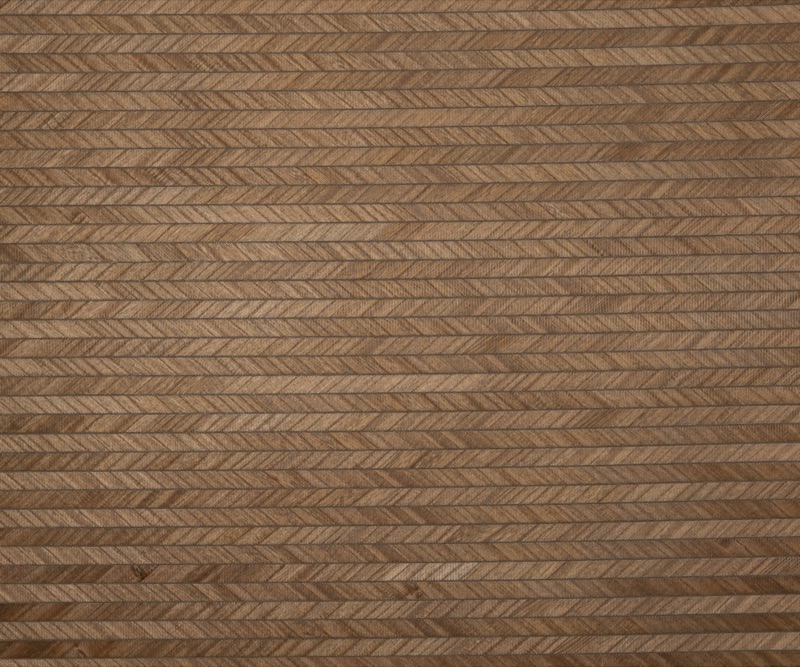
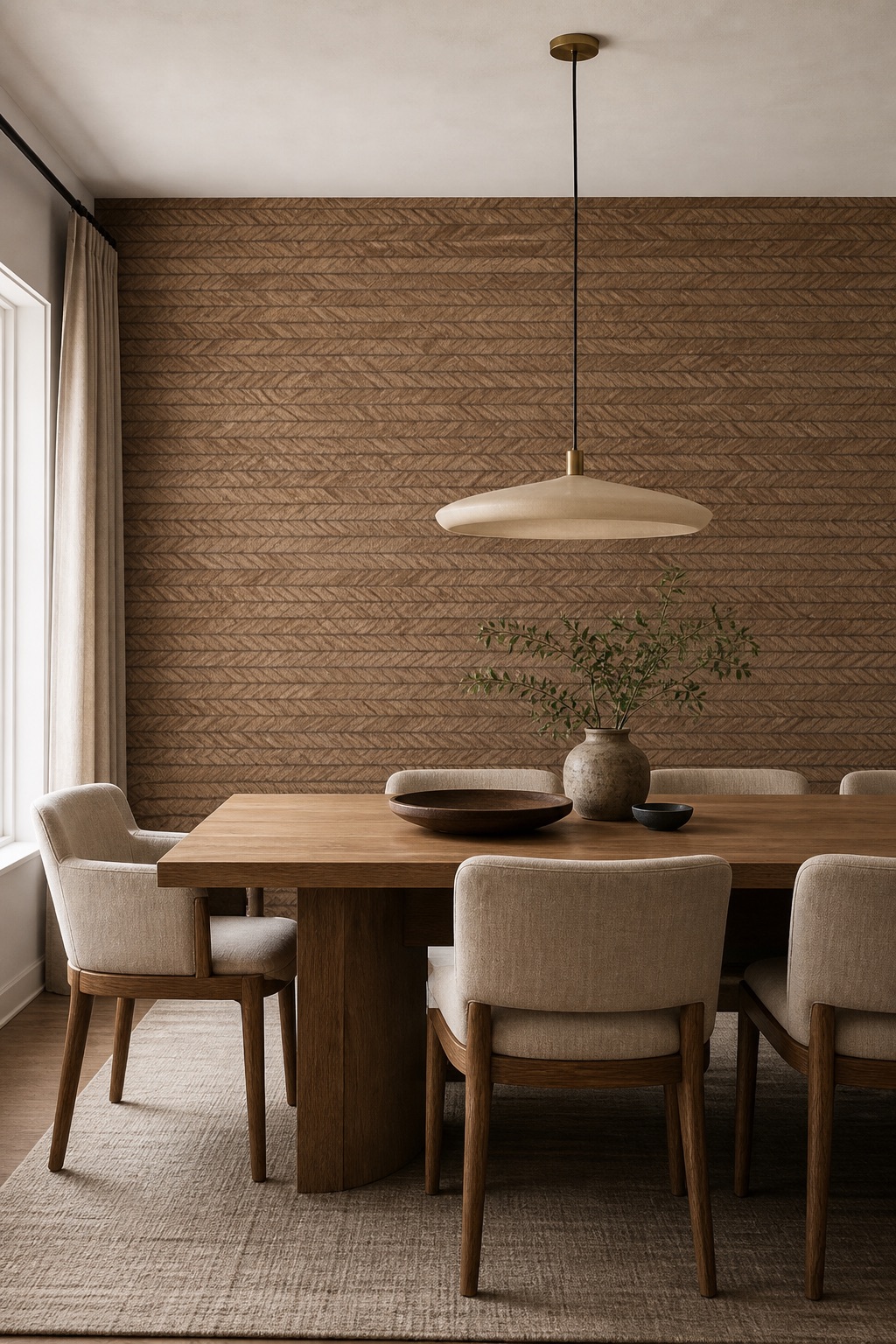
Oat Chevron is a dense horizontal herringbone grasscloth woven from flat-pressed narrow reed strands in a warm mid-brown ground, with tonal variation between individual reeds that reads as living texture rather than a printed pattern. The chevron geometry holds its logic at wall scale without becoming theatrical, making it well suited to living rooms, hotel suites, and japandi or organic-modern interiors where structure and warmth need to coexist. Produced with our partner mills to studio specification, oat herringbone grasscloth wallpaper is supplied to designers and trade buyers from 50 rolls, with custom colourways available on the same weave structure.
Chevron in Oat: How the Herringbone Grid Reads Across a Full Wall Panel
- Each strand measures approximately 1–2 mm wide, flat-pressed and consistent in profile with subtle tonal variation between individual reeds.
- Diagonal runs interlock at their peaks to form continuous V-junctions that travel horizontally across the roll width without interruption at panel joins.
- At a reading distance of two metres or more, the grid resolves into a warm unified ground; closer inspection makes each chevron arm clearly distinct.
- Medium texture scale allows the pattern to contribute visual weight without competing with furniture, soft furnishings, or artwork on adjacent walls.
- Matte finish throughout; the absence of sheen means the surface stays tonally consistent under directional spotlighting or track systems.
Oat Chevron's herringbone structure is built from tightly bundled narrow reed strands, each flat-pressed to a consistent profile before being laid in alternating diagonal runs. The result at wall scale is a quiet but structured surface that animates with proximity. For feature-wall applications behind a sofa or a bed head, the medium-scale chevron holds its geometry without demanding that the room organise itself around it. The matte surface absorbs ambient light evenly, which keeps the wall from advancing in smaller rooms and adds warmth in larger ones.
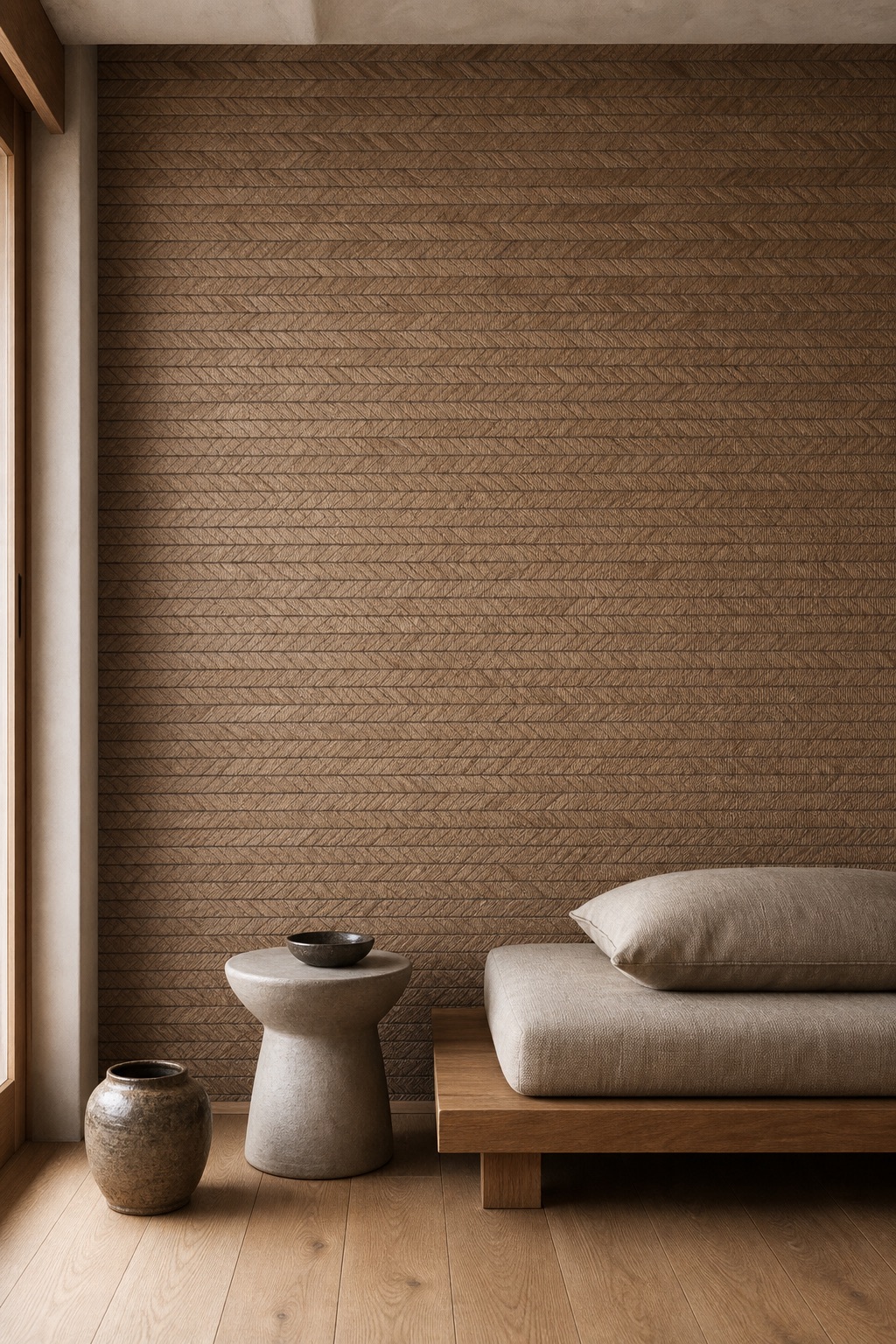
Wheat to Amber: How Oat Chevron's Warm Ground Shifts Through a Day's Light
- Under cool north-facing light, the primary colour reads as neutral wheat: calm and recessive.
- In warm afternoon sun, the golden-tan secondary tones surface and the wall takes on a honeyed quality.
- Under tungsten or warm-white LED, the chevron valleys deepen to a toasted brown, adding perceptible depth to the surface.
- Matte finish absorbs rather than reflects light, preventing glare in daylit rooms and maintaining even tone across large panels.
- The balanced warm undertone means the material performs consistently across both cool daylight and warm artificial light sources.
The warm mid-brown ground of Oat Chevron is neither flat nor single-note. Tonal variation between individual reed strands means the surface shifts in character as the day progresses, behaving closer to wood grain than to a painted wall. In spaces that move between natural and artificial lighting across the day (hotel suites, residential living rooms, private dining rooms), this responsiveness adds visual interest without introducing a new colour. The overall tone remains within the oat-to-amber range throughout, which makes it straightforward to specify alongside fixed companion finishes.
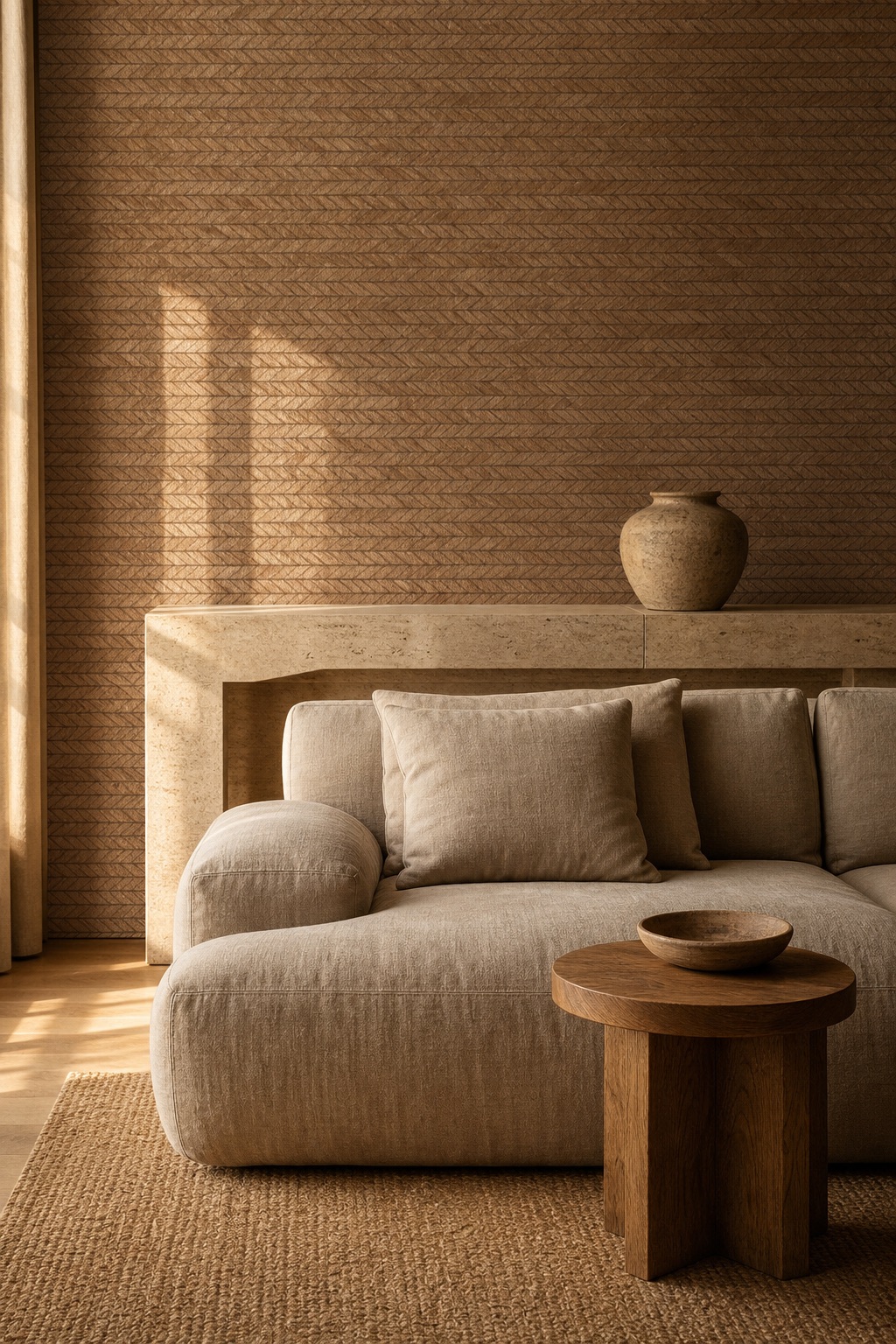
Tonal Anchor: Placing Oat Herringbone Grasscloth Wallpaper in Hospitality and Residential Interiors
- Feature wall behind a primary seating group, where the chevron provides a textured backdrop that reads clearly at scale.
- Hotel suite bedrooms and sitting areas, where a neutral warm grasscloth acts as the tonal backbone for soft furnishings.
- Japandi and organic-modern residential projects, where structured geometry and natural fibre satisfy both design registers simultaneously.
- Private dining rooms and members' areas, where a quiet textured wall extends an atmosphere without demanding attention.
- The mid-value oat tone bridges pale linen flooring and darker oak millwork, functioning as a tonal anchor between the two.
Oat herringbone grasscloth wallpaper performs best where a designer needs a single surface to carry warmth and texture simultaneously without committing to a strong colour. Its style compatibility is broad: the herringbone geometry reads as considered craft in japandi and wabi-sabi schemes, and as an organic-modern material in contemporary hospitality interiors. Specifiers working on hotel suite bedrooms or boutique lounge areas consistently find that a mid-value oat grasscloth reduces pressure on other finish decisions, allowing furniture, lighting, and textiles to read with greater clarity.
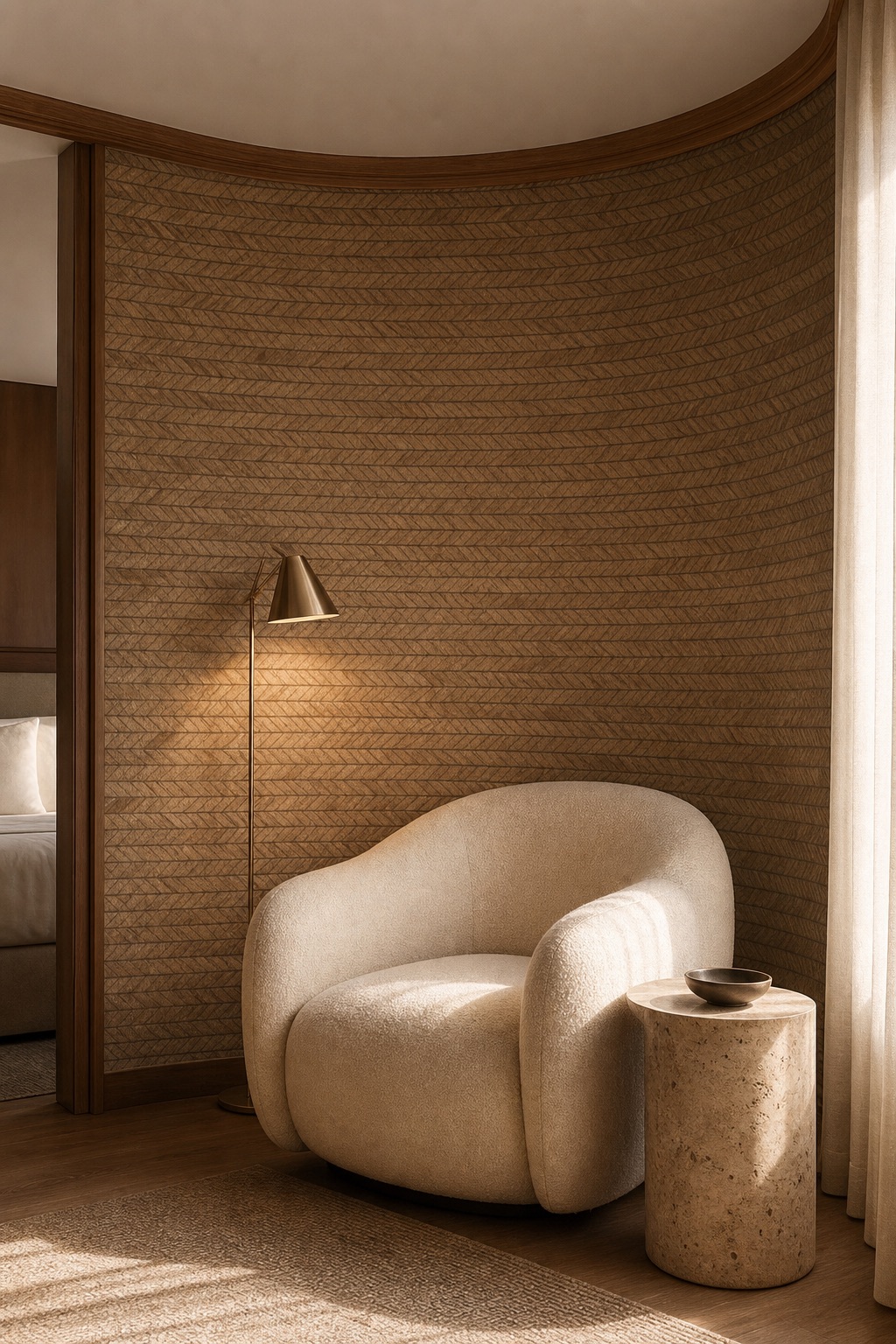
Same Structure, Your Palette: Commissioning a Custom Colour on This Weave
- The herringbone reed structure that defines Oat Chevron can be produced in a range of ground colours through a paid custom-colourway process.
- Our design studio works from client colour references (memo fabrics, paint chips, or Pantone codes) and translates them into a dyeing specification for the partner mill.
- A paid proof is prepared before any production commitment; proofing typically takes approximately 1–2 weeks.
- Custom colourway minimum order is 50 rolls (approximately 250 m²), consistent with standard order terms.
- The weave geometry and strand profile remain identical to Oat Chevron; only the dye ground changes.
Love this weave but need it in your own colour? Our design studio engineers custom colourways from your reference, translating memo fabrics or paint chips into a dyeing specification and returning a physical proof for approval before any production run begins. The herringbone structure itself stays constant, so the surface logic of Oat Chevron carries through into the commissioned piece. This process is particularly useful for hospitality projects requiring a specific brand-palette neutral or a colour matched to an existing upholstery programme.
From Sample Request to Dye-Lot Certificate: The Studio Process Behind Every Oat Chevron Order
- Paid sample books are available; a portion of the sample-book cost is credited against a confirmed order (up to 10%).
- All orders begin with sample sign-off; custom colourway work additionally requires a paid proof, quoted before any commitment is made.
- Production on standard natural materials runs 4–6 weeks after proof or sample approval; ocean freight is quoted separately and is at the buyer's cost.
- Every batch ships with its own dye-lot certificate, supporting the specification documentation required by procurement and project management teams.
- Three full-time in-house designers handle brief conversion, CAD work, and mill liaison; FOB, CIF, and DDP shipping terms are available.
- Founder active in natural wallcovering since 2018; produced with partner mills operating under studio specification.
A straightforward process sits behind every Oat Chevron specification. The studio reviews briefs directly, with three in-house designers able to turn a client reference into a production-ready specification without external translation. Single dye-lot production and per-batch lot certificates mean the oat tone you approve in the sample room is the tone that arrives on site. Order terms are confirmed on the pro-forma invoice; full terms and pricing structure are covered on our process and pricing page.
Buying grasscloth for a project or a brand?
- Minimum order
- 50 rolls (about 250 m²) catalog · 100 rolls custom / private label
- Lead time
- 4–6 weeks standard · 5–8 weeks specialty, after sample approval and payment
- Terms
- EXW Chengdu · FOB, CIF, DDP on request
- Samples
- Free digital kit in 24 h · paid swatch pack, credited in full on your first order
- Reply
- Within 24 hours
Frequently asked
- Will the oat colour shift or fade in rooms with significant natural light?
- Natural reed grasscloth in mid-brown tones is relatively UV-stable compared with deeply dyed dark fibres, but sustained direct sunlight will shift the colour gradually. The oat ground tends to lighten toward a bleached straw tone rather than developing uneven patches, which reads as natural ageing rather than a defect. For south- or west-facing rooms with significant glazing, our fading prevention guide covers screening and glazing strategies that extend the material's lifespan.
- How visible are seams on a horizontal herringbone grasscloth?
- Horizontal herringbone weaves produce more visible seams than plain-weave grasscloth because the V-junctions create a directional line that does not continue seamlessly across a butt join. A skilled installer using reverse-hang panel sequencing can significantly reduce the apparent break; our installation guide covers preparation and sequencing for herringbone grasscloth specifically.
- Which environments is oat herringbone grasscloth wallpaper not suitable for?
- Natural grasscloth is not recommended for bathrooms, kitchens, or any space with sustained elevated humidity; moisture can cause the paper backing to lift or the reed fibres to swell. It performs reliably in air-conditioned hotel corridors and suites, residential living rooms, dining rooms, and bedrooms where humidity remains within normal interior ranges.
- What is the minimum order quantity, and where can I find full pricing and terms?
- Custom colourway orders start from 50 rolls (approximately 250 m²); stock patterns may be available at lower quantities for first trials. Full pricing structure, sample-book terms, and order process are covered on our process and pricing page.