Natural Cork Wallpaper with Amber Foil Inlays
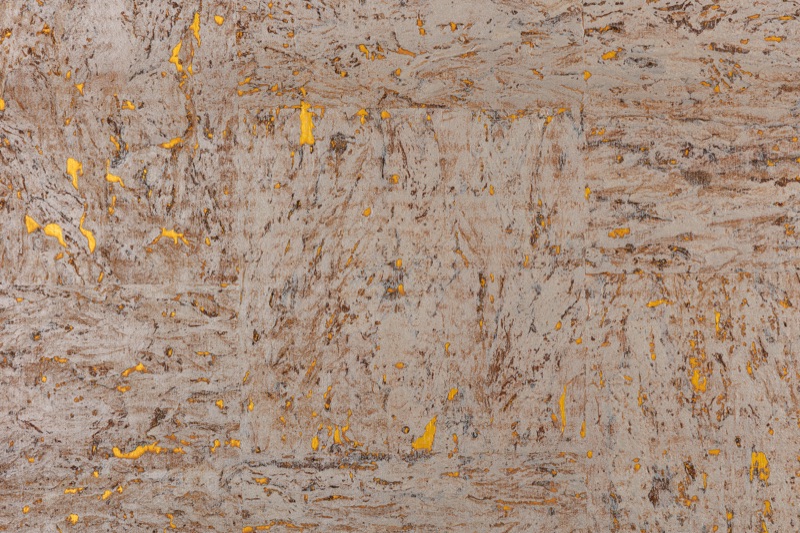
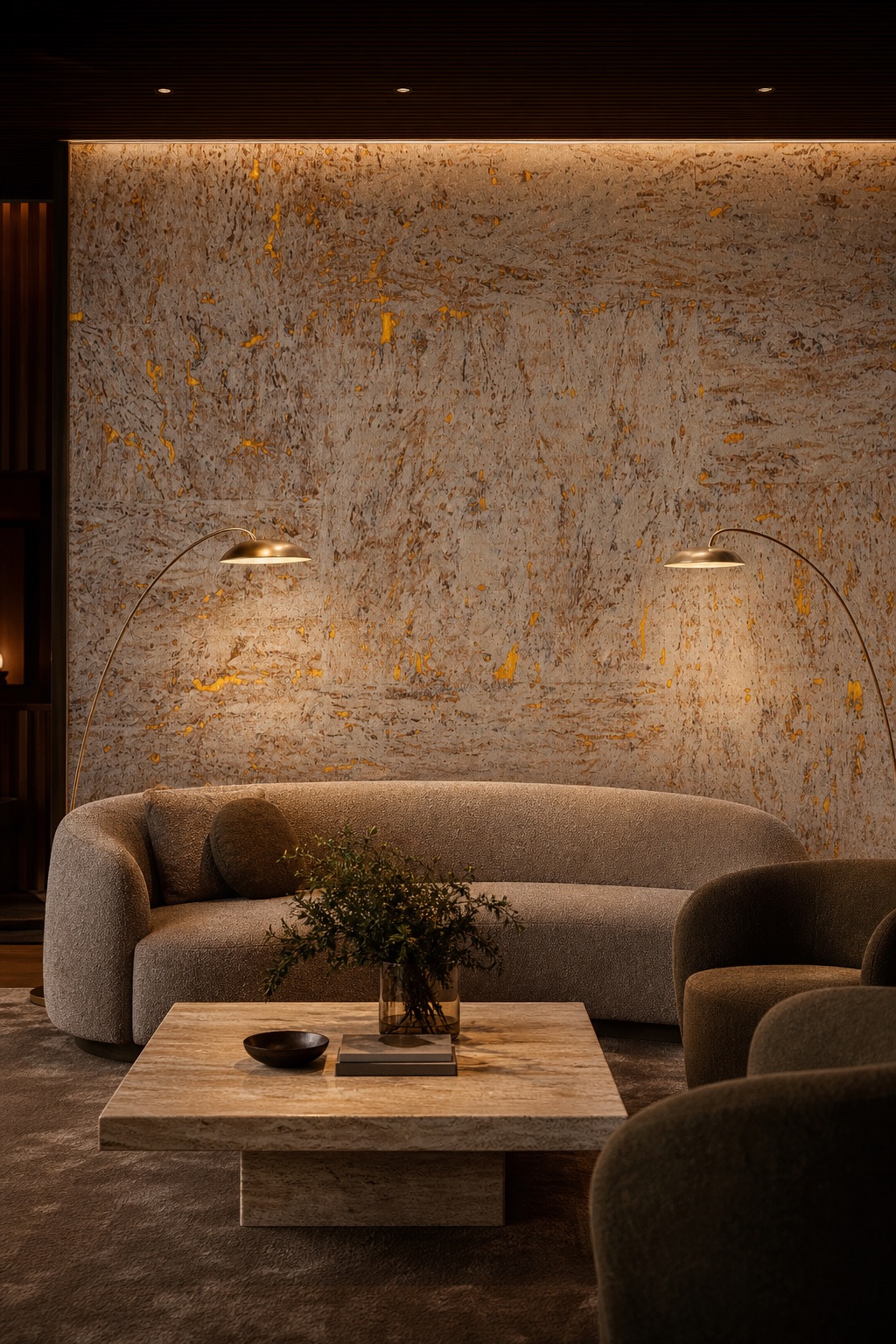
Amber Bark is a compressed natural cork wallcovering with a warm greige-taupe base and scattered amber-gold foil inlays that carry a low-gloss sheen against the matte bark field. Horizontal fibrous laminae give the surface depth and movement at any reading distance, while the irregular foil fragments activate under directional light in a way no printed or woven material replicates. Produced with our partner mills to Grasscloths' studio specification, this natural cork wallpaper is supplied to interior designers, hospitality buyers, and trade importers from 50 rolls (≈250 m²).
Amber Foil Against Matte Bark: How This Cork Surface Responds to Light
- The base cork field is fully matte, absorbing ambient light and contributing warmth without glare or surface reflection across the field.
- Amber-gold inlays are scattered irregularly across the surface; under directional tungsten or warm LED lighting each fragment activates individually as a low-gloss fleck.
- At distance the surface reads as a unified warm greige-taupe; within 1–2 m the gold fragments become distinct and contribute visual depth.
- The light behaviour shifts through the day: diffuse morning light renders the surface quietly tonal, while evening point-source lighting amplifies the amber inlays and gives the wall energy.
- Because the inlays are randomly distributed and non-repeating, panels read continuously across seams without requiring strict pattern registration.
The interplay between Amber Bark's matte cork ground and its scattered foil inlays is what distinguishes this natural cork wallpaper from a standard plain-cork specification. In spaces lit for atmosphere rather than task, the amber fragments do work that a uniformly matte surface cannot: they suggest warmth, richness, and controlled luxury without the committed sheen of a metallic foil or lacquer. The surface is bold enough to anchor a feature wall and quiet enough, at field level, not to compete with furnishings placed in front of it.
Hotel Lobbies, Bars, and Private Dining: Where Amber Bark Earns Its Place
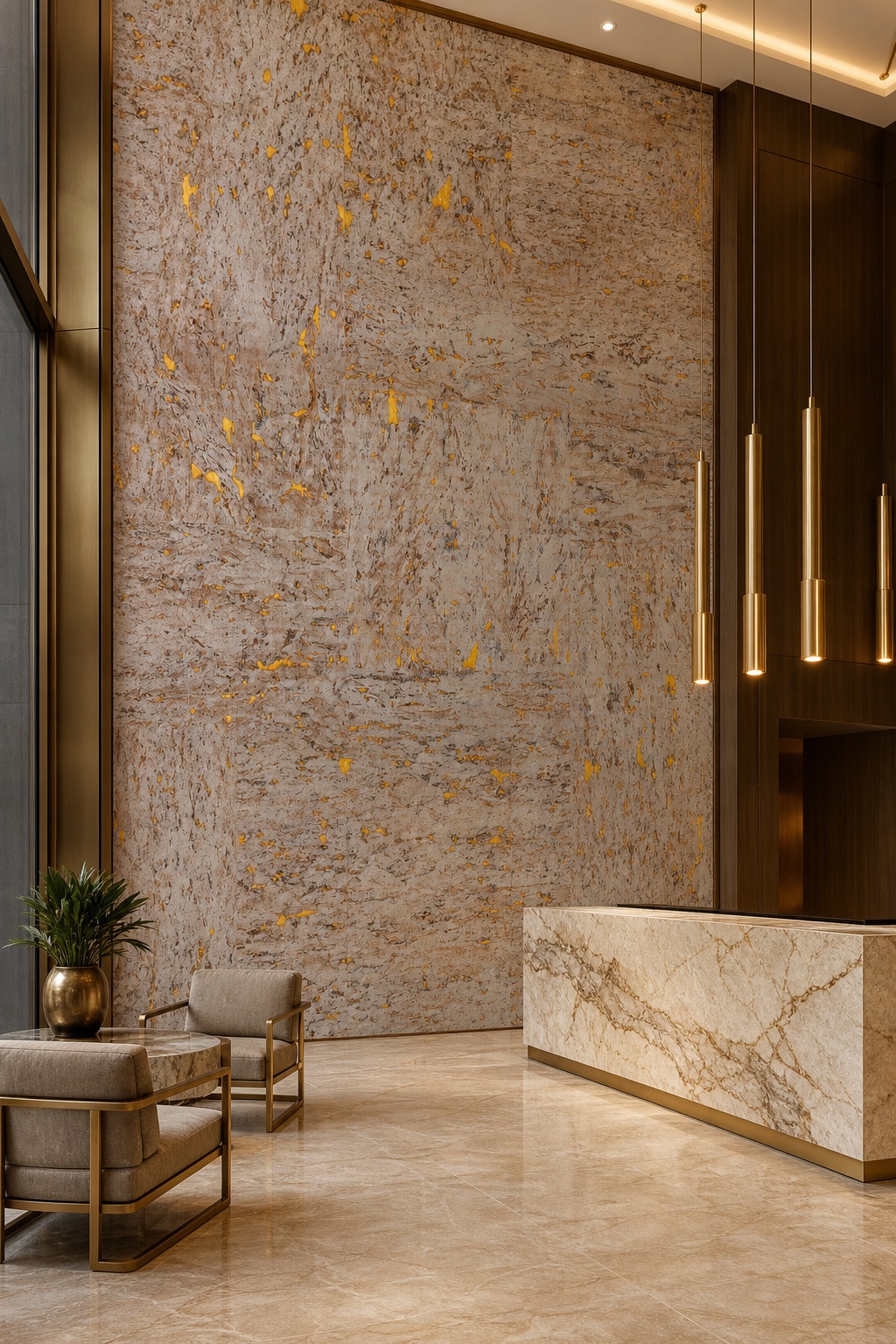
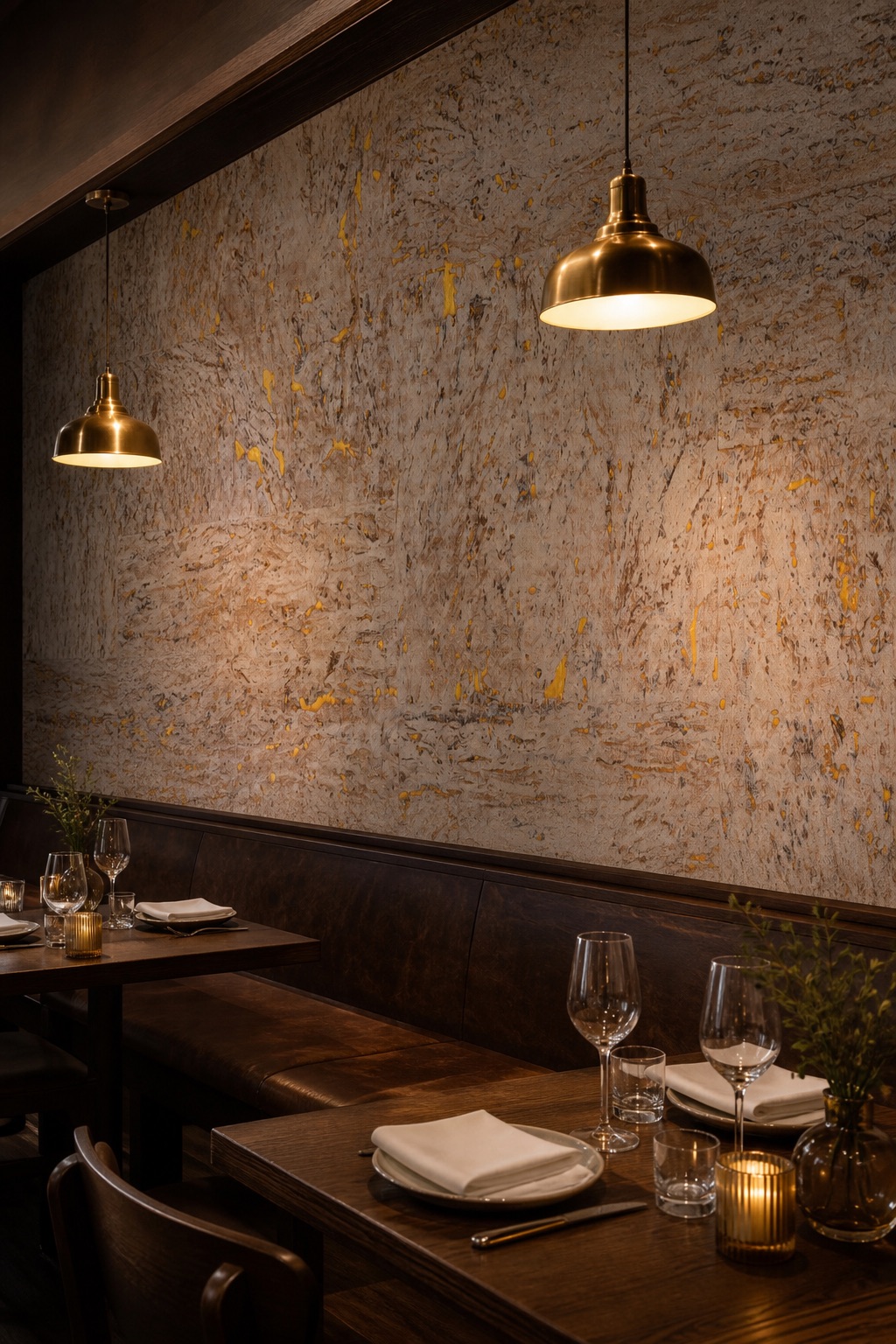
- The bold texture scale and warm amber accents suit high-traffic commercial environments where fine-scaled surfaces would be lost: hotel lobbies, bar back-walls, restaurant feature walls, private dining rooms.
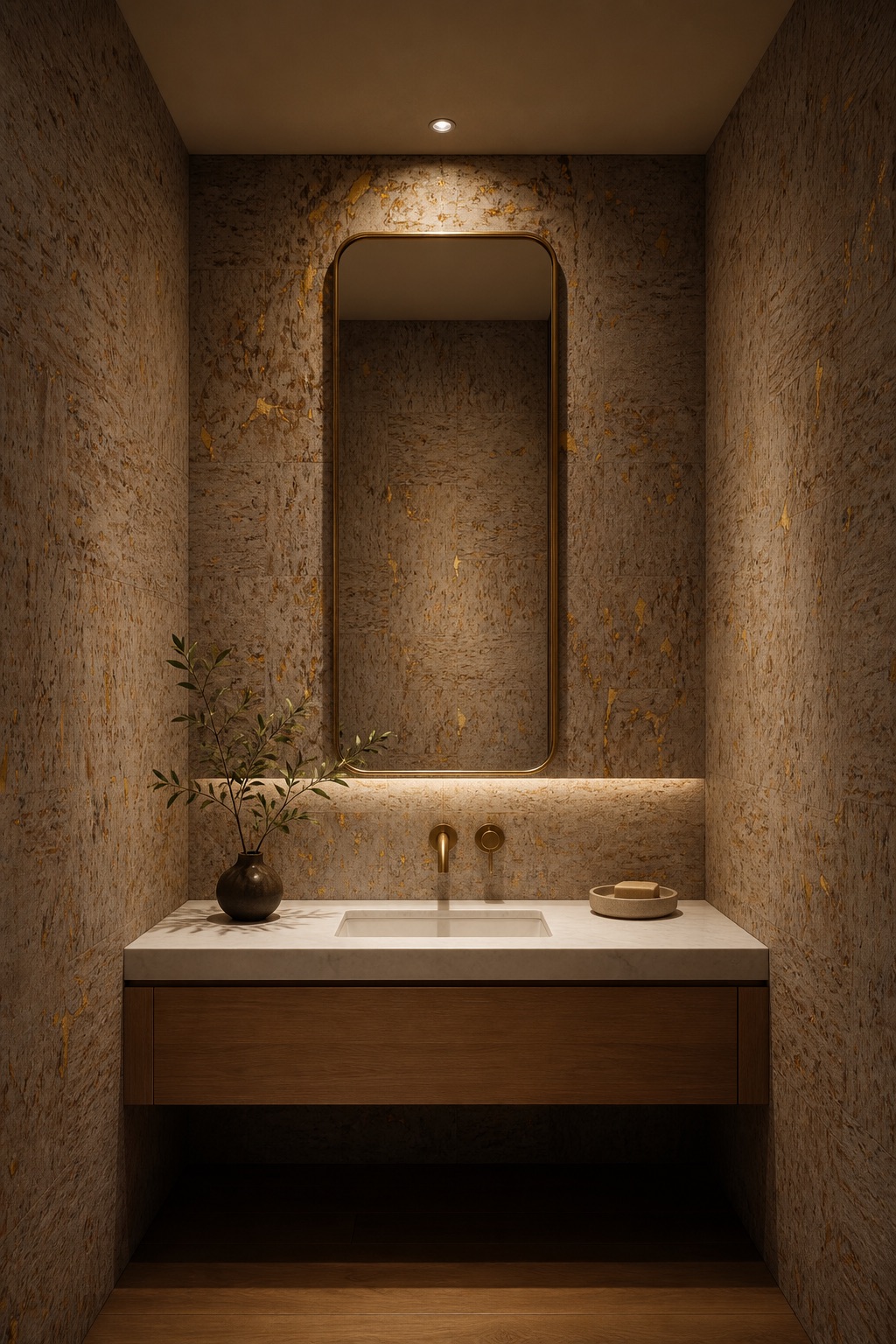
- In powder rooms and enclosed foyers the bold surface achieves maximum visual impact at the close reading distances these rooms naturally create.
- The warm undertone pairs directly with brass and aged-bronze fixtures, travertine stone floors, and dark-stained oak millwork.
- It reads as a single strong accent wall in larger public spaces; in intimate rooms it can carry all four walls without visually compressing the space.
- The irregular inlay pattern means that adjacent panels do not need to be matched as a repeating design, which simplifies installation on complex or curved walls.
- Cork's inherent dimensional stability makes it suitable for the slight humidity variations common in bars and restaurant dining rooms.
Amber Bark earns its commercial reputation precisely in the kinds of spaces it is designed for. The combination of organic bark texture and scattered metallic inlays sits comfortably in hospitality briefs that call for warmth without formality, or for an art-deco reference without the rigidity of geometric tile or printed paper. For specifiers working on restaurant fit-outs, boutique hotel interiors, or private club refurbishments, it offers a material answer that reads as both natural and curated.
Natural Cork Wallpaper in Practice: Humidity, Care, and What to Expect
- Cork's closed-cell cellular structure gives it inherent moisture resistance relative to woven natural fibres such as jute or seagrass, making it a practical choice for bars, lobbies, and restaurant dining rooms with normal conditioned-air humidity cycling.
- Avoid sustained direct moisture or steam contact; this rules out shower surrounds and steam rooms but is compatible with powder rooms and well-ventilated commercial dining areas.
- Surface cleaning: use a soft brush or vacuum with a brush attachment to remove dust periodically; for light marks, blot with a barely damp cloth and allow to dry fully before resuming normal use.
- The amber foil inlays are embedded within the cork laminate rather than applied as a surface coating, making them resistant to incidental scuffing during routine maintenance.
- Adhesive selection matters with cork wallcovering; consult our installation guide for recommended paste weights and open times appropriate for this surface weight.
Natural cork wallpaper is more forgiving in lightly humid commercial environments than most woven natural wallcoverings, and Amber Bark follows that pattern. The compressed laminated construction keeps the surface dimensionally stable through the humidity cycling typical of occupied hospitality spaces. With the right adhesive preparation and periodic dry-brush maintenance, a correctly installed specification should perform for the life of the interior fit-out.
Cork, Bark, and Mild Acoustics: What This Surface Contributes Beyond Appearance
- Compressed cork has a higher acoustic absorption coefficient than smooth plaster, glass, or vinyl wallcoverings, particularly in the mid-frequency range relevant to speech and ambient restaurant noise.
- This makes Amber Bark a valid supporting specification in restaurant dining rooms, private lounge areas, or hotel corridors where modest background-noise control is a secondary goal alongside surface character.
- Cork's acoustic contribution is supplementary rather than primary; for projects with a dedicated acoustic brief, it should sit alongside engineered panel systems rather than replace them.
- Specifiers weighing natural cork wallpaper against dedicated acoustic panels can find a comparative framework in our guide on acoustic demand.
The acoustic benefit of Amber Bark is real but should be framed accurately. In a busy restaurant or a hotel lobby, a full wall of compressed cork wallcovering will modestly reduce mid-frequency reverberation and absorb some sound energy at the perimeter. It will not substitute for a ceiling acoustic treatment or wall panel system where speech intelligibility or low-frequency absorption is the primary design goal. Used with that understanding, the acoustic dimension becomes a genuine supplementary specification argument for the hospitality settings this material naturally fits.
Studio Process, Custom Colourways, and How a Natural Cork Wallpaper Specification Comes Together
- Grasscloths operates as a design studio and trading partner: our three in-house designers specify surfaces at source and CAD-translate custom briefs, with production handled through 1–3 partner mills we have worked with since the studio launched.
- The working process runs from paid sample book, to a paid proof quoted individually, to a production order confirmed on the pro-forma invoice, on FOB, CIF, or DDP terms.
- Every production batch carries a per-batch lot certificate; because natural cork wallpaper is a single dye-lot material, ordering sufficient quantity for the full installation in one run is standard professional practice.
- Standard rolls are 0.915 m wide by 5.5 m long (approximately 5 m² per roll); grasscloth and cork MOQ is 50 rolls (approximately 250 m²); proofing takes approximately 1–2 weeks, with production at approximately one month plus ocean freight.
- Samples and documentation to support a buyer's own fire-rating, VOC, or installation-specification process are available on request; we do not hold certifications on the studio side.
Love this bark surface but need a different base tone or a deeper amber? Our design studio engineers custom colourways from your reference — a paint chip, a material board photograph, or a colour code. Our designers translate it into a production specification through our partner mills. The founder has been working in natural wallcovering since 2018, and the process is built around the batch consistency and documentation that commercial interior specifications require.
Buying cork for a project or a brand?
- Minimum order
- 50 rolls (about 250 m²) catalog · 100 rolls custom / private label
- Lead time
- 4–6 weeks standard · 5–8 weeks specialty, after sample approval and payment
- Terms
- EXW Chengdu · FOB, CIF, DDP on request
- Samples
- Free digital kit in 24 h · paid swatch pack, credited in full on your first order
- Reply
- Within 24 hours
Frequently asked
- Will the amber-gold foil inlays fade or tarnish under UV or sustained artificial light?
- The foil inlays are embedded within the cork laminate rather than printed on the surface, which gives them good resistance to incidental abrasion and surface tarnishing. UV fading of amber-gold metallic fragments is typically slower than surface dye fading on woven or printed wallcoverings. For installations with high direct solar exposure, we recommend placing a sample in the intended light condition for several weeks as part of the specification sign-off process.
- How do seams read on a bold, irregular bark surface like this?
- Because the cork surface carries no repeating pattern and the amber inlays are randomly placed, there is no pattern-match drop to manage across panels. Seams will be visible on close inspection, as with any wallcovering; at normal room-entry reading distances the random fibrous texture reads continuously across panel boundaries. Correct wall preparation and straight plumb lines are the primary factors in seam quality on a non-patterned material like this.
- Is this cork wallpaper appropriate for a restaurant or bar where grease, condensation, and cleaning chemicals may be present?
- Cork's closed-cell structure makes it more resilient to ambient humidity than woven natural fibres, and it is a practical choice for restaurant and bar feature walls not in direct splashing range. Avoid solvent-based or strongly alkaline cleaners; routine maintenance should be dry-brush or barely damp cloth only. For wall surfaces within direct condensation or splash range of a bar counter, a protective top coat applied by the installer is worth discussing at the specification stage.
- What if a panel is damaged after installation — can I reorder a matching batch?
- Natural cork wallpaper is a single dye-lot material: each production run produces one batch, and subsequent runs will carry natural variation in the base tone and inlay distribution. We issue a per-batch lot certificate with each order. The standard professional practice is to order 10–15% surplus over the calculated installation quantity during the original order so that any future repair panels come from the same lot.
- Where can I find full details on pricing, lead times, and the order process?
- Full commercial terms, including sample book credit, proofing fees, payment terms, and freight options, are covered on our process and FAQ page (/faq).