Ivory Grasscloth Wallpaper
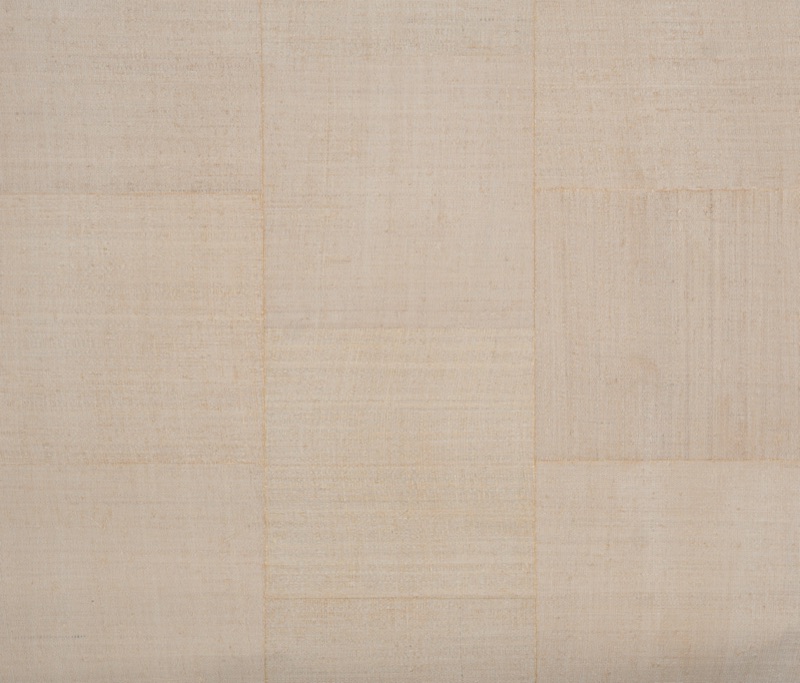
Ivory Field is a pale ivory-cream plain-weave grasscloth wallpaper, its fine horizontal slub and warm undertone giving walls a depth that flat paint cannot replicate. Woven strips joined in a subtle rectangular seam grid read as quiet geometry at full-wall scale, present on close approach and dissolved at distance. Supplied to designers, architects, and trade buyers from 50 rolls, it functions equally as a finish in its own right and as a foil for every material placed against it.
Tabby Weave, Visible Grid: How Ivory Field Reads Across a Full Feature Wall
- Plain tabby weave with visible horizontal slub; no dominant directionality, but a continuous soft horizontal grain runs across the surface from edge to edge.
- Woven panels are joined in a rectangular seam grid; the seam lines carry a faint honey-gold tone against the ivory field and read as quiet constructed geometry at wall scale rather than as a fault.
- Texture scale is fine: individual fibre variation is legible only on close approach; from two metres the surface resolves into a unified warm cream plane.
- The matte surface absorbs ambient light rather than reflecting it, making the wall feel recessive and softly textile rather than flat.
- On a feature wall three to four metres wide the grid typically shows three or four vertical seam lines; this is characteristic of natural grasscloth construction and is recognised as such across the trade.
The defining quality of this plain-weave grasscloth is not what it imposes but what it withholds. The horizontal slub gives the surface a grain that catches the eye only momentarily; at room scale the ivory field takes over, and the seam grid settles into a quiet woven warmth that few other wall finishes approach at this specification tier.
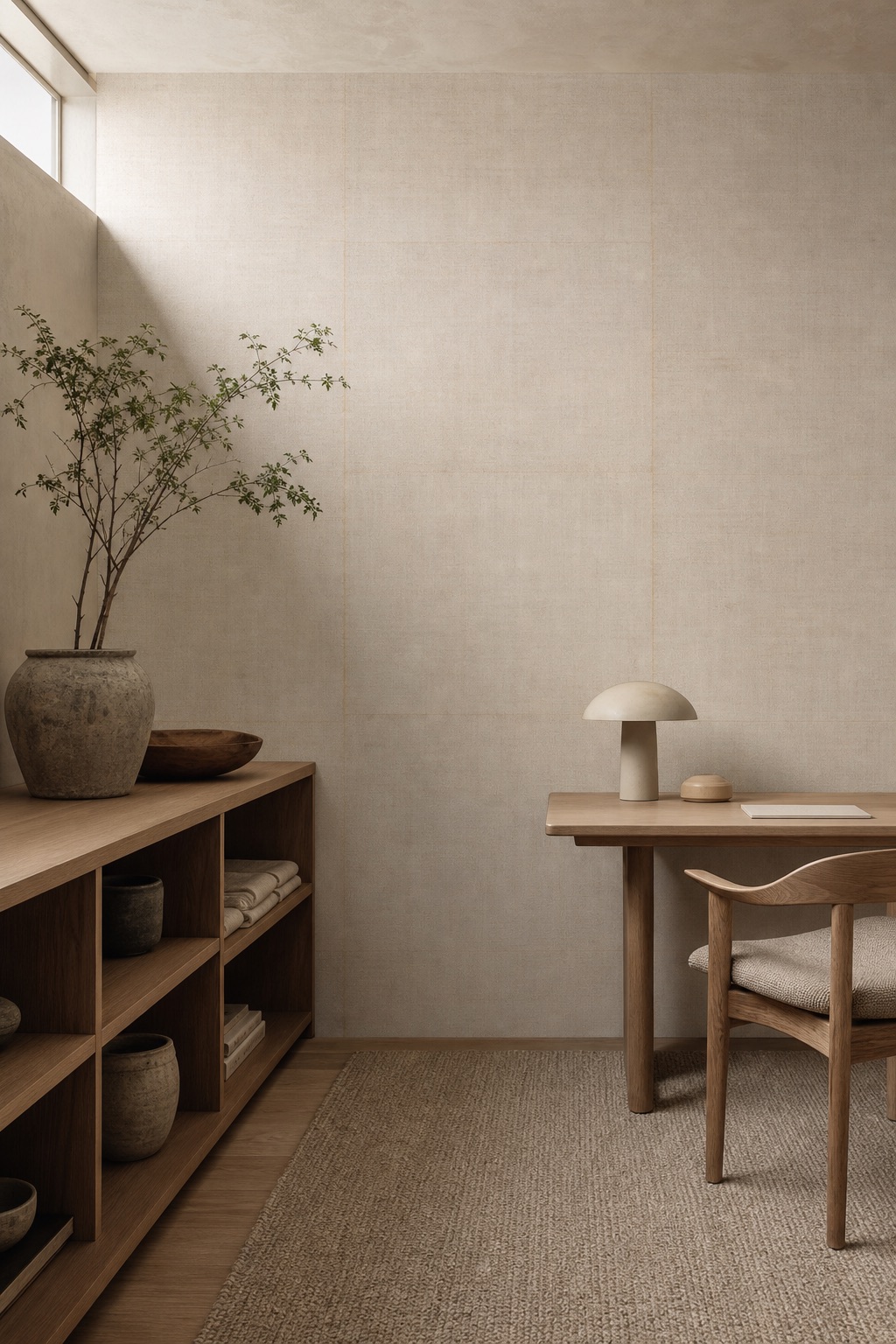
Pale Ivory Through the Day: How a Warm Cream Ground Responds to Changing Light
- In cool north-facing light the ivory reads close to linen-white, with warmth held in the fibre variation rather than the overall tone.
- Under warm morning or late-afternoon sun the cream deepens slightly toward a soft biscuit, and the honey-gold seam lines become briefly more distinct.
- By lamplight the surface takes on a gentle amber cast; the matte finish prevents hotspots or glare even under directional pendant or wall-sconce sources.
- The warm undertone means the material will not read as institutional or cold under LED sources with a colour temperature between 2700 K and 3000 K.
- South- and west-facing rooms should be assessed with a physical sample under the actual light condition before the colourway is confirmed.
Pale materials are the most light-sensitive specifications in any interior. Ivory Field's warm undertone acts as a buffer: in cool conditions it holds enough cream to feel intentional rather than washed-out; in warm conditions it settles into the room rather than bleaching the surrounding palette.
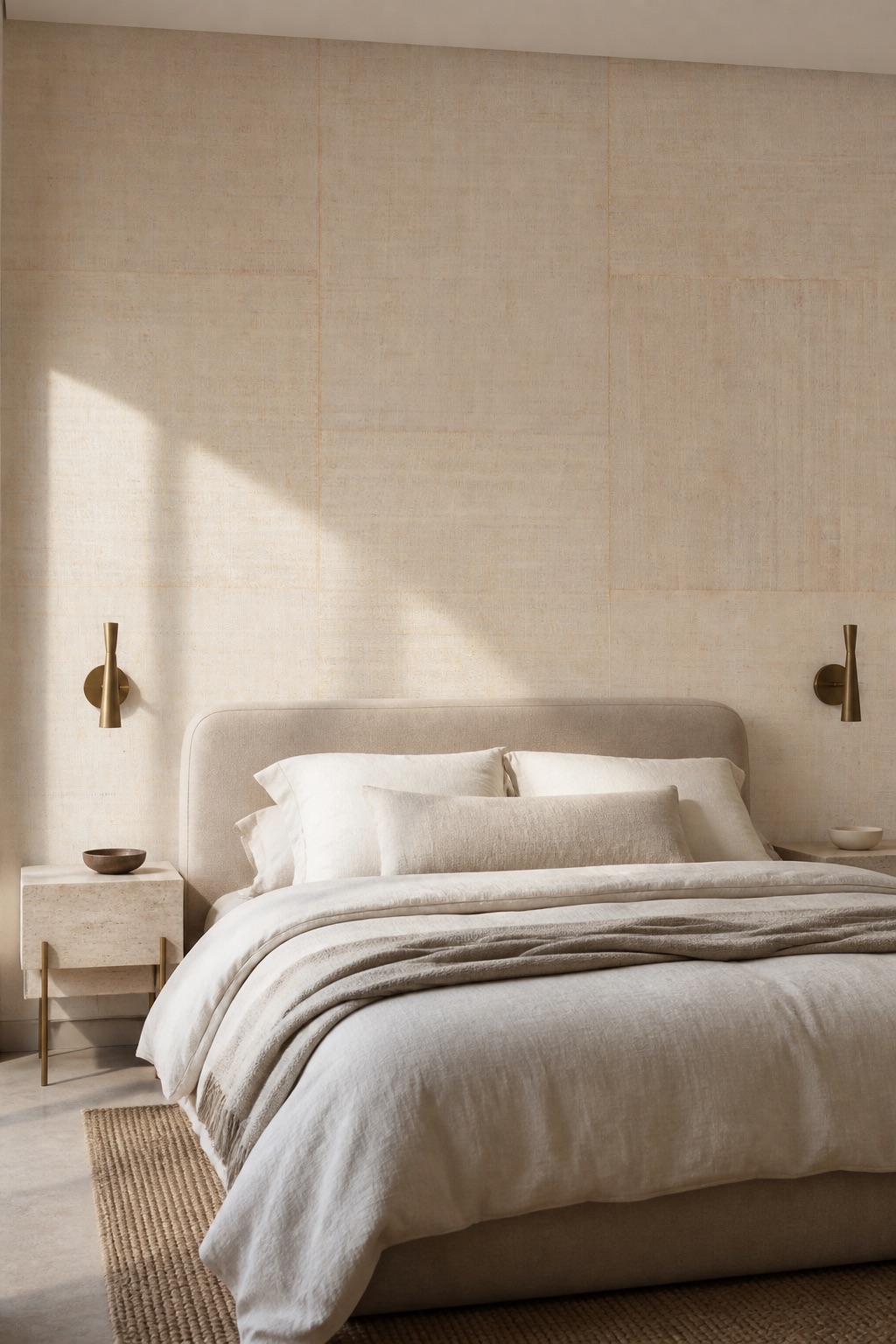
Where Ivory Grasscloth Wallpaper Earns Its Place: Hotels, Bedrooms, and Spa Settings
- Bedrooms and hotel suites: the matte ivory surface is restful under both task and ambient light; a full four-wall application is achievable because the tone does not dominate.
- Hotel corridors: a pale warm ground reads clearly under the recessed downlighting typical of hospitality corridors and differentiates the finish from emulsion paint without adding visual complexity.
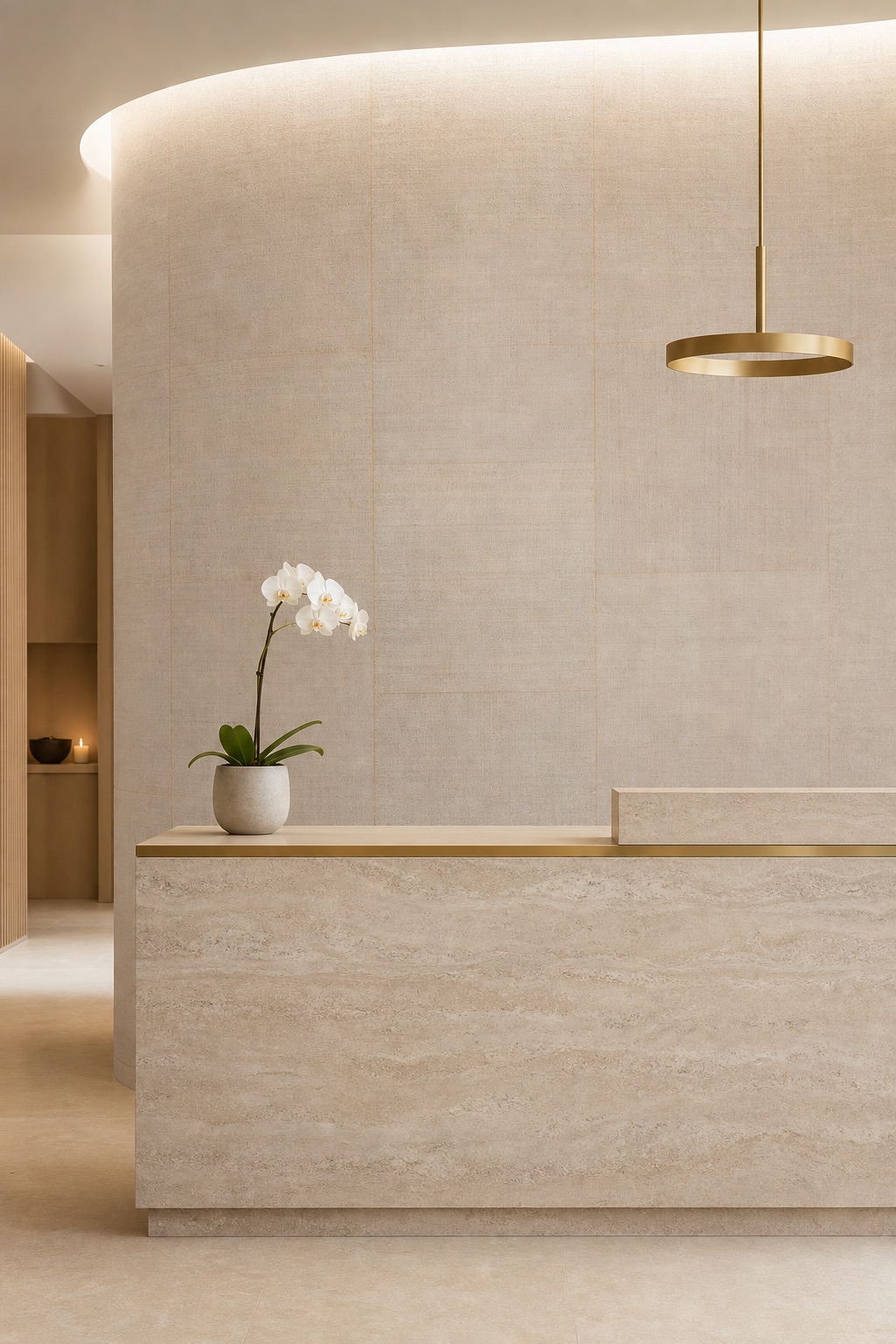
- Spa receptions and treatment waiting areas: the warm neutral pairs naturally with travertine, honed limestone, linen, and plaster finishes that define current wellness-sector interiors.
- Residential studies and home offices: the quietness of an ivory grasscloth background lets art, shelving, and task lighting read without competition from the wall.
- High-humidity environments (bathrooms, saunas) require confirmed vapour barrier installation and mechanical ventilation before specification; a powder room with low steam exposure is preferable to a wet bathroom.
Ivory grasscloth wallpaper functions best where the objective is warmth without weight. In hotel suites and spa settings it signals natural materials without competing with soft-furnishing investment; in residential rooms it provides a textile quality that paint-and-plaster schemes rarely achieve at comparable cost.
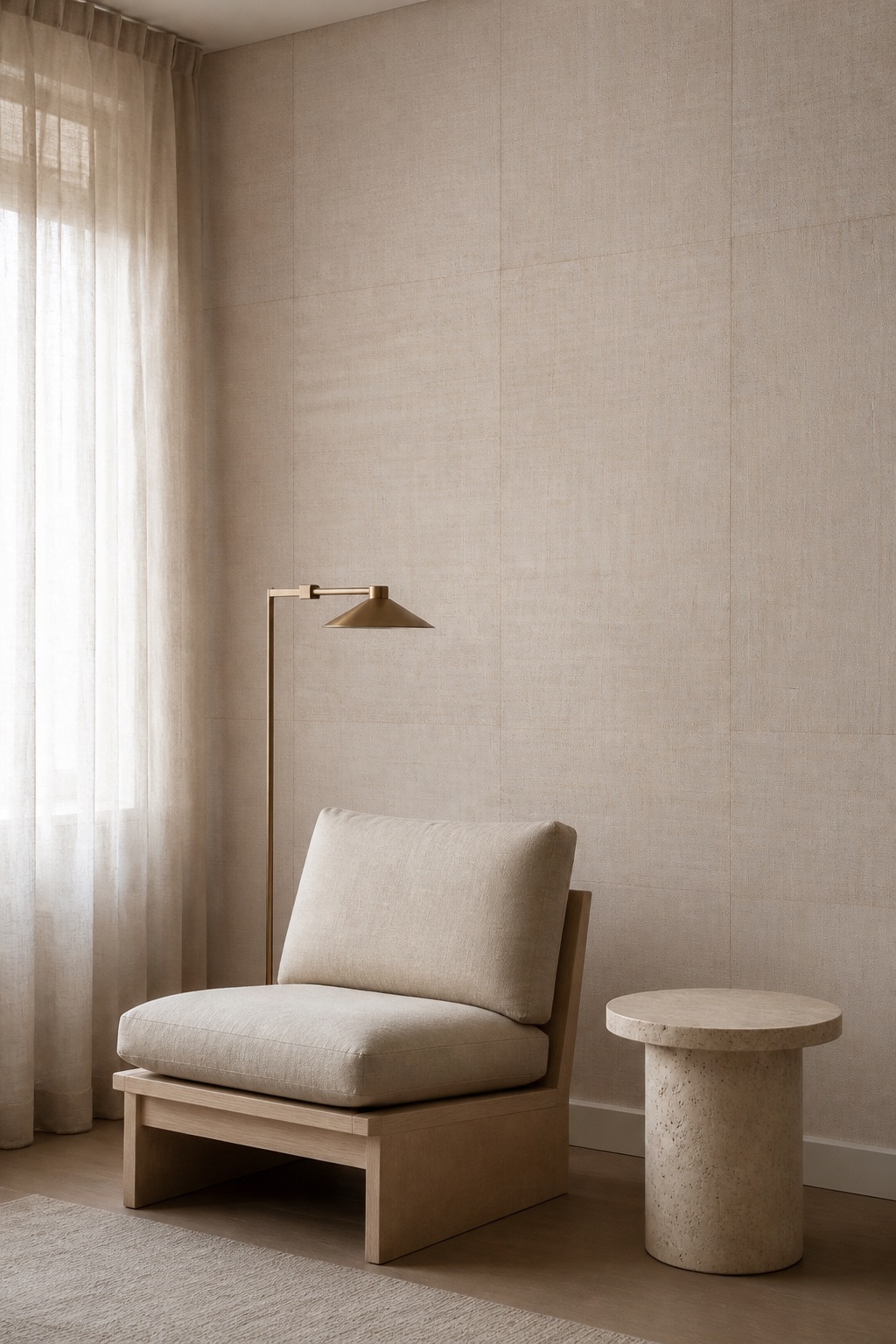
Ground and Companions: Building a Palette Around an Ivory Weave
- Travertine and honed limestone flooring or cladding sit naturally against the ivory ground, sharing the same warm-cream register without redundancy.
- Oiled or limed oak joinery and furniture carry the pale tone without competing; dark-stained walnut or oak introduces contrast that causes the weave to recede further into the composition.
- Brass and aged-bronze hardware echo the honey-gold of the seam lines; even a small quantity of this finish ties the palette back to the wall.
- Linen upholstery and curtaining maintain tonal unity; bouclé adds textural contrast while staying within the neutral register.
- Blackened-steel window frames, shelving brackets, or artwork frames sharpen the composition without hardening it.
- Strong cool accent tones (cobalt, charcoal blue, cool grey) push the ivory toward an unintended warmth and are best tested against a physical swatch before committing.
Love this weave but need your own colour or a different panel width? Our design studio engineers custom colourways from your reference image or colour card. For palette work on an unmodified ivory ground, the principle is anchorage rather than matching: travertine, oiled oak, and a brass fitting carry enough tonal overlap to feel deliberate, and the contrast between them remains textural rather than chromatic.
Sample to Shipment: The Studio Process Behind Every Ivory Field Order
- A paid trade sample book carries physical swatches from the current production batch; the fee is credited against a confirmed order (see our process page for current terms).
- Before bulk production, the studio prepares a paid proof run; proofing takes approximately one to two weeks and the cost is quoted up front before commitment.
- Confirmed orders proceed on the terms confirmed on the pro-forma invoice; FOB, CIF, and DDP terms are available, with all freight at the buyer's cost.
- Each production run is a single dye-lot; per-batch lot certificates are issued for specifier records and end-client documentation.
- Standard grasscloth production runs four to six weeks from proof approval; custom colourways share this timeline once the proof is signed off.
- Three full-time in-house designers translate reference images and colour cards into specifications for production with our partner mills; our founder has worked in natural wallcovering since 2018.
- Roll format: 0.915 m wide by 5.5 m long (approximately 5 m² per roll); custom colourway MOQ is 50 rolls (approximately 250 m²); stock patterns carry lower minimums for first-trial orders.
Every order begins with a physical sample, moves through a paid proof, and only then proceeds to production. That sequence protects both the specifier's approval process and the dye-lot consistency that hospitality and residential clients depend on at installation.
Buying grasscloth for a project or a brand?
- Minimum order
- 50 rolls (about 250 m²) catalog · 100 rolls custom / private label
- Lead time
- 4–6 weeks standard · 5–8 weeks specialty, after sample approval and payment
- Terms
- EXW Chengdu · FOB, CIF, DDP on request
- Samples
- Free digital kit in 24 h · paid swatch pack, credited in full on your first order
- Reply
- Within 24 hours
Frequently asked
- Will pale ivory grasscloth yellow or fade near a sunny window?
- Natural plant fibres contain organic pigments that shift gradually under sustained UV exposure, and a pale ivory tone is among the more susceptible colourways to visible change over time. Specifying UV-filtering glazing, drawing sheers or blinds during peak sun hours, and avoiding placement of strong artificial UV sources nearby are the most effective precautions. Our fading-prevention guide covers the full protocol: /guides/fading-prevention.
- How visible are the seams on this ivory grasscloth, and is that considered a defect?
- Seams are a structural feature of natural grasscloth wallcovering, not a defect. On Ivory Field the honey-gold seam lines read as quiet grid geometry at room scale. Standard practice is butt-seaming panels edge to edge; reverse-hanging alternate drops reduces any tonal variation between strips. A wall sconce or picture light positioned close to the surface will make seams more pronounced under raking light, so the placement of fixed lighting relative to the wall is worth considering at specification stage.
- Can ivory grasscloth wallpaper be used in a bathroom or other humid room?
- Natural fibre wallcoverings are moisture-sensitive. In a bathroom or high-humidity space, a properly installed vapour barrier and adequate mechanical ventilation are prerequisites; even with these in place, a powder room with low steam exposure is a more reliable application than a wet bathroom or steam room. We recommend trialling a physical sample in the actual space and confirming installation conditions with a qualified installer before committing to a full order.
- Is this fine-weave grasscloth suitable for a ceiling installation?
- A ceiling application is achievable with this material provided the substrate is flat, primed, and sealed, the adhesive has sufficient open time for overhead work, and the installer has prior experience with natural fibre on ceiling surfaces. The pale ivory tone can read luminously overhead, making a room feel more expansive. Our ceiling wallcovering guide covers substrate preparation and adhesive selection in detail: /guides/ceiling-wallcovering.
- What is the minimum order for this pattern, and where can I find details on lead times and payment terms?
- Custom colourways require a minimum of 50 rolls; stock patterns carry lower minimums for first-trial orders. Full details on proofing fees, payment terms, lead times, and payment terms are on our process and FAQ page: /faq.