Brown Rattan Wallpaper
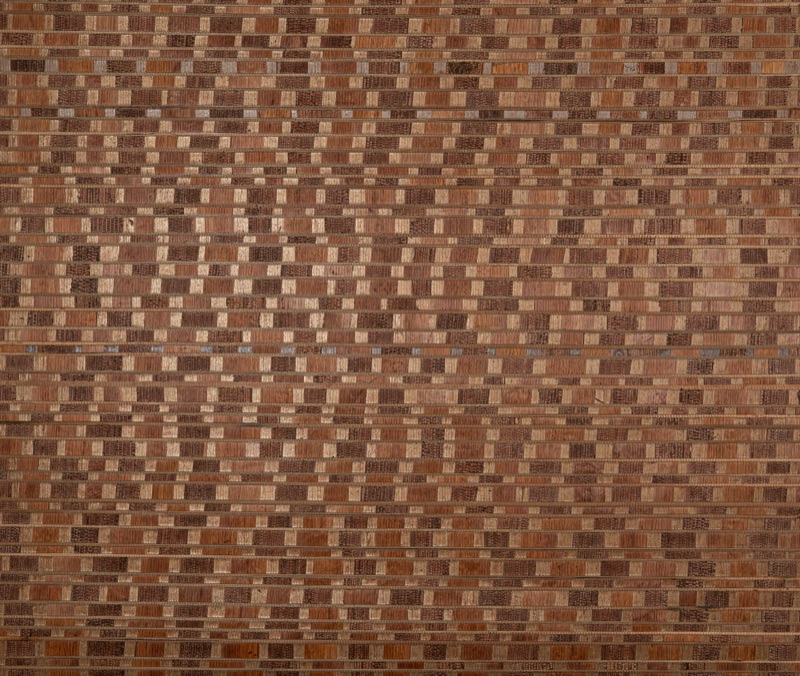
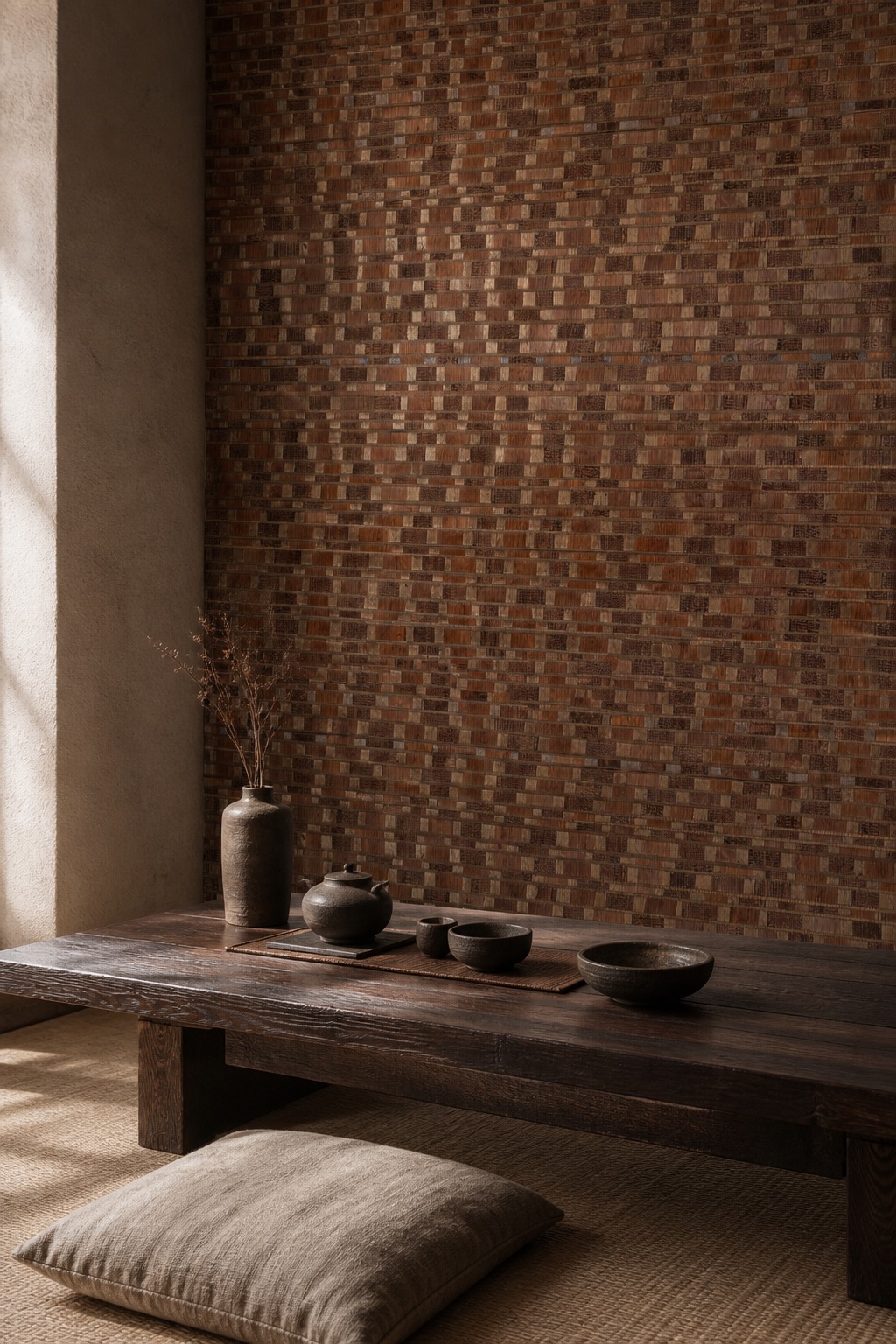
Chestnut Check is a medium-scale block basket-weave in warm chestnut brown, constructed from flat-pressed natural reed strips and supplied to designers and trade buyers from 50 rolls. Designers specifying brown rattan wallpaper for hospitality or residential projects will find it adapts to wabi-sabi and organic-modern schemes alike, with a texture-on-texture character that rewards close inspection and resolves into quiet confidence at room scale. Produced with our partner mills to in-house studio specifications, it is available for custom colourways from the same minimum order.
Block and Void: How Chestnut Check's Alternating Reed Units Register at Wall Scale
- Pattern: rectangular reed units set in alternating 90-degree orientations, forming a regular checkerboard grid across the wall surface
- Colour composition: warm chestnut brown alternating with pale cream, with dark espresso accents visible within the deeper block units
- Surface finish: fully matte — no reflective sheen; reads consistently from multiple viewing angles and under varying ambient light
- Texture scale: medium — the block scale creates visual presence without overwhelming a room
- Fibre direction within each block is visible to the naked eye, giving the surface a genuinely hand-made character
The flat-pressed reed units in Chestnut Check sit in a regular grid, each block rotated 90 degrees relative to its neighbours, which gives every intersection a clear direction-change in fibre. Standing at arm's length, the pattern reads as a layered mosaic of warm brown tones; at room scale, it settles into a grounded textural field rather than competing pattern. The fully matte finish ensures there is no reflective interference from raking or directional light, and the colour holds consistently whether the wall is front-lit or side-lit from a window. At medium block scale, the surface is forgiving to install and feels considered without being visually busy.
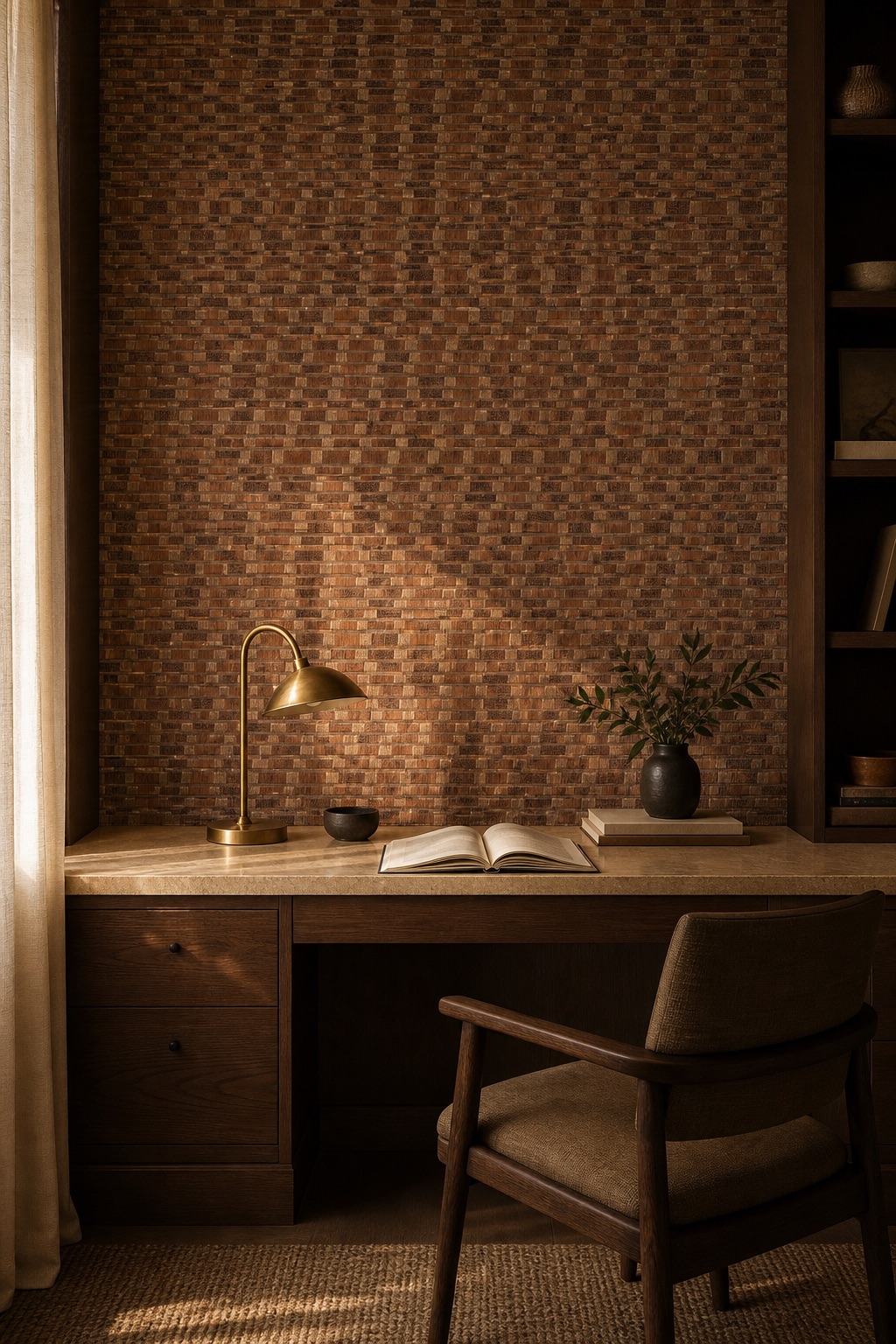
Living Rooms, Hotel Bars, and Dining Feature Walls: Where Brown Rattan Wallpaper Grounds a Space
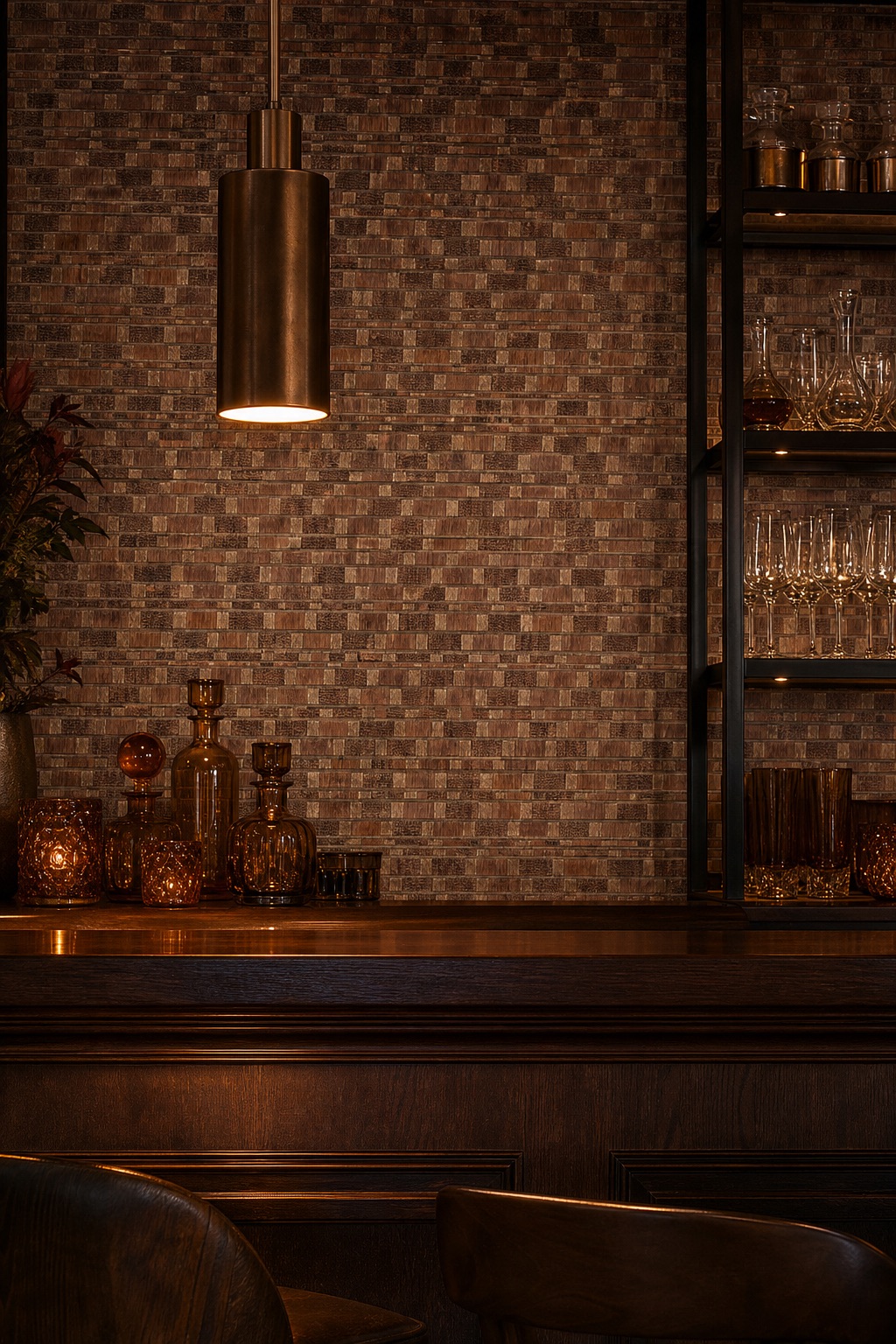
- Hotel bar back-walls: the warm chestnut ground creates depth against amber glassware and brass fixtures without requiring full-dark treatment
- Dining alcoves and private dining rooms: the organic texture adds warmth without competing with table settings or ceiling fixtures
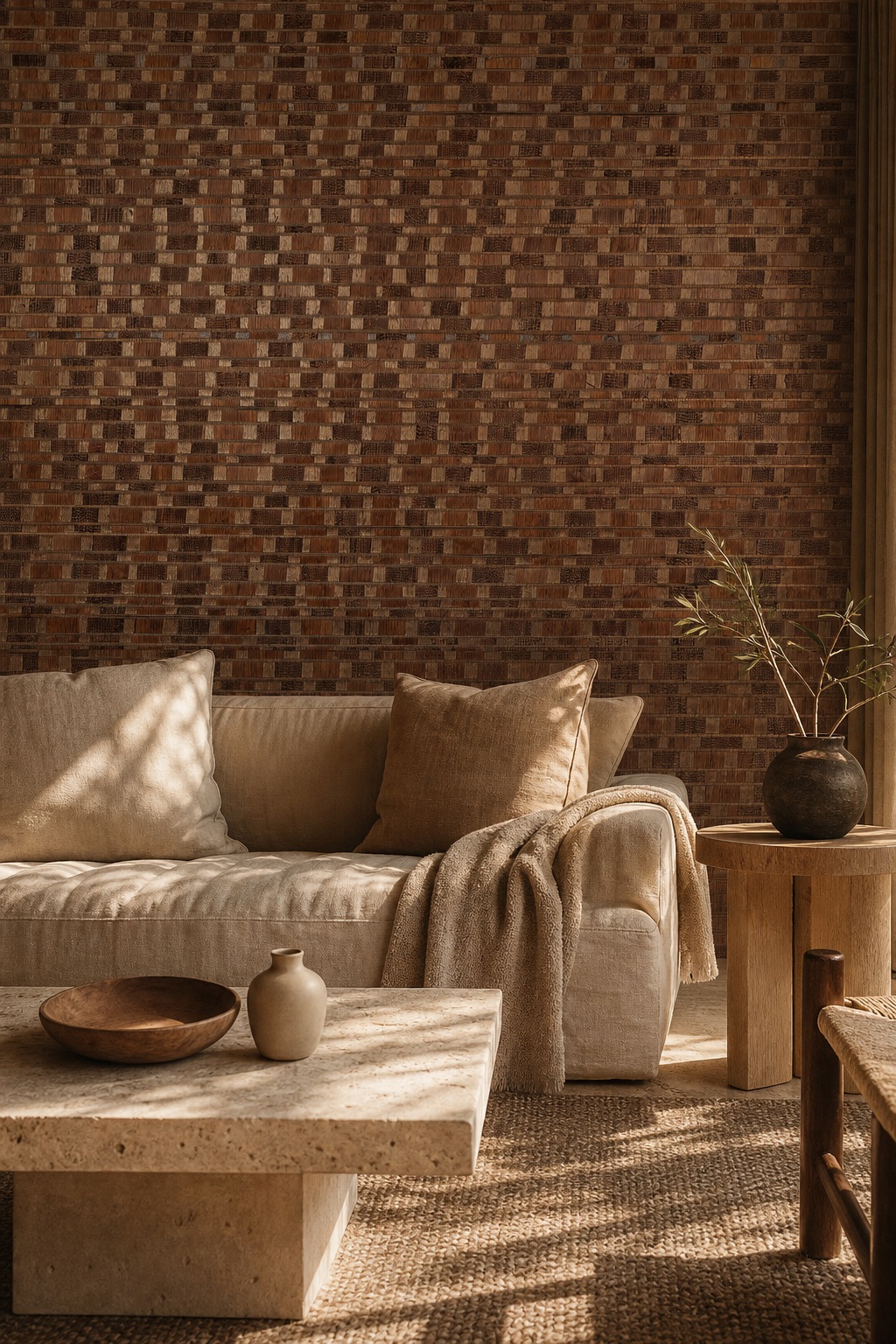
- Living room chimneybreasts and feature walls: anchors the main wall while allowing lighter materials on surrounding surfaces
- Studies and private libraries: textured counterpoint to bookshelves, plaster walls, and desk surfaces
- Wabi-sabi and japandi schemes: the material honesty of visible reed grain suits interior languages where authenticity matters more than surface perfection
Brown rattan wallpaper at this value and warmth serves as a visual anchor without requiring a fully dark treatment. Hotel bar feature walls, dining room alcoves, and living room chimneybreasts are the most natural applications, where the chestnut ground creates depth and draws the eye to the feature plane. In a study or private library, the organic texture counterpoints polished surfaces and bookshelves with quiet authority. The wabi-sabi and japandi design languages both accommodate Chestnut Check well: the material honesty of visible reed grain suits schemes where the surface itself carries the story.
Amber to Espresso: Reading Chestnut Check's Warm Tones Through Changing Light
- Under warm white artificial light (2700–3000K): chestnut units read closer to amber-copper; cream accents lighten toward ivory
- In cool northern daylight or overcast conditions: dark espresso units become more prominent, shifting the balance to a richer, deeper overall tone
- At dusk and in evening lamplight: the warmest, most amber expression of the palette
- Confirmed companion materials by undertone: travertine (shares warm beige ground), aged brass (echoes the amber register), natural linen (texture-on-texture contrast), dark oak
- Caution: cool grey or blue-tinted stone companions will read the warm undertone as yellow-brown
The chestnut brown in Chestnut Check carries a decidedly amber undertone that responds noticeably to light temperature. Under warm white artificial lighting, the brown units read closer to amber-copper while the cream accents become almost ivory, brightening the overall surface. In cool northern daylight, the dark espresso units assert themselves and the palette deepens. At dusk and under evening lamps, the warmest reading of the material emerges. This tonal range means a single wallpaper reads differently across the hours of the day, a quality that distinguishes this brown rattan wallpaper from flatter, single-temperature alternatives. Travertine, aged brass, natural linen, and dark oak all sit convincingly in this warm register.
Woven Reed on the Wall: Surface Behaviour and Practical Care for This Weave
- Construction: flat-pressed natural reed or split rattan strips; the visible grain is a genuine fibre characteristic, not a printed or embossed effect
- Humidity tolerance: suitable for typical interior conditions; not recommended in bathrooms with poor ventilation, steam rooms, or spaces with sustained condensation
- Cleaning: dry cloth or barely-damp sponge, working with fibre direction; never saturate the surface or seam edges
- Installation: professional installation strongly recommended; apply adhesive to the substrate rather than to the wallcovering face for best seam control
- Custom colourways and adjusted block scales are available through the studio for specifiers needing a specific colour matched to a project palette
Each unit in the Chestnut Check pattern is a flat-pressed natural reed strip; the surface grain visible in the swatch is a real fibre characteristic, not a printed or embossed simulation. Reed-based wallcoverings perform reliably in standard interior humidity ranges but should be kept clear of steam sources, sustained condensation, and direct water. For maintenance, a dry cloth or barely-damp sponge is sufficient for marks; always work with the fibre direction and avoid saturating the seam edges. Professional installation with a specialist natural-fibre adhesive applied to the substrate (rather than to the face of the wallcovering) gives the cleanest result. Love this weave but need your own colour or scale? Our design studio engineers custom colourways from your reference.
Samples, Paid Proofing, and Batch Documentation: Getting Chestnut Check Specified and Shipped
- Studio process begins with a paid physical sample book, credited against the order when you proceed (up to 10% of its value)
- Three in-house designers handle custom colourway development; proofing is quoted upfront and takes approximately one to two weeks
- Stock pattern minimum order is lower and suitable for initial project trials; custom colourways require 50 rolls minimum (approximately 250 m²)
- Production lead time: four to six weeks from payment on standard natural-fibre materials; ocean freight quoted separately, at buyer's cost
- Every production run carries a single dye-lot designation and a per-batch lot certificate
- Company founder has worked in natural wallcovering supply since 2018; the studio has three full-time in-house designers
The studio process is straightforward: request a sample book, review the material against your project surfaces, then proceed to a paid proof if a custom colourway or adjusted scale is required. Sample book cost is credited against your order when you proceed. Our three in-house designers convert reference images or paint codes into production-ready artwork; proofing is quoted upfront with no surprises, and typically completes in one to two weeks. Stock patterns of Chestnut Check may be trialled from lower roll quantities, which suits designers wanting to confirm the material before committing to a full project order. Custom colourways move at a 50-roll minimum (approximately 250 m²). Production runs four to six weeks from payment on standard natural-fibre materials, with ocean freight at the buyer's cost and quoted separately. Each batch ships with a per-batch lot certificate, an important document for hotel or multi-phase installations where batch continuity across rooms is non-negotiable. The company founder has been active in natural wallcovering supply since 2018.
Buying grasscloth for a project or a brand?
- Minimum order
- 50 rolls (about 250 m²) catalog · 100 rolls custom / private label
- Lead time
- 4–6 weeks standard · 5–8 weeks specialty, after sample approval and payment
- Terms
- EXW Chengdu · FOB, CIF, DDP on request
- Samples
- Free digital kit in 24 h · paid swatch pack, credited in full on your first order
- Reply
- Within 24 hours
Frequently asked
- Does brown rattan wallpaper fade more quickly than lighter-toned wallcoverings?
- Natural reed tones can shift subtly over years of UV exposure; the warm chestnut brown in Chestnut Check is susceptible to the same gradual amber bleaching seen across natural fibre wallcoverings generally. Fitting UV-filtering window film on adjacent glazing and keeping the surface out of sustained direct sunlight will significantly slow this process. We provide technical data on fading behaviour with our sample books on request.
- How visible are the seams in a medium-scale block basket-weave pattern?
- The regular horizontal grid of Chestnut Check gives a clear visual repeat, which makes seam alignment straightforward for a competent professional installer: the block rhythm can be matched accurately across adjacent drops. The most important precaution is ordering a single dye-lot to keep the block colour consistent from roll to roll across a multi-panel or multi-room installation.
- Is Chestnut Check suitable for a bathroom or a kitchen wall?
- Reed and rattan wallcoverings are not recommended for bathrooms with poor ventilation, wet-room adjacency, or any space where steam or sustained moisture is present. Low-humidity kitchens away from the cooking zone may be considered with caution if used as a feature wall. Our guide at /guides/humidity-risks covers room-by-room suitability in full.
- Can Chestnut Check work on all four walls, or is it better used as a single feature wall?
- The mid-value warm chestnut tone is balanced enough for four-wall use in rooms with adequate natural light; pairing the surrounding surfaces with lighter plaster or linen-tone paint creates contrast that keeps a full-room installation from reading as heavy.
- Where can I find full details on minimum order quantities, sample-book credit, and payment terms?
- All commercial terms, including sample-book credit, proofing fees, payment terms, and lead times, are detailed on our process page at /process.