Material Comparison
Grasscloth vs Linen: Two Woven Textures Compared
Both are woven, both are natural — but grasscloth and linen wallcovering differ in fiber, texture, durability and best use. A head-to-head comparison with data from our partner factories.
Key Takeaways
- Grasscloth = jute/seagrass/hemp fibers; linen = flax (Linum usitatissimum) fibers.
- Texture gap: grasscloth is coarse and organic; linen is smooth, refined and fabric-like.
- Linen is stronger: flax fibers have higher tensile strength and abrasion resistance.
- Linen is antimicrobial: flax naturally resists bacteria and mold growth.
- Both breathe: porous, VOC-free, moisture-regulating wall surfaces.
- Price: grasscloth $8–18/m² vs linen $10–22/m² (FOB).
- Best combo: grasscloth on feature walls for drama, linen in bedrooms/offices for quiet elegance.
At a Glance: Grasscloth vs Linen
| Feature | Grasscloth | Linen |
|---|---|---|
| Raw Material | Woven plant fibers (jute, seagrass, hemp) | Woven flax fibers (Linum usitatissimum) |
| Texture | Coarse, organic, highly tactile | Smooth, refined, fabric-like |
| Seam Visibility | Prominent (characteristic) | Minimal (tighter weave) |
| Durability | Moderate (residential) | Moderate-High (Type I commercial) |
| Antimicrobial | No | Yes (natural flax property) |
| Breathability | High | High |
| Moisture Resistance | Low | Low-Moderate (wicks moisture) |
| Color Range | Extensive (dye-receptive fibers) | Good (natural tones + dyed) |
| Price Range (FOB) | $8–18 /m² | $10–22 /m² |
| Custom color MOQ | 100 rolls | 100 rolls |
| Fire Rating | Class B1 (GB 8624) | Class B1 (GB 8624) |
| Best For | Feature walls, hotel lobbies, living rooms | Bedrooms, executive offices, healthcare |
How Do Grasscloth and Linen Differ in Texture?
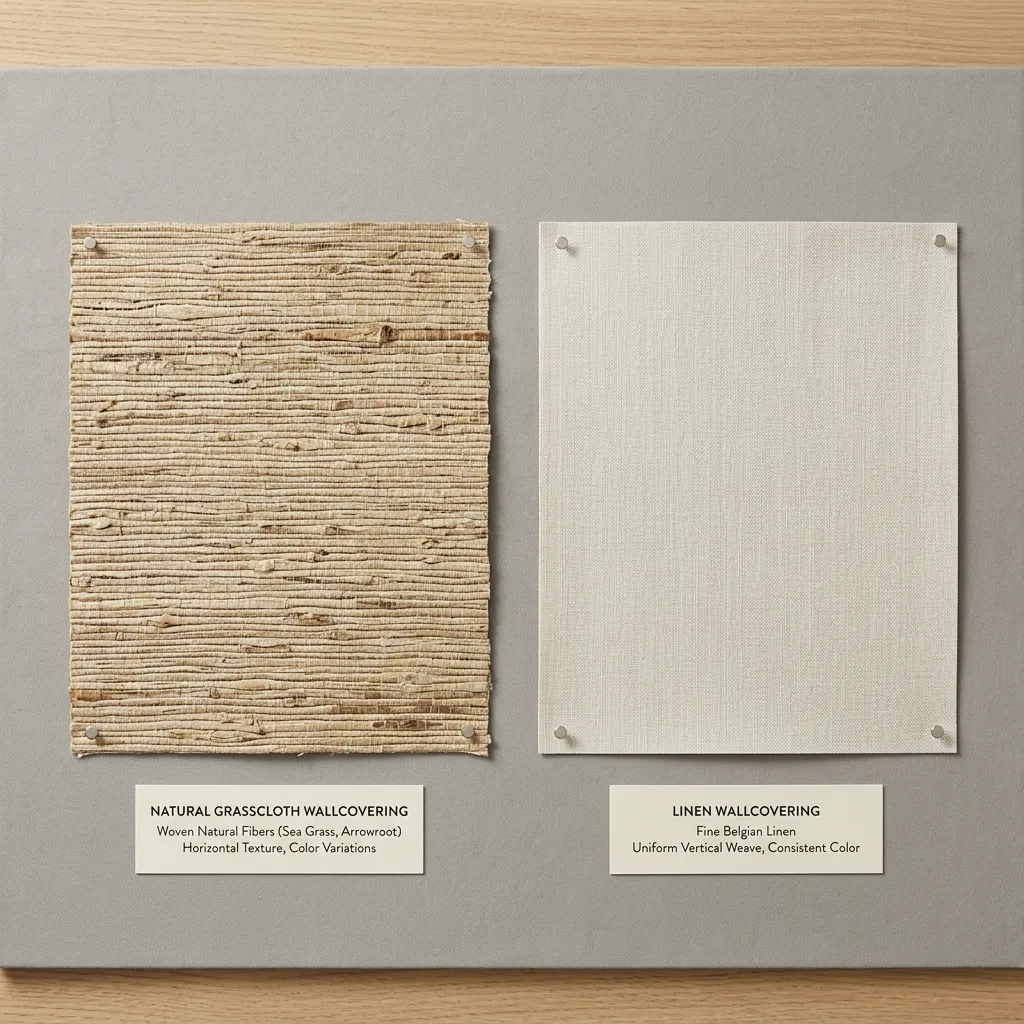
Grasscloth delivers a distinctly coarse, hand-woven aesthetic. You see and feel individual plant fibers — jute, seagrass or hemp — running horizontally across a paper backing. The open weave creates visible texture variation and characteristic panel-to-panel seams. Designers value this organic irregularity as a hallmark of authenticity.
Linen wallcovering uses finer flax fibers woven into a tighter, more uniform fabric. The result is a smooth, refined textile finish that feels like high-quality upholstery rather than raw natural fiber. Seams are less visible, color is more consistent, and the overall effect is quieter and more understated than grasscloth.
When to Choose Grasscloth
- Feature walls where bold, organic texture is the focal point
- Hospitality lobbies seeking a handcrafted, wabi-sabi aesthetic
- Projects requiring a wide range of vibrant dyed colorways
- Spaces where visible seams are embraced as artisanal character
When to Choose Linen
- Bedrooms and private spaces where a soft, refined finish suits
- Executive offices and boardrooms requiring understated elegance
- Healthcare or allergy-sensitive settings benefiting from antimicrobial fibers
- Spaces where minimal seam visibility is important
Is Linen More Durable Than Grasscloth?
Yes. Flax fibers are among the strongest natural textile fibers, with tensile strength approximately 30% higher than cotton and significantly higher than jute. This gives linen wallcovering better resistance to surface abrasion and snagging.
Linen wallcovering can meet Type I commercial wallcovering standards (ASTM F793), making it viable for low-to-moderate traffic commercial spaces. Most grasscloth is residential-grade only, vulnerable to water stains, adhesive bleed-through and fiber fraying from contact.
Both materials should be cleaned by dry brushing or vacuuming only. Neither tolerates wet cleaning or chemical solvents.
Linen's Antimicrobial Advantage
Flax fibers have natural antimicrobial and antifungal properties — they wick moisture rapidly and create a surface inhospitable to bacterial growth. This makes linen wallcovering a preferred choice for healthcare facilities, wellness spaces and allergy-sensitive residential settings. Grasscloth's open-weave structure can trap dust and airborne particles over time.
How Do They Compare on Breathability?
Both grasscloth and linen are highly breathable wall surfaces — a significant advantage over vinyl or non-woven synthetic wallpapers. Their porous, natural-fiber construction allows moisture vapor to pass through the wall assembly, reducing the risk of trapped condensation and mold growth behind the covering.
Linen has a slight edge in moisture management: flax fibers can absorb up to 20% of their dry weight in moisture before feeling damp, and they release that moisture quickly. This makes linen wallcovering a marginally better regulator of indoor humidity in temperate climates.
Which Is More Sustainable?
| Sustainability Factor | Grasscloth | Linen |
|---|---|---|
| Raw Material | Annual crops (jute, seagrass, hemp) | Annual crop (flax) |
| Water Usage | Low (rain-fed crops) | Very low (flax needs minimal irrigation) |
| Biodegradable | Yes | Yes |
| VOC Emissions | Very low | Very low |
| Certifications | Oeko-Tex, FSC (backing) | Oeko-Tex, European Flax® |
Both are genuinely sustainable choices. Flax cultivation has a particularly low environmental footprint — the European Flax® certification guarantees zero-irrigation, zero-GMO farming practices across France, Belgium and the Netherlands.
How Much Does Grasscloth vs Linen Cost?
| Material | Standard | Custom | Premium |
|---|---|---|---|
| Grasscloth | $8–12 /m² | $12–15 /m² | $15–18 /m² |
| Linen | $10–14 /m² | $14–18 /m² | $18–22 /m² |
Note: Prices are indicative EXW Chengdu ranges as of May 2026. Actual pricing depends on quantity, weave density and finish. Contact us for a project-specific quote.
Which Is Right for Your Project?
Choose Grasscloth If:
- Your design demands bold, organic texture as the focal point
- You need the widest possible color palette
- Budget is a primary consideration
- The space is residential or low-traffic hospitality
Choose Linen If:
- You want a refined, fabric-like wall finish with minimal seams
- The space requires antimicrobial or hypoallergenic surfaces
- Durability matters (Type I commercial viability)
- The design calls for quiet elegance rather than dramatic texture
Consider Both If:
Many designers use grasscloth on feature walls for visual impact and linen in surrounding areas for a softer, complementary finish. Both share similar installation methods and backing widths, so they can be combined in a single project order — simplifying sourcing and logistics.
Frequently Asked Questions
Is linen wallcovering the same as grasscloth?
No. Grasscloth is woven from plant fibers like jute, seagrass or hemp on a paper backing, producing a coarse, organic texture. Linen wallcovering is woven from flax fibers on a non-woven or paper backing, creating a finer, smoother fabric finish. Both are natural and breathable, but they differ in fiber source, texture and durability.
Is linen wallcovering more durable than grasscloth?
Generally yes. Linen fibers are stronger than jute or seagrass, giving linen wallcovering better abrasion resistance. Linen can meet Type I commercial ratings, while most grasscloth is residential-grade only. However, neither tolerates wet cleaning or high-humidity environments.
Does linen wallcovering have antimicrobial properties?
Yes. Flax fibers have natural antimicrobial and antifungal properties due to their chemical structure and rapid moisture-wicking ability. This makes linen wallcovering a preferred choice for healthcare and allergy-sensitive environments compared to grasscloth.
Related Guides
Grasscloth Guide
Complete reference on grasscloth wallcovering.
Real vs Faux Grasscloth
How to tell the difference.
Grasscloth vs Sisal
Two popular natural wallcoverings compared.
Grasscloth vs Cork
Texture vs acoustics comparison.
Grasscloth Pros & Cons
Honest advantages and drawbacks.
Installation Guide
How to install natural wallcoverings.
Compare Side by Side
Request grasscloth and linen samples to compare the texture, weight and finish in person — the difference is best felt by hand.
Request Samples