Material Comparison
Sisal vs Jute: Which Natural Fiber Wins?
Sisal and jute are both natural plant fibers used in grasscloth wallcovering — but they deliver very different textures, durability and aesthetics. Here's an honest comparison from a sourcing partner that supplies both.
Key Takeaways
- Sisal = agave fiber (stiff, fine, smooth); jute = corchorus fiber (soft, coarse, chunky).
- Durability: sisal tensile strength is 2–3× higher than jute.
- Texture: sisal is tight and consistent; jute is bold and irregular.
- Dye uptake: sisal accepts dyes more evenly; jute shows more variation.
- Price: jute $6–12/m² vs sisal $10–18/m² (FOB).
- Both are moisture-sensitive — avoid high-humidity areas.
- Both are sustainable: biodegradable, renewable, near-zero VOC.
At a Glance: Sisal vs Jute
| Feature | Sisal | Jute |
|---|---|---|
| Plant Source | Agave sisalana | Corchorus (jute mallow) |
| Fiber Character | Stiff, fine, high tensile strength | Soft, coarse, flexible |
| Weave Texture | Tight, smooth, consistent | Chunky, rustic, bold |
| Durability | High (abrasion-resistant) | Moderate (prone to fraying) |
| Dye Consistency | Even, uniform color | More natural variation |
| Moisture Resistance | Low | Low |
| UV Resistance | Moderate | Low (fades faster) |
| Standard Width | 0.91 m (36″) | 0.91 m (36″) |
| Price (FOB) | $10–18 /m² | $6–12 /m² |
| Custom color MOQ | 100 rolls | 100 rolls |
| Fire Rating | Class B1 (GB 8624) | Class B1 (GB 8624) |
| Best For | Offices, formal dining, hotel lobbies | Bedrooms, living rooms, casual spaces |
How Do Sisal and Jute Differ in Texture?
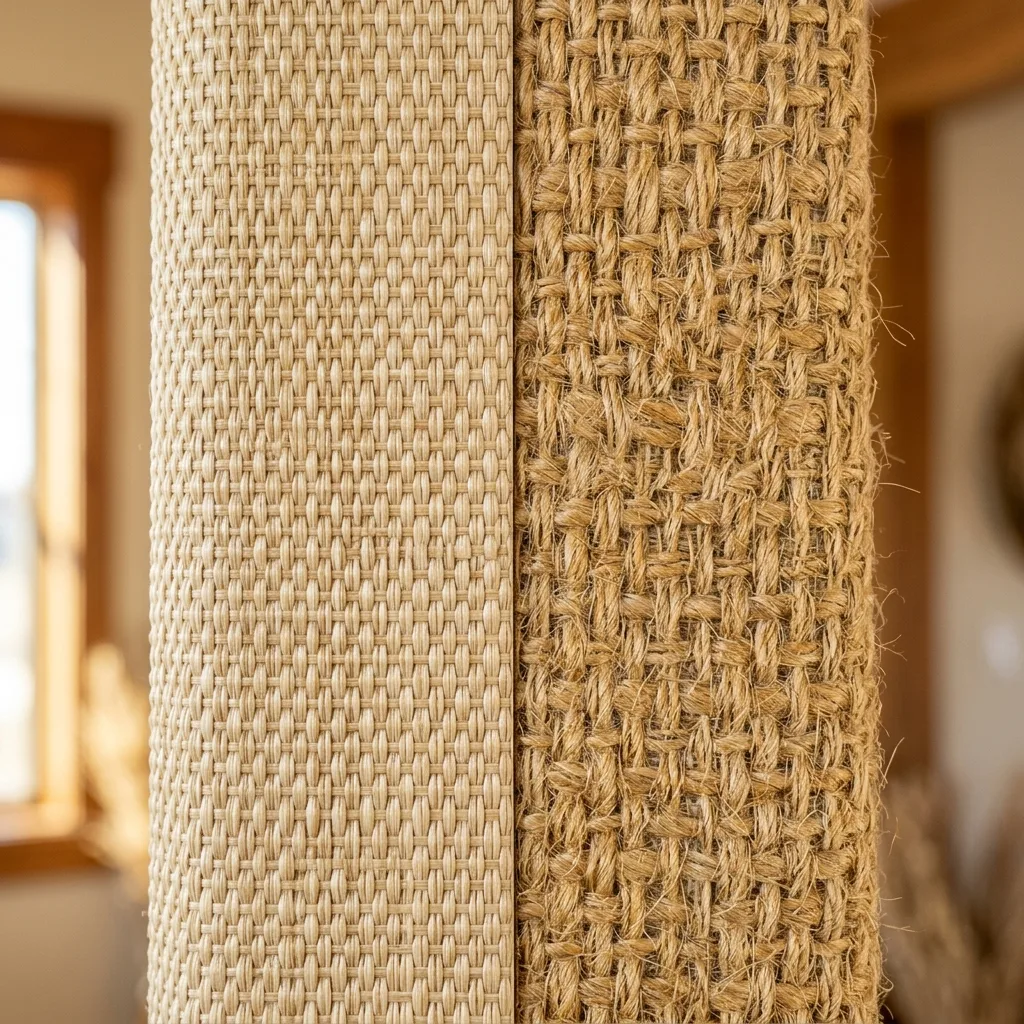
Sisal produces a fine, tight weave with a crisp, structured appearance. The agave fibers are naturally stiff, creating a smooth surface with subtle horizontal grain. Sisal takes dye exceptionally well, producing consistent, uniform colorways.
Jute delivers a much bolder, chunkier texture. The softer corchorus fibers create a coarse, irregular weave often featuring hand-tied knots and variable thread thickness. Jute has a distinctive golden-brown luster and a warm, rustic character.
Which Fiber Is More Durable?
Sisal wins decisively on durability. Agave fiber has a tensile strength roughly 2–3× higher than jute, plus superior abrasion resistance. This makes sisal the preferred choice for commercial wallcovering where walls face daily contact.
Jute is softer and more vulnerable to mechanical damage. Furniture contact can fray the fibers, and high-traffic areas show wear faster. For residential bedrooms and low-traffic living rooms, jute is perfectly adequate — but not commercial-grade.
Both fibers are vulnerable to water stains and UV fading. Clean both by dry brushing or vacuuming only.
How Do Colors Compare?
Sisal's stiff, uniform fibers accept dyes more evenly, producing consistent color across every roll. This makes sisal ideal for projects requiring precise color matching.
Jute's natural golden-brown base creates more color variation even within a single roll. For dyed colorways (blues, greens, grays), sisal delivers more reliable results.
How Do Costs Compare?
| Category | Sisal (FOB) | Jute (FOB) |
|---|---|---|
| Standard | $10–13 /m² | $6–9 /m² |
| Mid-Range | $13–16 /m² | $9–11 /m² |
| Premium | $16–18 /m² | $11–12 /m² |
Jute is 30–40% less expensive than sisal because corchorus is easier to cultivate and harvest than agave.
Prices are EXW Chengdu as of May 2026. Contact us for a project-specific quote.
Which Is Right for Your Project?
Choose Sisal If:
- The space is high-traffic commercial (hotel lobbies, offices, restaurants)
- You need precise dyed color matching across large wall areas
- The design calls for a refined, sophisticated texture
- Durability and longevity are project priorities
Choose Jute If:
- You want a bold, rustic, handcrafted wall texture
- The space is residential or low-traffic (bedrooms, living rooms)
- Budget is the primary consideration
- The design embraces natural variation and organic irregularity
Consider Both:
Many projects use sisal in high-traffic public areas and jute in private rooms. Both share the same 0.91 m width and backing, so they can be combined in a single order.
Frequently Asked Questions
Is sisal or jute wallcovering more durable?
Sisal is significantly more durable. Agave fibers have higher tensile strength and abrasion resistance than jute, making sisal better suited for high-traffic commercial spaces.
What is the difference between sisal and jute texture?
Sisal has a fine, tight, consistent weave that reads as smooth and sophisticated. Jute has a coarser, chunkier, more irregular weave that creates a bolder, more rustic texture.
Can sisal or jute wallcovering be used in humid rooms?
Neither is recommended for bathrooms or high-humidity spaces. Both absorb moisture and can develop mold or water stains. For humid areas, consider vinyl-backed alternatives.
Related Guides
Sisal Wall Coverings
Complete reference on sisal wall covering: weave, cost and where it works.
Grasscloth Guide
Complete reference on grasscloth wallcovering.
Grasscloth vs Sisal
The two most popular natural wallcoverings.
Grasscloth vs Linen
Jute weave vs flax weave compared.
Natural vs Synthetic
Plant fibers vs vinyl wallcovering.
Installation Guide
How to install natural wallcoverings.
Feel the Difference
Request sisal and jute samples side by side — the fiber texture is best appreciated in person.
Request Samples